Rebuilding Photos from Pacific Palisades.


After the catastrophic fires in January 2025 that burned down over 6,500 structures in Pacific Palisades (and over 9,400 in the Eaton Fire), I restrained my photographic urges and did not run to shoot images of someone else’s loss.

Today, I reasoned that photographing the ongoing rebuilding in the Palisades was not immoral or exploitative, only documentary.

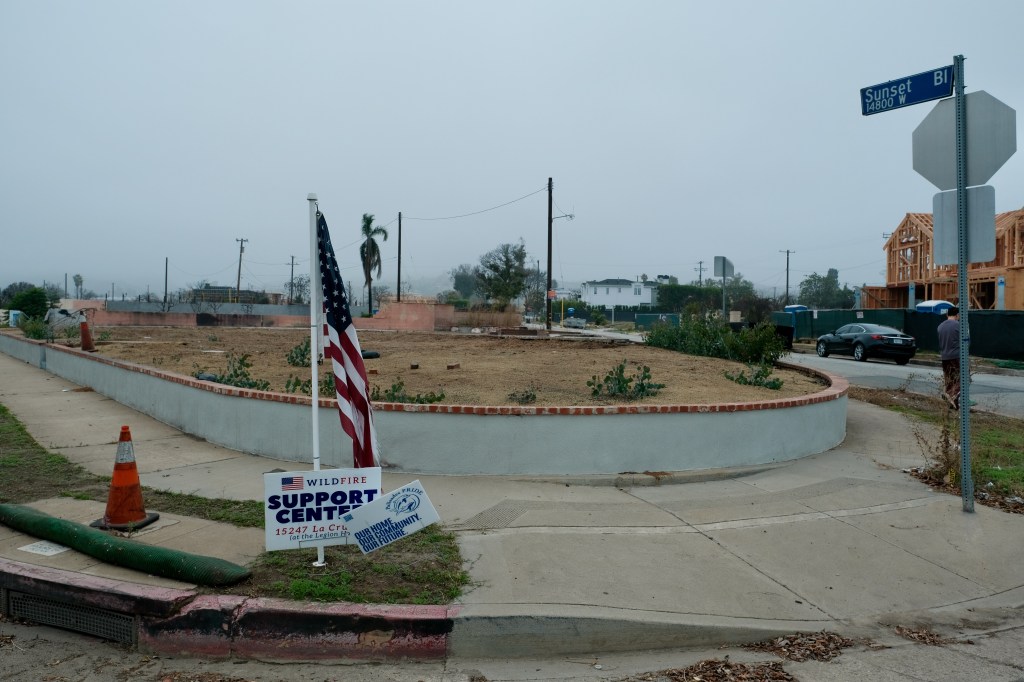
It was a cool, foggy Sunday morning with almost no traffic along the 700 Block of North Hartzell St, just off Sunset. I could stand in the middle of the road without fear.

Around me was a vast emptiness of empty lots, but with quite a few houses under construction, not only on Hartzell, but on nearby streets like Drummond, Carey, and Calloway. You could see through to many streets beyond the one you were standing on, looking at lumber boards on joists hundreds of yards away, just as if you had gone back 100 years to the very birth of Pacific Palisades.

Though there were no people, only a few construction workers hammering and drilling, the presence of the law was everywhere. There were signs against trespassing, US Army Corps of Engineers “California Wildfires Response Debris Removal Support,” NOT FOR SALE, PROTECT THE PALISADES, “This Home Will Rise Again,” #palistrong, Palisades Patrol. I felt the security presence of cameras, cops and Mr. Rick Caruso.

Everywhere there were signs for construction companies, architects, interior designers, garden designers, and realtors. Everyone with a skill to sell had a sign to show.

American flags were planted in soil like a Veteran’s Day cemetery. United in mourning, resolved in moving forward, the spirit of the Palisades shined. Or perhaps it was the spirit baptized in buckets of insurance money.

On all the blocks I walked today the metal street signs on posts survived. No burn marks, no damage, nothing but white letters on dark blue metal.  

How could the fires incinerate automobiles, trucks, refrigerators, washing machines, and hot water heaters? But somehow leave the proper names of the avenues, drives and roads intact? It is one of God’s strangest mysteries, perhaps she knows better than us the value of these named lots.

Further west on Bollinger Drive were some burned up vehicles with a big white house across the street. Every other house was consumed, and the lots everywhere were cleared, save for some with front door steps leading up to the sky; empty driveways, brick chimneys in fields, and sediment logs along the edges of lots to trap debris before it clogged drainage systems.

Walking in districts obliterated by now extinguished flames is a ghostly privilege of survivors. The living can never know the whole truth of what this was before. I hope I was respectful to those who lost everything. I am in no position to know their pain.

And now that the new houses are coming up, who knows what they will endure in the coming years, and even if the American nation and government that they are born into will endure and survive an epoch which seems more horrific each passing day.

The Old Way of Seeing.


It’s not likely that we will live to see Pacific Palisades or Altadena constructed in a way that evokes the traditional styles that were wiped out in January’s fires.

There is first the economics of the disaster. Many people will never have enough money to rebuild their homes. Some bought them many years ago, some inherited them. They had lower property taxes whose rates are based on what the original purchase price was.

For some, it was affordable to live in a paid-off home with grandfathered low taxes, next to the Pacific. That accident of time and fortune is gone forever.

The crisis in insuring homes, the cost of materials, the fragility of the economy, the flight of good paying jobs in entertainment, all of it has added up to a disaster that will be hard to climb out of.

There is also the problem of zoning. Where multi-family houses could be built, the powerful will step in (especially in Pacific Palisades) to mandate that every home be single family. And that will invite everyone to construct the ugly, laboratory like boxes that have proliferated on small lots around Southern California in the last 15 years. White, with black windows, unused balconies for joyous parties that never transpire. And security fencing, SUVs and artificial turf.

In Altadena, the destruction is tragic for other reasons. This was a neighborhood amenable to Black residents, and a place where multi-generational households built up wealth and security which was often difficult to obtain when your parents and grandparents were restricted from owning homes in other locations.

The integration of Altadena, the artistry of the homes, the beauty of the setting in the mountains, with many trees, old gardens, and the viability of churches, schools, and craftspeople with unique creations, was stamped upon this town.

Driving yesterday afternoon in 98 degree heat, through the dusty, hot, burned out districts of Altadena, we saw the vast ruins, but also the armies of trucks and workers hauling away the debris, towing away stacks of burned up vehicles, and the neat signs from the government on newly bulldozed and graded empty lots pronouncing them “clean.”

Architecturally, what will Altadena look like in the next ten or twenty years? Will there be a plan to rebuild in a harmonious and humane way, the method that Santa Barbara used after the 1925 earthquake?

“Before the earthquake, a considerable part of the center was built in the Moorish Revival style. After the earthquake, the decision was made to rebuild it in the Spanish Colonial Revival style. This effort was undertaken by the Santa Barbara Community Arts Association, which was founded in the beginning of the 1920s and viewed the earthquake as the opportunity to rebuild the city center in the unified architectural style.”-Wikipedia

Who will protect the Black history and the Black future of Altadena, an ingredient of the larger program of reconstruction that must proceed without killing off that which made Altadena a shining exception?


I’m fairly certain that Pacific Palisades will rebuild faster than Altadena. There is always governmental assistance for the most privileged.

The atrocity of public vagrancy, however, will continue to be pervasive under the current mayoral regime. Here passivity and resignation in the midst of homelessness is considered a virtue in the progressive wing of the Democratic Party.

Mayor Karen Bass has allowed, like her predecessor, the proliferation of trash camping, and is now looking forward, obscenely, to the 2028 Olympics which will place the gruesomeness of Los Angeles in a Potemkin village face lift. She never misses a photo opportunity to speak in her melodious, soothing, sweet, dulcet tones, imploring patience, incrementalism and understanding as 1 building permit a month is approved and 5,900 are in limbo.

Mayor Bass, Billionaire Rick Caruso, Hairdresser Gavin Newsom, are all eager to showcase the vast wealth, power, glamour and celebrity of the city to aid in the reconstruction of the western district of LA. Newsom even stepped up today to actually use the law to remove the trash camps around California. After billions of dollars, the patience of the governor has worn thin, and he has decided it is not a good image for the state to host burning trash fires along the freeways.


But what will the end results of the new post-fire houses look like? Will we once again have to endure architectural experimentation in the cheap, novel, grotesque, ostentatious style that pervades every corner of the region? Will the crumpled up, aluminum foil design of Gehry be our model for the city of the future? Perhaps not, as architects are often not even present in the construction of new houses. Only the general contractor in his pickup truck with his aesthetic refinements.

Will the oppressive sterility of the white box triumph? Or can we have the kind of California dream Will Rogers built? Can we have a piece of gentleness and civilized loveliness please? Or does everything that is built have to be the choice of the sports stadiums, the shopping center developer, the studio honchos? If that is the only way forward, then California is dead; spiritually, culturally, ethically, and economically.

Will Rogers State Park, July 2024. Destroyed January 7, 2025.


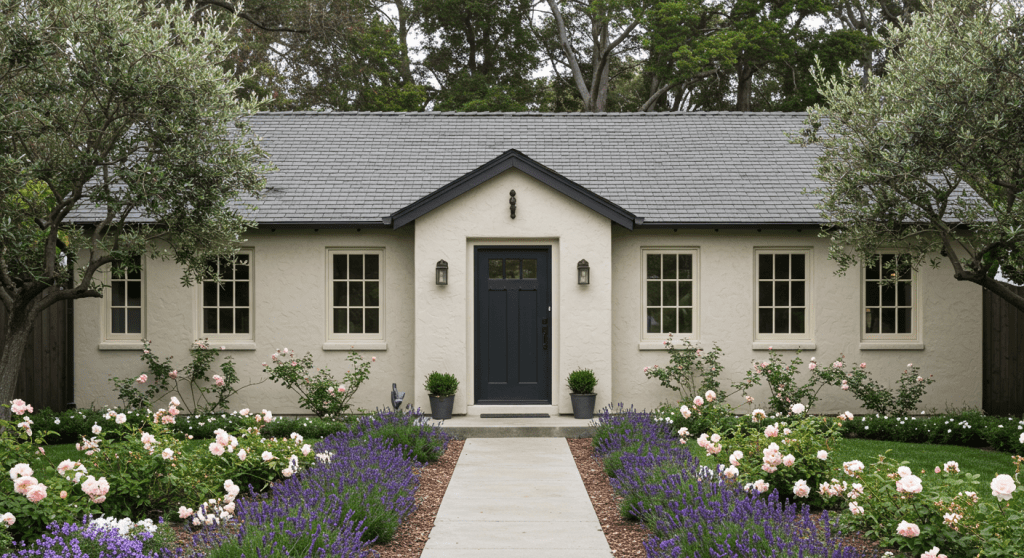
Perhaps the old way of seeing, the classical way of designing, the architecture of pre-modernist California, could help heal the disfigurement of the Golden State.

Imagine if you found these types of houses in the rebuilt lots of the fire zones? Could you fall in love with California all over again?