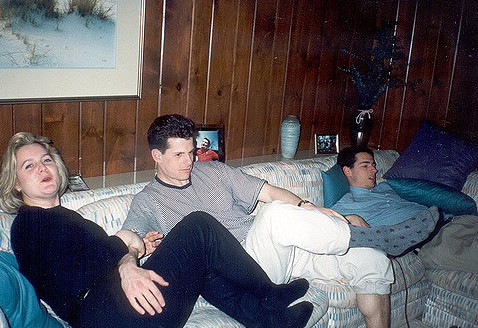
“Should”


Carmel O’Connell, me and my brother, Woodcliff Lake, NJ, 1992.


Sometimes the strangest offhand remark stays in my head, forever.

In the early 1990s, I worked with a woman at Ralph Lauren named Carmel. She later became a friend. Then I lost touch and I don’t know where she is today.

But she told me, back then, that I used the word “should” too much. “Try saying maybe or could but not should,” she advised.

I think about that word “should” and how often I see it used every day online, usually accompanied by advice to behave or buy or acquire a product, a regimen or a diet.

Today, January 16, 2019 a Google search of “should” brings up such titles as:

“If You’re Upset by the Gilette Ad you Should be”

“Why You Should be a Nationalist”

“Why You Should Quit Fruit”

“Why You Should Attend Our Cost Savings Virtual Conference”

“Why You Should Quit Social Media”

“Why You Should Keep Goats”

“Why You Should Change Up Your Running Routine”

“Why You Should Buy a McLaren 600 LT”

“Why You Should Think Twice Before Buying Airplane Coffee”

I could go on forever with should

The word should is weighted. It seems to be a command, a direct order, and something that is absolutely, inarguably necessary. 

We should reject should, if we could, and we can.

The Retraction From Life


Weaker, yet still alive, still able to speak, Louise M. Hurvitz was in her wheelchair, in the sunshine near the glistening Marina boats, when she told me she wanted to eat a steak.

That was on Monday, August 18th. She ate a hamburger that night, and a slice of pizza on Tuesday night. She was 8 months into her Stage 4 lung and bone cancer.

Nurse Linda said she was looking great.

Then on Wednesday she began to call for her sister “Millie”. She was up all night, and then asleep all day by morphine and Lorazepam. In periods of wakefulness, her glazed eyes no longer looked at me, but out into nothing.

She was no longer able to speak. I went every other day to see her, knowing she was entering death.

A blue booklet left by hospice, Gone From My Sight, explained how the bedridden dying walked out of life. We noted her symptoms mirrored in the book.

The late afternoon sun was bright in her bedroom on Friday, August 22nd. She screamed that her head hurt, her back hurt, everything hurt. She wanted me to shut all the drapes. I abided and put the room in darkness. Foreshadowing.

She was in her last days. Nurse Bertha said if she ate she would stay alive. And then on Friday, August 29th, Labor Day weekend, hospice came and said, “no more food or water”. She was given 72 hours.

All weekend were the pleasures of Los Angeles, the beach and the beer, the walks along Abbot Kinney, the barbecues, I partook of some haunted by an upcoming phone call.

And then on Sunday, August 31st at 11:30 PM we were called and told she was breathing irregularly. We got in the car and rushed down to the apartment. My brother and sister-in-law were at her bedside. A nurse helplessly held the nasal end of the oxygen tube against her open mouth.

She was gray faced.

She was gasping for breath.

I replaced the nasal oxygen with a whole nose/mouth mask. Nurse Linda arrived. The hospice nurse came. It was about 2am and we did not know how long she would live. Exhausted we left. And an hour later I was in bed when my brother called.

“I hate to tell you this but Mom has passed.”

All the fighting for her life, all the medications, the food, the physical therapy, the chemotherapy, the consultations with UCLA medical doctors, the cat scans and the other radiology, the organic smoothies packed with nutrients; all the equipment, the oxygen, the ointments; everything done to keep her alive and going. Done.

Her body was pronounced dead by a doctor. The cremation company came to the apartment to wrap up and remove her.


DSCF1114

We held a home service for her, almost a week later, on Saturday, September 5th.

Andreas Samson, my friend who writes Up in the Valley, attended and wrote a touching description of the bittersweet “party”.

There was food and drink, old photos on the flat screen television, a Spotify soundtrack of her beloved music (Frank Sinatra, the Fifth Dimension, Herb Alpert). Relatives who had never seen her sick, showed up to pay their respects.

And her life was presented selectively, with an emphasis on the young, beautiful, vivacious, pranking, intelligent, subversive sorority girl and network executive.

She, who died at 80, mothered a retarded boy, took care of an epileptic and ill husband, worried and fretted over children, finances, nightly meals, laundry and cleaning, her daily travails were wiped away or spoken of in one sentence salutes at our remembrance.

For 52 years, I had grown up and grown old with her. I knew her love and her craziness, her exasperating circular questions, her sparkling memory for names, faces, and events.

She, who drank vodka and grapefruit juice, and later switched to red wine, was probably an alcoholic. She was full of shame over events she had no power over, castigating and punishing herself.

But she fought hard to protect and to nurture, and daring to venture out of Lincolnwood, IL, moving to suburban NJ where she set up a new life with her family at 47, exploring Manhattan, New England and the East Coast with the curiosity and passion of a young woman starting out life.

2714559104_e8fd12d4a0_o

She sold airplanes with a male friend, a pilot and airplane broker who lead a life outside of norms, a man who was later convicted of stealing money from his customers. He flew Louise and our family, often, to Albany, Boston, Martha’s Vineyard, Manahawkin Airport, Miami, East Hampton, Nantucket, Block Island, all around the Eastern Seaboard. American life was seen from 8,000 feet, little houses and little lives across the vast expanse.

She went into the city to see plays with my father, to walk neighborhoods, to buy groceries at Fairway, see exhibitions at the Metropolitan, attend concerts and events at Lincoln Center.

She read the NY Times and Bergen Record voraciously, keeping herself informed on culture and politics. The papers piled up in wet and musty mountains stacked in the garage.

2650903946_43c1926371_o

She loved her new home in the woods, a place where the windows were always open and the rooms smelled of rain and leaves and florid humidity. In the spring, summer and early fall, the back deck, suspended on the second story of the house, was her outdoor space, a place of reading, eating, entertaining and midnight conversations by candlelight.


275609573_2d9e3f1b83_o

She lost my father after his long and agonizing brain disease, an illness that took 4 years to progress, rendering him an invalid.

But after he died, in her apartment in the Marina, she became a devoted grandmother and somehow earned the respect and awe of children who had once only seen sadness and burden in her exhausted eyes.

She was valiant onto the end; never giving into death, never acknowledging that life was less than the entirety. An iron dome of denial was her shield.

She was more than she ever admitted to being. She was magnificent in her life force, in her refusal to die, in her love for life.


Sunset on Woodcliff Lake.


Even now, just days after I helped my parents pack up their home of almost 30 years, it is still painful to contemplate the loss of the house and the community.

I shot the photograph on this page, one evening, as we drove across the lake. The reservoir sits there peacefully, a calming body of water in an increasingly frenetic world.

Just along the eastern side, the Pascack Valley train blows its whistle as it enters the station, a place where I once disembarked in the days when I commuted from here to New York City.

Somehow something immeasurable and profound seems to have been stolen. A quiet place with reassuring routines, those days that one spent reading under the large trees or watching the rain from the front porch. Gone for eternity.

Two old movies come to mind when I think of losing Woodcliff Lake. One is “Mildred Pierce” when little Kay dies of pneumonia and Mildred busies herself by working hard to open the restaurant. Another is “An Affair to Remember” when vacationing Cary Grant and Deborah Kerr, cruise ship in port, visit his grandmother in her small French port town. After a day of togetherness with the old lady, they hear the ship’s whistle blow, a low groan that stands for separation, loss and dwindling time.

So the real places, those towns of brick and wood, with four seasons and good food, farms and open lawns, and that enormous city built on bedrock with the beacon of liberty in its harbor, these locales now are airy memories.

Los Angeles, you welcome us! Here we come, crippled, exhausted and sad….

The future of happiness is a lie built on a promise that is built in a digital edit bay, on a seismically shaky phoenix whose very existence is a sham. But we smile, as we must, because tomorrow is a sunny day, and life must go on, and a thousand other cliches to recite ad nauseum, but deep down we know what our heart tells us is true.

What car can we lease?

The Tag Sale.


This past Friday, a company named Leighton Galleries held a tag sale at 25 Birchwood Drive to sell the contents of a home that has belonged to my parents since 1979.

The cars started lining up at 6am. The old, cigarette smoking man in suspenders made his way around back and peered in the sliding glass window at 6:30am as I drank my morning coffee. The doors opened at 10am. We brought my parents out, my dad in wheelchair, and went across the street to wait at Dr. Cantor’s home until the sale was over.

All day long the vehicles pulled up and walked out with bed frames, watercolors, lamps, mirrors and a dust buster. One cop, in a pickup truck with Passaic County stickers, was impatient to get his treadmill. He backed up on the lawn and gunned his accelerator for the front entrance. Two fat dudes carried the treadmill out, loaded it on to the flatbed, and the truck tore up the lawn and drove off. Someone stole the bird-feeder, or maybe it was sold.

My dad couldn’t really look at the sale while it was happening. He said to me, in stroke accented English, “It’s like my life is being torn up…” We took a short ride, to the pleasantly antiseptic Tice Corner, and used the restroom in the Senior Center, which is located inside the farmhouse that once belonged to the farmers whom the mall is named after.

We went back to the house after the “guests” had left and I grabbed a corn husk broom that I had locked up in “the safe room”. I swept up the wrappers, leaves and dirt on the wood floors. Many bargain hunters had walked around the house that day, more guests on one day than have probably ever been inside. They were all strangers, none of them friends, and they plundered and purchased so many memories and so many items of no small measurable emotional value.

Now we are here for just a few more days, in a large and elegant home which everyone here still loves and wishes to continue living in. But time, age and illness have converged to end the story of the Hurvitz Family in Woodcliff Lake, NJ.

Anticipation.


2607464218_98ef6b3213_o

Lillies., originally uploaded by Here in Van Nuys.

Every summer, the lilies pop up in this part of the country, and bring their bright colors to a mostly shaded background of dappled woods and stone walls.

This was the high point for me, the most glorious moment in the short summer. A few weeks after they bloomed, the lilies would fade, and then we would be in August, anticipating autumn, and school, Halloween, Thanksgiving, Christmas, winter.

That is why living in Southern California is so very strange. The guideposts of American life, the seasonal markers, are missing. Life and spring, with their promise of renewal and rebirth, go on month after month. The roses bloom in December, the leaves drop in February and reappear in March. Nature is marinated in formaldehyde, and the living things, humans and plants, are retouched, as if by digital process, to stay in bloom year around.

I don’t think this is natural. The “depressing” months, back East, if one chooses to think that way, when the leaves and temperatures drop and the ice and snow and slush surround us, are a breather for the planet. We need cold weather, yes we do. It is unnatural and unhealthy to live in heat and sun all the time.

That’s why I relish every thunderstorm this summer in New Jersey. Because when I return to Los Angeles in August, I will leave the rain and the short lived lilies behind in New Jersey.