Artificial Intelligence Plans a Three-Day Itinerary to Van Nuys 


AI knows everything about Van Nuys. But it has no opinions about Van Nuys. 

It hasn’t lived here 20 years, woken up under helicopter patrol, been robbed, assaulted, attacked or killed. 

It hasn’t driven down Victory Boulevard on a Saturday afternoon in the summer heat when there isn’t a soul walking down the street, just eight lanes of vehicles speeding past trash, ugly apartments, homeless encampments and mini malls. It hasn’t witnessed charming ranch houses with flower gardens, mature oaks and picket fences turned into concrete paved, iron fenced, security camera rentals with dozens of SUVs and strangers smoking weed next door. 

It knows nothing about the way Van Nuys was in the 1950s when every boy and girl was blond haired and rode their bicycle to school and lived on fifteen cent hamburgers and never gained a pound.

So perhaps ignorance, absent biases and prejudices, is the best approach to exploring Van Nuys.  

Why not give Van Nuys a chance to succeed in fantasy where it has failed in reality?

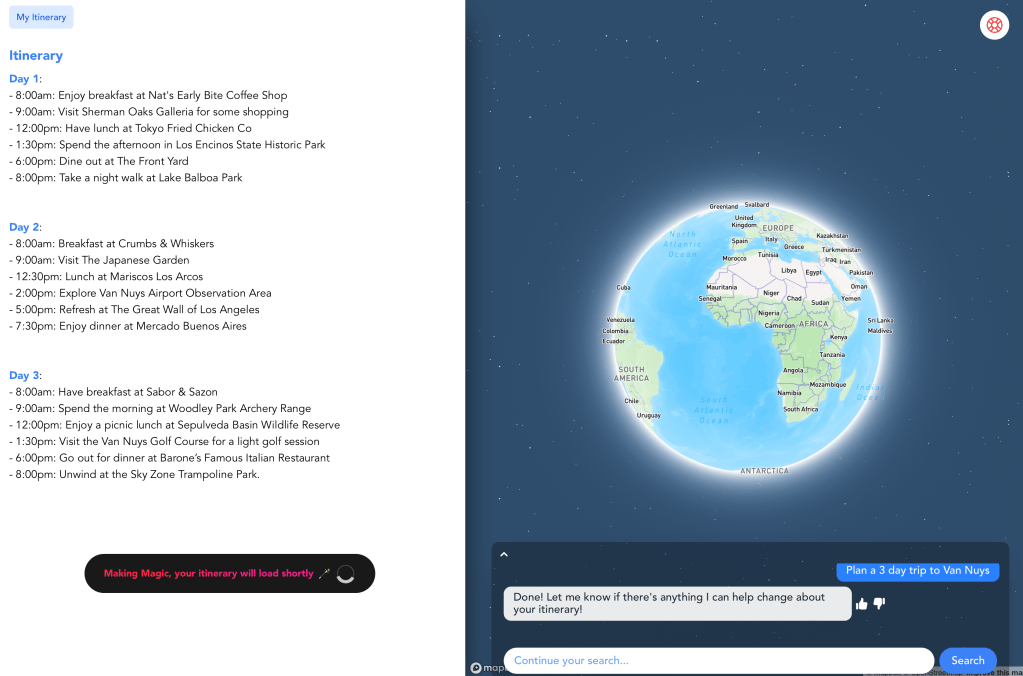
Magictravel is artificial intelligence for travel planning. I asked it to come up with a three-day itinerary for a visit to Van Nuys, and it supplied me with a refreshing, cynicism free, daily calendar of events.  

Blithely ignorant but well-informed, practical minded in suggestions, woefully dumb in logistics, it served me up activities and destinations timed for travel and visits.

Day One: 

For breakfast they recommended Nat’s Early Bite and I do like that place. I’ve eaten there many times. French toast and coffee for two in 2017 was about $20 so I assume that will be $45 now. 8-9am.

Breakfast would be followed by a shopping tour of the Sherman Oaks Galleria, which, if pre-pandemic memory serves me, has about three shops, many vacancies, and twelve places to eat, eleven of them frozen yogurt. 9-10:30am

Exhausted by so much shopping there, I would drive for 36 minutes to have lunch at Tokyo Fried Chicken in Monterey Park. 12-1:30pm.

Then I would get back on the freeway, drive 25 miles, all the way from the San Gabriel Valley to Encino, to spend three hours in 5-acre Los Encinos State Historic Park with its 19th Century Adobe House. I would spend three hours here, walking around in the hot summer heat, from tree to tree, truly stimulated by this fascinating place. 2-5pm

For dinner I would dine at The Front Yard on Vineland Avenue in the Beverly Garland Hotel. I only know from a recent visit there, that this is (shockingly) a quite lovely place with flowers, trees, fountains and a very civilized atmosphere quite unlike that which exists on Vineland under the freeway. 6-7:30pm

After dinner I would return to Woodley Park and take a nighttime stroll from 8-9:30pm. There are no cafes, no breweries, no dessert places, just many parking lots, a duck pond, and darkness. A little boring but this is considered top notch in Van Nuys. 

I didn’t ask for a suggestion on where to stay, so just assume I spent it at my home in Van Nuys. 

Day Two: 

We are eating breakfast (from 8am to 9am) at Crumbs and Whiskers 7924 Melrose Avenue. I leave my house at 7am because I know traffic is heavy over Laurel Canyon.

But now, after coffee with cats, I have a sneezing attack. Crumbs and Whiskers was (surprise!) a cat café and I am highly allergic to felines.  No worries. I will take a Claritin.

Magictravel.ai does not suggest post-breakfast activities near this restaurant, such as walking around Melrose, visiting Farmers’ Market, exploring Hollywood, LACMA or the Petersen Automotive Museum.

Being LA it suggests more driving.

We will get back in the car and drive 15 miles, 35 minutes away, to Woodley Park and walk around The Japanese Garden. 9-10:30am.

Lunch will be at Mariscos Los Arcos at 14038 Victory Bl. Family-run Mexican seafood. This sounds really delicious. ….12:30-1:30pm

After eating I’m anxious to get going to arrive at my next destination which is the Van Nuys Airport Observation area on Waterman Avenue, just west of Woodley and south of Roscoe. Yet another activity which takes place on hot asphalt, this is a delightful suggestion in the 100-degree heat. 2-3:30pm

After the thrill of watching jets tax, land and takeoff, there is refreshment at The Great Wall of Los Angeles (12900 Oxnard) where a 2,754 foot mural painted on the concrete wall of the LA River near Valley College seduces you with its depictions of women and minorities who helped build our stunning state of California. From 4:00-5:30pm I will walk back and forth along the dry concrete river and enjoy the artwork from the other side of the sewage channel. It cannot be seen up close by pedestrians, only by high sewage waters.

Finally, from 7:30-9pm we are having dinner on Sepulveda Boulevard in a very charming section of Van Nuys near Saticoy at Mercado Buenos Aires. Speeding cars, police sirens, car washes, and nowhere to walk add to the feeling of an endless vacation in paradise.

Exhausted from driving back and forth all day, I retire to bed in my house in Van Nuys. I may ask Magictravel for a body wash suggestion.

Day Three: 

The last day of touring in Van Nuys. Visitors can leave after today.

Unluckily, for me, I have to live here full time.

Here is my itinerary: 

8am-9am: Breakfast at Sabor and Sazon 14540 Vanowen St. I arrive there to find it is no longer in business but is now a marijuana dispensary.

Still hungry from not eating breakfast, I rush over to the Woodley Park Archery Range where I will spend the next hour and a half wandering around an archery range without a bow and arrow. 9-10:30am.

But I’ve got lunch plans. Picnic lunch at the Sepulveda Basin Wildlife Reserve. I will eat here (consuming the lunch I haven’t bought) surrounded by shopping carts, charred plants burned by hundreds of encampment fires, and try not to watch men having sex nearby. 12-1:30pm

Still in the park, I plan to play golf which seems nice enough since there are trees and irrigated lawns watered with recycled H20. 2-3:30pm.

Nearly my entire second day in Van Nuys has been spent inside the confines of Woodley Park.  Then I’m off to a more glamorous destination: Valley Glen.

Being a real foodie, I’m excited to eat authentic mid-century American “Italian” food at Barone’s Italian Restaurant at 13276 Oxnard St. with its retro vinyl booths and wood paneled rec room. I will probably order Fried Zucchini, Frank’s Special Pizza with Barone’s Famous Cheesecake and a few beers. 6-7:30pm.

After this great meal I will drive over, in the still hot, humid, smoggy night, to the Skyzone Trampoline Park 7741 Hazeltine 8-9:30pm where I plan to jump up and down with my stomach full of pizza, cheesecake, fried zucchini and three beers until I barf all over the trampoline.

A Proposal to Build Angels Stadium in Van Nuys


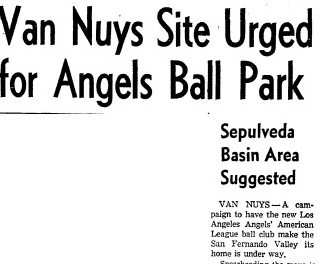
In December 1960, the Van Nuys Chamber of Commerce thought it would be a grand idea to have the recently conceived American League LA Angels play in a brand new stadium constructed right in Woodley Park Van Nuys. 

In the heart of flood basin. But conveniently located next to the 405 and the 101.

They wrote a telegram to club owners Gene Autry and Bob Reynolds imploring them to think about the “level and vacant” 100 acres “available for little or no cost” and adjacent right next to the just completed San Diego Freeway.

“We expect no local opposition to the plan,” said Nelson LaVally, secretary-manager of the chamber, confident that no families would object to the destruction of their local park.

There were two city-owned golf courses and a model airplane field. And the rest of the land “was leased out for agricultural use.”

LA Mayor Norris Poulson (R) supported the idea and liked the idea of a permanent home for the LA Angels in the heart of the largest park, flood zone and bird sanctuary in the San Fernando Valley. 

Councilman Patrick McGee (R) was also in favor of the idea of building a large 50,000 seat stadium with thousands of parking spaces in the middle of Woodley Park. He had given tours of the Sepulveda Basin a few years earlier to another LA ball club owner.

 “I made the same suggestion to Walter O’Malley and Del Webb and the NY Yankees before the Dodger contract was adopted,” Councilman McGee said. 

In 1958, McGee had vehemently opposed the Dodgers’ Chavez Ravine project (which displaced hundreds of Latino families) because it did not provide enough revenue to the city and would give oil revenues to a Dodger youth program, “spending public money for private individuals.”

The councilman thought the hotter valley weather more ideal. Most games would be played at night, and warmer temperatures in the SFV was appealing. Chavez Ravine and Wrigley Field in South LA were “20 degrees cooler”.

But the Angels ruled out the move. And the city’s Recreation and Park Department had other plans to add more 18-hole golf courses, tennis courts and several baseball diamonds.

Once again, visionary Van Nuys business minds and politicians came up with a shallow, ill-conceived and brilliantly self-destructive scheme that produced no results.

A pattern they would follow for the next 60 years. 

Color photos of Woodley Park: Credit to John Sequeira.

Sunday Errands


Yesterday, Sunday, there were no evident calamities around us. Tragedy took a day off. The air was clear from fire smoke, some blue showed in the sky, and we went for an air-cooled drive around our San Fernando Valley behind tinted windows and masked faces.

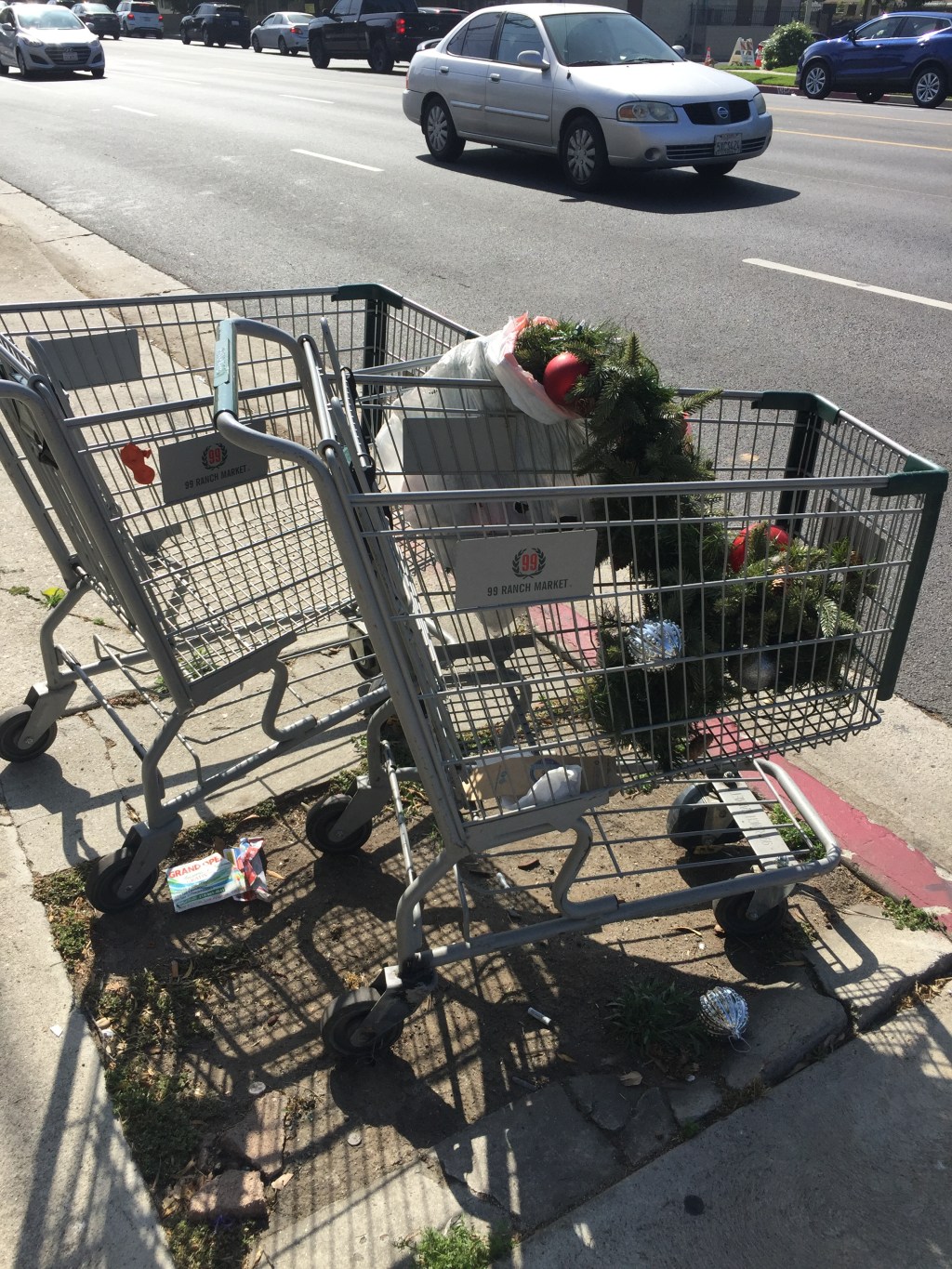
We passed Woodley Park, once a bird sanctuary, now just a burned-out bunch of fields with blackened pieces of wood and broken fences, shopping carts of trash and an air of war, desolation and defeat. 

There was the farm stand at Tapia Brothers and we stopped to buy tomatoes, Anaheim peppers, carrots and peaches, standing six feet away from other masked shoppers. Pulling out of the dusty lot there were two choices: drive somewhere else or go home. We chose the former.

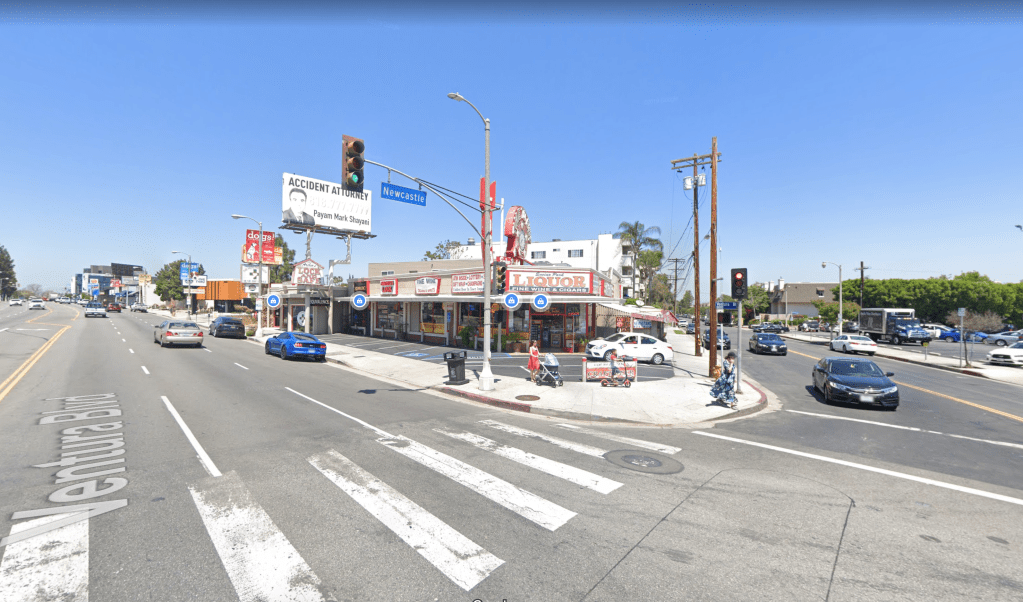
We went for a drive west along Ventura Boulevard through Encino and Tarzana, past those billboarded and plastic signed points of shlock and tackiness beloved by many, demoralizing in a good year, demoralizing in a bad one.

At Newcastle, groups of Jews in masks, yarmulkes, and tallit, walked with prayer books, dressed in their Rosh Hashana suits and dresses. A mentally ill Black man, without a shirt, danced obliviously in front of the liquor store as the faithful passed by him pushing baby carriages, on their walk home.

Further west, a homeless woman emerged from a tent parked along a concrete channel behind the prow shaped Encino/Tarzana library, temporarily closed. A blue sign hung along the fence on Ventura, “NO DUMPING: This Drains to Ocean.”

We drove all the way to Shoup Avenue in Woodland Hills, a district of Los Angeles where people once moved to get away from everything bad in the city. Under the 101, dozens of men and women were set up in a trash camp, living under tarps, in tents, the public sidewalk their front lawn.

At Woodland Hills Park, where Uncle Paul, Aunt Frances, Cousins Barry, Helene, Julie, Jason, Delaney and Courtney, spent many days of the past half century in the world of juvenile baseball and softball, homeless RVs parked. I wonder what flowered apron and blue rubber gloved Aunt Frances, who died in 2012, would say. She kept a spotless house, even telling me she would not eat dark raisins because they reminded her of little bugs. 

“Oh, Andy you’re so funny,” she would often say.

We turned down Erwin Street just to look at the corner ranch Aunt Frances and Uncle Paul bought for $63,000 in 1973. Uncle Paul is 99, a widower, still living there. The stucco is faded pink, there are bars on the windows, and Zillow estimates the house could fetch close to a million. Property taxes are about $800 a year, eternally fixed at the purchase price, a good deal for the retired soldier who fought at Iwo Jima and Leyte Island.

We didn’t go in but I thought of the inside I first saw in July 1974.

The Barcalounger, the brown carpet, the brown paneling, the yellow wallpaper, the cottage cheese ceilings, the dining room with the glass shelved cabinets full of Lladros and ceramic poodles and carved children with fishing poles, a room nobody ate in; the other dark rooms with the Roman shades or pleated drapes always pulled down against the sun, the bathrooms with wall-to-wall carpeting and mylar wallpaper, the rooms full of family photographs, the 1,762 square feet of living space without one book; the air-conditioning that ran year round, and the garage housing the Buick LeSabre, full of power tools and Leslie Pool Equipment, the refrigerator packed with Costco frozen foods, bottles of cold water and diet sodas, the TV always on for baseball and Fox News, these are the moments one cannot easily forget.

Then we turned around and drove east along Victory Blvd. passing the empty weed infested parking lot at temporarily closed Pierce College. We drove down Winnetka to get to the 101 and again passed another encampment under the freeway, more men and women living outdoors without housing in Los Angeles. 

When I go out these days, leave my house for a drive, I am in another nation, not my own, a scarred and withered place of broken people, angry and exhausted, in a city unclean and unjust. And ominously, seemingly, frightfully just about ready for a violent revolution. 

Woodley Park, R.I.P.


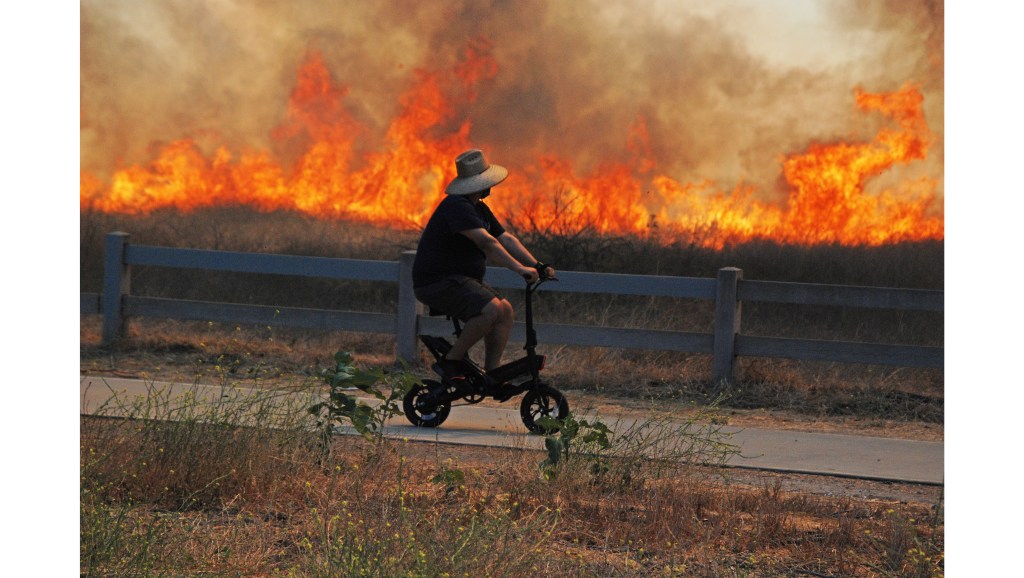
A man rides his mini bike down a bike path at Lake Balboa in the Sepulveda Basin as a wall of flames approaches Saturday, July 18, 2020. The fire put up a huge cloud of smoke and burned for well over an hour near a model airplane park and along Woodley Avenue. The blaze charred about 4 acres of brush before over 60 firefighters managed to contain it. No structures were damaged and no injuries were reported. (Photo by Mike Meadows, contributing photographer)

One of the ameliorating joys of moving to Van Nuys in 2000 was escaping, on bike, to Woodley Park, that formerly glorious area of bird sanctuaries, bike paths, grasslands, ponds, and the Japanese Garden.

Through the years I was so happy to ride through it, to feel the wind and the sun and openness of the park, a place to photograph, and wander and exercise in.

Since the reign of Mayor Eric Garcetti (Garbageciti) began in 2013, the park has become a homeless encampment, with hundreds trashing it with shopping carts, drugs, needles, garbage and worst of all, starting fires. 

It seems that every other month there is a massive blaze in Woodley Park, illegal cookouts or arson or just exploding propane tanks, and now the park is an ashen graveyard of nature, just black fields where tall grasses once thrived.

Why is it “humane” to allow vagrancy, disorder, disrespect and abuse of our parks, our streets and our environment?  We thought we had seen the worse of this city and nation in 2020, but if you want to feel even more gloom, take a saunter over to Woodley Park and witness for yourself the broken fences, the depleted environment, and the still evident trash camps of tents, shopping carts, stolen bikes and litter along Burbank Boulevard.

And ask yourself what competent and worthy leader would permit his city to become so degraded that even a simple park is too embarrassing to look at?

Our Lost Vitality


Sepulveda and Erwin, Van Nuys, CA.

Housing, it seems, is everything these days, the foremost topic on the minds of Angelenos. 

Those who can afford it fear those who cannot.

Fearsome, it seems, is our ragtag army of many thousands of un-housed vagrants who have established anti-communities out of shopping carts and tents, and made bedrooms, bathrooms and living rooms out of bus benches, trains, bridge underpasses and alongside our freeways. Covered in dirt and tortured by circumstance, pulling three bikes with two legs, they remind our fortunate ones that life often goes bad even for the good.

3/5/18 Bessemer at Cedros.

SB50, the state proposed override of single family zoning, struck terror into the hearts of many in Los Angeles who feared that the single family home, housing twelve unrelated people, might soon be replaced by twelve unrelated people in four houses on one lot.   

“Leave it to Beaver” (circa 1959) the imaginary ideal of Los Angeles.

“Leave it to Beaver”, “Dennis the Menace”, “Hazel” and the rest of the 1950s and 60s back lots of Columbia and Warner Brothers are how many, now aging, but still ruling this city, think of Los Angeles, and how it should look. 

When Dennis the Menance came home he didn’t enter into a lobby with an elevator. When Dr. Bellows drove up Major Nelson’s street, it was clean, tidy and sunny. 

Home of Major Anthony Nelson, “I Dream of Jeannie” (1965-70)
The cast and crew of the remodeled “Brady Bunch” home in Studio City, CA. (HGTV)

HGTV is now remodeling the real life home in Studio City that was used as the location for Mike and Carol Brady and their bunch, recreating in reality a 1970s home, inside and out, following an architectural blueprint from the set pieces of an inane, 50-year-old television show that seemed saccharine the night it premiered in 1969.

It is heartwarmingly creepy to see the now white-haired kids throw a football in an astroturf backyard, retirees feigning juvenile excitement as a synthetic reality show impersonates their old sit-com and pumps new advertising blood out of Geritolized veins.

____________________________________________________________________________

Woodley Park, 2018.

But life is not a syndicated sitcom. What’s on TV is not what’s beyond our windshield.

We live in Los Angeles, and die a bit here, day by day. The city is getting worse in every imaginable way: housing, health, transportation, taxes and education.

Homeless on Aetna St. Feb. 2016

On the roads, in real life, in 2019, cars are now parked and packed alongside every obscure street because it takes four working, driving adults to afford one $3,200 a month apartment.

Building more apartments doesn’t mean more cars, it simply means less apartments. And less apartments means more rent, so Los Angeles keeps eating itself up in contradictions of cowardice and myopia.

__________________________________

Japan

As I travel around Los Angeles and see all the enormous parking lots and one-story buildings alongside eight lane wide roads, I wonder why we are so unable to build enough houses to house everyone.

California is not nearly as crowded as Japan, yet that country ingeniously designs small dwellings that artistically and creatively provide homes for every type of person.

On the website Architizer, I found the work of a firm called Atelier TEKUTO.

Homes shown on Architizer by Atelier Tekuto are really tiny, but they are built solid, with each dwelling quite individual in style and form, an irony in a country where every black haired man coming from work is dressed in a white shirt and dark suit.

But Japan somehow pulls together the artistic and the structural to provide enviable and well-designed homes in well-protected, spotless communities. Violence is rare, except yesterday, but nobody goes out at night fearing random mass shootings, it is safe to say.

We can’t, or should not, want to remake the depravity of our dirty, violent LA into clean, peaceful, obedient Japan, with its fast trains and scrubbed sidewalks, but we might borrow some of their ideas. After all, we conquered them in 1945, can’t we take home some intellectual souvenirs?

Imagine if Van Nuys took the courageous and innovative step to redo the large, unused parking lots behind all the abandoned shops on Van Nuys Boulevard with a mix of little houses like these and perhaps some larger structures several stories high?

What we have now is this:

Don’t we have a Christopher Hawthorne now, Chief Design Officer, working under Mayor Gar[BAGE]cetti? Former architecture critic at the LA Times, he may know one or two architects from his old job. Perhaps Mr. Hawthorne can take action?

What have we got to lose? 

We are so far down in quality of life that we must engage our energies to pursue a remade Los Angeles.

A city that does not harm us but lifts us up.

As Japan shows, you can have enlightened ideas without living alongside mounds of trash and outdoor vagrancy.

There is no logical connection between toleration of outdoor garbage dumps and political tolerance in general. In fact the worse our surroundings get, the more people will turn right and maybe even hard right.

Sepulveda Dam.


Sepulveda Dam January 1, 2008
Sepulveda Dam
January 1, 2008

One of the great architectural wonders of the San Fernando Valley.