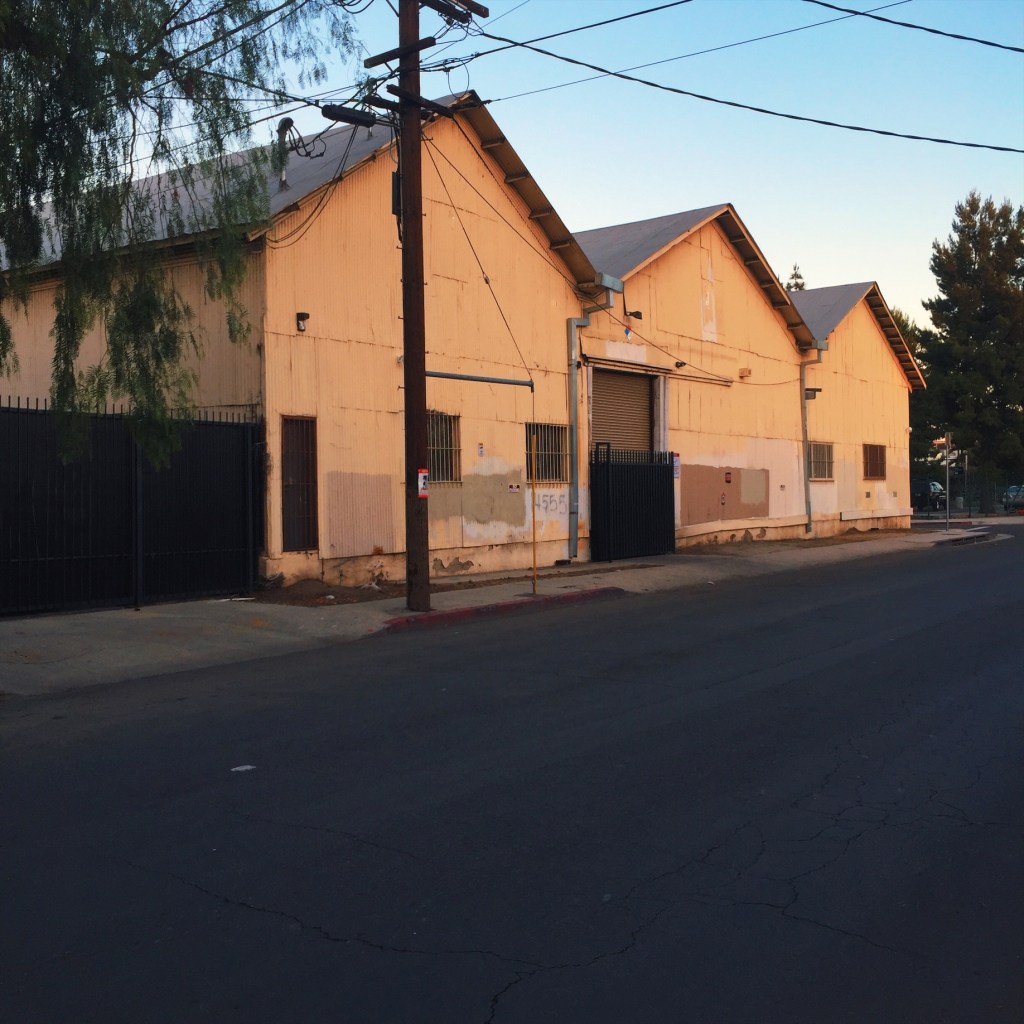
Valley Feed and Fuel


14551 Bessemer St. (Photo by Andrew B. Hurvitz)
Map 14551 Bessemer

On the NE corner of Bessemer and Vesper, here in Van Nuys, there is a steel walled storage warehouse with three pitched roofs.

Unmarked with any signs, it seems to have been there many years, and is characteristic of structures that once stood alongside rail lines to receive and to send out produce, grains, and manufactured products to faraway markets.

I dug up information from the city and found that “14551 Bessemer St.” was built in 1922, at a cost of $4,000, for the Fernando Feed and Fuel Co. It stood alongside the freight lines and was serviced by a dedicated Southern Pacific rail spur that went right into the property.

6/22/1922: 14551 Bessemer St. Van Nuys, CA Dept of Buildings Application

By 1925, chicken ranches were a big business in the San Fernando Valley, with an estimated 1,000,000 laying hens in the valley producing some 12 million eggs at a gross return of $5 million dollars. (In 2019 dollars, about $72 million.)

A 1925 LA Times article said that the Fernando Feed and Fuel Company started in 1916 as a feed store, but grew, in nine years, to 1,500 customers, large and small. Several other facilities for warehouse storage were located in Owensmouth and Van Nuys with a crew of 45 men and 15 trucks delivering feed and other orders to customers.

Chicken ranches, on one, two or five acres were a type of housing development that sprung up all around Southern California. They allowed families to feed themselves and also make a living selling chickens and eggs. At that time, other orchards grew oranges, walnuts, lemons, avocados, asparagus, and strawberries. 

A 1916 LA Times article praised “rose lined Sherman Way” (later renamed VNB) and the white feathered leghorns that dotted recently established (1911) Van Nuys.

“White Feathered Leghorn” Chicken. (source unknown)

Scientific work to bolster the agriculture industry and  promote poultry farming was often shown. 

In 1920, a four-day poultry institute was given at Van Nuys High School, by Prof. Dougherty, head of the poultry division, college of agriculture at U of CA, under the auspices of the LA County Farm Bureau and the Van Nuys Poultry Association.  A vaccination to fight chicken-pox was demonstrated there. 

Entrepreneurs and peripatetic innovators flocked to Van Nuys to raise chickens in advanced ways.

At a five-acre ranch on Woodman Avenue, in 1925, a recently transplanted Englishman, JCF Knapp, who had run plantations in Sumatra and India, had finally realized his lifelong dream to become a poultry farmer in Van Nuys. His operation had the capacity for 4000 chicks, and Mr. Knapp confidently asserted that he had not only a successful business model but a new kind of assembly line efficiency [for producing Grade A chickens on the scale of Model A’s.]

Also in 1925, WW Todd Realty Co. reported that a new set of chicken farms, totaling five acres, were to be built on Ranchito Av. near Tulare St. in Van Nuys. Some 100,000 laying Leghorn hens were expected to arrive in the valley within six months. 

[Ranchito Av., for the geographically ignorant, runs parallel to Woodman and Hazeltine, halfway between both. I found no modern maps with a Tulare St. however]

A 1920s aerial photograph of downtown Van Nuys shows the Fernando Feed and Fuel storage warehouse and the combination of commercial buildings along “Sherman Way” (renamed in 1926 Van Nuys Bl.) and orchards that were planted right inside the middle of town. VNHS is in the upper center/right of the photo. (below)

Van Nuys Feed and Fuel 1925, view NW

The chicken farms of the 1920s, which boosters never stopped boosting, gradually died out when the Great Depression hit after 1930 and sank agricultural prices.  By the late 1930s, suburban development came to the San Fernando Valley, and during the war (1941-45), industrial and defense plants, soldiers, military hospitals and the urgencies of war supplanted the rural way of life raising chickens. 

After 1945, the San Fernando Valley was the fastest growing place in the world, and every acre of land was transformed by housing developments, shopping centers, and car centered designs. 

The chicken farm, with its odors and mosquitos was now a menace, and housewives in Reseda were scared to let their children play outside.

Lost in the stories about the chicken farms is an old America that valued challenges and thought itself capable of surmounting them.  Poor, barely educated and hard-working people came here and somehow transformed Los Angeles into an advanced city that also grew its own food and sold off the surplus to an amazed and grateful nation.

Van Nuys, once a proud and admired center of advanced agricultural innovations, committed civic suicide. It destroyed its downtown by ripping up diagonal parking, widening the road to freeway widths, removing the streetcar, tearing down old buildings and replacing them with empty plazas and zombie moonscapes of trash and concrete. It embarked upon decades of laying down asphalt and laying out the red carpet for criminals, malcontents and derelicts.

Porn, marijuana, prostitution, bail bonds and slumlords were the largest industries by year 2000. Hopelessness replaced optimism and dystopia seized this district like an incurable disease. 

And politicians were thought worthy, not for their works, but only if their last names ended in the letters S or Z.

At least we have the Internet to thank for a glimmer of what it once was.

As the Turnmire Turns…..


Alvin Turnmire, 1947

Beverly Turnmire, 1947

He is 21, dressed in a Hawaiian shirt with a cotton bomber jacket and button front denim jeans. She is 19, holds a Boxer pup and wears a leopard print coat and appears somewhat sad and disturbed.

They are Alvin and Beverly Turnmire, recently married.

Their address is a home in Studio City at 4232 Goodland Ave. near the golf course. They probably live with his parents, but they want to get out and get an apartment.

And Burbank police said they committed a string of burglaries in order to furnish their new place.

November 5, 1947 is the date of their arrest. They were caught 71 years ago, and are probably dead. But their reincarnated young beings still walk Ventura Boulevard.

Studio City people: in love with dogs and exotic clothes, chasing goods and desires beyond their reach, a place of happiness and meltdowns, a magnet for dreamers, a trap set in the San Fernando Valley for aspirational types who fled from somewhere else, a district where many survive by impersonation, wearing costumes and carrying animals and evading responsibilities.


1954: Cop with Five Truckloads of Stolen Building Material

And then Alvin Turnmire, 27, is arrested seven years later. For white people back then there were always second chances.

Photograph caption dated March 8, 1954 reads “Officer Thomas Quarles examines king-sized wire snips as he stands amid five truck loads of building material loot alleged stolen by Alvin R. Turnmire, 27, and found by officers at the suspect’s Sun Valley home. Goods was (sic) valued at $20,000.” The article partially reads:  “A Sun Valley father, who seven years ago looted Burbank stores to set up housekeeping, is back in jail today for a fantastic nine-month series of burglaries.”


1957: Cops with stolen loot.

Alvin Turmire, now 31, is arrested again, ten years later, in 1957, now living in Pacoima. He is still committing burglaries. For white people back then there were always third chances. Maybe it helps that he was a Marine, fought in WWII, earned a Purple Heart, “got a Jap bullet in the leg at Iwo Jima, as his wife explains.”

Photograph caption dated August 1, 1957 reads, “T. E. Holt, left, checks stolen property at Valley station with Det. John Sublette after police picked up two truckloads of stolen goods at home of Alvin Turnmire, 31, 8969 Snowden Ave., Pacoima. More than $10,000 worth of various equipment was picked up. Turnmire was booked on suspicion of burglary and is scheduled to be arraigned today.”

Photo credit: LAPL/Valley Times/

Foley’s Donuts and North Hollywood (via Japan and Vancouver)


Page-06 Page-01

Page-08 Page-04

Page-07 Page-03

On a recent visit to Vancouver, I met a naturalized Canadian named Christopher Foley, who by coincidence comes from a family that settled into the San Fernando Valley in the early 1930s. Chris lived in both the SFV and San Francisco and later emigrated to British Columbia.

He showed me, in his digital scrapbook, some fascinating old pictures.

His grandfather, a movie photographer, had moved from West Virginia in the early 1930s to work in the studio system.  Later on, the family opened up a donut shop in North Hollywood called, not surprisingly, “Foley’s”.

His mom, actress Mary Foley, played a band member in “Some Like it Hot” (1959/Dir. Billy Wilder) which starred Marilyn Monroe, Tony Curtis and Jack Lemmon.

His father served in Japan after World War II, and I asked Chris for these fantastic images of his dad and people in that country.

Their clothes, including selvedge denim, are what collectors these days call “Heritage” and are sought after in both Japan and the United States.

Page-13

Page-12

Page-09Page-10