Fortune Way.


Returning from Pasadena last Sunday, we crossed into Highland Park and randomly drove up N Avenue 66, a street along the Arroyo. 

There were old houses, once gracious houses, that a century or more ago were single family residences with wide gardens and porches and plantings. Most had been disfigured and broken up into rooming houses or torn down for crappy apartments in the 1950s.

Climbing into the hills we entered into another sub-district of mid-century ranches on small plots on curving streets, one, perhaps jokingly named Easy Street.

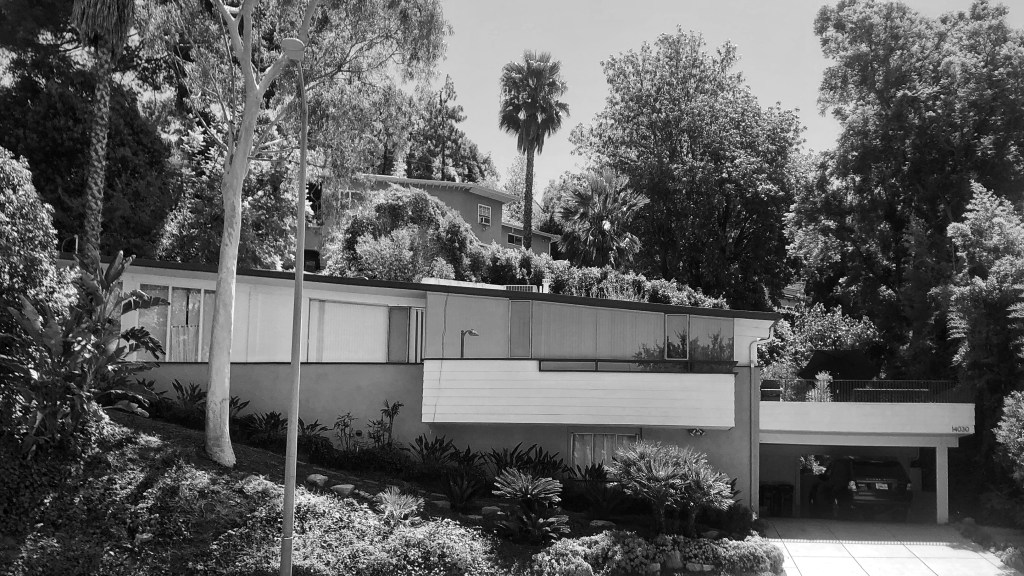
Then we stopped to admire 936 Fortune Way, a 1966 home built for $40,600 by architect PJ McCarty. 

A box on concrete blocks with decorative panels and metal screens, it has a large, flat roofed portico supported by two tall steel posts with hanging globe light, concrete steps and a second floor balcony shaded by the overhanging roof and privacy screens along the rail. 

Though there are palms and desert plants implanted into the blocks, the overall effect of the surroundings of the home is one of deadness in the hot, blinding, relentless sun; lifeless streets without pedestrians, enormously wide for maneuvering and parking enormous vehicles; and the strange, atomized artificiality of suburban numbness, a place where the people are inside in darkness and air-conditioning, on digital devices, high, drunk or napping.

Trained by media to desire and salivate for now unaffordable homes like this one, we don’t often think how very weird and self-destructive LA is, where multi-million dollar houses can exist without anywhere nearby to walk to, without any sense of community, only a coming together to fight crime or development, actions which make people feel better without accomplishing anything significant, lasting or beneficial. 

AI Creates Lovely Houses.


Every new house around me, nearly every one, is ugly. They either have no architecture or they are builder’s standard stucco with vinyl windows and gargantuan garages. These garages will store junk (not vehicles) and the house will cost $700,000 to build and sell for 1.5 million or 2.5 million and still be the homeliest thing you ever laid eyes on.

These new houses never have symmetry. The windows are too small or there are two many. Random shapes and designs are slapped together and ignorantly mashed up to produce cheap and gaudy eyesores. The most common thing is the all concrete garden with gates, a dozen security lights, cameras, large vehicles on a circular driveway. And a double width, double height iron doorway.

I wonder why there is not a single builder who can just observe and copy classical architecture and create a pleasant, well-proportioned and elegant little house?

Like you see in Denmark.

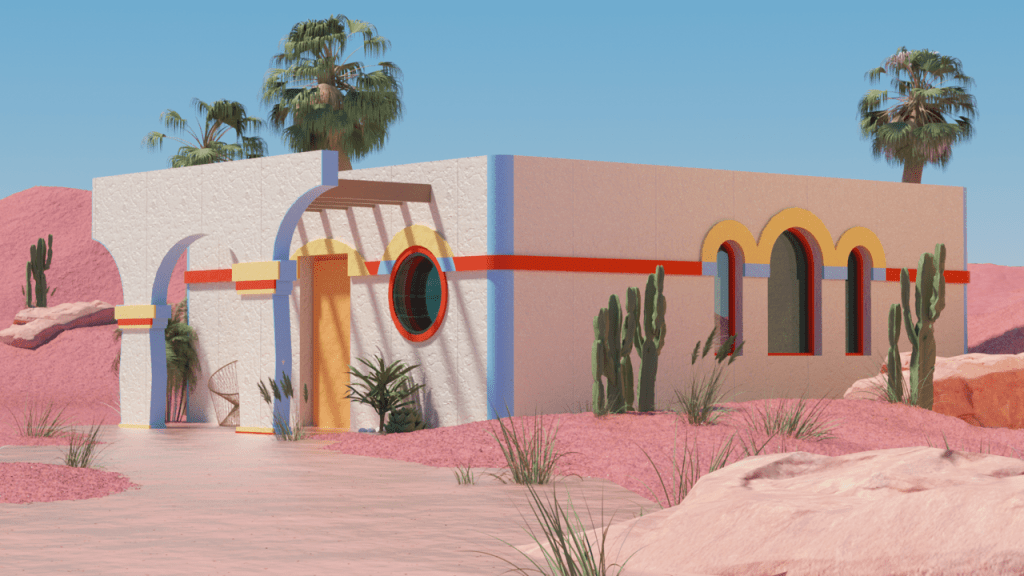
As an experiment I instructed an AI program to create: “A two story tall Danish house with pitched tile roof and casement windows.”

These are some of the designs it produced. Tell me these aren’t better than 99% of all new houses built in North America.

Walking Along the 6th Street Bridge.


I finally made it down to the 6th Street Bridge.

It’s an impressive structure that leaps and struts and flies over rail tracks and factories, electric yards and the river. It is startlingly plain, almost crude in its sculpted mass and bending arches. There are raw bolts attaching the cables to the concrete. Steel fences stretch along the pedestrian walkway. Dark shadows and blinding sun mark the bridge from beginning to end.

Unyielding in substance, rigid, unforgiving, brutal; it is a stage for fast cars, reckless driving and unintentional suicide. But also a balletic performance of geometric shapes and unexpected revelations along the way.

Mute yet expressive, untested in the long term, it is a baby of this metropolis. And born to a city that abandoned it to a wasteland which one day may be remade with trees, parks and apartments; or left behind to become yet another great, unfulfilled California promise.

Walking here last Saturday, August 26th, I thought of the late Mike Davis (City of Quartz) who wrote brutally and trenchantly about Los Angeles.

I don’t have his exact words, but in that book he described an architecture of barbed wire, steel gates, security cameras, the way this city is set up like a penitentiary with hostile inmates surrounded by deterrents, police and threatening lethality.

The 6th Street Bridge, ironically, has earned a reputation for criminal mayhem: daredevil driving and people who climb upon the arches to show off. I saw no rowdiness, in fact the road was remarkably empty and we only passed a few pedestrians. But in all directions artificial and man made structures are the entirety. Absolutely nothing is natural. The lone exception I saw was a cellphone tower who identified as a palm tree.

Million Dollar Living


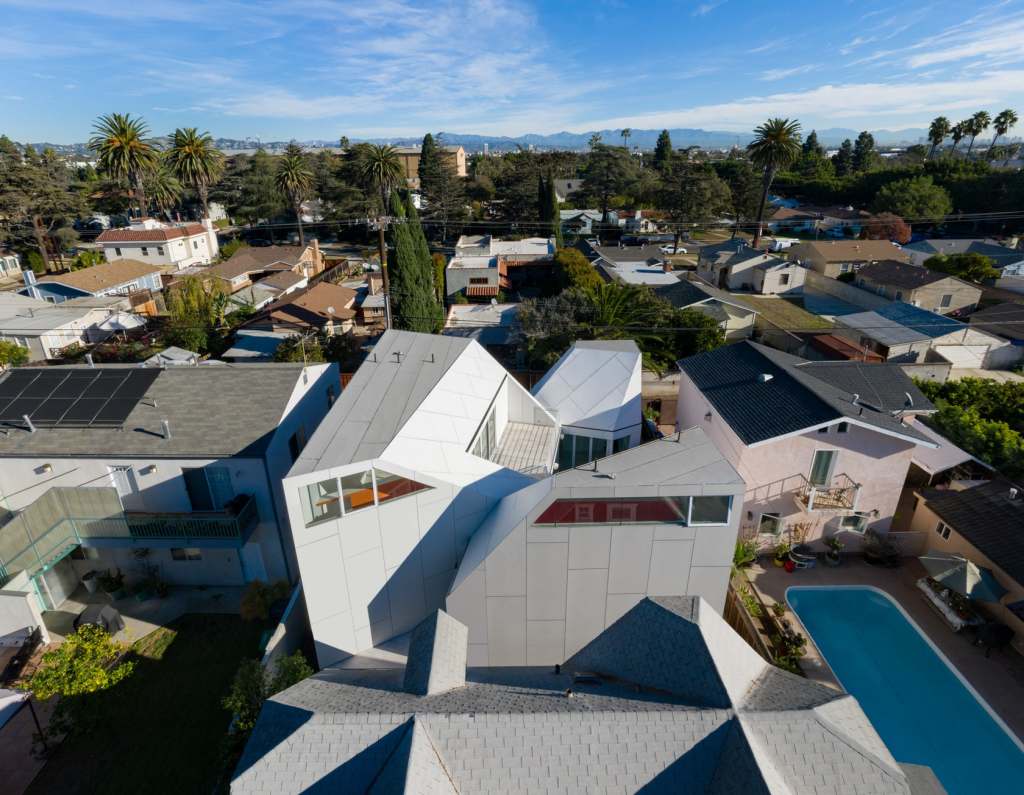
For an estimated cost of about $6,000 a month you can live in a brand, spanking new, “single family” house constructed right on Sepulveda Boulevard, with a front entrance on the beautiful street, leading you into white walled, vertical living with enormous open plan kitchen, four bedrooms, 3.5 baths, several balconies and roof decks.

However….

You won’t have a back or front yard. Your next door neighbors will be mere inches apart from your unit. A tarp covered homeless encampment and RV is in full view across the street.

At night, you may not be able to sleep with the constant noise of ambulances, fire trucks, police cars, speeding vehicles, and intoxicated and drugged people on the sidewalk.

There is Valley Presbyterian just up the block, and several nursing homes across the street with their daily and nightly medical emergencies.

But all this may not matter to you as you worship your “enormous kitchen with Tafisa HPL custom cabinetry, quartz countertops with a waterfall island and Bertazzoni state-of-the-art Italian stainless steel gourmet appliances.”

At a mere $911,500 this single family home will require a yearly income of probably a quarter million, as you will also owe $12,000 or more in property taxes. Utilities, mortgage, HOA, that’s all extra.

If all this sounds too good to refuse, march on over to 6708 N. Royce and see if you can get into this delightful design for living.

Two Family House Designs: 1928


Matot Construction Co. produced many thousands of homes in the Western United States in the 1920s.

In a 1928 book of designs, there are many homes which feature styles characteristic of Los Angeles neighborhoods, the little bungalows in Spanish, Tudor or Colonial which used to dot the streets all over our city, especially in the Fairfax District.

Of course, many of these houses have been knocked down and replaced by gargantuan modern ones which destroy any semblance of character or charm on a street.

Such as this maximum security prison inspired beauty:

2012 S. Curson Ave.

Interestingly, in the Matot booklet, there are several “two-family” designs which emulate single family houses but house two distinct families under one roof.

This kind of architecture was widely used in Los Angeles when new arrivals came here. These dwellings were the opposite of the brutal tenements that made up New York City. They evoked fantasy and escapism, but also brought a gentleness to life in California which incorporated sunshine, nature and relaxed living.

It would be interesting if Los Angeles could build these two family houses, in groups of courtyard arrangements, on land where parking lots and mini-malls stand, on decaying and abandoned shopping centers in Van Nuys, etc.

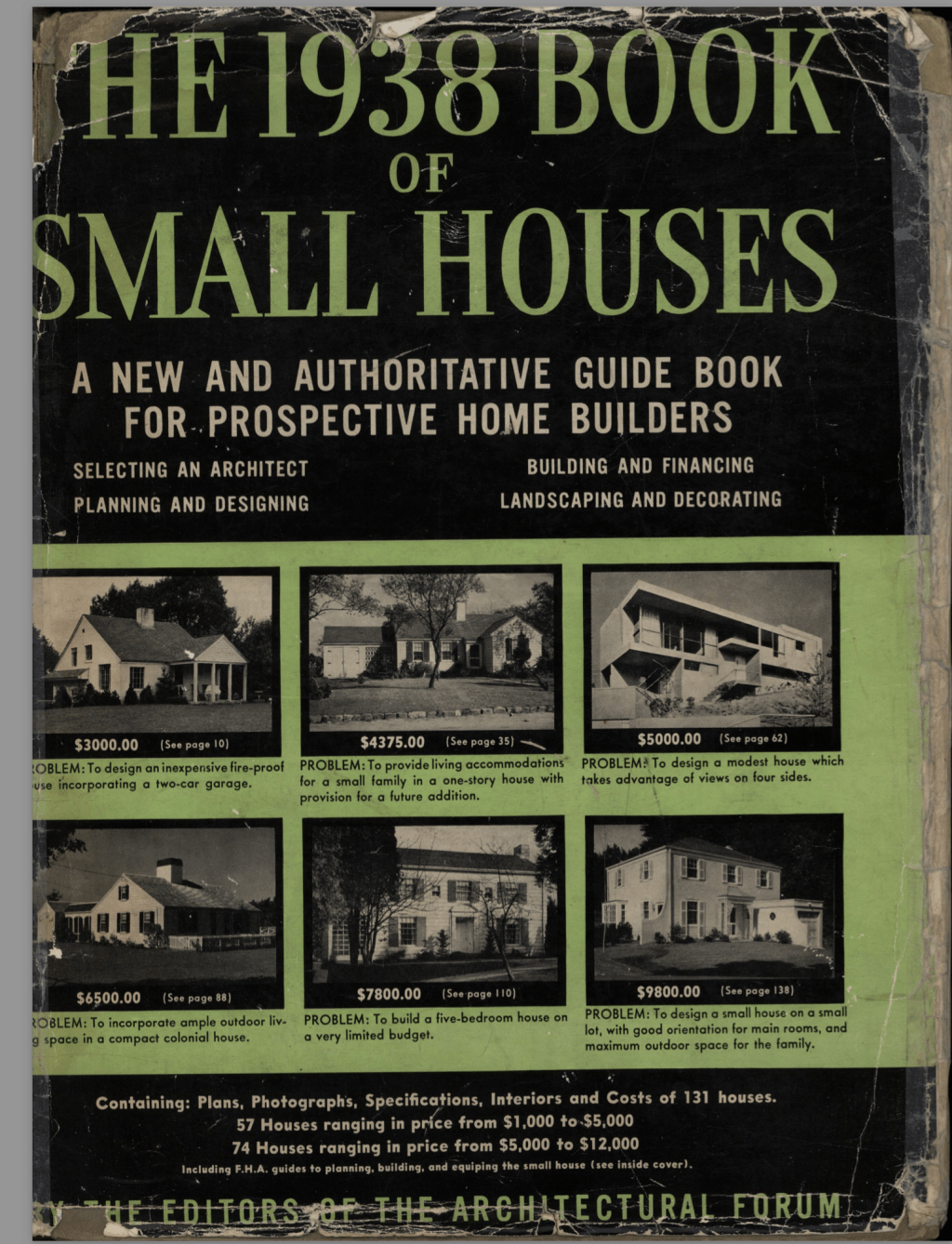
The 1938 Book of Small Houses: Some Selections, Some Commentary.


Here is a 1938 book I dug up on Archive. org

The 1938 Book of Small Houses is a selection of the best residential work of American architects.

Published during the Great Depression, when there was a dire lack of housing, the book showcases how innovative, cost-conscious and community oriented architects built on a budget.

I selected some houses that were built in Southern California, one also in San Mateo, CA.

There are a few by Schindler, Neutra and Paul R. Williams. Many are by lesser known names.

These are 84 years old.

An astonishing amount of time has passed, nearly a century, and these houses still retain a hold on our hearts.

Constructed in a variety of styles, from modern to Georgian to Colonial Revival, they evince a time when architecture tended to understatement, modesty, and proportionality.

Unlike today, nothing is painful to look at. There are no obese styles with garish ornamentation, or massive oversized windows, three story tall entrances, round driveways with 10 vehicles parked in front.

If classical columns appear, they follow the classical proportions. Laid out in a rule book thousands of years old. And when new styles are worked out, they too have geometric logic.

Nobody trusted a fool with a pickup truck to build their castle.

Modern was not a synonym for arrogance.

Nobody winced when they saw the final 1938 product.

In 2022, millions is expended and achieves so little attractiveness.

Most of these old houses cost between $4,000-$10,000.

$6,000 in 1938 is about $115,000 today.

We are so used to ugliness all around us, so narcotized to the malformed and monstrous new palaces that pockmark Encino, Tarzana, Woodland Hills and Calabasas, that we cannot imagine that once upon a time architects and builders and homeowners aspired to build quiet, well-behaved, lovely houses to beautify a neighborhood.

And provide a restful, relaxed, joyous home for their owners.