North Hollywood: High and Low.


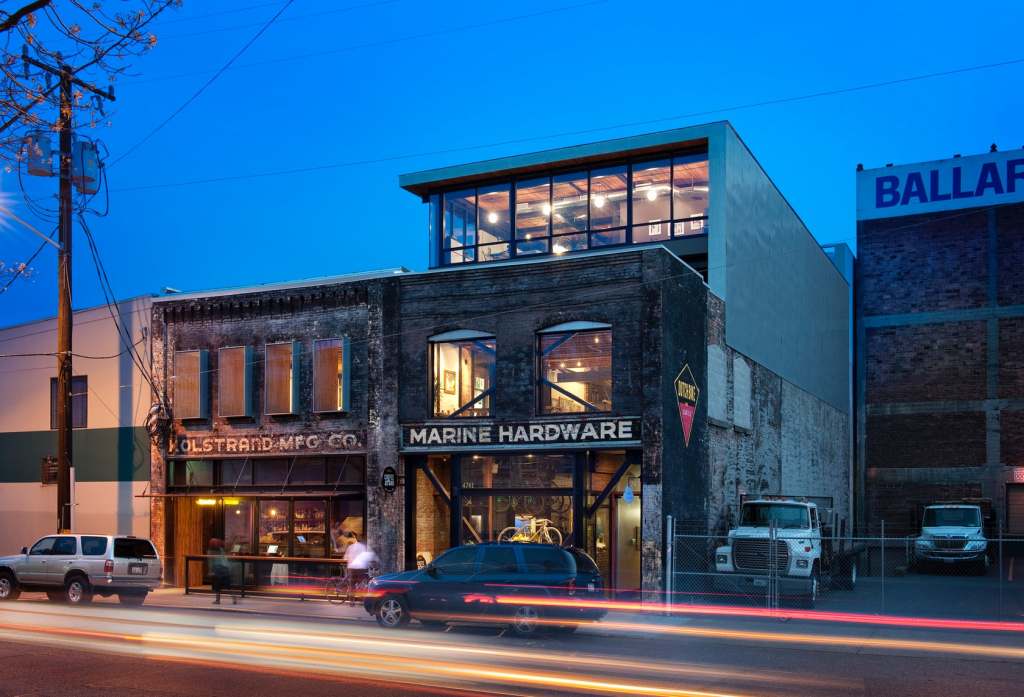
East of Vineland Avenue, along or near Burbank Blvd, North Hollywood has a collection of small businesses, creatives, prop houses, and studio related companies that turn out goods and services, real and virtual.

On a windy, clear, cool Saturday we came to walk around. We explored Satsuma, Chandler, Cumpston and Riverton Avenues.

At 5453 Satsuma, a small, white, mission style stucco church was transitioning to secular renovation for a company called Spacecraft. The site was an otherworldly juxtaposition of architectural divinity and outer space travel.

In the 1946 North Hollywood Street guide, it seems that Santa Susana Catholic Church was the center of a Spanish speaking community along Satsuma that was strictly encased (segregated) between Chandler and Burbank, but not one house north of Burbank, or one house south of Chandler. All the old houses were knocked down and replaced by industrial concerns in the 1950s. Only the church survived but not as a church.

At 5416 Satsuma, a black and pink cinderblock building stood behind a chain link fence laced with reeds. A decapitated palm tree and wooden power pole completed the scene.

We walked along the Chandler bike path, next to a Robert Spiewak mural painted on a building in 2000, during the reign of Mayor Richard Riordan (1993-2001).This Angeleno themed artwork is a dystopian, militaristic vision of power poles, mountains, sky, missiles, and skyscrapers entangled in traffic or the internet. 

My masked, hand sanitized friend Danny stood in front of the mural, marking our own pandemic time as we are poised on the brink of a potential world war and nuclear holocaust. 

On the north side of Chandler, a half-completed structure (for USPS?) is going up with lots of steel and diagonals, in an aggressive, edgy, industrial style that looks like what they were building in West Los Angeles twenty-five years ago. 

At 10747 Chandler, one story buildings from the 1950s, for lease, are neighbors with a homeless tent. And adjoining the block is a clay-colored stucco, streamline modern building, with mean little windows guarded by frilly iron bars, also for lease.

Praxis Custom Frame & Upholstery is housed, anonymously, in a deep teal and decoratively topped structure with brown awnings at 10717 Chandler.

This was once the location of Triple C Polishing and Plating Company according to a 1946 North Hollywood Phone Directory.

A matte finish, gray, Toyota Tacoma 4 x 4, pumped up and preening, was parked in front.

Steel Lighting is a new design on an old building, crisp and clean, black and white, with a cornice of black barn lights extending across the facade. 

Martin Iron Design (est. 1990) is hidden away at 10750 Cumpston. An American flag droops over a wall like a sad, lonely dog. HOLLYWOOD is crafted in metal over a steel walled security gate. 

Curving Riverton Avenue is half industrial, half little houses from the 1940s, a street like a small town, with tiny (million-dollar) residences that face west, into the sun and the new sidewalk, the parking lots and the shadow emitting steel plates that protect VFX Video Services at 5543.

Arxis Design Studio is at 10800 Burbank Blvd. corner of Riverton.

WE ARE ARCHITECTS!

They shout.

Their firm is housed in a torturously proportioned building punctured with a whacko assemblage of exaggerated, protruding windows with monstrous, robotic, tinted glass eyes that scan a parking lot. 

All who look up at the misshapen, off-kilter windows know they are entering a hallowed kingdom of architecture.

That concludes a sampling of North Hollywood, High and Low.

The Toolbox House, Osaka, Japan.


From Dwell Magazine, an example of a tight, urban house in a densely populated area of Osaka.

As I have asked many, many times: why can’t this type of housing be constructed in the commercially zoned areas of Van Nuys? Near the Orange Line? Near the Civic Center?

Imagine this fitted behind an alley in Van Nuys? As a modern, clean, civilized upgrade for the slum housing one sees along Bessemer, Calvert, Delano, Cedros, Erwin, Friar.

Slum Housing on Cedros.

“At first glance, it can be hard to spot the Toolbox House. Tucked away on a long, narrow lot in the downtown area of Osaka, Japan, the silvery home sits much lower than its high-rise neighbors. Yoshihiro Yamamoto of the local firm YYAA designed the dwelling for a couple and one of their mothers, who sought a single-story house that is “compact and easy to use, like a toolbox.”-Dwell Magazine.

Culver City Awakened.


After a long hiatus, we ventured Sunday morning down to Culver City to walk around the new buildings and the architectural oddities.

Once a stronghold of flat, inland dullness, a largely white town peppered in a monotony of starter ranches and stucco apartments, barber shops, taco stands, model trains, gun stores, and typewriter repair shops, Culver City has undergone a two-decade long makeover into a town of light rail, bike and bus lanes, restaurants, lofts, luxury restaurants, furniture, art displays and wine bars.

29 is the median age for work, and 69 is the median age for owning a house. And everyone else of any age is welcome as long as you wear yoga pants and carry a small dog.

In the last two years, all the formerly open parking lots near the Expo Line have been filled in with large, modern architecture: residential and commercial.

The Helms Bakery area used to be the only area that imitated urbanity, but today we walked through it, and there were few pedestrians. But all the old furniture stores were open, and Father’s Office was getting ready for service. An electric bike was parked outside of the Kohler Store, a man and a woman conversed next to a fountain, and through my camera’s viewfinder 1930s Hollywood was alighted in 2022.

Washington Bl. is now a multi-use roadway with specific lanes for cars, buses, bikes and pedestrians, an oddity of our region that takes some mental and focal readjustment.

A thin, blond woman in mask carried a shopping bag and waited for the light to change near Shanti Hot Yoga (“We’re open again! 7 Days of Yoga for $7”).

On the corner of Washington and National, adjacent to the elevated rail, there were new buildings, each one different but not too different: modernism with steel, glass, angles, some wood and some plants, and strong, assertive street walls.

On National Blvd with its spotless sidewalks and young trees, we walked, tranquilized and medicated, by train sounds and light breezes. A paved bike path coexisted with a train that hummed down the tracks high up on a concrete overpass. 

Sunshine was rampant and inescapable.

We were the only pedestrians. 

I had that disembodied sensation one only finds in Los Angeles: isolation and excitement, boredom and anticipation, urban exploration in a landscape of sunshine and emptiness. 

At “Nike Corp – Extention Lab”, 3520 Schaefer St. steel girders and compressed lumber presented an incomplete cathedral of construction. The wood was blond and warm. The materials seemed ready to be pounced on by that shoe brand’s rubber sneakers.

We walked south one block to Hayden Avenue, to a junction of ugly brilliance: Samataur by Eric Owen Moss, the architect whose offices and deconstructed designs decorate the entire street.  

Before the pandemic I would have hated this discordant scene, but now I rejoiced, for the chained off tower and the accompanying office blocks survived intact: startling, grotesque; yet unique in their ambitious awfulness: empty parking lots, cinderblock walls, dark glass windows. 

And a sign called “Clutter.” Without any.

These are the workhouses for young, multi-cultural creatives of dazzling imaginations whose languages are only taught at MIT or art colleges. I’m sure these well-compensated bees have worked on my brain many times as I play video games or buy a bottle of gin with the most gorgeous and award-winning fonts, or scroll through Netflix. They are all 29, tall, and play frisbee on the roof and bring their dogs to walk and I really do hate them all. 

They work for companies where Tyler, Dylan, Ashley and Rebecca, must list their preferred pronouns after their names and every company has a mission statement that begins with “we believe every human being has the right to…”

On the west side of Hayden, 3535 is another Eric Owen Moss, a multi-story stucco structure from 1997 with protruding supports that fly out of the building, angled walls angled for entertainment. Everything is decorative irony, not form follows function, but form for forms sake. Tenants are graphic design and media companies. This is a perfect setting for sons-of-bitches startups, Tesla influencers, wellness lubricants, Armani jackets and collectible sneakers.

At 3585 was Sidlee. This conglomeration was perhaps the most interesting of all the oddities along Hayden Avenue. 

The company, which describes itself in the most inscrutable and amorphous ways[1] has seemingly vacated this arrangement of forms and textures scattered along a parking lot like a museum of sculptures. 

Vespertine, (dinner for two: $650) a luxury restaurant of museum like dishes, was the tenant of a tall glass building encased in protruding, undulating sheets of horizontal and vertical steel. It was built next to a river of concrete rocks like a dry stream; nearby, a four-story tall steel tower sculpture supported rows of steel cactuses in steel pots suspended 40 feet in the air; a concrete park was furnished with cushy concrete seats and shaded by shaved down cats tails. 

If the ghosts of director Michelangelo Antonioni, and actors Monica Vitti, and her still living co-star Alain Delon came to film a sequel to “L’Ecclisse” (1962) this would be their location.

Another strange fact of 2022 was the absence of security guards. I could walk up to any building and take photos. This was impossible from exactly September 22, 2001 to March 20, 2020, when Fear of Arab Terror was replaced by Fear of Invisible Virus

There were signs everywhere for masks and Black Lives Matter, and everywhere I looked I knew I was living in the here and now of 2022, poised somewhere between the past and the present, never quite certain of reality, but walking in it every step of the way.

END


[1] “Deep-rooted in the United States since 2012, Sid Lee Los Angeles has become a thought-leading hot shop for the country’s most iconic brands. With an extensive network reaching all the way to New York, our L.A. team delivers work that matters for a global clientele. This multi-faceted team at the epicenter of content and innovation offers fully integrated solutions supported by the weight of Sid Lee’s global collective.”

Pastel Houses For Sale in Lake Balboa, Reseda and Northridge


Right now, on Redfin, there are a select group of pastel painted houses, (north of Victory, west of the 405), for sale.

This is not a snicker at their colors. Rather it’s a type of respect that their cheery shades are still existent.

As a rule, every single house must be painted white with black windows. New or used, they all must follow this ironclad color scheme.

To encounter houses painted in the colors of sherbert ice cream, popsicle peach, or rose, blush or grapefruit pink is quite a shock, like walking into a house and finding someone reading a book.

Hurry to Redfin. These historic artifacts are not long for this world.

For if these sell, which they surely will, being great bargains at just under a million, their new owners will rush to cover them in white paint.

A Motley Crew: The New ADUs


“The Los Angeles Department of Building and Safety (LADBS) implemented the Standard Plan Program to provide LADBS customers a simplified permitting process for the design and construction of ADUs that are built repeatedly. The use of standard plans reduces the time required for plan check resulting in faster permit issuance.

Under the Standard Plan Program, plans are designed by private licensed architects, and engineers to accommodate various site conditions. Plans are then reviewed and pre-approved by LADBS for compliance with the Building, Residential, and Green Codes. When the applicant selects an approved Standard Plan, LADBS staff will review site-specific factors for your property, including compliance with the Zoning Code and foundation requirements.” -LADBS


Mayor Eric Garcetti and Christopher Hawthorne, Chief Design Officer.

Under the authority of Mayor Garcetti’s Chief Design Officer Chris Hawthorne, a whimsical man, a new menu of backyard house designs, produced by various local architects, has appeared like magic. Mr. Hawthorne was previously involved in architecture writing at the Los Angeles Times and in the re-design of our civic lampposts. He is a frequent guest speaker at international architectural events from New Zealand to Miami and a recurring guest on KCRW Frances Anderton’s radio show on design.

Rather than concentrate on coming up with emergency housing for 100,000 unhoused Angelenos who live in trash piles and tents inside parks and along freeways, mayoral efforts were waged to come up with ironic design concepts in lighting.

The International House of ADU Menu seems to be an attempt to inject some fashionable urgency, flavored with irony, into the critical need of providing housing for a city where it is expensive and rare.

Pre-designed and pre-approved, these ADU (Accessory Dwelling Units) are intended to hurry up the construction of the second house in back of the first house transformation of Los Angeles.

Let’s look at what the architects have come up with.

Welcome Projects “The Breadbox”

Is a play on the traditional mission house with an oversized arched roof. Perhaps the closest to classic of all the designs, it has a cute appeal for those who are tired of the box.


Abou

A 1967 Laurel Canyon type intoxicated with rough wood siding and a slanted roof, not especially pretty to look at, but outfitted in white interior with blond wood floors. Picture Janis Joplin in a hot tub drinking whisky out of the bottle with Abby Hoffman and Jimi Hendrix.


Taalman Architects’ IT House

Perhaps the most Bauhausian of the group, this glass and steel box will allow its inhabitants full exposure to sunshine during the day and illuminate inside activities for outside spectators and neighbors at night.


Amunátegui Valdés ADU

Los Angeles zoning allows ADU’s to be built four feet from the back of property line.

So imagine how delightful it will be for neighbors who encounter a 15’ foot high building with an outdoor roof deck allowing partygoers and drunk revelers to float above all adjoining backyards like devilish angels? Here the architect has abandoned all pretense to privacy by designing a house where dozens of people can look down other people’s backyards from the top of a badly conceived back house. Imagine a house of YouTube influencers living here. What fun!


LA Más 

“is a non-profit based in Northeast Los Angeles that designs and builds initiatives that promote neighborhood resilience and elevate the agency of working-class communities of color.”

Here virtue signaling meets up with 1980s post-modernism in gaily painted houses whose designs look like fast food outlets along the boulevard. The golden arches, the multi-colored column (kids eat free?), the decorative woodwork, these are FUN places with bright colors. And even if they are not especially attractive, and look like Walmart brand doll houses, they are immune from criticism by a vaccine of political correctness. 


When Los Angeles is done bulldozing every backyard to “produce more housing” will the net effect be to put more cash in the pockets of those who already own houses?

Why not up-zone the miles and miles of one-story commercial buildings and huge parking lots that blight our city?

Why not leave in place the gardens, which are the only park system we have, and really ramp up the production of moderately priced residential units near public transportation? 

Something to think about. 

Below, in B&W, are current aerial photos of “downtown” Van Nuys.

An RV For the Person with Many Homes Around the World.


Today, on our morning walk, around 6:30am, we passed an old RV that had pulled up near Kittridge. A tall, gaunt, middle-aged man came out with a cigarette and a big can of Colt 45. He walked up Noble, beer and smoke in hand. And, like so many of us these days, seemed headed to nowhere in particular.

Facebook must have known I had that RV and that lost man on my mind.

For, inexplicably, on my feed today, a glossy spread advertised a $190,000 Bowlus Road Chief RV, an exact replica of the 1930s with 2020 features. They start at $190K and go up in price from there.

26 feet long, six and a half wide, 3,200 pounds, the aluminum skinned, aircraft riveted trailer sleeps four.  The all-wood interior features anodized galley, five silent gravity ceiling vents, LED Lighting, luxury commercial grade flooring, hotel bathroom with privacy doors, Italian Marine shower head, vanity, and toilet with a hygienic, “easy emptying cassette system.” There is also a stainless steel bathroom sink, teak shower seating and flooring, and yours and mine large wardrobes with hanging bars.

You can park, off-grid, in any desert and still enjoy a powerful, lithium iron, phosphate power system that runs for seven days. Even the A/C blows for up to four hours a day without current. Control it all on your smart phone. If it gets cold at night, don’t worry, the floors are heated and there is continuous hot water.

A “Wyoming” décor option features “natural brown seating that is incredibly soft with an unrivaled comfort. It pairs perfectly with luxury bedding in flax and oyster. The awning has stripes of flax and beige.”  It would suit one of Ralph Lauren’s mistresses.

Hand crafted in Oxnard, California, the tale of this exquisite trailer goes back 90 years to designer, engineer and aircraft builder Hawley Bowlus who built the famed “Spirit of St. Louis” airplane which Charles Lindbergh flew to Europe in 1927, the first time a man crossed the ocean by plane.

Mr. Bowlus built some 80 Road Chiefs in the 1930s before ending his project in 1937 and returning to aircraft production. Many are still in operation today and fetch a premium.

The new CEO of Bowlus Road Chief is Ms. Geneva Long who conceived of this while in Wharton Business School. She and her company have quite a few accolades: 

• The first female-founded RV company

• The first [RV] with heated floors and life-work solutions that include the first charging stations/router/wifi amplifier for personal technology

• The first direct to consumer model in the RV market with sales generated online

• An ultra-luxury market for travel trailers

• The first lithium-powered travel trailer with sophisticated power management systems

• The first truly sustainable RV

The Bowlus Road Chief is a glorious toy for any person wealthy enough to afford one for their unique and privileged leisure. 

Imagine Gwyenth Kate Paltrow in Pioneertown, CA alighting from hers after lovemaking, the scent of This Smells Like My Orgasm candle wafting out into the desert as she rubs a soothing and aromatic nutritive Tammy Fender Bulgarian Lavender Body Oil ($65) over her moistened, tanned, bony arms and hands.

RVs: An Ethical Question

My question, as always: why can’t all the innovation, design, capital, industry, and technology be applied to housing those who are desperately in need of a place to live? Are we blind and deaf to the tens of thousands camped out in tents along our streets? Do we not smell the fires that burn every single day in these drug and alcohol saturated encampments? 

Why can’t Mr. Garcetti employ Ms. Long or someone from her team to build ten RV cities with lower cost versions of this? Perhaps the City of Los Angeles could have ten factories around the city to employ workers turning these out for our current housing emergency and put up ten villages around the city to house homeless. Am I insane for proposing this?

In 2016, voters passed Proposition HHH which allocated $1.2 billion to build homeless housing.

LAist wrote:

“The city estimated in 2016 that it would cost between $350,000 to $414,000 to build a unit of supportive housing (in other words, one apartment), depending on the number of bedrooms. Now, more than three years after that estimate, the median cost per unit of housing in the Prop HHH pipeline is $531,373, according to the audit.” In 2019, three years after passage, not ONE UNIT HAD BEEN BUILT.

Imagine if during WWII we were attacked in 1941 and never built one aircraft until 1944? We would be saluting Hitler today.

You could have two, nearly three luxury Bowlus Road Chiefs for the price of one unit of supportive housing.

Something is terribly wrong in our city. And his name is Eric Garcetti.

So, let us appreciate the qualities and accomplishments of the Bowlus Road Chief. And let us not forget this jewel box of an RV will travel past the freezing, the hungry and the forgotten, a misbegotten luxury which could be a template for saving many, but instead is a frivolity for the very few.