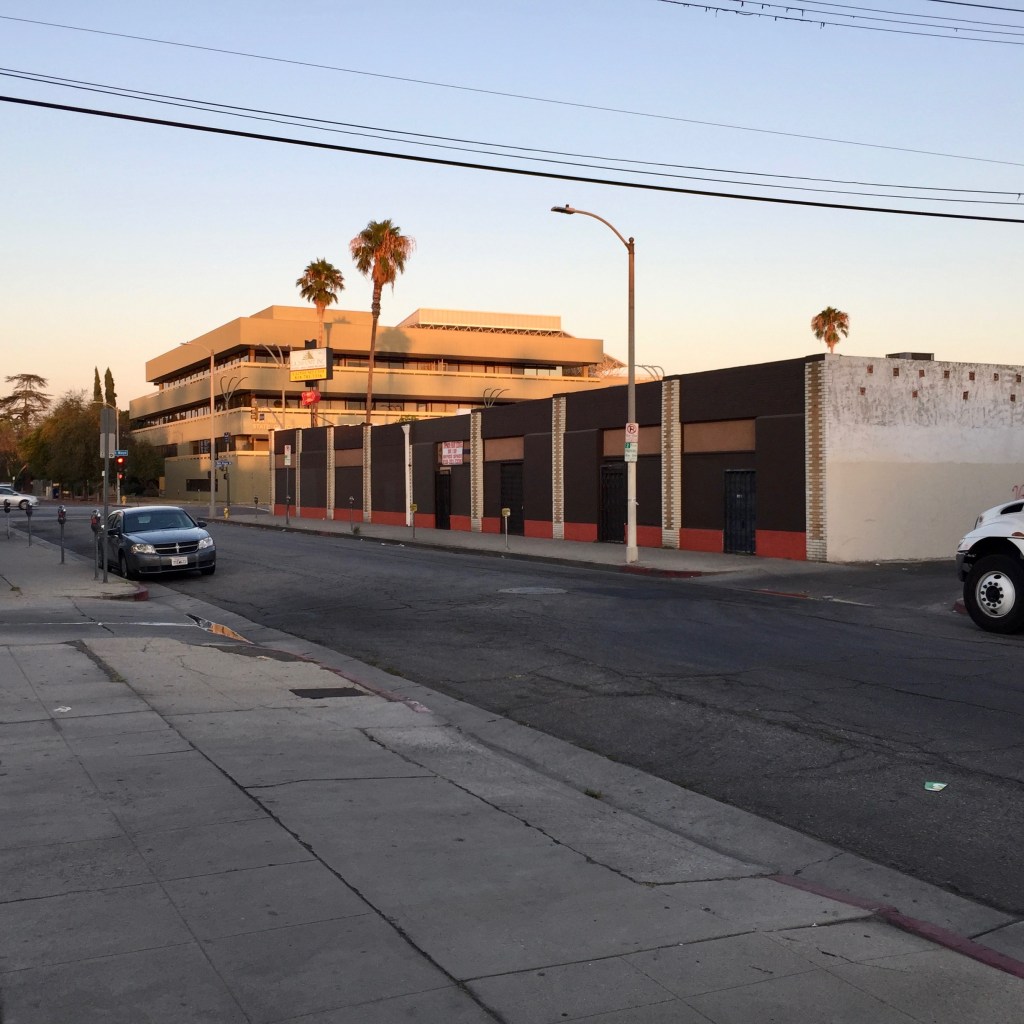
Put on your mask, there is still a pandemic going on. Everyone else is wearing one, because it is a responsible and civil gesture, protecting oneself and others.
Let us go walking on spotless streets.
See the others walk past us. Everyone is trim, they seem to take care of their health.
Let us go into the temple grounds.
How beautiful it looks at dusk!
See the glorious architecture, behold the trees in bloom. There are families everywhere. Nobody fears a mass shooter. Nobody is scared of homeless or mentally disturbed people. All is orderly and regulated, safe and comforting.
Let us walk through Gyeongbokgung Palace, into the gardens, along the walkways, under the trees.
There is no garbage, no litter, no trash camping, no graffiti. People are content because they live in a city and a nation of self-respect and dignity, law and order.
Let us live in Los Angeles as one might live in South Korea.
America once saved Korea. 40,000 American soldiers died, 100,000 were wounded to protect freedom and fight communism. The prosperity and happiness of modern South Korea was built upon the sacrifices of many who died so life could be lived in liberty.
Now Seoul, if it is not too much trouble, can you please save the soul of America?
Seeking to escape the haze and home confinement, we went where we used to go on Sunday in normal times: Santa Monica.
We parked on one of the wide, flat streets north of Montana, away from crowds. And we walked in masks that we imagined shielded us from dangers visible and invisible.
At Adelaide and 4th, where a palm lined grass island ends at a cliff and now blockaded stairs, someone had written “No Vaccine” on a wall.
This year everything is No: no work, no travel, no movies, no dining out, no socializing, no school, no hugs, no kisses, no bars, no strangers, no baby visits, no old people, and, of course, no vaccine.
Before the pandemic there were many runners here, and they would run up and down the stairs, but the virus put an end to that, and now the bad air ensures it.
This part of Santa Monica is grand, with large houses, of every style and decade from the past 100 years, but everything, under the grayish, smoky skies seemed tired, out of breath, defeated; like the city and the state and the nation.
There were Porsches parked in driveways, and Mercedes speeding past, but there seemed no respite from thoughts of ruin and gloom. Who will save us? Will we burn down? Will we be safe when fascism takes over? Or will the lawless sack the mansions and the stores while hated cops stand by and watch? Will a smart leader emerge? Or shall we suffer under Q-Anon and the conspiratorial voices on Next Door?
Who shall live and who shall die and who shall find the most followers on Instagram?
Only the Shadow Knows.
Along Ocean Avenue at Georgina there is a restoration of a grand mansion, with construction illustrations of the elegant plans, and other photographs of historic and happier Santa Monica. Why there’s Mr. Pepper Gomez, Muscle Beach Contest Winner, 1950.
On Georgina there are yard signs, some of them angry. “Elect a clown, expect a circus” says one placed inside a long olive tree lined forecourt of a gated house.
Sometime from the 1940s through the 80s, this area was not so rich. There were large houses, but they weren’t expensive, so developers came in and tore down some of the historic ones and put up cheap apartments.
A 1971 apartment at 129 Marguerita is emblazoned with a strange sign: 129 Career. A door or two off Ocean Avenue, the 2-story building is remarkably plain and homely, with a side alley of individual garage doors, stucco wall and steel windows. Balconies are big and full of plastic furniture. The good life was once available at bargain prices.
And at 147 Adelaide (built 1926) there is a mysterious, long, downsloping, concrete driveway that leads into an old, wood door garage with a five-panel utility door next to it. Two spotlights were on at Noon, and in the distance, haze covered the canyon and the hills and the houses.
Zoé Textereau (b.1986) and Pauline Martinet (b.1987) are two artists from Paris, France whose oeuvre is composed of graphite drawings of many places they have visited, among them Los Angeles.
I found their work on Instagram. Their architectural drawings of Los Angeles find beauty in banality. Perhaps because there are no people in these images, they have an affinity with our present time of desolation and isolation.
They are all something marvelous, an illustration of our city, seen through the eyes of two French artists, a revelation of form, geometry, shadow, texture and shape.
Our built mistakes: the round driveways, the fake pillars, the long awninged walk into an apartment house, the vinyl window and vertical blinds on a stucco wall, the landscaped lake of gravel around a palm tree, the steel security door, the tarp covered car in the driveway of the deluxe house with arched porch and glued on stone walls, and the randomly laid flagstone wall illuminated at night; these are their subjects.
Los Angeles is an artificial encampment watered by imported irrigation, stitched together by freeways and endless streets, baked in sunshine, built in discordance, promoted and extolled for no good honest reason. We have no ensemble of unity in our buildings, no public squares, no grand arches, no central gathering place. Tens of thousands are camped out in trash along the roads and under the overpasses. Those who own property pave their gardens, puncture the skies with revenue producing billboards; they construct monstrosities and guard them with guns and security cameras, they venture out from patrolled properties in tinted windows, sunglasses, and breathing masks.
But Textereau and Martinet find beauty in our banality. We can too.
Today’s Uber ride starred Anthony, formerly of Spanish Harlem, who picked me up at a neighbor’s house in his gray Toyota Prius on Hamlin St. for the 35-minute pool ride to Studio City.
A friendly, chatty, 40-year-old New Yorker in dreadlocks, he started off by ignoring an incoming phone call from “my best friend” who he said never returns phone calls.
But his friend, he explained, was a stand-up guy, a former addict who was spending the weekend up in Santa Barbara to help his sponsor who had fallen off the wagon, gotten back into drugs and alcohol and whose sister was illegally selling the house from under him.
We turned up Calvert Street to pick up a second rider, Ryan, a tanned, curly haired guy from Santa Clarita who worked as “an outdoor cinematographer.” On the ride down to his apartment on Valleyheart Drive he bemoaned the lack of money in his profession, but he also said his friends who travel the world and post about it on Instagram are mostly paid with products, not money.
After Ryan left, we picked up a ride at Fashion Square. This time it was a lanky, tall, black cigarette smoker, Albert, who threw out his butt before he got into the backseat of the car carrying his bag of new shoes. He was on his way down to Studio City to do some vintage shopping at Crossroads. He wore long red basketball shorts and had a dead-eyed expression on his young face.
He said he was short on funds, but made good money as a restaurant delivery worker, as well as getting Social Security money from the government and food stamps. His ambition was to work in fashion, either in films or TV. He wanted to buy a car, but he was also struggling to pay his $1,000 a month rent.
The driver said he made great money as an Uber driver, as much as $1500-$1800 a week, and that he could pay himself up to five times a day as funds came in. He was working to achieve success as a standup comedian. He was excited when I told him he had picked me up in front of the Workaholics House where the owner currently has monthly comedy shows in the backyard for $20 a head attended by hundreds of people.
Finally, we got to Peet’s Coffee and inside there was a regular: Actor/Comedian Jane Lynch (Glee, Best in Show).
We are looking for a slow-paced, day-dreaming, moody worker who does not have it all together, and cannot define themselves in a single sentence.
The atmosphere in our company is relaxed, courteous, clean, casual but introspective. There is jazz or classical music playing, and the bosses trust you to execute work without them losing their temper or becoming unhinged.
Nobody comes to our office on bike, but we love the idea of promoting biking as a way to commute. Please bring a bike to the office (carry it atop your SUV) so we can stress how important it is to bike to work.
There is a promised retirement plan in all our want ads, and a fully paid health plan including coverage for mental health, pregnancy and childcare, and six weeks paid vacation. We think keeping our workers healthy will help them be productive and happier. And that’s what we promise you when you apply here.
The office is located near your home, and if you want to stay home and just go online, that is also a prerogative. Nobody should be forced to come to work everyday if they don’t feel like it, and if they think they can work better at home, that makes sense. Try it after you work here and see how long you end up working here.
In all honesty, our company prefers young workers, preferably ones who just graduated college and have no family responsibilities. That makes it easier for us to pay you less. We do have a 53-year-old woman here but she works nights cleaning our offices.
We also like diversity in race, gender, and looks, as long as you are not over 33 you are welcome in our company.
We are especially eager to promote great causes that help people in need as long as these causes can promote a great image for our company. Breast cancer, dog and cat adoption, and healthy eating are some of our favorite image causes.
You will see our kind of company all around Culver City where a uniquely conforming sameness renders each and every place the province of fresh-faced workers who create internet content, produce internet content, monitor internet content, license internet content, promote internet content, trade internet content, sell internet content, translate international internet, and spin off apps for every type of content found online.
If you think you want to work with us, please click the link below. We are so excited to find amazing people like you!
Over the weekend, I was invited to a wake held in a family home somewhere up high in the hills of Sherman Oaks.
The house was set at the end of an ascending private driveway.
But it was not an exclusive house, the intimidating kind we imagine these days. I saw no cameras or threatening signs. There was no menace, only hugs and handshakes.
It was a 1952 ranch, un-gated, welcomingly decrepit, covered in shingles, set atop a ridge overlooking The San Fernando Valley, and a view to a vast, wild nature preserve. It was, indeed, charming, an adjective now banished from most residential dwellings in Los Angeles.
Inside was a dark, sprawling, old house with mourners, family members and friends, a table set with food, and more people sitting out on a flagstone patio, on plastic chairs, or, around the corner, drinking beer and smoking cigarettes. A lazy hammock sat in a dirt yard under many trees; a yard that lead up into a steep trail, also a part of the property, with mature oaks and wild grasses and an open steel trash can with discarded bottles and cans.
Back inside the house, I walked into the kitchen, still furnished with the original knotty pine cabinets, and a 1970s Tiffany lamp that hung over a small breakfast nook.
There was a pamphlet on a table printed for the deceased, Angelica, who was born May 14, 1948 and died March 25, 2019 leaving behind a husband and two grown sons.
A photo of her, taken perhaps in the early 1970s, when she was about 25, showed a radiant, dark-haired woman.
I remarked to one guest that I expected young Natalie Wood, circa 1955, to walk out and greet us. Then, overhearing me, a very old man with a hearing aid, white-haired and frail, spoke up.
“I dated Natalie Wood,” he said.
He went on to talk about his one date with the young actress. He called her home the next week to take her out again. But her mother said her daughter “was out with Jimmy.”
And that was the end of a beautiful friendship.
I spoke again with the widower, smartly dressed in an old, well-made, V-neck cashmere sweater, in a heft and weight no longer made, and I offered my condolences.
Unsure of where to go, I wandered out into a tool shed in a room neither indoor nor outdoor. Decades of equipment was hung on walls, piled up on tables, and stacked six or seven feet deep. There was multiples of everything: clippers and rakes, ladders and screwdrivers, hammers and spray cans.
This was a house where you might have gone to a wild high school party one weekend at 16 or 17. There would have been 50 or 100 people, a live band playing, kegs of beer, people sneaking off into dark trails or behind closed doors to get high or get off. Vomiting, burgling, breaking, burning, the party would have ended with police cars, screaming parents and fistfights.
Our California Dream, a nostalgia for it, is a fantasy so intoxicating and so mesmerizing that we lust for it, we fight for it, and are consumed with getting it, but yet we must not devour it all at once, for it will eventually devour us.
How I miss those thrilling years I never had here.
Two days ago, I was wandering here, around the California I never knew, but the one that existed until very recently, a place where people never threw anything away, a region where houses were intertwined with wild nature, a state of life where people were high, intoxicated, sensual, creative, and building; an industrious land where leisure was work and work was leisure and no grown man ever outgrew childhood, happiness was just one hit song away, and every night at six a cold bottle of Chablis was uncorked.
Two days ago, Sunday, I took a platonic liking to a (middle-aged, how I hate that word) woman who looked like she was born inside a VW van, grew up in Malibu, and went to school barefoot near a rocky stream. She had the glazed look of someone who had too many compliments and too much stimuli thrown at her, so she withdrew, behind vagueness, to a guarded, opaque sensitivity in an emotional jewel-box.
I took her photo in the little hallway behind the kitchen. She was one of the cousins.
Two days ago, I stopped to sit down with those not so young, boyish guys drinking beer and smoking cigarettes. My plastic chair kept bending, like it was about to snap, so I got up and went out to the driveway, and started to say good-bye to the host. We hugged and promised to get together soon.
But that house, a type marked for extinction, built for $16,000, purchased for $88,000, it haunts me.
A verdant, natural, nestling, cozy refuge from the city, destined for the bulldozer and the investor. Why can’t it just stay the way it is? Why must people die? And why must their houses, their stories and their hearts fall into oblivion?
Rise up dead people and sing again!
Last Sunday, up on Marble Drive, I was somewhere special. I met a ruined beauty still singing the old songs. She sang for me too, and I listened. And I hope to go back soon to hear her sing again.
You must be logged in to post a comment.