You March That Way, You’ll Live This Way


1955.

Once upon a time, my father’s family lived on the South Side of Chicago.

Grandpa Harry and Grandma Fanny had their little house on 88th and Clyde, a squat brick home built in 1950 with a back porch and a spotless kitchen. 

Uncle Paul, Aunt Frances and Barry lived on Luella, not far from Grandpa Harry.

And Uncle Harold and Aunt Evie lived with their children, Adrienne, Michael and Bruce in expansive, grand old apartments overlooking Lake Michigan along the South Shore.

Harold and Paul had both been soldiers during WWII, married young, and came back home. Harold was an engineer, so he started a heating/air-conditioning company that installed systems in many buildings in Chicago. Paul (1921-), veteran of Iwo Jima and the Battle of Leyte, worked as a plumber and electrician. He is still alive at 99 and lives in Woodland Hills, CA.

In 1968, after the assassination of Martin Luther King Jr., there were nationwide riots. And the stores on the south side were burned down and looted. And my grandfather’s new 1968 Chevy Impala, parked on the street, had its antenna broken off by a vandal. That’s when everyone sold their houses and moved up north to Rogers Park and Lincolnwood, North Lake Shore Drive, Deerfield and Highland Park. 

Because they were safe there. 

There were federal investigations by the Kerner Commission, whose findings were released in 1968, to get to the root causes of rioting from 1967, the year before. And they found, (surprisingly!), that segregation, poverty, discrimination, poor jobs and broken families contributed to unhappy lives. 

_______________________________________________________________________-

After every insurrection, after every march, after every episode of mass looting, there comes a vow to move forward and make certain that this time, this time for sure, these events will not happen again.

So the streets in major cities were renamed Martin Luther King Jr., and on television Norman Lear created “The Jeffersons” and “Good Times.” And Hollywood and the media proclaimed that justice would reign over all the land.  See the diversity!

And then there is a reaction, a call for law and order, new laws for harsher sentencing, new reforms for welfare, and progressive ideas to rebuild the cities (Brooklyn, Venice, South End Boston) by making everything safe for tech and shopping and historic renovations, and guess who will be removed again? 

Giuliani is the king. Love what he’s done! This city is the best it’s ever been. We’ve been through 9/11 and now we are never going to be down and out again!

_____________________________________________________________________

Who gets shot and who goes to fight the wars and who dies in the streets and who dies on the battlefields and whose population is dying today of Covid-19 and why is it always the same answer?

Why is it still terrifying to drive through the west side of Chicago before you reach Oak Park and tour Frank Lloyd Wright’s houses? Who lives there and who kills there and who suffers there? It’s always the same answer.

Let the looting and fires and protests begin! America don’t you see what’s going on! 

You are violent by custom, and this is another type of violence. How dare they smash shop windows and steal what isn’t theirs!

___________________________________

Note:

Estimated U.S. military spending is $934 billion. It covers the period October 1, 2020, through September 30, 2021. Military spending is the second-largest item in the federal budget after Social SecuritySource.

That works out to about $2,838 per person in the US. Or about $236 a month for every man, woman and child in the country.

We aren’t even at war. But you could argue we are always at war.

__________________________________

People of pinker pigmentations are again woken up and made to face the suffering of some of their fellow, darker citizens. And every year the same old story is retold, just with new clothes, new celebrities, new movies, and now, a new hashtag, #oscarsowhite or #blacklivesmatter. 

And a silent majority, one whose all-white room I sometime inhabit, deplores criminality, violence, and looting; and I’m locked in there in that all-white room; I can’t get out, because I like the all-white décor that tells me that some people are violent and barbaric and have the wrong values. I feel better about myself, in that all-white room, knowing I’m law abiding and that should be end of the discussion. I’m suffocating in there, I can’t breathe, but I am relaxed in my self-assurance and high self-esteem.

Because if you get in trouble you are a troublemaker. 

_________________________________________________________________

Where I came from is some of who I am.

I grew up in 1970s Lincolnwood, IL and there were no black people other than domestics who worked in people’s homes. 

In 2017, Lincolnwood was racially composed of 57% whites, 30% Asian, and 6.2% Latino or other.  I didn’t see a mention of African-Americans.

There was once a way to run away from troubled places, and seek refuge in a safer neighborhood, but I think we have run out of hiding spots.

They have come to Beverly Hills and Buckhead and Santa Monica, and they is us. 

In 1992, I worked in the Polo Ralph Lauren mansion on 72nd and Madison in New York. There was no social media, no Twitter or What’s App, only rumor.

So as Los Angeles burned, New York City trembled, and rumors of mobs attacking Herald Square and other locations were falsely spread. There was not mass violence or destruction in New York City, that year, and it remained largely in Los Angeles, mostly, infamously, in South LA and Koreatown.

The Polo Store had wooden doors with glass windows, and the security guards pulled the cloth window shades down. They turned the lights off, and we all went home around 3pm on Friday, May 1, 1992. I walked through Central Park in my linen suit and back to my little apartment on West 96th St. to sit in the air-conditioning and wait out the troubles. 

Until this past week I thought we lived in a new time of toleration and nobody was that angry and the times I saw horrendous videos of police brutality seemed the exception and not the rule. And I lived, because I am allowed to do so, in a bubble of wishful thinking and fantasy, in a country that mistreats others but not me.

I thought Barack Obama was the pinnacle of we shall overcome. 

And I was wrong. Dead wrong. 

I was naïve. 

Me? 

Naïve? 

No. 

Just white.

I’m protected from the injustices perpetuated by a system designed to give me a boost up, a feeling of betterment, because others are down there, and can’t be as good as me, no matter how spectacular they are, by virtue of their inherited DNA.

That’s really the truth. Because you might have an MBA, or be the CEO of a company, and if you go running as black you might be shot dead. So why bother to be the best if your country already decides you are the worst? That is the quandary of racism, it rips down the individual to a category, incarcerating her within a foul story of failure. 

It takes a remarkable concentration of effort for the protagonist to overcome her role as the demon in a bad fairy tale.

Like an Obama or Oprah or any father or mother of color in North America.

______________________________________________________________

We are at a point that is not only about the murder of the man by copper knee in Minneapolis. 

There is the small matter of our chief executive, a corrupt ignoramus, who came to power, by questioning the birth certificate of our black president.

We are sick, we are unemployed, we are uninsured, we are scared. 

We were kept home, kept in fear, brought out in mask, and indoctrinated to wash hands. We stayed home and got our groceries delivered, and got a check from the government, and some people got sick, some died, and the nation looked in vain for a leader who could not lead, a savior who could not save, and today we are waking up in the wreckage of our homeland.

A virus still stalks the Earth and lives in our saliva.

When Los Angeles was at its richest and most prosperous, three months ago, there were 100,000 homeless. And that was permitted, by the leaders, the citizens, and the public. 

When Los Angeles was at its most diverse, the whitest among us drove our children to school districts that were majority white, and our morning and afternoon traffic was largely made up of children riding to and from whiter schools with their parents. 

And that was toxic and unjust, racist and unfair, blatantly racist. When you think about it.  Public schools where no children walk to school. Public schools, not of neighborhoods, but of magnets propelled to collect like particles to adhere with.

And what have we done to change education, health inequalities, housing shortages, racism itself? Because it all circles back to race when you ask people where they want to live or go to school.

We have an invisible problem right before our very eyes. 

Our feet stand on blood-soaked soil. But we don’t see under our white sneakers.

We are striving to succeed, we want our children to succeed, but what is personal success if our nation is a failure?

So many marched, that way this week, holding up signs: impassioned, motivated, angered.

It was a religious fervor of moralism sweeping the country. 

But nothing has changed, really. Stores are burned and looted, cops get down on their knees, mayors and governors call for a new dawn of tolerance and kindness.

The new plate glass windows go up, the tags scrubbed off the buildings, and surely Oprah will find a new heartwarming book to promote by a young black author.

Instagram will black out, and hash tag, and celebrities will proclaim they stand with the oppressed and the hated, and vow that a new day is here.

And new laws will get passed. And everyone will listen to great podcasts about race and police. And eventually the marchers will not march. They will go home, or get jobs, or go back to school, and the national hibernation will end, and the fast, furious ambitious race to get more for me will resume. 

The next time someone dies unjustly, Our God, Lord Smartphone, will record it. 

But Lord Smartphone cannot right a wrong. Only we can.

We marched that way, but we’ll live this way.

Crossing Ventura.


Sometime in late 2018, early 2019, I’m not sure exactly when, they created a pedestrian crosswalk, with flashing lights, across Ventura Boulevard. at Ventura Canyon Avenue.  The crossing is about a block east of Woodman and a few doors down from Yok Ramen at 13608 Ventura where I go about once a week.

This is in the heart of Sherman Oaks, where stores that paint your nails, sell used records or live birds are sprinkled along the boulevard along with massage, dry cleaners, and laser skin treatments. And Floyd’s 99 Barbershop where every customer from 18-80 is a rock star.

I’m familiar with this area and its friendly banalities.

About 20 years ago, I knew a divorced woman in her 40s, with a little girl’s voice, who spent most weekday mornings at the location where the ramen place is now. 

Back then it was a bakery and a coffee shop with big muffins and big mugs, chocolate croissants and caloric treats. She sat at a table with her journal and wrote music and poems. Today she is retirement age, married and living in rural England.  And that’s how I got to think about the time passing and the way people pass time on Ventura Boulevard. 

As Orson Welles once said, “The terrible thing about L.A. is that you sit down when you’re 25 and when you stand up you’re 62.”  

And if you spent a couple of decades eating chocolate chip muffins on Ventura Boulevard what have you got to show for it?

To keep people alive, and moving, mostly in cars, the people and “leaders” of Los Angeles have devised, through the years, the same kinds of ideas to make safer the naked and shameful stunt of walking across Ventura Boulevard.  These include longer pedestrian signals, traffic islands, and painting the street with lines or figures to indicate that humans on foot also roam in the land of cars.

We tweet in seconds about trivialities like nuclear war, impeachment or the fires in Australia but we cannot assume that six decades will correct the urban failures of Los Angeles. Photographs from the past prove my point.

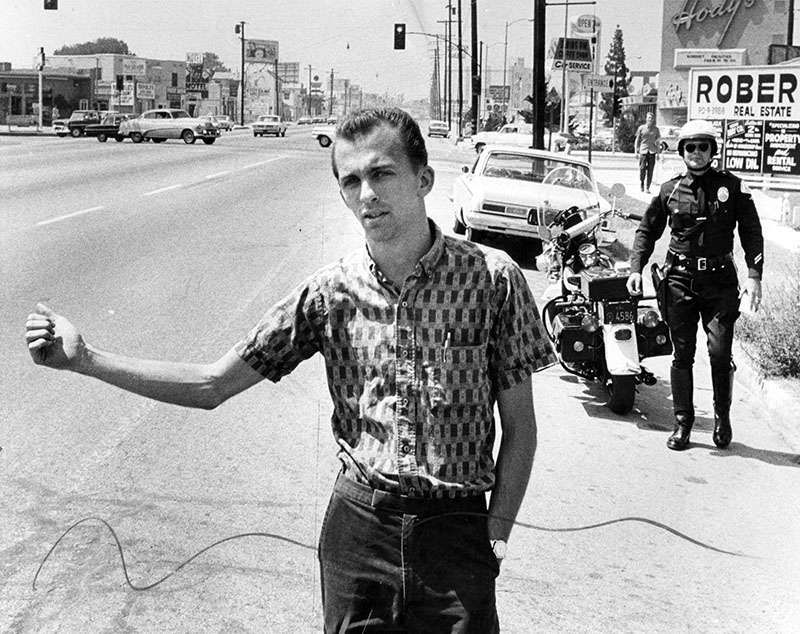
On November 30, 1959, Dr. Louis Friedman, Dentist, painted his own crosswalk, with a corn broom, on the pavement at Murietta and Ventura, to protect his patients. He had unsuccessfully asked the city to do so but his requests were ignored. So he took the initiative and laid down the lines.

That same year, Carl Stezenel, 10, of North Hollywood stood at the corner of Radford and Ventura and tried to cross in the time allotted, 9 seconds. If a 10-year-old boy found that challenging, imagine the typical woman of that era in high-heeled shoes, gloves, hat and a cigarette pushing a baby buggy?

Carl Stezenel’s plight may have influenced a December 1, 1960 dedication for a new landscaped traffic island at that same location. Men in suits (a sure sign of importance) attended the event, in a district whose distinguished architecture featured auto dealerships and gas stations. 

Five years earlier, in 1955, motorists on Ventura near Dixie Canyon Avenue were warned that they were approaching a nearby school by a painting on pavement of a running boy with a ball. 

People who worked and shopped in the area did care about how it looked. Years before it was considered normal and decent to allow tens of thousands of intoxicated and mentally ill people to live on the streets with garbage filled shopping baskets, the issues of why there was no tree cover on the boulevard haunted the civic minded. 

The palm tree, with a trunk so skinny it could never crowd out a Cadillac at the curb, was the obvious solution.  

Studio City is now lined with palm trees, a species that provides no shade to sidewalks that are baked in sunshine 350 days of the year. In 1954, the first palm trees were planted as part of a beautification scheme. Fully grown, their trunks look like posts without billboards, a perfect style for this city.

The sameness of businesses in the late 1950s along Ventura Boulevard presented problems. We, who are of CVS, Starbucks and Chipotle, may understand that historical plight.

Studio City and Sherman Oaks had a competitive streak. 

To bring customers between the two districts, a special free bus was introduced on February 18, 1959. If you had a watch that needed repair, wanted to purchase panty hose, a typewriter ribbon, or a cigarette case, now you had a no fare bus to take you up and down Ventura Boulevard, opening up a world of possibilities. 

That bus must have been cancelled after 10 episodes.

Further east, at Balboa and Ventura in Encino, the traffic situation was already dire in late 1953 when work-bound suburban residents were forced into only two lanes of eastbound road, while the westbound, going into less populated Tarzana and Woodland Hills was free of congestion. The solution: three lanes in the morning, and then move the cones and make it three lanes westbound at night. 

Eventually, the current road was widened into three lanes in each direction, with an advanced staring-into-the-sun design for morning and afternoon drivers. 

High rise office buildings sprung up in the 1960s and 70s, some as high as 15 stories, but nobody in the single-family neighborhoods nearby cared because the occupants were white and well-paid. Today, a four-story tall apartment with 130 apartments, and 3 affordable units is considered social engineering and overcrowding by many in Encino.

We are now into the third decade of the 21st Century and Ventura Boulevard still lacks safe pedestrian crossings because most drivers and pedestrians are looking into their mobile devices.

Photo Credits: LAPL/ Valley Times Collection

A Cleared Lot


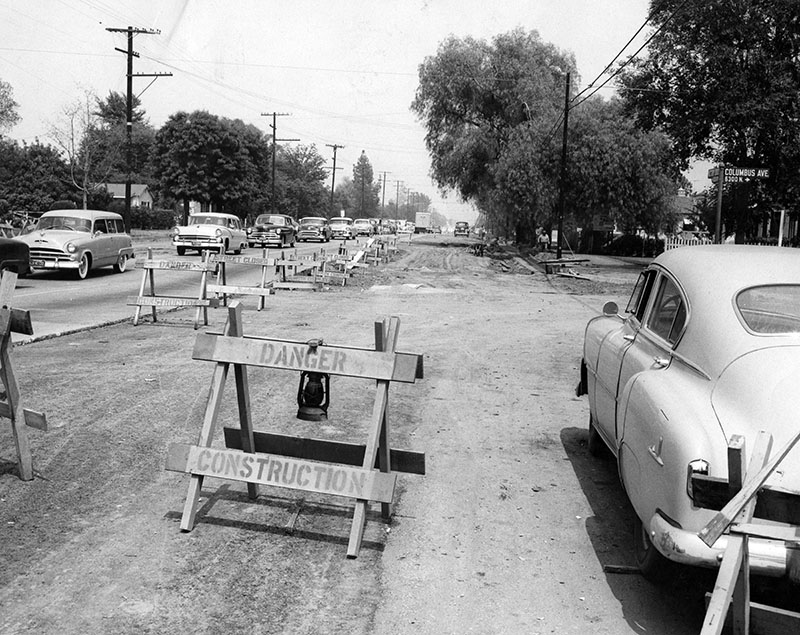
They have almost completely cleared the 27, 762 SF lot that is 6505 Columbus.

The property once held a single family house, constructed in 1937.

One of the owners was a production manager and second unit director, Cliff Broughton, Sr.

On November 14, 1949, Mr. Broughton’s son, Cliff Jr. was piloting the 136- foot-long schooner Enchantress, along with 14 passengers, from Newport Beach, CA to Panama, and later Tahiti, when it ran aground in a sandbar off the coast of Baja California. The boat was eventually freed and everyone survived.

The senior Mr. Broughton put 6505 Columbus up for sale in 1950. Perhaps the yacht drama had distressed him.

In an LA Times classified ad from January 15, 1950, 6505 Columbus was called “Rancho Perfecto.” The one acre estate with 6 rooms, included a guest house, rumpus room, laundry house, tool house, double garage with storage closets, patio, and a lighted badminton court. There were also “plenty of shade and fruit trees.”

They were asking $22,500.

For many years 6505 was part of six other large, underdeveloped and underprivileged properties on the west side of Columbus from Hamlin to Kittridge. In a previous post this area was described accurately as I saw it.

Now they are almost done clearing the house and flattening the land where some four homes will sit between two roads, Hamlin and a TBD.

A large apartment building will be the backdrop for the next 100 years of drama at 6505 Columbus.

A Once Neat City.


Looking from Wall Street between 8th and 9th Streets. “Japanese and Negro District”

The California Historical Society has a fine website with old photographs of Los Angeles. The Anton Wagner Collection is especially notable for its images of our city in the 1930s.

The Great Depression was in full swing and Los Angeles was a place where people also struggled to make a living, even though photographs show new buildings, apartments, public works, farms and industries. It seems everyone was working and the city was thriving despite hard times.

One thing that stands out is the spectacularly tidy streets with swept sidewalks, clean curbs, and not one sign of shopping carts filled with garbage or mountains of trash.

This was during the most severe economic downturn in American history, yet Los Angeles functioned as a functioning city, where the presentation of tidiness, order, and cleanliness was foremost.

There were many poor, destitute people in the 1930s. But Los Angeles did not create a dystopian city where people shit in the streets, or lived along the road, or slept on bus benches, or roamed mentally ill in parking lots, or set up tents on residential streets for outdoor trash camping.

There were not two-story high trash piles that authorities promised to remove in three months time.

Cheap structures on Eagle Rock Boulevard, looking east from north of York Boulevard

There was a crisis and it was called the Great Depression, but government and people, here in this city, were not seized in panic and unable to respond or knocked over by circumstances.

They ran the city well, with pride, and these photographs of ordinary life in the City of Angels, 85 years ago, should fill our modern, jaded hearts with shame for what we have allowed Los Angeles to become under Mayor Garbageciti.

Clearing Up a Photo Mystery


I found a DWP  Collection photo from the 1920s that shows the Van Nuys office of “Wagner-Thoreson Co.” (a realty company) and a nattily attired man standing in front. 

In the background is an estate on a large piece of land. A signpost reads: “Sherman Way” and “Lane St.” The photo had some information underneath which said “Lane St. was later renamed Califa St.” 

Where exactly was this? 

On Google Maps there is not a “5856 Sherman Way.” I thought the signpost might be blocking a number “1” so I inputted “15856 Sherman Way” but that address, in present day Valley Glen, was not at an intersection.  Califa and Sherman Way do not intersect either.

The 1926 San Fernando City Directory listed “Wagner-Thoreson Co.” at 5856 Van Nuys Bl. (at Califa). Not “5856 Sherman Way.”

Then I remembered something. 

Sherman Way was once the route of the Pacific Electric streetcar. The PE snaked its way up through the Cahuenga Pass into North Hollywood, then west down Chandler Blvd. It turned north up Van Nuys Blvd. and then travelled to go west on Sherman Way.

But Chandler Blvd. and Van Nuys Blvd. did not exist in name until 1926. From 1911 until 1926 Chandler, Van Nuys and Sherman Way were all named: South Sherman Way, North Sherman Way and Sherman Way!

On May 25, 1926, the Los Angeles City Council, with some infighting between San Fernando Valley residents, came to a compromise and agreed to partition the Sherman Way family into three distinct names: Chandler, VNB and Sherman Way.  


So the man in the mystery photo is standing on present day Van Nuys Blvd. at Califa, a block south of Oxnard.

Van Nuys Bl. 1930

Pacific Electric service lasted until December 29, 1952. 

Cahuenga Pass 12/29/52
N. Hollywood, CA. 12/29/52
Chandler Bl. 12/29/52

These sad and wondrous Kodachrome photos from the collection of Caesar “CJ” Milch (not the original photographer) show the #5146 car that once ran up through the Cahuenga Pass and into the eastern San Fernando Valley on its last day.

The Armenian Directory: 1932.


Within the collections of the Los Angeles Public Library there are city, business and phone directories going back to 1873.

Among the historic books can be found The Armenian Directory of The State of California, 1932, related to the Armenian community of Los Angeles, at that time, numbering a few thousands, many of whom were settled in Pasadena, and throughout the Southland.

The first wave of emigration from Armenia came after the First World War when Turks murdered millions of Armenians during the breakup of the Ottoman Empire. Most of the refugees came from Western Armenia near Turkey.

Here in Los Angeles they established an industrious, skilled, hard-working community. They built churches, founded benevolent societies, and created cultural and social institutions centered on music, food, and dance. 

Their professions in their new adopted city were many and varied and included dentists, physicians, attorneys, tailors, grocers, bakers and funeral homes.

The Standard Crate Co., Inc. built fruit boxes and gave “special attention to Japanese customers” many of whom grew citrus. Ten years later these same clients were rounded up and put into detention camps, a tragic and historical irony the Armenian advertisement could not foresee or imagine.

The Hollywood movie industry was already famous worldwide when the Antranik Dramatic Company advertised their actors. Mastery of frivolity has always been important in this city.

It seems that many Armenians did well here. 

The Altoonian Family, and their sedan, is seen below in a 1926 photograph. The 1933 directory lists an “Altoon Apartments” at 2405 S. Hoover, and several Altoonians who lived at that address.

At Joe’s Garage, 2505 E. 4thSt. the motto was “Once a customer, always a customer.”

A magnificent Art Deco ad for signs is a last breath of the 1920s with its rhythmic patterns and syncopated layout.

The Luther Eskijian family is shown in 1924, perhaps in front of their home at 1738 Bridgen Rd., Pasadena. Boys are in knickers, those short pants that children wore up into the mid 1930s.

The Constantinople Cigarette Shop at 356 South Broadway made special monogrammed cigarettes “which makes [a] splendid gift or present for your friends and relatives for their birthdays.” 

The International Grocery Co at 134 N. Main St. had such Armenian foods as aghy banir, lablebi, boulgour, chadana and fistuhk. Or cheese in brine, roasted chickpeas, crushed wheat, pine nuts and pistachios.  A one-gallon tin of olive oil was an enormous luxury item priced at $2.50 ($25.68 today).

Elegant tailoring was the province of Gregory H. Chashoudian at 4562 Beverly Blvd east of Western Avenue. His skills were endorsed by B.R. Ware, Attorney, who said Mr. Chashoudian’s suits were “entirely satisfactory” and reasonably priced.

The world was in the midst of the Great Depression. 

Yet looking through the pages of the Armenian Directory in 1932 one feels a sense of pride and admiration for these industrious people who overcame such grueling tragedies and unjust cruelties. 

They somehow made it to Los Angeles, CA and established stable and prosperous lives in a new and unfamiliar land.