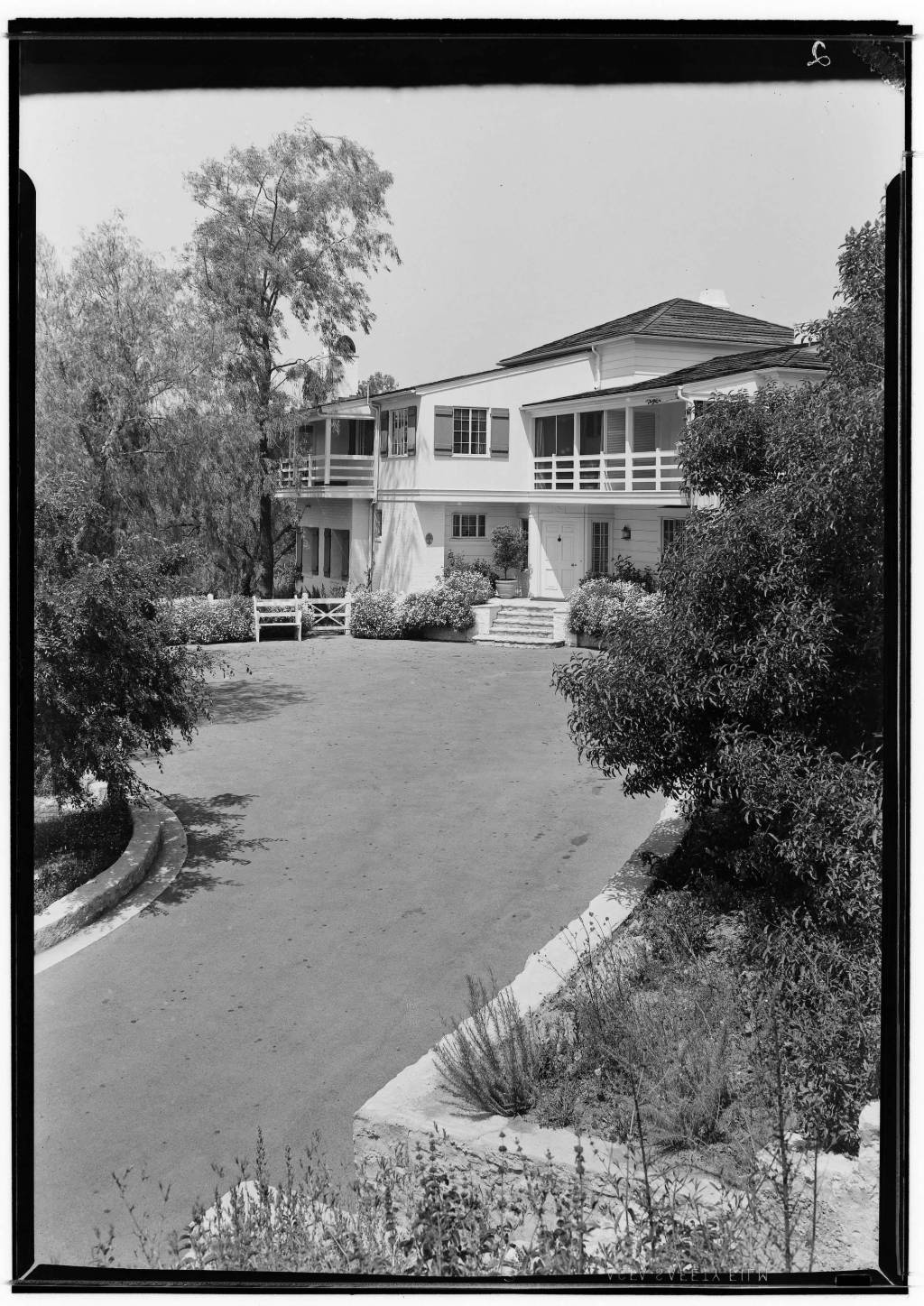
Myrna Loy and Arthur Hornblow, Jr.’s “Lime Orchard” Home 1938


The Criterion Channel is showcasing the actress Myrna Loy (1905-1993) in its August line-up.

One of the most popular and lauded performers of the 1930s and 40s, Ms. Loy was famous as the co-star of “The Thin Man” films with William Powell, characters who solved crimes in the well-dressed and liquored penthouses of Manhattan.


She was adept at underplaying comedy, always alluding to something funnier and sexier without drowning in it. Her personality was built upon allusion and intelligence. Along with “The King” Clark Gable, she was voted “The Queen of Hollywood” in the late 1930s.

Married and divorced four times, she never had any children.

But in 1938, as these astonishing photographs (by Maynard Parker) show, she was married to Mr. Arthur Hornblow, Jr. and they lived on a spectacular estate in Beverly Hills, CA with vast lime orchards, tennis court, swimming pool and a rustic, but refined, California country estate with wood siding, shaded porches and many flowers, trees, and vistas of the undeveloped mountains.

Everything about this property sparkles with the graciousness and rarified perfection of well-tended Southern California affluence. They swam, they played tennis, they drank cocktails in the wood paneled library. They might have flown with Howard Hughes to Catalina Island or gone fishing on a boat that docked in Baja California. They danced, they played music, they acted in movies, and their lives, off set and on, were theatrical, and moved, often intoxicated, with emotion, and grace.

In these photos are two opposing qualities that complement each other: restraint and opulence. This large house is well-proportioned, charming, whimsical and cozy. 

Nobody lives like this now. Nobody, even the richest, has a library of books. Nobody has servants working in the house or gardeners tending to acres of lime trees. Nobody opens their windows to ventilate their rooms. All of it, phony or real, has been torn down, and today we can only go online and drool. 

Photos are from The Huntington Library.

Architectural Digest 10, no. 1, 1938, 43–49.  Martha B. Darbyshire, “‘Lime Orchard’: The California Estate of Mr. and Mrs. Arthur Hornblow, Jr.,” Country Life & The Sportsman 75, March 1939, 45–47.  Better Homes and Gardens, September 1940, 29.

Fashion Entanglement


Last year, in early 2019, before all hell swept over the Earth, I was working as a photographer.

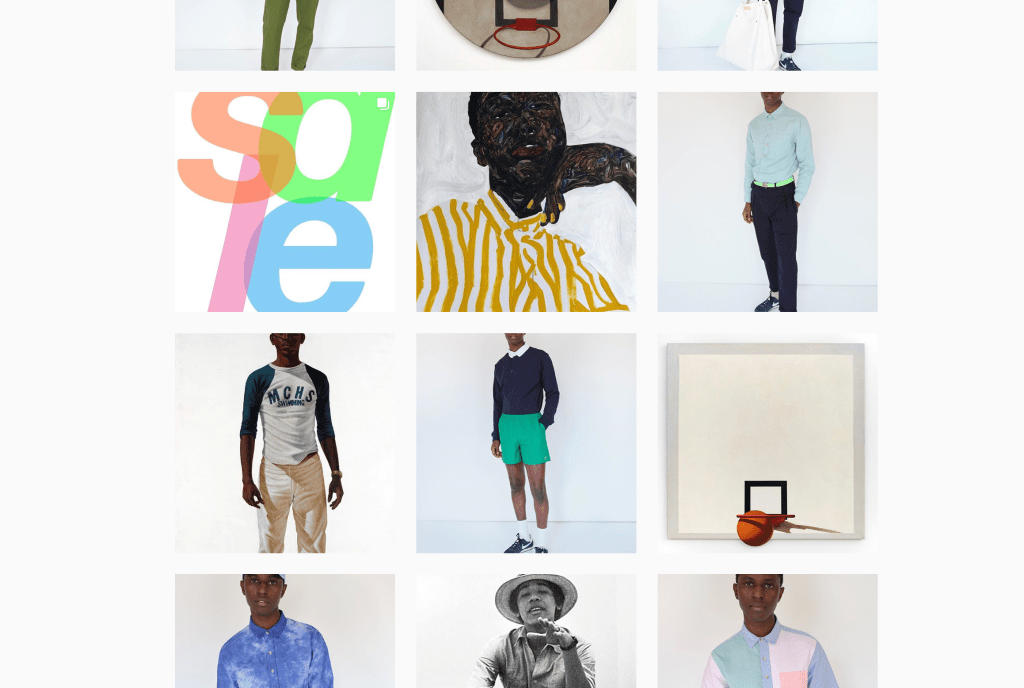
Seeking to refresh my portfolio, I contacted a model on Instagram who was a striking looking Black male. He had close to 20,000 followers. He agreed to a “trade for print” (TFP) which is just a term for a barter arrangement where a model and photographer work for free in a mutually beneficial arrangement.

I thought about how I might shoot this person, and I found a start-up clothing company that was just gearing up. The designer founder, a middle-aged white, who had 20 years of experience in fashion, had just moved from New York. He made rugby shirts, well-tailored trousers and other prep clothes that were locally manufactured in downtown Los Angeles to high quality standards.

I contacted the designer and drove down to his perfectly decorated art deco apartment in Hancock Park where he had selected and neatly folded jackets, pants, and shirts to photograph. Again, the arrangement was just to “tag” his products on Instagram and he would get credit and some free advertising and I would have loaner clothes for my model.

The model came over to my house. I shot him in the clothes as he stood in my backyard, and in a chair in my living room. And then he left. And all was fine. The Black guy with the green eyes in the colorful shirts looked wonderful. (I have erased his face to protect his identity.)

I felt some compassion for the model, who was, of course, also pursuing acting. I gave him a couple of leads of directors or producers I knew and said he should follow them online. He sent me texts of thanks. And that was the end.

Then the designer saw the gratis, no charge, promo photos. 

And for whatever reason, he hated, despised, and was completely revolted by the good-looking young Black male. He gave no reasons, but it seemed that he preferred a “preppy, All-American” (WASPY) male.  He was aghast at the free photographs and not at all appreciative of the pro-bono work. He told me he wished that I never put this Black man in his clothes.

A day later the model contacted me and asked why the designer had (unknown to me) blocked him on Instagram. I had no answer. My heart broke because I could not understand why. I could only guess racial animosity. But could not prove it. Why the hostility directed against this dark-skinned man? He had done nothing wrong other than wear the designer’s clothes!

I had, in my initiative, promoted a new clothing line, and an upcoming model, and all I had were some very fine photos. It had cost me nothing, except for the gasoline driving 30 miles roundtrip to Hancock Park.

Then a few months ago, about a year after the shoot, the model, whom I hadn’t communicated with, sent me a DM on Instagram. It read something like this: 

“You do not have the right to TFP my name to promote your friend’s clothing company! You are OLD! Why don’t you go fuck your Chinese boyfriend!”

I didn’t answer. The attack was completely unprovoked. It did not matter to the model that he got free, edited, professional photographs that he could use to promote himself. And that my “friend” was not a friend at all, just a brand I found on Instagram. I guessed that the pandemic had made him just a bit more crazy as it had all of us.

Today, out of curiosity, I went to see whatever happened to that promising start-up company that made the very colorful rugby shirts and high-quality khakis. 

I couldn’t see it. The clothing company designer had blocked me on Instagram. 

I’m recounting this story because I had the best of intentions all around in producing this small shoot. Everyone was treated fairly, courteously, respectfully. Nobody was mistreated in any way.

I found an alternative way to look at the website of the designer’s IG page. He has one Black model in every single photo. And dozens of boxes of “Black Lives Matter” and all sort of salutes to racial justice and racial equality. 

Of course, it’s past May 25, 2020. George Floyd is dead. Black Lives Matter. Everyone must show social media empathy for the cause. The company that sells the $200 khakis makes sure that its’ images are on the appropriate side of compassion.

I see the kind posts this year. I remember the mean actions of last year.

Today, in fashion, we salute Black Lives.

What about next year?

The Battle of Alta Loma Terrace.


In early 1964, Steven Anthony, 33, a Barney’s Beanery bartender and ex-marine, his wife Elona, 22, and three young children, Steven,2½ Deborah, 1 ½ ; and Pam, 5 months, were living, just south of the Hollywood Bowl, in a bucolic 1920s English cottage at 6655 Alta Loma Terrace.

Then they were served with an eviction notice. And told to vacate their home because it stood in the way of a proposed $6.5 million Los Angeles County-Hollywood Museum.

(2017 Dollars: $51,492,200.65)

When LA Sheriff Deputies arrived Saturday, February 8, 1964 to evict the family, Mr. Anthony, “cradling a shotgun in one hand and a baby in another,” held the deputies at bay for seven hours and won a reprieve to stay in the home for a few more weeks.

The case of the shotgun wielding marine, Brylcreemed, burly and courageous, seems to have captured the support of his neighbors, and sympathy from a wide variety of Los Angeles, a city, that saw a little guy battling forces bigger and better financed.

If the Sheriff returned to evict him, Mr. Anthony promised that he would have a dozen ex-marines at his side. His attorney, Paul Hill, filed a brief with the US Supreme Court. While the motion was being considered, deputies were told to stay clear and allow the law to adjudicate.

LAT/LAPL


The county argued that the new museum was a public project and they had the right to seize an obstructing private home. A jury awarded Mr. Anthony $11,750 for his “half” of the home but he thought it was too little. He sent his wife and kids out to Big Bear City while the matter boiled. The US Supreme Court turned down the review.

Now Mr. Anthony waited….

On the evening of Monday, April 13, 1964, as the 36th Annual Academy Awards aired, Mr. Anthony welcomed two “pals”, ex-marines he thought, into his home, along with a woman, and another attorney. The bartender trusted the men because he had met them at Barney’s Beanery, and later at a Young Republican’s meeting where he was honored.

At the same time, some 30 deputies, and a moving truck, all under the cover of darkness, gathered outside.

Quickly, Mr. Anthony was slugged in the jaw by one of the “marines” (really an undercover mercenary), taken down, law enforcement stormed the house and he was taken into custody and jailed. The ruse finally got him.

LAT/LAPL


The movers quickly emptied the house, and the structure was soon demolished. Neighbors raised money for bail and Mr. Anthony was released. But he was soon put on trial.

He was sentenced to serve six months in jail, and afterwards he sued the county of Los Angeles for two million dollars. His family moved up to Sonora, in central California, where he made a living building houses. Tragically, in 1976, his 15-year-old son Stephen fatally shot himself.


After spending $1.2 million for a public-private venture with film mogul Sol Lesser, a three-man committee, headed by the late financier Bart Lytton, decided the Hollywood Museum project was unfeasible and would not pay for itself.

In a 1976 interview, Mr. Anthony, who was even accused of having Communist sympathies for standing up to the so-called law and the so-called Hollywood elite, said: “Wherever we go, people mention it. But we had to fight the system. Otherwise they’d take anything they want under eminent domain. We were harassed, just like in a Communist country.”

LA Times 12/8/1976

It seems quaint now, really, to imagine a lone, shotgun-wielding bartender holding off law enforcement, if only to keep his house and family intact. The lethality of modern weapons, the electronic spying tools of our government, the drones, the copters, the smart phones; in the militarized nation of America, would this drama, re-enacted today, ever end so peacefully, a potential mass killing tripped up by two phony men play acting?

What seems even more improbable today is that anyone would demolish an artsy English cottage in the Hollywood Hills. Anyone lucky enough to own one would probably be a millionaire. The fight, if any, would be over the house: who could keep it, who owned it, who could restore it.

Timing is everything in life. A family was evicted, they lost their home, they had to move out of the city. And the museum that instigated the exile was never built.

Yet a parking lot was.

It’s a fitting memorial for Los Angeles. The car always win in the end. We have no controversial statues to pull down. Our history is the parking lot. It rules over us all.


SaveSave

SaveSave

Resurrection Through Colorization.


I’m not the first person to happen upon these colorized photographs of old black and white images. But I’ll write about it anyway.

“Imbued With Hues” is Patty Allison’s project to bring to life vintage photos and somehow breathe new life into dead people and lost places. 25,000 follow her on Facebook.

She is in her mid 50s, and lived in Portland, ME where she worked as a dog groomer, but now resides in Long Beach, CA. She has been doing her special hobby for four years and she has a special affinity for old cars. This information I learned from a 2013 article about her.

A lot of her color choices are guesses, especially when it comes to clothing.

But the results are glorious.

Below are some selections, heavily weighted towards Southern California.


1937 Cord 810 Phaeton – Marsha Hunt with director producer Cecil B. Demille

1932 Packard Twin Six 905 Coupe Roadster with Clark Gable

1929 Cadillac V8 2-Door Convertible Coupe with Body by Fisher, Style #8680 at Bullock’s Wilshire, Los Angeles, photo taken in 1938.

1932 Packard Sport Phaeton and owner actress Jean Harlow

Parade of Progress.
February 1956 – E Street, San Bernardino, California, Old Route 66.

1937 – Riette Kahn at the wheel of an ambulance donated by the American film industry to the Spanish government. Grauman’s Chinese Theater in the background.

1929 – Cord front wheel drive in front of National Auto School, Southern California.

1927-28 Model L Lincoln Limousine

Golden Gate Bridge, San Francisco, CA, early 1950s.

The Wanderers.


I have a favorite person whom I have known for 15 years, since he came to Los Angeles, fresh-faced and smiling, out of Arkansas and onto Zelzah Avenue in Encino where he tried his hand at acting and improving at the Groundlings.

Sadly, he left here and went to graduate school at NYU, got married, got children and got divorced.

His name and accomplishments have danced across my computer screen as his Facebook friends have grown to over 1200 people and at various times he has credits as a writer, screenwriter, producer and columnist.

And last night I saw him for about 1.5 hours, for the first time in seven years, and we met in a crowded bar on Santa Monica Boulevard where you can only valet park, and he was with a friend, a friend with an iphone who was texting continually and the three of us went to another bar on Fairfax where more people joined us and I was the only one who was born north of the Mason-Dixon line and the conversation revolved around projects in development and people who were waiting to hear some confirmation of some impending entertainment job that was supposed to happen but had not. Y’all know the story…..it’s called Hollywood.

Narcissist that I am, I stared into mirrors of the bar, and compared and contrasted myself to last night’s companions.

I know I haven’t reached any level of professional accomplishment in my own life, and that screenplay I should have sold has never sold, and that book I should have completed has not been written, and those titles and jobs I might have climbed into and those incomes I might have earned have not been earned, but somehow, against those obstacles of my own making, I have become happier in the past few years.

And I think I know why.

I don’t work in entertainment. I really don’t. I write a blog. I take photos.

And it is refreshing. I see myself and I see Los Angeles as entities with possibility and hope whose fulfillment does not depend on someone working at MGM, Sony, Sundance, AMC or E!

People who live in Los Angeles but do not work in entertainment, these people are generally better off financially, ethically and psychologically.

On Mullholland, driving west, they can see the hills and the orange sun setting without the big lips and huge face of Angelina Jolie darkening the dusk. The earth is older than Hollywood and will be here years after man has vanished.

But for today, if only Hollywood and its poisons could be taken out of the bloodstream of Los Angeles, the city could be experienced for what it is, honestly, fervently, innocently.

To just live here without an entertainment agenda or ulterior motives is liberating.

I drove yesterday, in the bright sun, with the dry winds blowing, and had lunch with friends, and I stopped into my favorite clothing store, General Quarters, and chatted with Blair Lucio.

Blair envisioned, imagined, created, and opened a perfect little traditional men’s store. He doesn’t hop and jump and whore himself for publicity. He was not keen on me asking him if I could borrow some of his clothes for shoot. He doesn’t want to loan anything out because he has a few pieces and he intends to sell them.

He may succeed and he may not. I certainly hope he does. But his methods have garnered my admiration because they are true. Unlike the Hollywood wanderers…

And tomorrow and the day after I will talk and text with Hollywood people, the people who think they will become the next big thing and make love to Andy Cohen or get backslapped on-stage by Simon Cowell, or work in a bright writer’s room on a dark show about zombies, vampires or detectives. Some will pick up the microphone and lay down tracks, and others will Twitter incessantly, hoping that fate will bend to ego and self-promotion. They will be enacting and working on the self-destructive and futile passion of pursuing a career in Holllywood.

The New Immigrants.


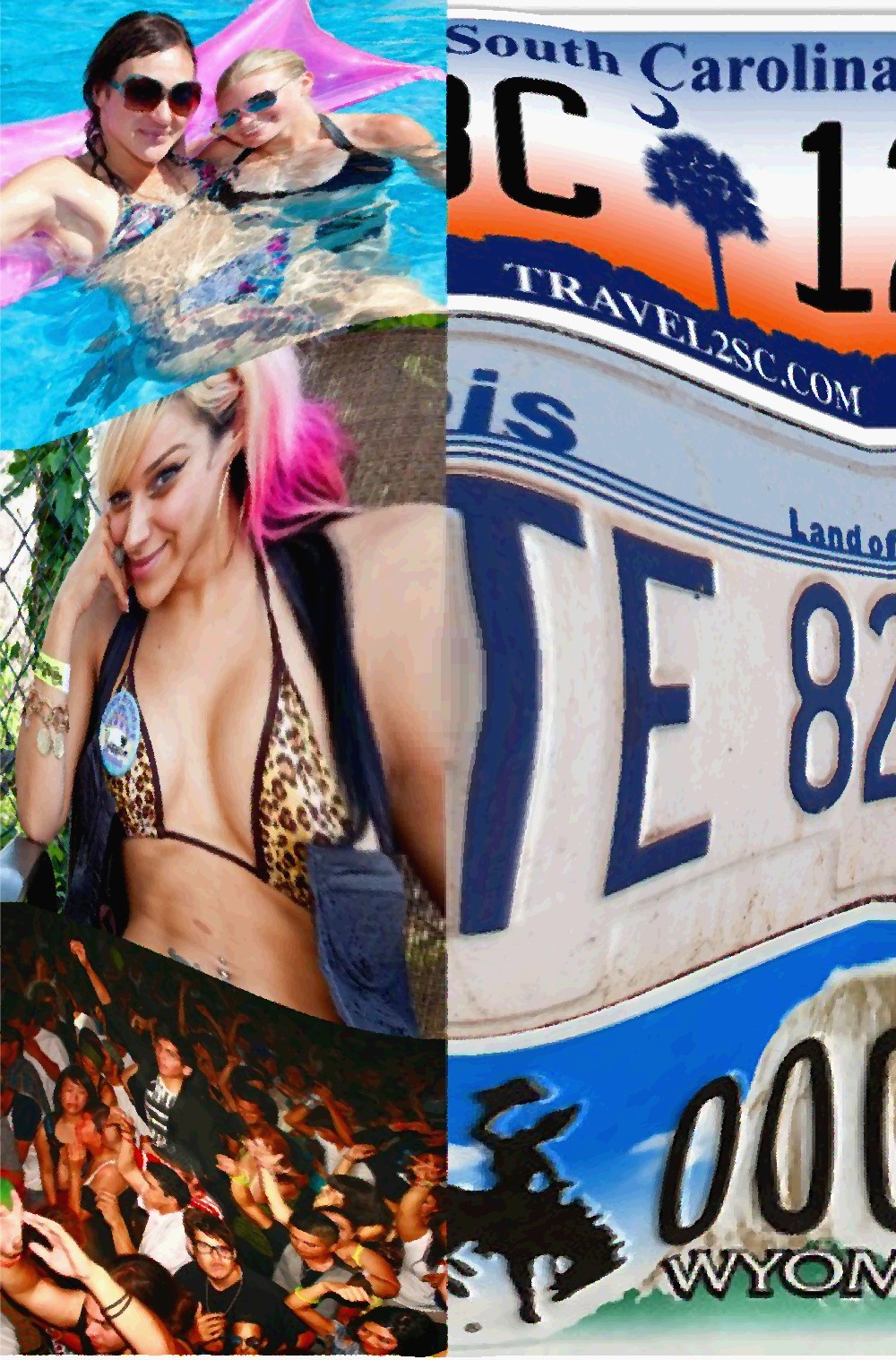
Photo credits : Shannon Cottrell/LA Weekly.  Mosaic: by HIVN.

The other day, emerging into the sunlight, at the LA Fitness parking lot, in Universal City, I was confronted with the painful sight of five cars with out-of-state license plates: Ohio, Wyoming, Virginia, Tennessee and Iowa.

These are the new immigrants to California. They are mostly young, white, tattooed and illiterate, post-collegiate settlers.

I see them hogging up the freeway, and texting while driving. Many of them are sub-intelligent, and speak in grunts and groans: “Yeh” or “Hey” or “What’s up?”

Compared to the well-groomed and nicely mannered young people who immigrated to California 50 years ago, this bunch seems to have no manners.

They are taking some of the best jobs in California and some of the worst ones too.  Real Californians are now almost completely shut out of the job market.  Waiters, receptionists, valet parking, graduate students, personal trainers, bank tellers, retail sales—every once viable occupation is now taken over by people under 25.

Many of these recent immigrants live like pigs. One young woman I met, a native of Massachusetts, kept moldy French fries under her bed for months. She smokes pot and actually made one of her male roommates into her boyfriend.  She has a backyard full of dog shit.  These are the type of people that are now crowding the Golden State.

Their blank faces and gleaming white smiles cannot hide the devious truth that they are almost all out to get married, get rich, get famous and find happiness.  They greedily eye real estate, hoping to buy houses that rightfully should be occupied by real Californians.

And many of these lazy young people sit for hours in coffee bars and cafes, talking about idle gossip, surfing the Internet and sometimes even asking their parents for financial help. Most of them lack health insurance, while many will get sick and then depend on health insurance to pay their medical bills! Others are addicted to such exotic and useless hobbies as video games, yoga, running, drinking liquor, music downloading, and chin-ups.

It’s time that the people of California followed the example of Arizona and made immigration a top priority for law enforcement. The social fabric of our state is decaying, and California will no doubt become just a repository for the young and the useless, the confused and the ambitious, the intelligent and the stupid….in short just a magnet for young Americans who contribute too much and too little to the problems of this state.