Rose Bowl Motel


3170154321_de3a5eb9fc_o

Rose Bowl Motel, originally uploaded by Here in Van Nuys.

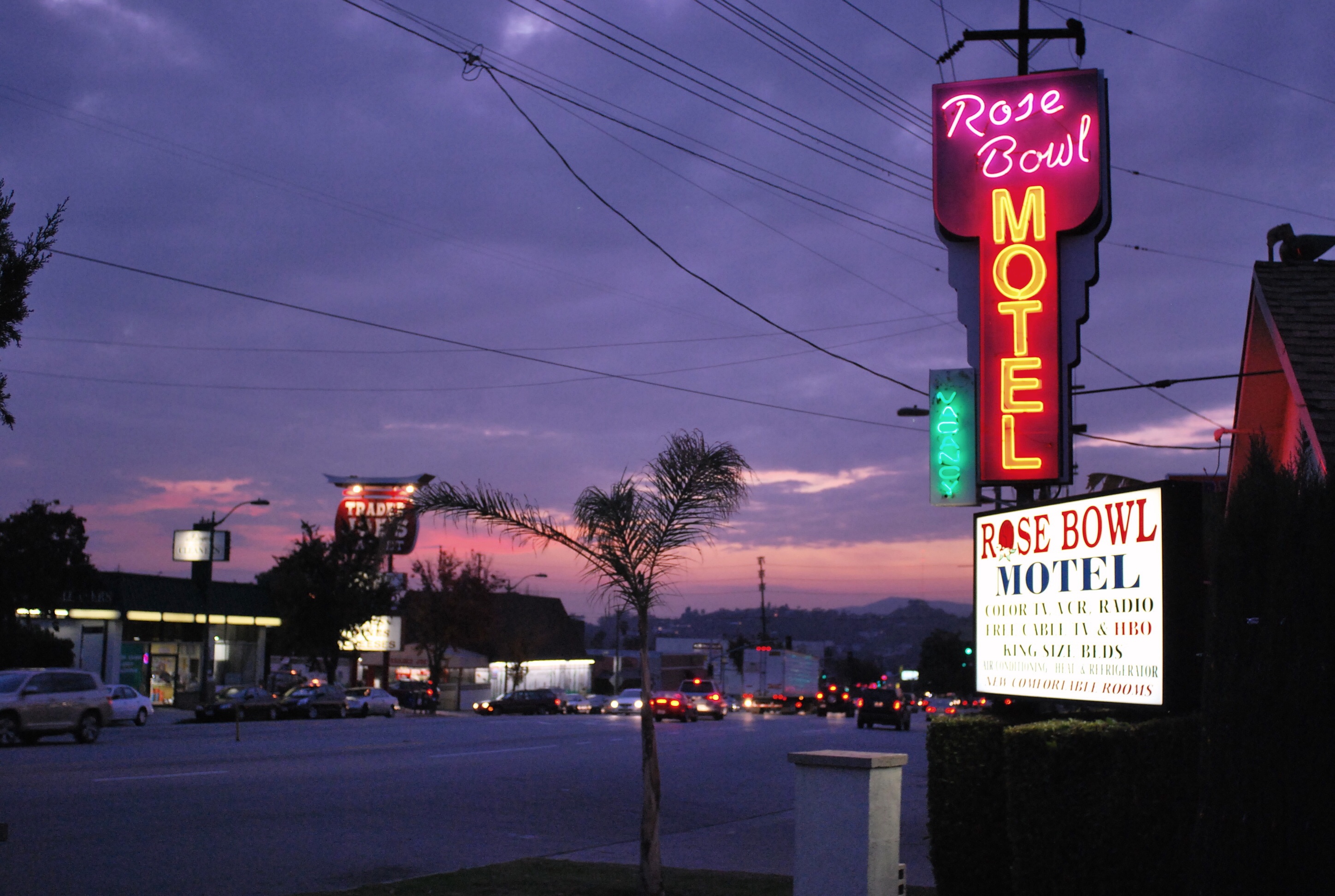
Old California neon sign on Colorado Boulevard in Eagle Rock.

Descent into Tanness.


I am working in Glendale (6 days, weeks, months?) on a “clip” TV show, inside a late 1950’s notable work of red brick architecture that stands at a jaunty angle where it meets Brand Boulevard.

Most weekdays, at lunch, I walk along hazy Brand Boulevard.

Nobody who lives in Los Angeles should be so greedy as to look a pedestrian oriented environment in the mouth, but I cannot help myself. My critical powers sometimes compel me to hate things I should love.  Brand Boulevard is one of these.

Yes, it is remarkably clean. It seems safe, not too dirty, planted with trees and now studded with advanced parking meters that abolished the idiocy of one meter, one car. Like Palin’s Alaskan oil revenues, one communal meter pays for all.

Along the sidewalk, I pass crowds and restaurants filled with very well fed people. Many of them are dressed in tan or black and have stuffed every square inch of their bodies  into tan suits and tan khakis. They pour out of large, horizontal, tan colored, air sealed office buildings and into a tan city where the air is never pristine enough to see a blue sky.  This is a sepia coated city, sitting alongside the glorious Verdugo Mountains, but one is no more aware of the altitude than if they were in Normal, Illinois.

As one proceeds south, there is a sudden artificial mirage, appearing out of nowhere. It is the AMERICANA at Brand!

An antique streetcar carries passengers around a security patrolled outdoor mall. Ornate lampposts, green squares of sod whose lines are still visible and distinct, Santa’s House, and a strange steel structure which looks like a decapitated Eiffel Tower.  These set pieces are arranged, along with Federal style brownstone fronts and Parisian apartment houses. Luxury touches include uniformed valet parking and enormous crystal-type chandeliers hanging above the street.

I wonder what it is like to live in the Americana, for the builder (Caruso) has made it possible to call this ersatz town a home. You cannot smoke or take a photograph if you are a visitor to the Americana. But lets say you are on your balcony, one of the many that overlooks a shopping garden with 24 hour a day piped in music, light shows and dancing fountains: what must it be like to have your private space be so totally appropriated and seized by these theatrical surroundings?

I don’t care to live in Glendale, which is mostly full of well-meaning monotony. But I also wouldn’t want to live in the Americana, a child’s fantasy of what a grown up city might look like.   Both extremes, of dullness and over-stimulation, are critical elements of life in greater Los Angeles.

In Glendale, one descends into tanness and awakens in a musical color-filled daze.

A Park Atop the Hollywood Freeway.


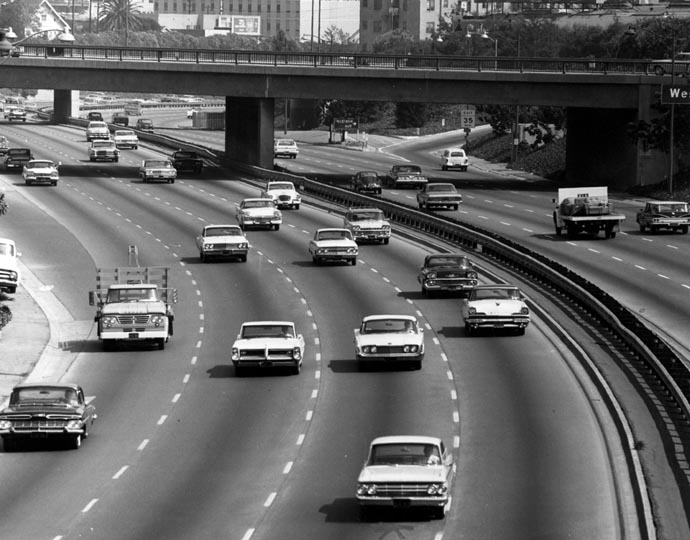
Hollywood Freeway.

In a sign that Los Angeles is becoming a more environmentally sensitive city, a new 44-acre park, to be built atop the Hollywood Freeway, may be started in 2012.  The project, assuming funds are available, may cost $1 billion dollars and bring recreational space to a densely populated and park sparse region of the city.

The LA Times has an article explaining the details. What follows are my opinions:

The building of the Hollywood Freeway in the early 1950’s, sliced right through the residential and commercial heart of the district. It cut off the Franklin Avenue area from the business district along Hollywood Boulevard. It brought noise, pollution, traffic and congestion to one of the most formerly lovely sections of the city.  It hastened the decline of Hollywood, by making the automobile the prime focus of city planning and ignoring pedestrians, public transportation and the pulmonary health of our citizens.

By bringing the freeway underground, Los Angeles will follow the example of other American cities like Boston, whose Big Dig is an attempt to connect the North End back to the rest of Boston and improve the traffic patterns of not only cars, but people on foot.

The Hollywood Freeway should never have been built so ruthlessly. A concrete knife plunged into the heart of a great city will now have some remedial arterial surgery to repair the damage.

Daily News: Homeowners Facing Foreclosure Converge on Van Nuys Seminar.


Desperate Southland homeowner plead case toIndyMac bankers

By Tony Castro, Staff Writer

VAN NUYS – Retired cartoon animator Marcia Munn faces foreclosure on the Northridge home she has owned for 24 years, so three weeks after she voted for Barack Obama, she made a desperate public plea to the president-elect.

“Please help me to keep my home,” she begged in a tearful interview. “Please make these banks realize what is happening. They don’t need to make as much money as they think they need to.”

On Saturday, Munn, 61, was among hundreds of Los Angeles-area financially beleaguered homeowners who packed into Van Nuys City Hall in hopes of having IndyMac Federal Bank modify their mortgage loans to avoid foreclosure.

Munn has been so frustrated dealing with the bank that she hoped the nation’s incoming president would hear the voices of people like herself who face losing their homes because banks won’t modify loan terms.

Like Munn, most of those homeowners, waiting in line with long forlorn looks, said they felt helpless and talked of months of unsuccessful negotiations with bank officials.

IndyMac Federal Bank is the institution controlled by the federal government, which manages the assets and liabilities of the failed IndyMac Bank.

IndyMac spokesman Evan Wagner said the more than 400 customers who had signed in by early afternoon would be processed to see if they qualify for loan modifications.

By early afternoon, some homeowners who were just then arriving left when they saw that more thanhalf of those seeking to see bank officials were still waiting in line.

Jesse Perez of Los Angeles said he and his brother, both owners of condominiums they are trying to save from foreclosure, were told by IndyMac representatives to go on the Internet to acquaint themselves with loan modification application procedures.

“They told us we could do this online because they’ve got too many people here today,” Perez said.

The event, billed by the bank as its first “Home Preservation Day,” was organized by the city as part of a campaign to help homeowners struggling to keep their homes amid a financial crisis that has already crippled some banks and makes refinancing and loan modifications more difficult.

“L.A. residents need government and banks to lend a helping hand, not a faulty mortgage, to keep families in their homes and restore the foundation of economic stability,” Mayor Antonio Villaraigosa said in a written statement.

Other events include the opening of foreclosure prevention resource centers around the city to offer counseling and foreclosure clinics, beginning with the first in Van Nuys Dec. 10.

On Saturday, Munn and many others trying to avoid foreclosure expressed concern that the rhetoric of public officials wanting to help them appeared to fall on deaf ears with the banks.

Munn, for instance, has been trying for months to have her loan rate modified from 7 percent down to 6 percent in hopes of reducing a monthly mortgage payment of $3,700 to around $3,000 – an amount she said she could easily make on her fixed income that includes a pension, disability payment and Social Security.

“But the bank refuses to modify the loan,” she said. “From $3,700 down even to $3,200, and I could keep my home.”

tony.castro@dailynews.com (818) 713-3761

Councilman Zine Introduces Motion to Protect School Zones and Sensitive Use Facilities from Intrusive Paparazzi.


FOR IMMEDIATE RELEASE                                                           CONTACT:
Tuesday, November 18, 2008                                                       Jessica Tarman
Communications Director
213-473-7003/213-276-2093
jessica.tarman@lacity.org

Councilman Zine Introduces Motion to Protect School Zones
and Sensitive Use Facilities from Intrusive Paparazzi

(Los Angeles) – On Tuesday, November 18th, Councilman Dennis P. Zine introduced a motion to curtail paparazzi activity in school zones and around medical facilities. After months of fact-finding, legal research, and deliberation, Councilman Zine and the Los Angeles Regional Paparazzi Task Force determined that school access zones and hospitals are some of the most vulnerable locations for public safety to be compromised by the irresponsible actions of the paparazzi.

“School zones and medical facilities are extremely susceptible to the reckless behavior of the paparazzi,” said Councilman Zine. “The paparazzi become a public safety hazard when they block access to critical facilities, speed in these zones, impede traffic flow, violate the privacy of celebrities and their children, and frighten innocent bystanders. I, for one, am not willing to risk public safety for one ‘million dollar’ shot.”

“We support and thank Councilmember Zine for his efforts to protect our members, their families, and the public from predatory paparazzi,” said Pamm Fair, Deputy National Executive Director of the Screen Actors Guild.

The text of the motion reads:
“The actions of overly aggressive paparazzi have grown from being a simple nuisance to posing a serious public safety threat. No where is this more evident than in the City of Los Angeles, the entertainment capital of the world. When swarms of photographers converge on public sidewalks, roadways, and vital facilities such as schools and hospitals, the risk of serious injury or even violence becomes very real. While the First Amendment protections granted to news gatherers must be defended and upheld, the City of Los Angeles must also protect the safety of the general public.

In an effort to find workable solutions to the problems posed by aggressive paparazzi, an informal working group called the Los Angeles Regional Paparazzi Task Force brought together experts from the cities of Los Angeles, Beverly Hills, Calabasas, Malibu, and West Hollywood, along with representatives from the entertainment industry and County and State government offices, for a series of collaborative meetings. One of the group’s key findings was that there are certain sensitive use locations where people have a reasonable expectation of privacy.

Taking advantage of the fact that high-profile individuals must do things like send their children to school, visit hospitals, and go to medical facilities, unscrupulous paparazzi frequently stake out these locations in order to capture the perfect photograph. The ensuing frenzy of photographers crowding building entrances causes severe disruptions to facilities’ normal operations, negatively impacting celebrities and the general public alike. Due to the special public safety interests surrounding our schools, hospitals, and medical facilities, additional regulations are needed to establish appropriate time, place, and manner restrictions for commercial photography around these sensitive use locations.

I THEREFORE MOVE that the Office of the City Attorney be requested to prepare and present to the
Public Safety Committee an ordinance that would prohibit an individual from entering an access zone of a school, hospital, or medical facility with the intent of taking photographs or other visual recordings for a commercial purpose.

I FURTHER MOVE that this prohibition not be applied to the taking of photographs or other visual recordings if such activity is requested or permitted by the school, hospital, or medical facility; if the targeted individual consents to being photographed or recorded; or if such activity is within the lawful duties of a law enforcement official or other government agent.

I FURTHER MOVE that, for the purposes of this ordinance, an “access zone” be defined as any area
within 20 feet of any point of public access to a public or private preschool, elementary school, middle school, junior high school, or high school; or any hospital or medical facility.

I FURTHER MOVE that, for the purposes of this ordinance, “commercial purpose” be defined as the expectation of a sale, financial gain, or other remuneration.”

This motion was referred to the Public Safety Committee where a public hearing will take place. A copy of the motion is available at http://www.lacity.org/cd3.

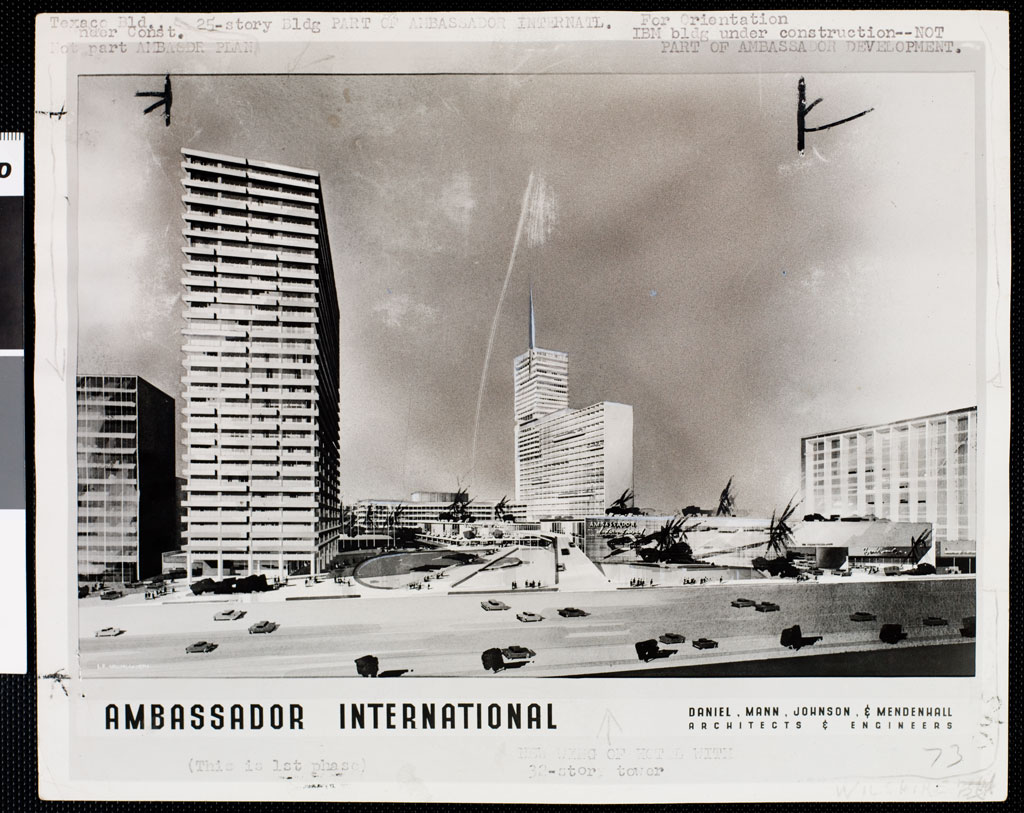
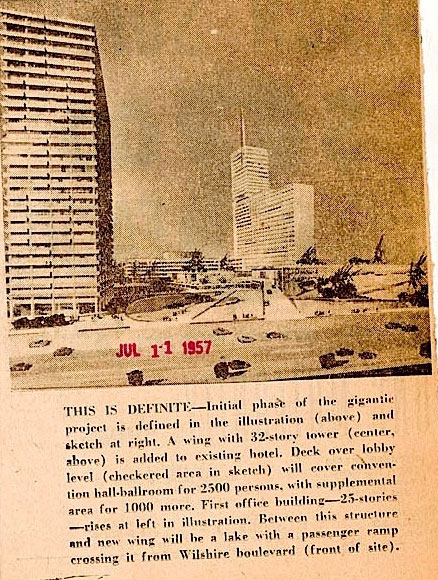
This is Definite.


Last night I attended a discussion about our city at the A + D Museum on Wilshire.

Inside the ground floor of a skyscraper across from LACMA they were serving up white wine, brown beer, little bites of cheese, crackers and lots of talk about where built Los Angeles is headed.

A very new and stylish architecture and urban issues magazine called Next American City had invited a panel which included NAC’s editor in chief Diana Lind, Christopher Hawthorne, architecture critic for the Los Angeles Times and Sam Lubell, editor of The Architect’s Newspaper.

It’s always interesting to come to these events, where we “thinkers” and unemployed artists, writers, architects, urbanists and others bemoan how bad buildings are, and hope that the great black hope will usher in a new era of high speed rail, affordable housing, clean air, farmers markets and dense pockets of multi-family housing surrounding shaded parks where fit children can play under the watchful eyes of nutritionists.

But this is a glum, perhaps even catastrophic moment in our city.  We have to again readapt to the fact that funds will be cut for everything both necessary and needed (police, hospitals, clinics, symphonies, parks, transportation). Every ballot initiative that promises to put into legislative law an inarguable funding forever….. will perhaps be defeated.  We cannot count on anti-gang funding or public transportation money.

Chris Hawthorne of the LA Times spoke about his newspaper’s recent firings of so many smart and productive writers. He recounted his post-collegiate days of wanting to write about architecture, and how in the early 90s, they weren’t building as much, and editors didn’t care, and then all of a sudden there was a great late 90’s boom in design, and he had work.

But now we live in a time when Google threatens to destroy the freedom of press in the US by systematically depriving every single printed magazine and newspaper of advertising.  It is possible that Los Angeles, a city so often derided as “lacking a center”, may become a metropolis of 10 million without a viable newspaper of record. Even the NY Times may go the way of the World Trade Center.

The fact is that Los Angeles will go on and develop in its own unique way. The big money, the kind of Eli Broad money which wants to create “greatness” by developing an institutional downtown, may not see the light of day. We have Disney Hall, but it is surrounded by fetid air, homeless shopping carts, empty sun baked sidewalks and that sound of air slipping out of the speculator’s cash balloon.

The things that make Los Angeles great were here before man arrived: the sunshine, the mountains, the oceans, the Oak trees. We created the freeway, the mini-mall, the bungalow, the drive-in, the studio back lot, and Scientology.  And patted ourselves on the back for our great contributions to the betterment of mankind.

But we also filled the valley with brown and poisoned air, pockmarked the great boulevards with billboards and wooden power lines, tore down historic buildings and homes and replaced good solid garden apartments with dreadfully ornate junk.

What many “love” about LA is purely a natural accident of geography and topography.

One attendee last night was a woman who lives “near the Beverly Center” and stood up to tell the panel and the people in the audience that grotesquely ugly and badly designed buildings were disfiguring the lovely and old character of her area.

And once again, the same old story was told of how we cannot stop development, how this is the way it’s always been done in Los Angeles, and in the unspoken subtext that everybody thinks but cannot say, that the Armenian, Persian, Israeli, Russian go-getters who see opportunity and know how to maneuver in this city, will continue to tear down old and well proportioned things and erect gross edifices that will never find their way into the pages of Dwell Magazine.

We talk lovingly of Neutra, Schindler and the Case Study ranch homes of the post-war era, but the truth is we live mostly in a sea of vast ugliness that covers the land from Palm Springs to the Pacific. We take our little postage stamp house or about- to-be- foreclosed property and sometimes think about the larger city.

But nowadays, we are most focused on our own economic survival and are too busy to notice that a non-profit group is growing vegetables on land near downtown tended by former gang members.

So what? I need money to pay my god damned mortgage and my health insurance costs $400 a month!

The big money goes to Wall Street, and cities like Los Angeles must content themselves with visionary talk and discussions about “the future of the city”.

Imagine if just one billion of the seven hundred billion dollars had been sent to Metro to construct a subway to the sea?