“He cracked open a space where the light could shine through.”


“As the country waited for ballots to be counted, it was Biden — not the occupant of the Oval Office — who was reassuring people that this democracy was intact, that the system was working and that the center would hold. He was the voice of calm optimism in the midst of tumultuous times.

When he became president-elect late Saturday morning, he did something far more herculean than accepting responsibility for a worsening pandemic and a struggling economy. He removed a terrible, suffocating weight from the back of this nation. For the more than 74 million Americans who voted for him — and surely even for some of those who did not — Biden’s election allowed this country to laugh, to dance and to breathe. He cracked open a space where the light could shine through. Indeed, his victory caused people to weep in joyful relief as they became aware of the heaviness that had afflicted their hearts, after they’d suddenly been relieved of it.”-Robin Givhan, Washington Post, Nov. 7, 2020

Mayor Garbageciti’s Los Angeles


Last night we went down to Koreatown and found a cheap, excellent sidewalk café serving fresh dumplings at the corner of 6thand Catalina. Golden Pouch has tables and benches along the sidewalk. You walk up and pay at an Ipad and you sit down and wait for your name to be called. Within 20-25 minutes you are eating delicious, steamed, pork, shrimp, vegetable, chicken or spicy taco dumplings.

And as you sit and wait, or sit and eat, you are accosted by a revolving cast of homeless men who come up to your table, some incoherently, and ask for money, or sit beside you and talk about a conspiracy involving mind control, and you try and shoo them away, but they might stay or they might go and you have no control over your private conversation and your evening out. Some lose their temper, they scream, and you have to endure it.

It was a night when Koreatown was bustling, as usual. You could walk from places serving rolled ice cream, fried chicken, yakatori, oysters, cold noodle soup, a cornucopia of Korean, Japanese; bars, coffee restaurants and cafes.

There was a large amount of younger men and women with middle-aged adults, I assume parents, taking their kids out for an evening, possibly kids newly arrived at college, going to USC or UCLA and persuading their parents to go down to Koreatown, a normal experience for any Angeleno, and probably a treat for mom and dad from suburban Columbus, OH.

Yet, all over, sleeping in tents, along sidewalks, in shopping carts full of belongings, are homeless.

Imagine the impression Los Angeles gives to visitors who see this.

This is just Koreatown. Go downtown and you enter a Twilight Zone of lost people in the thousands sleeping on boxes, untreated, uncared for, defecating and urinating and creating mountains of garbage along streets, under bridges, along the river, everywhere.

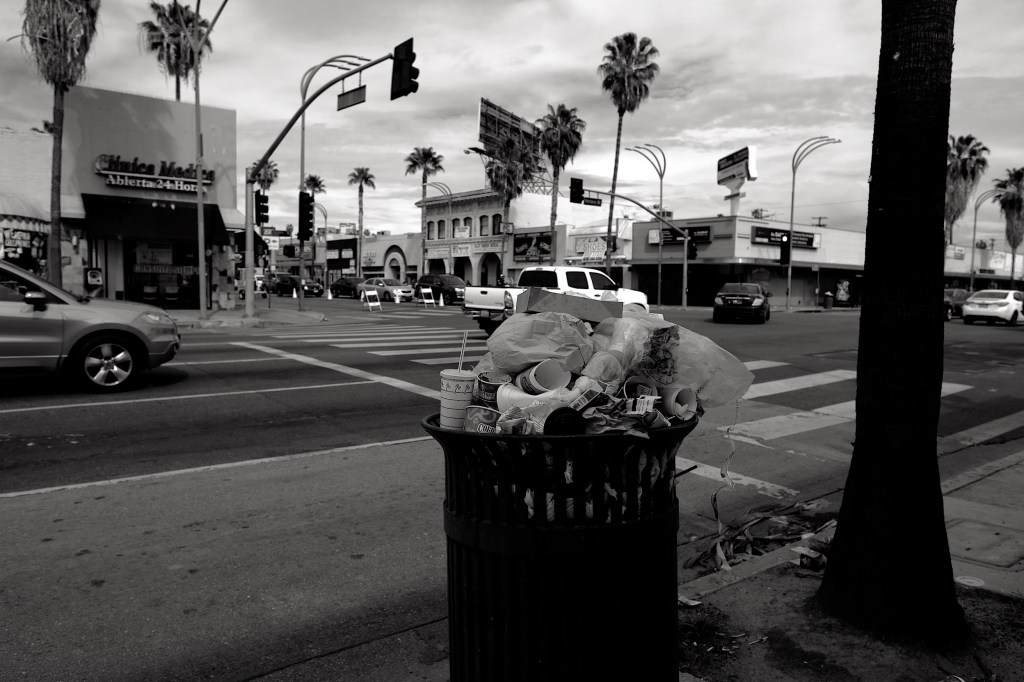
Mayor Garbageciti is more popularly called Mayor Garcetti but he is truly the mayor who has made this city the American capital of garbage. Under his leadership, parks are garbage dumps, prosperous business districts are garbage dumps, everywhere from Woodley Park in Lake Balboa to Pershing Square are garbage dumps.

He is the Mayor who thinks we should increase the incentive to allow street vending too. Decriminalize it.So sidewalks near Westlake are now full of anybody and everybody selling unlicensed anything on the sidewalk. Every alley near the sellers is full of shopping baskets piled high with garbage.

A champion of public transportation, he allows homeless to set up homes on bus benches, causing paying riders inconvenience and discomfort and discouraging and diminishing ridership.

On these days of summer, when the heat is at record setting temperatures and the new humid reality of warmer Pacific Ocean moisture drifts over the city, we must breathe a combination of smog, vomit, dog and human shit, and traipse over streets where the lawful act of walking is less important than unlawful, open air, Calcutta markets.

Nobody is patrolling the streets. Nobody is enforcing the laws. If they are, showing me where it’s working.

Mayor Garbageciti.

There are rumors he is thinking of running for President of the United States.

He can’t do anything about the gross and filthy condition of the city he alleges to represent. Imagine him in office, a cipher hologram of a human, a smiling projection on the wall of an official office, pretending to do progressive things.

Clean up the garbage and the madness in Los Angeles and then you can offer up your national celebrity candidacy.


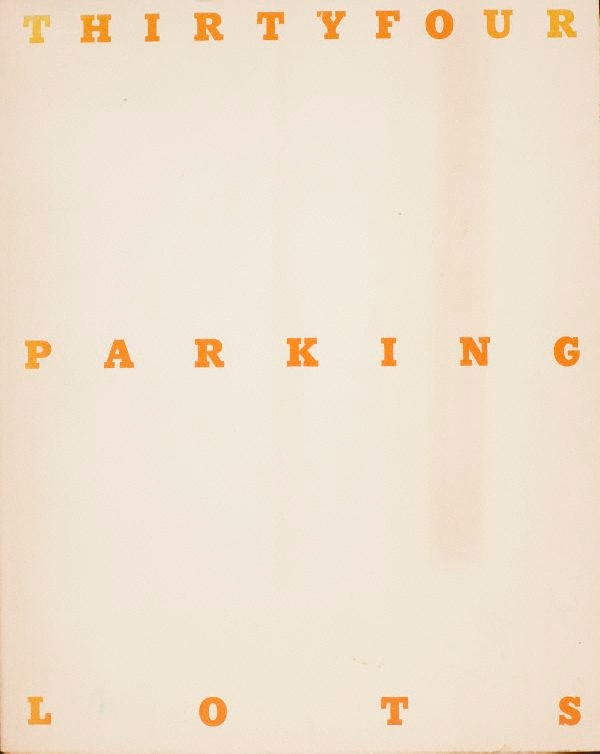
Thirty-Four Parking Lots in Los Angeles (1967)


Thirty-Four Parking Lots in Los Angeles (1967)

I previously wrote about this topic in 2014, but bring it up again as Los Angeles, and the State of California, are now in a furious debate about housing, cars, homelessness and how best to build.

All B&W photographs below are by Ed Ruscha. 


Ed Ruscha’s “Thirty-Four Parking Lots in Los Angeles” was published 51 years ago.

The artist, born in Nebraska in 1937, came to this city in 1956 to study at the Chouinard Art Institute. He also had an apprenticeship in typesetting.

Graduating in 1960, only 23 years old, he started working at an advertising agency doing graphic design. Influenced by the works of Jasper Johns, Robert Rauschenberg, Andy Warhol and Roy Lichtenstein, Ruscha was featured in a 1962 survey called “New Painting of Common Objects.”

That year he published “Twentysix gasoline stations” and later “Every Building on the Sunset Strip.” (1966)

He was the first, or perhaps the most notable artist, to create a deadpan, earnest, unesthetic photography of built Los Angeles. He looked, without pretense, at the sprawling, cheap, roadside city of billboards, car washes, instant apartments and filling stations and wrapped up his black and white photographs into little, smart, best-sellers.

Ruscha was talented and knew how to sell things, always a winning combination in the city of angles. (intentional)

The 1960s was a dirty flood of bitter reckoning that hit America and threw cold water on its made-up, powdered face.

Assassinations, sexual relations, racial issues, drugs, protests, music, environmental desecration, Vietnam: the entire decade blew up a contented self-image.

A nation, which thought itself a beacon of light onto the world, was forced to reconsider its own grotesque violence and misunderstand it.

Confronting Los Angeles, Ruscha presented a homely city with a picture book full of raw honesty.

State Board of Equalization 14601 Sherman Way, Van Nuys, CA.

May Co. 6150 Laurel Cyn NH

Inside “Thirty Four Parking Lots in Los Angeles” are some aerial shots of ordinary Van Nuys, North Hollywood and LA in 1967, with those enormous oceans of parking lots floating boat-like buildings.

Up in an airplane, looking down, Ruscha captured lines and boxes transposed upon the land, asphalt which looked, on its surface, much like the curtain-walled office buildings of that era.

Goodyear Tires 6630 Laurel Cyn NH

Good Year Tires at 6610 Laurel Canyon in North Hollywood occupies only a dot atop a long “I” shaped land-mass of parking.

Dodger Stadium

Dodger Stadium is buried deep within the hot skins of asphalt, a vaginal shaped structure where men played ball.

7101 Sepulveda, Van Nuys, CA.

And 7101 Sepulveda, a now abandoned office tower near Sherman Way, has trailers and motels on its perimeter, as well as plenty of free parking. Today, this area often hosts large encampments of homeless people, so the peripatetic ways of Van Nuys have historical precedent it seems.

Eileen Feather Salon 14425 Sherman Way, Van Nuys, CA.

14425 Sherman Way was called the “Eileen Feather Salon” and has but one long building fronting Sherman Way with parking in back.

Today, that corner is a cacophony of grossness and visual pollution including donuts and Denny’s. Signs are everywhere. And the weary eye becomes nostalgic for the simple joy of a lone building and its parking lot set down on arid land in the once less populated San Fernando Valley.


7128 Van Nuys Bl. 8/5/14

We are now engaged in a great civic debate about housing, and public transportation, and some voices hope (mine included) that denser buildings along bus and train lines will help alleviate high rents and homelessness.

Yet we never quite escape the trap set by the automobile: where to drive it, where to park it, how to best accommodate its needs.

Every single debate about new buildings always begins and ends with parking. Tens of thousands sleep on the street, families cannot afford rents or mortgages, developers are hamstrung providing parking for everyone and their guests, and Los Angeles dies a little each day from auto related illnesses.

Every time we think we are biking or busing more, something sinister comes onto the scene, and we now have 100,000 Ubers and Lyfts clogging the roads, and making our lives more hellish even as we praise their conveniences.

We plan a light rail down Van Nuys Boulevard and the auto dealers like Keyes stop it at Oxnard. They still run things. They destroy the city, and they are congratulated and worshipped for it. Thousands of their new cars are stored at outdoor transit adjacent parking lots built by Metro with taxpayer funds. Ironic.

Every time we imagine we are free of the car, we are forced back into it to chauffeur little white kids to school in better neighborhoods, to commute to $10 an hour jobs, to spend three hours every day in our vehicle so we might live in a house that consumes 50% of our income. Madness.

Ed Ruscha’s simple aerial photographs of parking lots are still a fact-based statement of what this city is. And how we are all swallowed into it.

Goodyear Tires 6630 Laurel Cyn NH

Cinnamon Politics.


Cinnamon Politics

A few months ago, I walked into a Santa Monica dry spice store that my friend and I had dismissed a few years earlier.

It seemed ridiculous to us, that people, in the farm-fresh and organic era, would buy dried spices and spice blends at premium prices, and also waste money inside a store where the edibles sat in glass bottles in the burning Western window sun, becoming milder, less fragrant and more tasteless by the day.

Yet the business lived on, as culinary mediocrity often does in Los Angeles, eventually thriving in its insipid rendition of gourmet flavoring for chef lite hacks.

But then I came back into the spice store a few weeks back. I gave it another try. Maybe I was wrong.

I bought something called Northwoods Spice: salt, black pepper, paprika, thyme, rosemary and garlic, which the company describes as perfect for chicken or fish.

It cost about $13 for seven ounces. And I used it once or twice with no noticeable or discernible improvement in my food. In fact, the food had come out worse with the addition of the Northwoods Spices, giving baked chicken the flavor of something my mom might have cooked in 1975 Lincolnwood, IL served with Uncle Ben’s rice and creamed corn.

Equality’s Front Lines

Today, that company sent out an email with an entirely different agenda. They were giving away either a magnet or a cookbook called LOVE PEOPLE with any $10 purchase.

Penzeys.jpg

Further down the email, the owner and alleged author of the email, Bill, talked up his support for “people on the front lines of the continuing struggle for equality.”

Who, really, are the “people on the front lines of equality?”

To some they are students screaming to take down President Woodrow Wilson’s name at Princeton University. To others, like me, equality is often accomplished in a quiet or modulated voice: teaching, reading, praying, thinking, writing, to postulate ideas and reform minds, and argue, through logic and insight, for the reform of certain societal inequities such as equal pay for women and men.

The mob, screaming and tearing up for You-Tube, is the curse of our time. The Arab Spring, so liberating online, has burned up in the Saharan sands and splattered blood from Jerusalem to Paris to Mali. Millions protest. But not one speaks freely.

But, here in America, The Spice Man speaks freely.

He tied in the struggle for equal rights to the strange events in Ferguson, MO, where, in 2014, Darren Wilson, a police officer, shot to death Michael Brown, a black man who had just robbed a store and roughed up its owner.

A grand jury later decided not to prosecute Officer Wilson. And rioting followed after this legal decision.

So why bring this tragic event into a way of advertising your spices? The killing was an epic event, a turn of racial history, an explosion of anger, an invocation for rioting, an example of passion gone amok. To employ this police/pigmentation tale of violence to market spices reduces its enormity to triviality, and grounds it down into mere cocoa powder.

The seller of garlic powder, turmeric and thyme, whose exposure to worldwide aromatics evidently endows him with insight into all senses of the human condition, then compared police reform to Catholic priesthood reform, linking the two institutions, which have no relation or logical connection, but obsequiously praising The Catholics and The Cops for “coming a long way from protecting their own no matter what, to understanding that not everyone has what it takes to do the job.” Perhaps The Spice Man and his unessential oils belong in the latter category.

A scandal about police brutality, a scandal about child abuse, and now (to my mind) a scandal of a salt salesman using the most controversial and unsettled issues of our time to push his product.

Bill’s presumptuousness, his wise ignorance of imagining that his clientele shares his views on the proper role of police, on racial profiling, on police tactics, on law enforcement-all of it- sickened me because it used sensitive and philosophically critical issues in the service of selling spices.

In this strange marketing email, he also praised the Milwaukee police department for “an incredible forward-thinking outreach to our city’s homeless community.” In old America, before the 1980s, the police arrested people sleeping on the streets, not only because it was illegal, but also because it was unsanitary and unsafe. And gutters, park benches, alleys and dumpsters were deemed not fit for human habitation.

Strangely, there are still people, (like me) who think that there should be a law against allowing people to set up home on the sidewalk. Tolerance of it allows it to grow and become a movement of its own, normalizing the cruelty and barbarism of it, and giving a free pass to liberals to walk from their Range Rover with the handicap sticker on it, right into Studio City Lululemon on Ventura Boulevard, past the old lady who has slept on the metro bench for six months.

So now the police, as cited in Milwaukee, are expected to be the ambassadors of graciousness to the mentally ill, and to people made mentally ill by living outdoors in urban filth.

But back to The Spice Man.

He thinks he knows his customers. He thinks he knows them because sells them political opinions, set out in marketing blasts, better kept to himself.

He ought to make a better product before he jumps ahead to planetary reform.

Spices, kept out for too long, lose their potency, like old bromides.


Young Asia.


Image

They were young when we boarded Singapore Airlines at LAX, bound for Tokyo. 22 men and women, flight attendants, smooth skinned, well mannered, and slim, women with hair pulled back wearing Sarong Kebaya. Graceful, smiling, polite, they maneuvered in and out of the aisles, pushing carts, pouring tea.

The flight left on time and touched down in Tokyo as silently and softly as a Kleenex falling on a pillow.

The airports were dazzling, slick, architectural and inviting: Tokyo Narita, Singapore Changi, and KLIA.  Customs officials in every nation were polite, well-spoken, welcoming. Everything they are not in Los Angeles.

The skyscrapers were young, newly built, tall, dropped into every corner of Kuala Lumpur: Icon Mount Kiara, Charigali Tower, 60 floors tall, St. Regis Hotel, 80 stories tall, Menara Tradewinds, Warisan Merdeka (118 Floors Tall!), KL Tower (Menara Kuala Lumpur) 1,381 feet tall, Ilham Baru Tower (62 floors).  They were clearing out jungles, paving over valleys, erecting vast suburban housing and vertical towers in Cyberjaya, Shah Alam, Bangsar, Petaling Jaya. Soon, a high-speed train will connect Singapore, KL and Bangkok.

The land was young, landfill on the west side of Melaka, thousands of acres of new commercial buildings lined up like soldiers in a future army of retail, uninhabited infants.  Old classical mansions that once stood on the shore were abandoned and empty, their contents stolen, their memories wiped clean.

The KL malls were new, full of shoppers, hordes of black haired boys and girls in bright scarves and long dresses, eyes glued in their smart phones, moving through vast air-conditioned, bright spaces. The Pavilion! KLCC Suria! Star Hill Gallery!

The Malaysian highways were new, and along the new landscaped lanes, billboards shouted advertising with smiling faces, multi-cultural Malay and Chinese faces beaming in Samsung, Jasmine Rice, Panasonic, Thai Airways, Telekom Malaysia, Air Asia, Hyundai.

The Malaysian born bride was young, effervescent, intelligent, ambitious, and well connected. She owned a condo, a house (under remodel) worked for a bank and travelled to Singapore, Bali, Jakarta, Hong Kong, Shanghai, Seoul, and Melbourne. She had a lot of friends, a lot of family, a lot of generosity and much love around her. She was the future, for just this moment, of a region where education and money are exploding exponentially.

And the trains in Tokyo, the intersections of Shibuya, Shimokitazawa, Ginza, Shinjuku, they were young, overwhelmingly so, populated with hundreds of thousands of post 1985 human beings pouring off the modern perfectly run trains, into stores and shops and cafes, hurrying everywhere, acquiring purses, shoes, makeup, perfume, suits, electronics.

Inside the endless shops of Tokyo Station, the bowing and the smiling, the serving and the selling, a furious, unabated, exhausting and exhilarating controlled carnival of commerce, this was Japan.

And everywhere, in every corner, the spirit, the energy, the optimism, the faith in tomorrow and the future, a region poised to take over the world, relentless in its work, socialized to harmonize, grouped en masse into money-making and modernism, this was young Asia.

I went here on holiday, for three weeks, to attend a wedding in Kuala Lumpur, to vacation in Phuket, Thailand and stop off in Tokyo for four days.

I came back to Los Angeles in culture shock. For what I saw back there made the Golden State seem dyspeptic, backward, self-congratulatory– without merit.  Our new international airport had dirty windows; the customs people were fat and shouted angrily at passport holders. The bus was late and the driver made jokes (“This bus isn’t going to Van Nuys. Long Beach! Just kidding!”) that delayed our trip.

And the news was that the government was shut down. I thought of that on the 405 bus ride home, having just seen, 10 hours earlier, postal workers at work at Tokyo Station, on Sunday afternoon.

America is no longer young, in outlook or output, and I wonder if we even have any dreams left in our national imagination.

Cindy vs. Nuri


On Tuesday, July 23rd, two women, Cindy Montanez and Nuri Martinez, will face off in a special election to decide the next leader of LA’s 6th District which includes Van Nuys, Arleta and Sun Valley.

After a dozen non-productive and self-destructive years of Councilman Tony Cardenas, the district is still one of the least appealing areas of the San Fernando Valley. Downtown Van Nuys is dying, its post office closed, its shops vacant. The Van Nuys Neighborhood Council is a long-running joke, producing theatrics and anger instead of cleaning up the streets.

Why Van Nuys should continue to suffer is one of the strange mysteries of our city.

It is centrally located, adjacent to North Hollywood and Sherman Oaks, an easy commute to Woodland Hills, Studio City and Hollywood. It is served by buses and three freeways, so it certainly does not lack transportation. On many streets there are stunningly beautiful homes often used for filming movies and commercials.

The downfall of Van Nuys, which was established in 1911, began after WII when regional shopping centers replaced mom and pop stores. The widening of Van Nuys Boulevard and Victory, the elimination of diagonal parking, the ripping down of old houses to make way for large government buildings, the influx of immigrants who were poorer and less educated, the slumlords who bought up apartments and let them decay, the emptying out of legitimate business to make way for pot shops, massage parlors and bail bonds, all of these contributed to the El Crappo aura. And basically El Crappo is all one sees driving along Van Nuys Boulevard.

Whomever wins on Tuesday, Ms. Montanez or Ms. Martinez, both ladies (I like that word) will have to dig in her heels and bring shovel-ready action to Van Nuys, and concentrate with all her might in rebuilding a civilized and thriving district that is no longer the laughing stock of Los Angeles.