Some Upcoming Ballot Initiatives


Here is a rundown of some upcoming ballot initiatives Los Angeles voters will decide in 2020.

Red Light Running: Inconvenient but let’s not shame red light runners.

MEASURE RLR

In recent years there has been an epidemic of red light running in Los Angeles. 

To understand the problem, which is not solvable by law enforcement or red light shaming, a $6 million study was conducted by the California Therapists Union (CTU) to try and understand the emotional reasons behind running red lights.

A shocking 88% of red light running drivers were found by CTU to have personal worries. Some were stressed at work, others were unemployed, many were anxious about historical events and current debt. Family problems including abandonment by parents and helicopter parenting were also cited.

A new ballot measure, which will tax red citrus fruits with a 1% per pound fee, will help pay for a new 100 person therapy unit of the LAPD to meet with drivers who found, through no fault of their own, that they drove through red lights. $40 million is expected to be raised by the tax.

Mayor Garcetti and the CTU both strongly support this.

A Treeless Pacoima Home, through no fault of its owners.

MEASURE TREE EE

It is no secret that there is a great inequality between citizens in the amount of trees on private property. In one area of Sherman Oaks, wealthy homeowners have, on average, 18 trees, even with only one or two residents on a property. In a more just and fair nation this arboreal injustice would be intolerable!

In Pacoima, many homes have one or two trees and their front lawns are covered in asphalt. And one tree sometimes must often work overtime, day and night, to shade 8-16 people living in a house. It is unfair, that simply because of wealth, some homes are more shaded than others.

Measure TREE EE will tax each tree $100 on properties over $1,200,000 in value, to go into a general fund that will finance whatever the city needs from social services to street art.

Silent Meow No More!

MEASURE LGBTPET

Queer pets, including dogs, cats, and goldfish have been widely ignored until now, after a $10 million dollar Bill and Melinda Gates Foundation study found high rates of depression and early death in pets whose sexuality was unacknowledged by humans and other animals.

Depressed gay cats, for example, are often seen alone, on window sills, sleeping on sofas, hiding from their owners, and exhibiting symptoms of repressed anger, hissing and clawing. Yet socializing these cats, with other cats of their declawed gender, showed promising improvements.

Gay or bi-sexual goldfish, shockingly, suffer most from sexuality issues, and many live less than five years in an environment of drowning purposelessness and tabletop ennui.

A Life With Purpose Thanks to LGBTPET.

A $2.00 a gallon tax on orange soda will help pay for 100, on call psychiatric veterinarians to visit homes of distressed animals. LGBTPET will raise some $75 million and help support all mental health programs for non-human Angelenos.

Valley Feed and Fuel


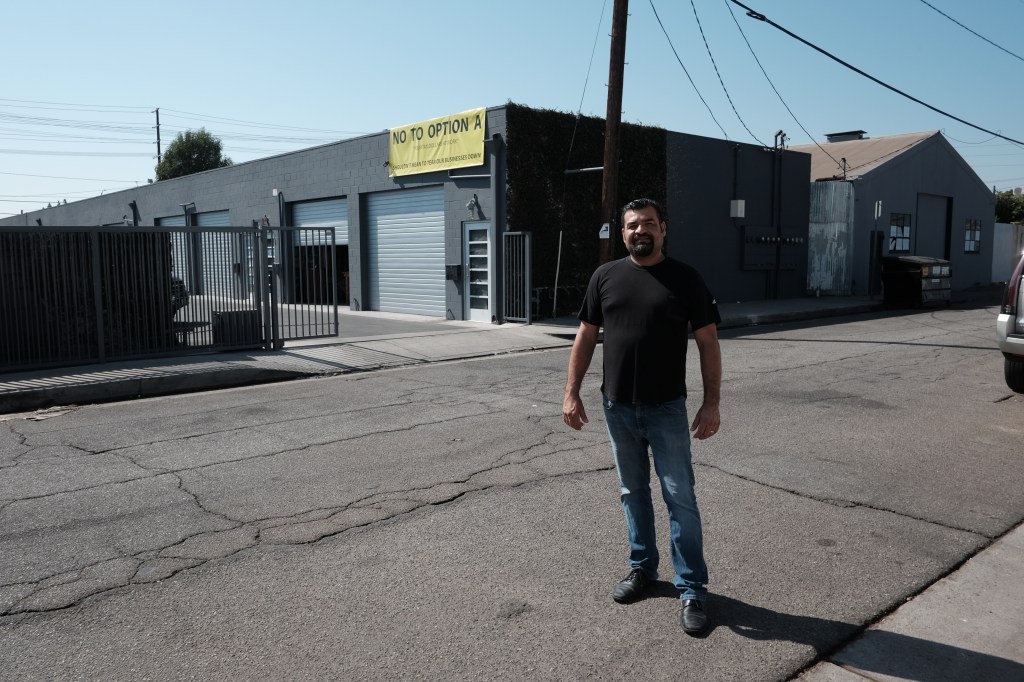
14551 Bessemer St. (Photo by Andrew B. Hurvitz)
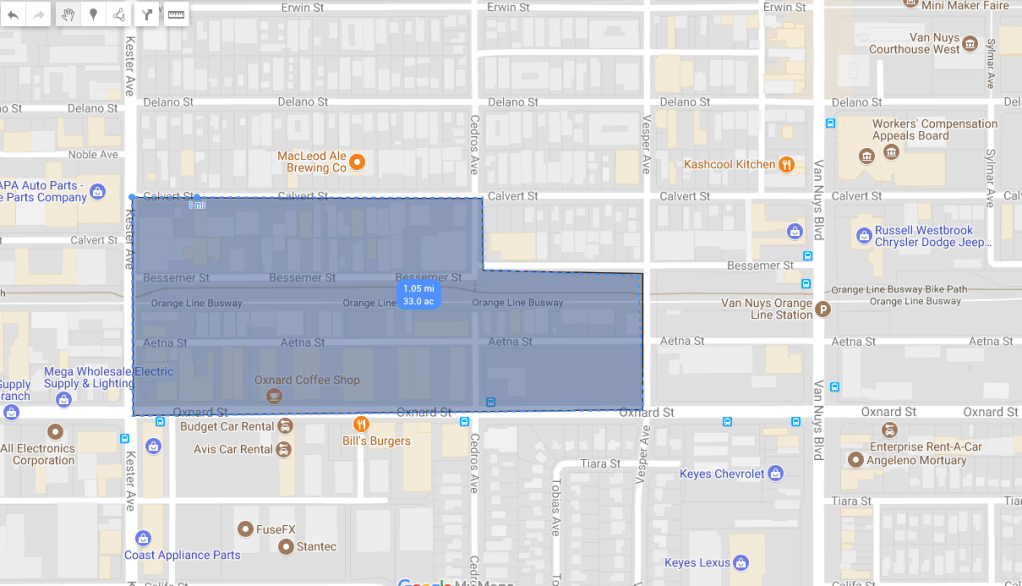
Map 14551 Bessemer

On the NE corner of Bessemer and Vesper, here in Van Nuys, there is a steel walled storage warehouse with three pitched roofs.

Unmarked with any signs, it seems to have been there many years, and is characteristic of structures that once stood alongside rail lines to receive and to send out produce, grains, and manufactured products to faraway markets.

I dug up information from the city and found that “14551 Bessemer St.” was built in 1922, at a cost of $4,000, for the Fernando Feed and Fuel Co. It stood alongside the freight lines and was serviced by a dedicated Southern Pacific rail spur that went right into the property.

6/22/1922: 14551 Bessemer St. Van Nuys, CA Dept of Buildings Application

By 1925, chicken ranches were a big business in the San Fernando Valley, with an estimated 1,000,000 laying hens in the valley producing some 12 million eggs at a gross return of $5 million dollars. (In 2019 dollars, about $72 million.)

A 1925 LA Times article said that the Fernando Feed and Fuel Company started in 1916 as a feed store, but grew, in nine years, to 1,500 customers, large and small. Several other facilities for warehouse storage were located in Owensmouth and Van Nuys with a crew of 45 men and 15 trucks delivering feed and other orders to customers.

Chicken ranches, on one, two or five acres were a type of housing development that sprung up all around Southern California. They allowed families to feed themselves and also make a living selling chickens and eggs. At that time, other orchards grew oranges, walnuts, lemons, avocados, asparagus, and strawberries. 

A 1916 LA Times article praised “rose lined Sherman Way” (later renamed VNB) and the white feathered leghorns that dotted recently established (1911) Van Nuys.

“White Feathered Leghorn” Chicken. (source unknown)

Scientific work to bolster the agriculture industry and  promote poultry farming was often shown. 

In 1920, a four-day poultry institute was given at Van Nuys High School, by Prof. Dougherty, head of the poultry division, college of agriculture at U of CA, under the auspices of the LA County Farm Bureau and the Van Nuys Poultry Association.  A vaccination to fight chicken-pox was demonstrated there. 

Entrepreneurs and peripatetic innovators flocked to Van Nuys to raise chickens in advanced ways.

At a five-acre ranch on Woodman Avenue, in 1925, a recently transplanted Englishman, JCF Knapp, who had run plantations in Sumatra and India, had finally realized his lifelong dream to become a poultry farmer in Van Nuys. His operation had the capacity for 4000 chicks, and Mr. Knapp confidently asserted that he had not only a successful business model but a new kind of assembly line efficiency [for producing Grade A chickens on the scale of Model A’s.]

Also in 1925, WW Todd Realty Co. reported that a new set of chicken farms, totaling five acres, were to be built on Ranchito Av. near Tulare St. in Van Nuys. Some 100,000 laying Leghorn hens were expected to arrive in the valley within six months. 

[Ranchito Av., for the geographically ignorant, runs parallel to Woodman and Hazeltine, halfway between both. I found no modern maps with a Tulare St. however]

A 1920s aerial photograph of downtown Van Nuys shows the Fernando Feed and Fuel storage warehouse and the combination of commercial buildings along “Sherman Way” (renamed in 1926 Van Nuys Bl.) and orchards that were planted right inside the middle of town. VNHS is in the upper center/right of the photo. (below)

Van Nuys Feed and Fuel 1925, view NW

The chicken farms of the 1920s, which boosters never stopped boosting, gradually died out when the Great Depression hit after 1930 and sank agricultural prices.  By the late 1930s, suburban development came to the San Fernando Valley, and during the war (1941-45), industrial and defense plants, soldiers, military hospitals and the urgencies of war supplanted the rural way of life raising chickens. 

After 1945, the San Fernando Valley was the fastest growing place in the world, and every acre of land was transformed by housing developments, shopping centers, and car centered designs. 

The chicken farm, with its odors and mosquitos was now a menace, and housewives in Reseda were scared to let their children play outside.

Lost in the stories about the chicken farms is an old America that valued challenges and thought itself capable of surmounting them.  Poor, barely educated and hard-working people came here and somehow transformed Los Angeles into an advanced city that also grew its own food and sold off the surplus to an amazed and grateful nation.

Van Nuys, once a proud and admired center of advanced agricultural innovations, committed civic suicide. It destroyed its downtown by ripping up diagonal parking, widening the road to freeway widths, removing the streetcar, tearing down old buildings and replacing them with empty plazas and zombie moonscapes of trash and concrete. It embarked upon decades of laying down asphalt and laying out the red carpet for criminals, malcontents and derelicts.

Porn, marijuana, prostitution, bail bonds and slumlords were the largest industries by year 2000. Hopelessness replaced optimism and dystopia seized this district like an incurable disease. 

And politicians were thought worthy, not for their works, but only if their last names ended in the letters S or Z.

At least we have the Internet to thank for a glimmer of what it once was.

Van Nuys: City of Parking Lots


Between Oxnard and Vanowen, on either side of Van Nuys Bl. fully 75% of the land is taken up, not by buildings, but parking lots.

Near Oxnard, on both sides of the Busway, parking lots are used mostly for storage of unsold, new cars from nearby Keyes dealerships.

Along the civic center, there are enormously underused concrete parking lots, several stories high, built in the 1960s.

Civic Center Parking

Moving north, beyond Vanowen, near Kittridge, there are wide open parking lots behind shuttered businesses where perhaps 25% of the spaces available are used for cars.

Think about these parking lots when people complain that Van Nuys is too crowded, that we don’t have room for more apartments, that we don’t have space to house homeless persons, that we cannot find room for parks, that we simply don’t have land for urban gardens or nature spaces.

Think about these parking lots, see them in your head, when people complain that there is nowhere to park, that we spend too much time in traffic, that our air quality is low, that we are baking in a hot area where there are not enough trees even as the Earth warms.

Our Lost Vitality


Sepulveda and Erwin, Van Nuys, CA.

Housing, it seems, is everything these days, the foremost topic on the minds of Angelenos. 

Those who can afford it fear those who cannot.

Fearsome, it seems, is our ragtag army of many thousands of un-housed vagrants who have established anti-communities out of shopping carts and tents, and made bedrooms, bathrooms and living rooms out of bus benches, trains, bridge underpasses and alongside our freeways. Covered in dirt and tortured by circumstance, pulling three bikes with two legs, they remind our fortunate ones that life often goes bad even for the good.

3/5/18 Bessemer at Cedros.

SB50, the state proposed override of single family zoning, struck terror into the hearts of many in Los Angeles who feared that the single family home, housing twelve unrelated people, might soon be replaced by twelve unrelated people in four houses on one lot.   

“Leave it to Beaver” (circa 1959) the imaginary ideal of Los Angeles.

“Leave it to Beaver”, “Dennis the Menace”, “Hazel” and the rest of the 1950s and 60s back lots of Columbia and Warner Brothers are how many, now aging, but still ruling this city, think of Los Angeles, and how it should look. 

When Dennis the Menance came home he didn’t enter into a lobby with an elevator. When Dr. Bellows drove up Major Nelson’s street, it was clean, tidy and sunny. 

Home of Major Anthony Nelson, “I Dream of Jeannie” (1965-70)
The cast and crew of the remodeled “Brady Bunch” home in Studio City, CA. (HGTV)

HGTV is now remodeling the real life home in Studio City that was used as the location for Mike and Carol Brady and their bunch, recreating in reality a 1970s home, inside and out, following an architectural blueprint from the set pieces of an inane, 50-year-old television show that seemed saccharine the night it premiered in 1969.

It is heartwarmingly creepy to see the now white-haired kids throw a football in an astroturf backyard, retirees feigning juvenile excitement as a synthetic reality show impersonates their old sit-com and pumps new advertising blood out of Geritolized veins.

____________________________________________________________________________

Woodley Park, 2018.

But life is not a syndicated sitcom. What’s on TV is not what’s beyond our windshield.

We live in Los Angeles, and die a bit here, day by day. The city is getting worse in every imaginable way: housing, health, transportation, taxes and education.

Homeless on Aetna St. Feb. 2016

On the roads, in real life, in 2019, cars are now parked and packed alongside every obscure street because it takes four working, driving adults to afford one $3,200 a month apartment.

Building more apartments doesn’t mean more cars, it simply means less apartments. And less apartments means more rent, so Los Angeles keeps eating itself up in contradictions of cowardice and myopia.

__________________________________

Japan

As I travel around Los Angeles and see all the enormous parking lots and one-story buildings alongside eight lane wide roads, I wonder why we are so unable to build enough houses to house everyone.

California is not nearly as crowded as Japan, yet that country ingeniously designs small dwellings that artistically and creatively provide homes for every type of person.

On the website Architizer, I found the work of a firm called Atelier TEKUTO.

Homes shown on Architizer by Atelier Tekuto are really tiny, but they are built solid, with each dwelling quite individual in style and form, an irony in a country where every black haired man coming from work is dressed in a white shirt and dark suit.

But Japan somehow pulls together the artistic and the structural to provide enviable and well-designed homes in well-protected, spotless communities. Violence is rare, except yesterday, but nobody goes out at night fearing random mass shootings, it is safe to say.

We can’t, or should not, want to remake the depravity of our dirty, violent LA into clean, peaceful, obedient Japan, with its fast trains and scrubbed sidewalks, but we might borrow some of their ideas. After all, we conquered them in 1945, can’t we take home some intellectual souvenirs?

Imagine if Van Nuys took the courageous and innovative step to redo the large, unused parking lots behind all the abandoned shops on Van Nuys Boulevard with a mix of little houses like these and perhaps some larger structures several stories high?

What we have now is this:

Don’t we have a Christopher Hawthorne now, Chief Design Officer, working under Mayor Gar[BAGE]cetti? Former architecture critic at the LA Times, he may know one or two architects from his old job. Perhaps Mr. Hawthorne can take action?

What have we got to lose? 

We are so far down in quality of life that we must engage our energies to pursue a remade Los Angeles.

A city that does not harm us but lifts us up.

As Japan shows, you can have enlightened ideas without living alongside mounds of trash and outdoor vagrancy.

There is no logical connection between toleration of outdoor garbage dumps and political tolerance in general. In fact the worse our surroundings get, the more people will turn right and maybe even hard right.

I Don’t Care About Your Identity….


Woodley Park.

May 13, 2019

Someone recently was very excited because there is a new slate of young, female, diverse people who are running for the Van Nuys Neighborhood Council. She is one of the contestants and wanted some input on what I thought about the VNNC.

I rolled my eyes. Nothing good has ever, ever come out of the Van Nuys Neighborhood Council, and if you don’t believe me, take a walk up Van Nuys Boulevard today and see the boarded up shops, the homeless, the filth and the neglect.

Maybe I should expand that to the office of Nury Martinez, a city councilwoman who has been in that job for some five years and has presided over the further decline and frightening expansion of homelessness that plagues our city and our district in particular.

Often young aspirants seeking election will roll out first, those labels which they think matter. You are queer, you are a woman, you came from Honduras. And you are under 30. That last designation is the most important because you have “fresh ideas”, ideas which only those people born after 1989 have thought of.  And you care, you really care about this community because you are queer, you are woman and you came from Honduras.

And you are also against: exploitation, triggering, cruelty, bigotry, and policies that discriminate against homelessness, against the undocumented, and against those who have been convicted of crimes and are unjustly punished.

Fine. All fine. All open for debate, though you may not ever agree to debate these issues because you are right and I should know you are right.

But I have one thing to say to you, candidate for political office: I don’t care about your identity.

I know you are angry because growing up you wanted role models and when you looked on TV or in the movies you were given maids and gang-bangers instead of entrepreneurs and philosophers. Pity. You didn’t model yourself after Marsha Brady or Samantha Stephens so you went into a tailspin.

Your identity is your fortress, your crowing achievement, because, after all, you’ve worked hard to acquire that DNA.

But running on a platform of DNA, gender, or preference labels doesn’t stop crime, bad schools, illegal dumping, trash camping, random violence.

The Cuban-American dad who lives with his daughter near Burbank and Kester takes his Sunday morning off to ride bikes with his daughter through a trash-filled bike path along the Orange Line. Does he care if the representative who neglects this park is Latina? No, he cares if the park is clean and safe.

The Guatemalan born, American history professor who takes the bus from Van Nuys to teach at CSUN stands at a bus shelter where a homeless person has placed six shopping carts and has made a home there for three months.

The lesbian mom from Mexico who lives on Vanowen with three school age children still has to drive them from her bad school district to a better one five miles away and she helps, unwittingly, to contribute to traffic and school segregation. Would it matter if she were Irish-American, born in Indianapolis and married to a man?  

The broadcasting of identities is like a theater of the absurd because it presents a chimera, an illusion of a person who comes into the public realm advertising her external labels instead of presenting her internal ideas.

I’m reminded me of Jussie Smollet’s words after creating his hoax, he used his “gay, black” identities to hide the true nature of his fabrications. By trotting out the ingredients on his label he sought the mantle of believability and righteousness. But the content of his true character remains.

I don’t care about your identity. I care about facts, about telling the truth, about pursuing equal justice under the law. And that applies to aspirants for political office as well.

The two little boys, Diego, 5, and Eddie, 7, who live on Delano, whose grandparents emigrated from El Salvador, cannot ride their bikes down to Bessemer, two blocks away, because 20 homeless people, some drug addicts, some mentally ill, live on the street there. 

If Diego and Eddie were named Diego and Eddie Moskowitz and they couldn’t ride their bikes in their own neighborhood would their ethnic identities matter more?

I don’t care about your identity.  Nury Martinez has a great duo of identities: female and Latina and really, truly, what does that matter for the well-being of Van Nuys?

Being a Latina, doesn’t make you a more effective thinker, leader, community organizer any more than being a Canadian from Haiti does.

Your identity won’t bring in new investment, it won’t appeal to developers, it won’t clean up the streets, it won’t lessen traffic, it won’t purify the air, it won’t make food healthier. 

Van Nuys needs a dose of old fashioned law and order and political and police muscle to let the law-abiding citizens of this district know that we will not fall apart and disintegrate into factions of identities who then will be unable to come together to work as a community to fight our common problems. 

Clearing Up a Photo Mystery


I found a DWP  Collection photo from the 1920s that shows the Van Nuys office of “Wagner-Thoreson Co.” (a realty company) and a nattily attired man standing in front. 

In the background is an estate on a large piece of land. A signpost reads: “Sherman Way” and “Lane St.” The photo had some information underneath which said “Lane St. was later renamed Califa St.” 

Where exactly was this? 

On Google Maps there is not a “5856 Sherman Way.” I thought the signpost might be blocking a number “1” so I inputted “15856 Sherman Way” but that address, in present day Valley Glen, was not at an intersection.  Califa and Sherman Way do not intersect either.

The 1926 San Fernando City Directory listed “Wagner-Thoreson Co.” at 5856 Van Nuys Bl. (at Califa). Not “5856 Sherman Way.”

Then I remembered something. 

Sherman Way was once the route of the Pacific Electric streetcar. The PE snaked its way up through the Cahuenga Pass into North Hollywood, then west down Chandler Blvd. It turned north up Van Nuys Blvd. and then travelled to go west on Sherman Way.

But Chandler Blvd. and Van Nuys Blvd. did not exist in name until 1926. From 1911 until 1926 Chandler, Van Nuys and Sherman Way were all named: South Sherman Way, North Sherman Way and Sherman Way!

On May 25, 1926, the Los Angeles City Council, with some infighting between San Fernando Valley residents, came to a compromise and agreed to partition the Sherman Way family into three distinct names: Chandler, VNB and Sherman Way.  


So the man in the mystery photo is standing on present day Van Nuys Blvd. at Califa, a block south of Oxnard.

Van Nuys Bl. 1930

Pacific Electric service lasted until December 29, 1952. 

Cahuenga Pass 12/29/52
N. Hollywood, CA. 12/29/52
Chandler Bl. 12/29/52

These sad and wondrous Kodachrome photos from the collection of Caesar “CJ” Milch (not the original photographer) show the #5146 car that once ran up through the Cahuenga Pass and into the eastern San Fernando Valley on its last day.