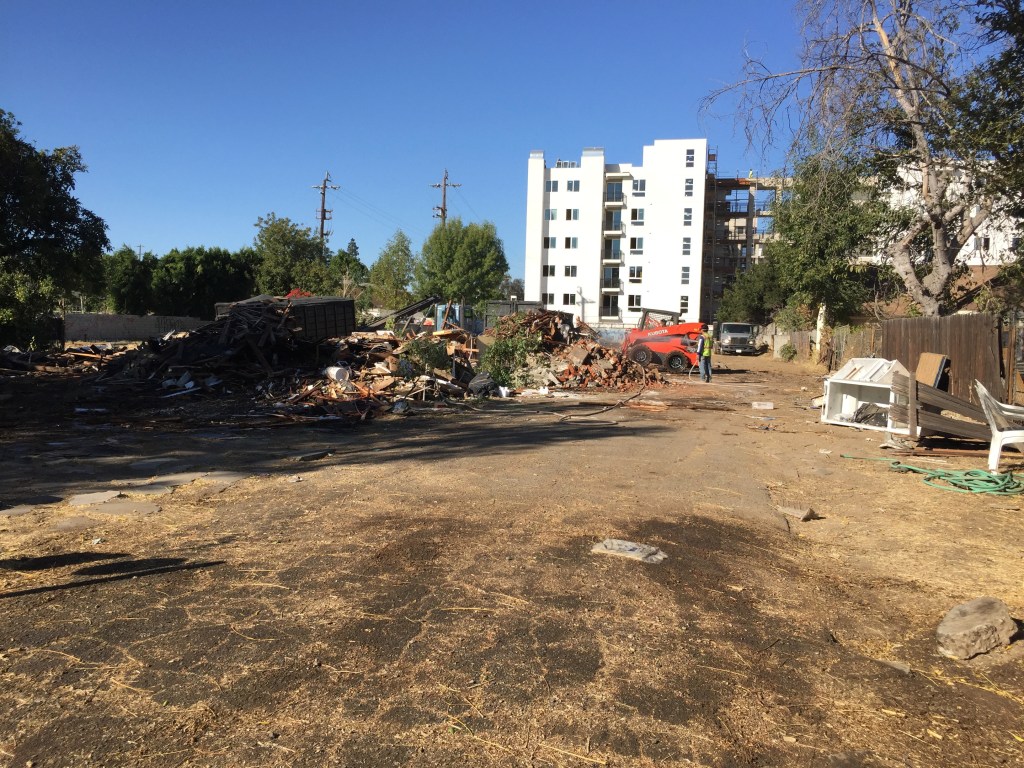
They have almost completely cleared the 27, 762 SF lot that is 6505 Columbus.
The property once held a single family house, constructed in 1937.
One of the owners was a production manager and second unit director, Cliff Broughton, Sr.
On November 14, 1949, Mr. Broughton’s son, Cliff Jr. was piloting the 136- foot-long schooner Enchantress, along with 14 passengers, from Newport Beach, CA to Panama, and later Tahiti, when it ran aground in a sandbar off the coast of Baja California. The boat was eventually freed and everyone survived.
The senior Mr. Broughton put 6505 Columbus up for sale in 1950. Perhaps the yacht drama had distressed him.
In an LA Times classified ad from January 15, 1950, 6505 Columbus was called “Rancho Perfecto.” The one acre estate with 6 rooms, included a guest house, rumpus room, laundry house, tool house, double garage with storage closets, patio, and a lighted badminton court. There were also “plenty of shade and fruit trees.”
They were asking $22,500.
For many years 6505 was part of six other large, underdeveloped and underprivileged properties on the west side of Columbus from Hamlin to Kittridge. In a previous post this area was described accurately as I saw it.
Now they are almost done clearing the house and flattening the land where some four homes will sit between two roads, Hamlin and a TBD.
A large apartment building will be the backdrop for the next 100 years of drama at 6505 Columbus.
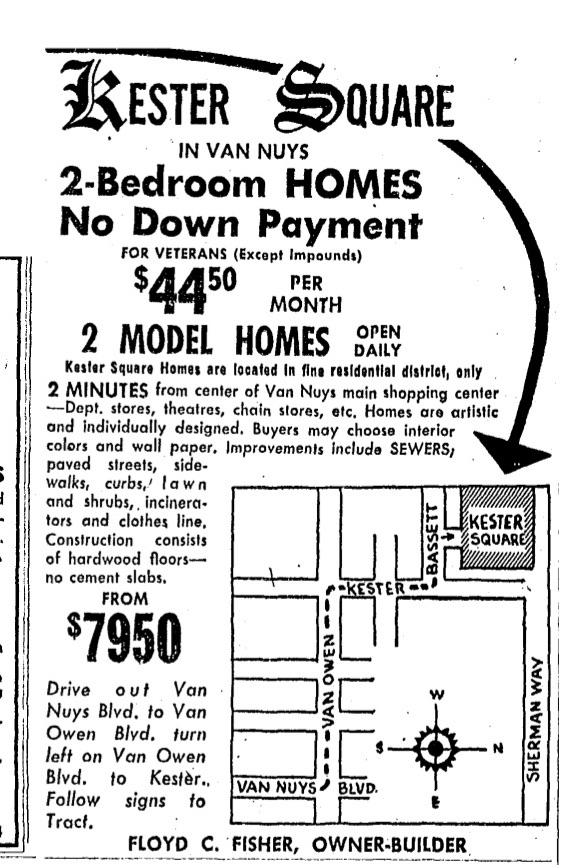
With no down payment, for $44.50 a month, you could buy a brand new, 2 bedroom, 1 bath home in Van Nuys in 1950 starting at $7,950.00 ($83,033.63 today).
Kester Square, a little pocket of 37 new single-family residences, was quickly erected in a few months and planted on old farmland just steps from Kester and Vanowen.
The San Fernando Valley was booming five years after the end of WWII and every smoking factory, every plan to build thousands of little houses on every square inch of land, and the daily, hourly pouring down of asphalt over millions of bulldozed walnut and orange groves was a continual occasion for rejoicing.
In Kester Square, new sewers, paved streets, sidewalks, curbs, lawns and shrubs, along with clothes lines and a backyard incinerator made life very instantly suburban ideal. There was no environmental review, just men in suits with money buying up land and building everywhere.
5/21/50 LA Times
Van Nuys Boulevard, “2 minutes away” from Kester Square, still had chain stores, restaurants, theaters and diagonal parking. It’s ruination, starting with street widening, began in 1955 and it has been on its death bed ever since.
Circa 1950.1953 Van Nuys Boulevard.
Today when you drive down Bassett St., just west of Kester, a few blocks north of Vanowen, you still encounter a neat, tidy, small home pocket of pleasant houses. The general non-affluence of the area acts as a preservation tool because nobody can afford to or make money tearing down houses and replacing them with oversized uglies.
You would not dare venture out at night to stroll down Kester to Vanowen, but if you stayed home, or went out into your yard, front or back, you would still have a nice place to live, almost 70 years after Floyd C. Fisher, owner-builder, built a couple thousand homes for white veterans and their families.
Vanowen near Kester. Housing in Van Nuys, CA/ 2007.5 7 1950 LA Times
Browsing through the archives of the Huntington Library, I came across a set of photographs by Maynard Parker. They depict the inside and outside of a new home, one of 119 in a 100-acre development called Royal Oaks, south of Sepulveda, near Ventura, in 1950.
Back then there was no 405, no 101.
Sepulveda Blvd. was a two-lane road whose serpentine forms slithered through the Santa Monica Mountains, an undeveloped area of oaks, grasses, hills and clear skies. A 1939 view from Magnolia looking south shows its verdant ruralness.
1939/ USC Digital Library
The 1000-acre estate of General Sherman was subdivided into various tracts, and given a pretentious name: Royal. There would be Royal Oaks and Royal Woods and Sherman Woods. These luxury homes in California Ranch, Early American, English Tudor and other styles would nestle in the low foothills of Sherman Oaks and usher in a new chapter of suburban life for the socially upward class of settlers.
The first subdivision, Royal Oaks in Sherman Woods, was a $1,100,000 investment in land and construction cost. 100 acres and 119 sites were priced between $6500-$9500 each and “fully improved with paved streets, sewer and water systems, underground wiring and ornamental street lighting.”
A December 4, 1949 LAT advertisement assured that the “smog-free” estate community was carefully restricted and protected against harmful encroachments.
Ironically, this same community today lives amidst the biggest encroachment of all time: the concrete, noise, fumes and traffic of the 405 and a furiously angry pack of speeding, distracted women in SUVs whose disregard for life and law afflicts and curses the roads 24/7.
Let us exit 2016, and return to the peace and quiet of 1950: less cars, no freeways, and dappled sunlight peaking through the marine layer……
The house in the photos, a model home, is, even by today’s standards, a substantial and beautiful place. There are large oak trees and a gently sloping lawn caressing a copiously large and expansive house of strong and graceful lines.
Un-ornamented and quietly self-assured, the architecture is ahistorical and gracious. A three-car garage, casement windows, large overhanging roof and a newly paved street proclaim affluence without ostentatiousness.
Inside, there is a dining room wallpapered in faux stone and a modern ceiling fixture -not a chandelier- hanging over a light wood table with low backed chairs. Even in 1950, California design was advanced. Who, in West Hollywood today, would not kill for this room?
In the living room, there is a large, abstractly printed, sectional, rattan leg sofa. It sits against a wall of sheer drapes and floor-to-ceiling windows. An Oriental coffee table, low-armed chairs, dark shaded lamps, and a wood paneled ceiling effortlessly meld the West Coast with the Far East.
Cigarette anyone?
The kitchen is charmless but functional, all in white metal, illuminated by flush ceiling fixtures, and equipped with double ovens, work stations, and a sit-down, countertop desk with an upholstered chair and a dial telephone.
Try these peanut butter and celery canapés. They’re marvelous.
There is an indoor/outdoor casual room, probably the only type of room we don’t make anymore, paved in brick; furnished in metal, washable chairs, and served by an open brick passage where food and drinks might be passed from kitchen maid to seated guests. A hanging starlight fixture and a large, potted metal tree reference nature and the outdoors.
Back when we were on Leyte Island killing Japs we never thought we’d be sitting here a few years later drinking Mai-Tai’s!
A guest room has shag carpeting, pleated drapes and sliding glass doors. There is wall-to-wall carpeting. And twin day beds with an L-shaped coffee table topped with a ceramic dove and a bowl of wax fruit, a writing desk with drawers and a decorative lamp. Here, visiting niece Helen or Uncle Homer or the Haynes Sisters stayed for weeks on end after arriving at Union Station from Chicago or Kansas City or Grand Island.
If you need anything from the linen closet ask Beulah and she’ll get it for you.
The presentation of an ideal lifestyle, the yearning for comfort and luxury, the conception and presentation of a story, these are those elements of fantasy wrought into reality and sold to us by imaginative and innovative builders, architects, designers, decorators, marketers and public relations professionals.
These are the images on the surface of Maynard Parker’s black and white photographs.
The untold story, left out of these gorgeous photos from 66-years-ago, is the enslavement of work, the onerous debt, the ecological destruction and the wanton wasting of the Golden State’s open spaces, all sacrificed under the altar of material house dreams. When we have it all how do we know when we have it all?
We still want to live here. We are just lost getting here.
Here is a great old photograph of Van Nuys Blvd at Friar St. in 1950.
In 1950, there was still diagonal parking along the boulevard, an arrangement that helped to create a sense of enclosure and neighborliness. Some of the signs along the street were Whelan Drugs, Van Nuys Stationery Store and Bill Kemp Sportswear for Men. On the left side of the photo: a See’s Candies and other small retailers whose facades have been modernized behind flat slabs.
This bustling scene was already on the way out as regional shopping centers, such as Valley Plaza (1951), made their way into the San Fernando Valley and lured customers with lots of parking and giant stores.
While the massive migration of illegal immigration has certainly changed Van Nuys, the post-war decisions of Los Angeles, her government, her people and her power brokers, to widen streets and remove streetcars, to build freeways not trains, and to develop every last square inch of orange grove and meadow, these are the true killers that robbed us of our historic inheritance.
Life was more civilized back then and we can only look back in awe.
This photograph is offered for sale at DECOR ART GALLERIES 12149 Ventura Blvd. Studio City, CA 91604 (818) 755-0755
You must be logged in to post a comment.