December 1956: Disastrous Malibu Fire


As front liners, on foot or flying aircraft, are still fighting the worst fires in Los Angeles history, it is instructive to see that this is the inheritance of living in this region.

In late December 1956, Malibu was ablaze. Many homes were lost. The same aspects we witness today applied: heroism, narrow escapes, families in terror, and brutal conditions of fire fighting.

Though the vast majority of people who lost homes were obscure middle class people, the headlines then, as now, announced celebrities who also suffered property destruction.

Ralph Edwards, TV personality, loses $75,000 beachfront home!”

In 1956, one helicopter was in service, and after the fire, more were purchased. The militarization of fighting fires, and the use of the most advanced technology and highly trained professionals became the norm.

Here are some photos with their original captions found in the archives of the Los Angeles Public Library:

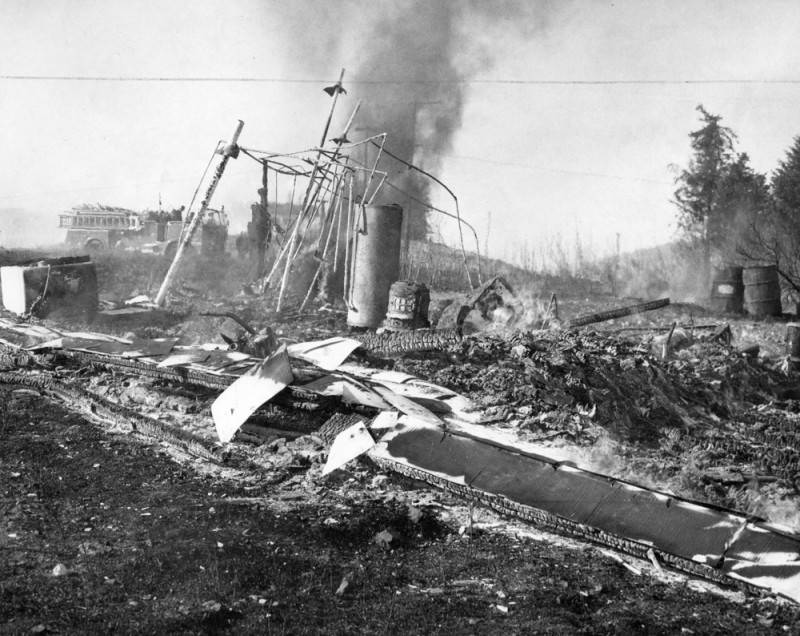
  1. Photograph dated December 26, 1956 shows debris from an unknown structure after the fast-moving mountain blaze burned through the Paradise Cove area in Malibu.
  2. “This is view of fire taken from top of Escondido Canyon looking toward ocean.  Shortly after picture was snapped, flames and smoke rolled down beach burning expensive waterside homes at Paradise Cove and Escondido Beach.  Today, flames are moving north and threaten to jump Mulholland Highway near Lake Malibu.  Army of men and mechanized equipment are massed on this highway in an effort to halt advance of flames over Santa Monica Mountains into plush lake resort area.”
  3. “Volunteer American Red Cross nurse pulls covers up over one sleeping youngster brought into Webster School which was set up as disaster station shortly after flames began threatening resort area near Malibu Beach.  Flames forced more than 1,000 persons to flee for their lives.  Evacuees with only clothes on their backs beat a path to school door to receive lodging and food for night.  Fire officials today fear that school will also be evacuated as flames loomed overhead near Malibu Canyon road.”
  4. Dennis Szigeti looks dazedly at all belongings he managed to salvage from home before it burned to ground in Latigo Canyon drive.  All six of Szigeti’s children were evacuated from home before it was consumed. Szigeti family was luckier than some which had to get out without time to save any of household belongings.”  The article partially reads, “The catastrophic fire which continued to race wildly out of control through the Malibu mountains today threatened to leap over Mulholland Highway near Malibu Lake and burn into the western end of the San Fernando Valley above Calabasas.  The fire has already jumped Mulholland Highway at Decker Canyon and advanced west into Ventura County toward the exclusive Lake Sherwood area.”
  5. “Helmeted John Durbin, 20, volunteer fireman from nearby Thousand Oaks, carries patio chair from plush $32,500 Lake Sherwood home of Mrs. Jean Robison.  Flames fueled by escaping butane gas burned all night.  Hoover home was across road and was first hit by blaze as flames moved inland from Triunfo Ranch, one-quarter mile south of Ventura boulevard near Thousand Oaks.”
  6. “Mrs. Charles Clarke, 5903 Ramirez Canyon, holds her son Billy, 1, closely as she looks up blackened canyon from Paradise Cove.  She, like hundreds of others, became refugee as brush fire inferno swallowed up more than 20,000 acres near beach area.  Her husband brought family to safety and went back to try to save home with help of firemen.”  The article partially reads, “The catastrophic fire which continued to race wildly out of control through the Malibu mountains today threatened to leap over Mulholland Highway near Malibu Lake and burn into the western end of the San Fernando Valley above Calabasas.  The fire has already jumped Mulholland Highway at Decker Canyon and advanced west into Ventura County toward the exclusive Lake Sherwood area.”

“The Malibu fire of December 27, 1956, apparently started on Backus Summit, inland from Zuma Beach. It destroyed 35 homes, killed one person, and injured thirty-three others – both firemen and civilians. Flames shot high enough to be seen from miles away, and the heat was so intense that rocks exploded, and embers and sparks showered down out of the hills across Pacific Coast Highway. Several of the homes destroyed were those of Hollywood personalities, including television’s Ralph Edwards. The Malibu fire was described as the worst Los Angeles County fire since 1938.”

  1. “Fire houses, etc. near Malibu Mountains Inn, Latigo Canyon Rd and Ocean View Drive, at head of Latigo & Ramirez Canyons.”

      2. “Groups of evacuees from S. Rambla Orieta (?) — Mr. and Mrs. Frank Hyatt, left, & Mr. & Mrs. A.W. Rebard, & family”.

      3. “Mrs. Joe Stephens Sr., right, and Red Cross nurse Mrs. Ralph Peterson, left, support Mrs. Nellie Stephens as they carry her to bed in Webster School disaster center. She and other members of family left home at 20641 Malibu Rd. as blaze came dangerously close.”

      4. December 29, 1956 reads: “Skeleton is all that remains of lakeside home belonging to Roy Hoover in Lake Sherwood fire which raced through community. More than 3,000 acres have been reported burned in this area alone. House at time of blaze was occupied by Jack Jones Jr., his wife and their three sons. They all fled to safety. Two firemen suffered injuries while fighting for lake homes.”

      5. “Reporter examines burned-out fire chief’s car”.

      Nixon in Panorama City: November 29, 1956


      0 0-1


      0-3

      Not long after VP Richard M. Nixon and his boss, President Dwight D. Eisenhower, won the 1956 election, Nixon and wife Pat toured Southern California.

      Introduced by Congressman Edgar W. Hiestand (R), a staunch anti-Communist and a member of the John Birch Society, Nixon spoke to an enthusiastic shopping center crowd under a banner sign which read: “Panorama City Welcomes Dick”.

      (Photos courtesy of the USC Digital Archives)

      The Barbara Jean Jepsen Murder: January 31, 1956.


      Jepsen_murder_1956-2

      Jepsen_murder_1956 copy

      15050 Victory

      4Jepsen_murder_1956

      3Jepsen_murder_1956

      On January 31, 1956, Barbara Jean Jepsen, an 18-year-old married woman, was found stabbed to death by her husband Joe Earl Jepsen inside their unit at 15050 Victory in Van Nuys.


      The murder of the young woman shocked the city.


      Photos of the crime scene exteriors are kept in the USC Digital Archives and offer a glimpse of detectives, in long coats and hats, gathering evidence and questioning blond, leather jacketed Mr. Jepsen.


      As the investigation proceeded, other women in Los Angeles were also mysteriously knifed to death, and the killer or killers remained at large.


      screenshot_285
      screenshot_284

      screenshot_283

      One of the suspects was Liberace’s younger brother Rudolph, 24, whose strange (?) behavior in Granada Hills caused neighbors to call police. Rudolph was later released and not charged with any crime.


      The cottages where Mrs. Jepsen and her husband lived, and she died, have been torn down but are remarkably similar to ones still standing near Lido Pizza on Victory.


      As far as I can ascertain, the murder of Barbara Jean Jepsen is still unsolved 58 years later.


      Video

      1956 Van Nuys Family Home Movies


      The arrival of record player, kids dancing in the yard, adults frolicking and laughing, this is Van Nuys 57 years ago as seen in this Munnecke Family Home movie.

      1956: Van Nuys


      Image
       
      People handing campaign posters to children in swimming pool.
      Location: Van Nuys, CA, US
      Date taken: September 1956
      Photographer:

      J. R. Eyerman

      Note the electric microphone and speaker placed at water’s edge while a child swims in the pool.

      1956: Construction of the San Diego Freeway


      This slideshow requires JavaScript.

      In 2011, we are living amidst a big construction project on the San Diego Freeway which will add new lanes and which has also torn up vast sections of Westwood near Wilshire and Sunset along Sepulveda.

      The USC Digital Archives has photographs of the 1956 beginnings of the San Diego Freeway, when bulldozers and explosives tore through the Sepulveda Pass and made it possible to eventually travel the nine miles from Encino to Westwood in less than two hours.