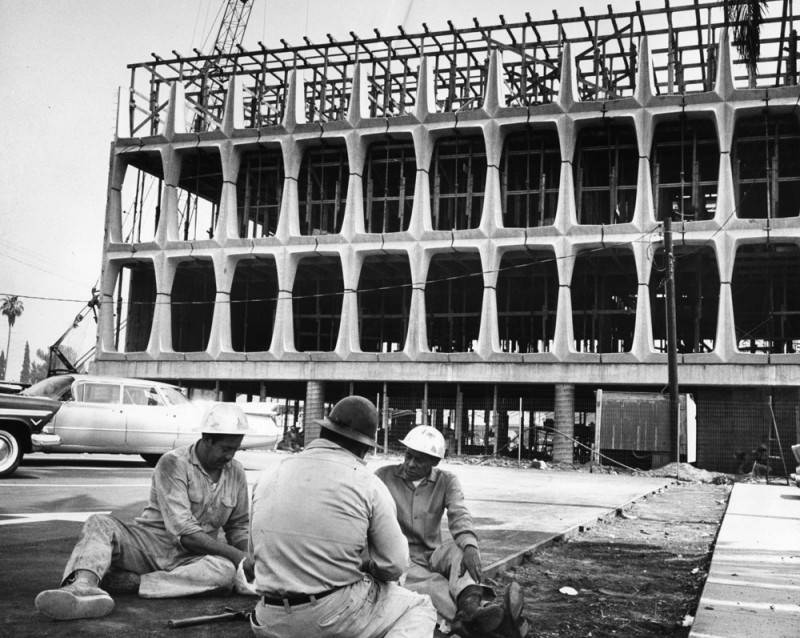
Beware of Big Promises: 1963


Community leaders, developers, planners, business people, and boosters are forever promising a brighter day tomorrow.

So it was in Van Nuys nearly 60 years ago.

The new police station, a striking piece of $5 million dollar architecture, whose inspiration appears to be many vertically positioned Philco televisions, was nearing completion on March 29, 1963. The grand civic center, a pedestrian promenade, a library, and several court buildings would complete the ensemble.

On February 16, 1963, 400 well-groomed white people gathered at the Masonic Temple Lodge on Sherman Way to view the exciting land use plans unveiled by the Los Angeles Planning Department governing the future development of Van Nuys.

A mystery remains: Why was a law enforcement structure removed from the street and shoved way back behind a deserted pedestrian mall?

The idea that a police station, whose presence is ostensibly there to prevent crime, should be buried far from the streets where officers patrol, is one of the confounding results of architectural planning which often presents glorious schematics but fails to consider practical results. Van Nuys Boulevard today is a ghost town, except for those who are there to make crime. A cop or two might reassure diners, drinkers, and those who are out for a nighttime stroll.

And the plans for Van Nuys? What have they produced in the last six decades? Probably the largest conglomeration of urban ugliness, environmental catastrophe and social upheavals within the entire United States.

Our surroundings are here to serve only the needs of cars, our air is dirty, our parks few and overrun with garbage and homeless, and we live under the daily and nightly sounds of gunfire, fireworks, sirens and patrolling helicopters. Our rivers are concrete, our boulevards are decorated with billboards and wooden traffic poles, our corner stores are marijuana outlets or parking lots, and the sidewalks are festooned with shopping carts, discarded sofas and tents.

Though most everything along the wide streets looks like impoverished crapola, the rents are exorbitant, and a “starter” home is $800,000. Any efforts to build higher than four stories brings out the angry loudmouths on NextDoor, and developers are maligned and despised by the general public while bearing ridiculous regulations that require onerous fees and expensive construction that inflates costs and discourages new housing. The little old lady, who inherited the three bedroom ranch house from her parents, and pays $300 a year in property taxes, is usually the bitterest one of all.

“I pay taxes! Why does everything look like shit!” she screams.

What kind of city do we live in? What is wrong with us?

Our system of life on Earth is failing globally, and especially here in Van Nuys.

The lesson: beware of great promises made by the powerful for they only care about themselves.

Credit: LAPL/Valley Times Photo Collection

July 28, 1962: Youth Shot to Death in Van Nuys Apartment


Clearly, there was crime and murder in Van Nuys in 1962.

In great staccato shorthand a woman is described as “a 22-year-old divorcee and dime store manager” (doesn’t that say it all). Divorced and managing a dime store. Things could be worse at 22.

Miss Colleen K. Mitzel was alone, in her apartment, and called police from a bedside phone when she heard an intruder, later identified as Leonard A. Farmer of Glendale, aged 19, ripping her living room screen.

She kept her revolver but did not use it, waiting for the police to come.

When cops arrived, the suspect was ransacking the apartment and then barricaded himself in a bathroom. After he refused to come out and surrender, Officer Dale Baker and his David Spickles fired through the door and killed him.

The intruder died in a stranger’s bathroom in Van Nuys. An ignomious way to depart this world.

He had a police record and had served time in a Florida prison.

1962: Fear Free Junior Colleges May Begin Charging Tuition.


Valley College, 1962

In 1962, junior colleges like Valley College were as free as high schools. Legally they were prohibited from collecting tuition.

“Pictured is a student walking the campus of Los Angeles Valley College with the photograph edited to show the word “Free?” hovering above. Photograph article dated August 13, 1962 partially reads, “There is increasing talk in school circles over the possibility of charging fees to students attending junior colleges in California…Currently, junior colleges (or two-year colleges) are considered part of the secondary school system and legal authorities have held that they may not charge fees any more than neighborhood elementary schools or high schools may.”

Photo Credit: Jeff Goldwater/ Valley Times Collection/ LAPL

Modernity and Kitsch.


I recently came across these 50-year-old photographs by Allan Grant that were published in the November 23, 1962 Life Magazine.

They show a brand new supermarket, Piggly Wiggly,that had recently opened at 15821 Ventura Blvd. in Encino. The structure is now gone, replaced by a long, white office building.

What surprised me most was seeing the blend of modernity and kitsch, an architectural and marketing precursor to present day Gelson’s.

There is a view of the exterior, decorative concrete canopies, very 1962. But in front are also 19th Century street lamps, an old wagon, and even trees.

Signs are in decorative fonts.

Inside there is the astonishing sight of butchers in straw hats and bow ties; in another photo is a large sign: “Foods of the World”; and in one image… diagonally stacked shelves of barware: highball, martini and wine glasses, ice buckets, long tapered candles and ash-trays.

Female clerks, done up in beehive hairdos and made up faces, sell cosmetics beside a Victorian wood turret front display case. Lady shoppers (were there any other kind?) could stop off here, pick up a bottle of Shalimar and run home to take a dip in the backyard pool, then broil some lamb chops, and have the table set before Leonard or Irv pulled up in the driveway.

And behind a glass counter, a behatted chef shows off pots of soups to women in pearls and old retired gentlemen peering over.

A lineup of cashiers, stand in formation under the watchful eyes of their male bosses, next to carriage lamp lit checkout lanes. The girls wear puffy shouldered, black and white dresses with their names embroidered on lace.

These photos are fine testament that they had perfected, half a century ago, the California ideal, blending kitsch fantasy with cold, hard business acumen.