Beware of Big Promises: 1963


Community leaders, developers, planners, business people, and boosters are forever promising a brighter day tomorrow.

So it was in Van Nuys nearly 60 years ago.

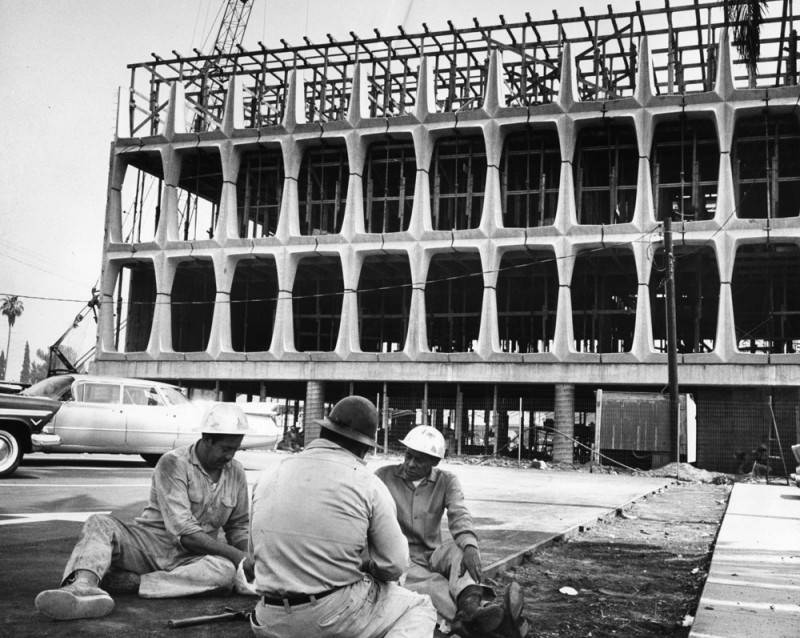
The new police station, a striking piece of $5 million dollar architecture, whose inspiration appears to be many vertically positioned Philco televisions, was nearing completion on March 29, 1963. The grand civic center, a pedestrian promenade, a library, and several court buildings would complete the ensemble.

On February 16, 1963, 400 well-groomed white people gathered at the Masonic Temple Lodge on Sherman Way to view the exciting land use plans unveiled by the Los Angeles Planning Department governing the future development of Van Nuys.

A mystery remains: Why was a law enforcement structure removed from the street and shoved way back behind a deserted pedestrian mall?

The idea that a police station, whose presence is ostensibly there to prevent crime, should be buried far from the streets where officers patrol, is one of the confounding results of architectural planning which often presents glorious schematics but fails to consider practical results. Van Nuys Boulevard today is a ghost town, except for those who are there to make crime. A cop or two might reassure diners, drinkers, and those who are out for a nighttime stroll.

And the plans for Van Nuys? What have they produced in the last six decades? Probably the largest conglomeration of urban ugliness, environmental catastrophe and social upheavals within the entire United States.

Our surroundings are here to serve only the needs of cars, our air is dirty, our parks few and overrun with garbage and homeless, and we live under the daily and nightly sounds of gunfire, fireworks, sirens and patrolling helicopters. Our rivers are concrete, our boulevards are decorated with billboards and wooden traffic poles, our corner stores are marijuana outlets or parking lots, and the sidewalks are festooned with shopping carts, discarded sofas and tents.

Though most everything along the wide streets looks like impoverished crapola, the rents are exorbitant, and a “starter” home is $800,000. Any efforts to build higher than four stories brings out the angry loudmouths on NextDoor, and developers are maligned and despised by the general public while bearing ridiculous regulations that require onerous fees and expensive construction that inflates costs and discourages new housing. The little old lady, who inherited the three bedroom ranch house from her parents, and pays $300 a year in property taxes, is usually the bitterest one of all.

“I pay taxes! Why does everything look like shit!” she screams.

What kind of city do we live in? What is wrong with us?

Our system of life on Earth is failing globally, and especially here in Van Nuys.

The lesson: beware of great promises made by the powerful for they only care about themselves.

Credit: LAPL/Valley Times Photo Collection

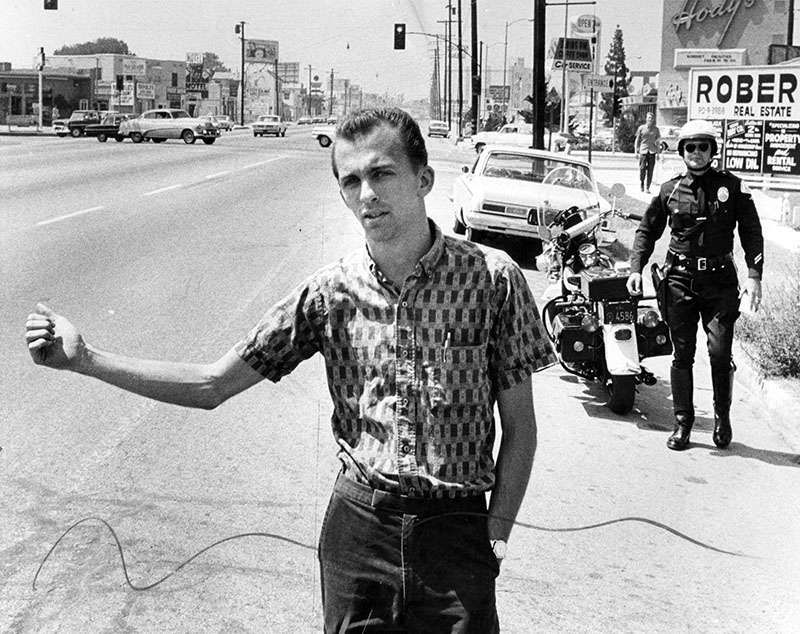
1963: LAPD Warns Hitchhikers of Predatory Homosexuals.


“Photograph article dated July 18, 1963 partially reads, “Valley police have been issuing citations in recent months to teen-agers who hitchhike up and down Van Nuys Blvd. The department is worried because several Valley youths have been the victims of homosexuals who pick them up and refuse to let them out of the car. Capt. Hagan pointed out that hitchhiking is against the law when it is done on freeways or any roadway where the hitchhiker walks out and stands in the roadway. The hitchhiker, however, is within the law if he stays on the sidewalk.” Motor Officer J. E. Nibes is about to tell Jeff Sillifant, North Hollywood, that he’s breaking the law. ”


Opening of the Financial Center Building (14545 Victory), 1963


00129222
00108813
In the 1960s, Van Nuys was booming, respectable and the site of progressive, modern banking.

00108814

In this October 7, 1963 photo, from the Valley Times Collection at the LAPL, actors and local business and financial leaders gather to snip a ribbon at the new headquarters of the Financial Center Building. The building still stands, just west of Van Nuys Boulevard.
00108815

“Dressed in a custom-made Lincoln-style outfit, Martin Pollard, left, chairman of the board of Lincoln Bank, 14545 Victory Blvd., Van Nuys, snips the ribbon with the symbolic rail-splitting ax to open the new headquarters in the Financial Center Building. Assisting Pollard in the opening ceremonies were Arthur D. Aston, president of the Van Nuys Chamber of Commerce; Ed Begley, actor; La Rayne Richards, Miss Van Nuys; Miles Rhyne, president of the bank, and Horace Heidt, honorary mayor of Van Nuys. Following a two-day grand-opening Thursday and Friday, the bank has returned to regular schedule of hours, 10 a.m. to 3 p.m. Monday through Thursday and 10 a.m. to 6 p.m. on Fridays.”

Not only was there a Lincoln Bank in the new Financial Center Building, but also a Jefferson Savings. In the photo below, men in suits and women in high heels smile at a bright future of home loans.

00129223

“First visitor to Jefferson Savings’ new headquarters in the six-story Financial Center Building is Mrs. Jones Hawley of Encino, left. She is given a warm welcome by president William Ravenscroft, left center, executive vice president and manager Larry Kirwan, and Miss Los Angeles (Jackie Jansen). Miss L. A. served as official hostess during Jefferson Savings’ open house celebration. New building is at 14545 Victory Blvd., Van Nuys.”

Four days before President Kennedy was assassinated, an oil portrait of Thomas Jefferson was presented to Jefferson Savings.

November 18, 1963 reads, “Famed artist Josef Silhavy (left) talks about his finished oil painting of Thomas Jefferson to president William Ravenscroft (right), and executive vice president and manager Larry Kirwan, Jefferson Savings and Loan Association. Painting hangs in Jefferson Savings’ new headquarters in Financial Center Building, 14545 Victory Blvd., Van Nuys.”

00129224

12012 Chandler.


$(KGrHqN,!oMFBlWKBW,RBQqwCPDGC!~~60_57 BRL61-0294 BRL64-0116 Honeywell Service Center Building Back Honeywell Service Center Building Front

Scanning through some of the postcards loaned to me by Tommy Gelinas at Valley Relics, I came across this 1963 postcard of a new building at  the corner of Chandler and Laurel Canyon in North Hollywood.

12012 Chandler was the home of “the first Honeywell 400 computer service center in the US.”

The Honeywell 400 was a system the size of a room, so nobody who worked with one carried it into this building for servicing. It was an early 1960s workhorse for processing payroll and other functions of business and industry. According to Kraza, Honeywell was part of a second generation of computers that came of age when transistors replaced vacuum tubes.  ” Transistorized computers were more powerful, more reliable, less expensive, and cooler to operate than their vacuum-tubed predecessors.”

The black and white photographs above show the Honeywell 400 in operation. However, they are not from 12012 Chandler.

Link

4419 Fulton Terrace


Huntington Archives

Image

Image

Image

I have often passed this apartment at 4419 Fulton, north of Moorpark, and noticed its unique and graphic address sign.  While searching through the archives of photographer Maynard Parker (1900-1976) housed at the Huntington, I came across photos he made in 1963.

Masculine and modern, the squat and flattened lettering, ingeniously aligned with the low slung horizontality of the building, is as much architecture as the architecture itself.   Almost cartoonish and leading into pop-art, it leaves behind the decorative scrolling that marked 1950s apartments whose builders slapped their daughter’s names on building fronts (“Debby Ann”, “Stacy Lynn”) or borrowed from faraway places (Tahiti, Hawaii or Fiji).  The indoor entrance, private and serene, concrete slabs floating across water, marries Japan to Southern California.

If this building is not on a historic preservation list- it should be.

Title:Fulton Terrace Apartments. Exterior. Los Angeles, CA

Architects: Burlew and Liszt.

Creator/Contributor:

Parker, Maynard L., 1901-1976.

1963 May

Contributing Institution:Huntington Library, Photo Archive