“Vacant apartments in the Valley are scarce, rents are heading toward all-time highs, and observers expect little change for the next three years.”-LA Times 8/24/1969
Vacancies Decrease, Rents Increase, Los Angeles Times. Aug 24 1969
Most of the new apartments will be large, luxury, high-rent operations because land is so expensive.
Landlords are choosey and many refuse to rent to tenants who have pets or children. Only 25% will allow pets or kids.
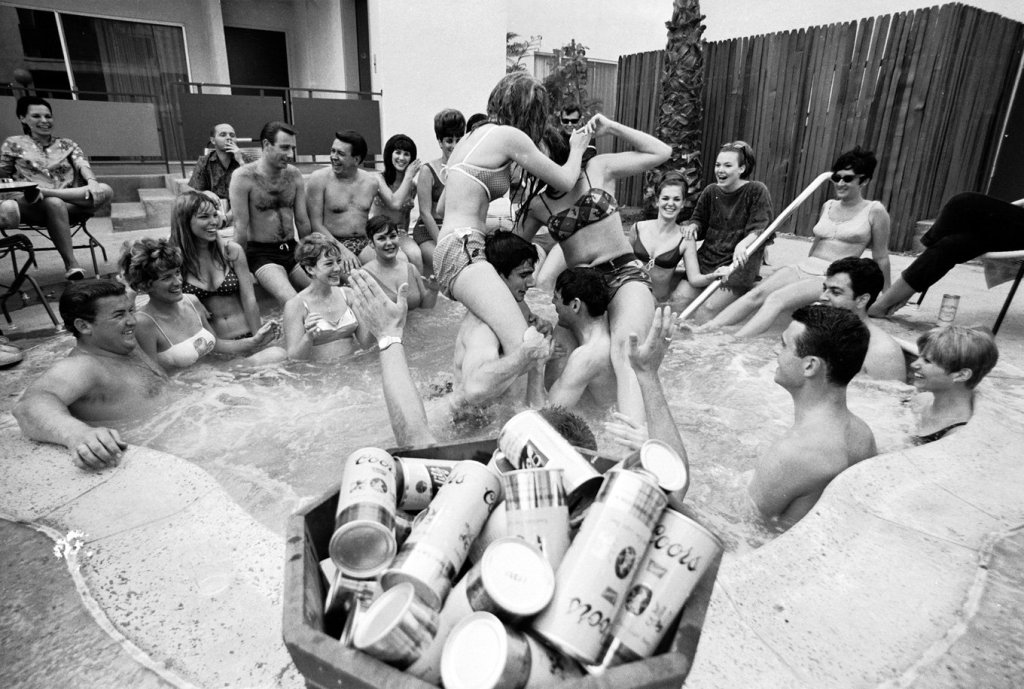
South Bay Club, Torrance. Photographer: Arthur Schatz. March 1967. [The LIFE Picture Collection/Getty Images]
In North Hollywood, only 3.8% are vacant, in Van Nuys, 2.5% and in Northridge, 2.7%.
Ten and 12-unit buildings were once common, but now land costs and materials are pushing builders to put up 40, 60 or even 80-unit structures.
The average tenant in the San Fernando Valley, incidentally, is 27-years-old and cannot afford the high rents.
And some of the rents that are being asked are quite shocking.
Dec 21 1969 Apartment Rentals LA Times
Furnished and unfurnished bachelor apartments are going for $85-$95 a month ($90=$657 in 2018); one bedrooms are averaging around $115 ($115=$796.42 in 2018); and two bedrooms for $175 ($175=$1,211 in 2018).
Walt Taylor of Van Nuys, who is the new president of Valley Apartment House Owners’ Association, fears that if the trend continues only large corporations will become landlords, or even worse, the government.
The early March air smelled quite frequently of jasmine yesterday.
The skies were cloudier, anticipating and foreshadowing the slowest, rarest event that mercurial, moody nature ever delivers to Los Angeles: rain. We want it so badly that when it comes we regret it, like so much else in life.
I walked east along Victory and stopped at 14619, where a two-story building, housing VIP Printing, caught my eye.
Built in 1960, it’s a box with a second floor of louvered windows and panels, alternating. The first floor has shops under a protruding horizontal overhang. Except for the ugly signs marring the façade, it has a plain purity and deserves better treatment.
On the corner of Van Nuys Boulevard and Victory, the symbol of Van Nuys: an overflowing trashcan.
Also at that intersection: decrepit one-story buildings.
In a finer city, these prominent parcels might be five, six, seven, or eight stories tall and contain many apartments on each corner. This is Van Nuys, stuck in 1966, perpetuating wasteful land use, wasted because housing is desperately needed. We need one less pawnshop and 500,000 more apartments.
The Q Bargain Store at 6351 Van Nuys Bl. was built as Sontag Drugstore in the 1940s. It still has the streamlined look of its youth. Like all of Van Nuys Boulevard north of Oxnard, it got old, it got poor, and we all got fucked.
Norvald Bldg, 1940, 1953, 2018.
Deformed beyond belief is the decapitated 6314 Van Nuys Boulevard, which in its decorative heyday was called the Norvald Building. Prominent people and institutions: realtor/developer Harry Bevis, Bank of America and DWP were tenants in the 1940s and 50s. A 1953 photograph shows Van Nuys Stationery store, Whelan Drugs and Bill Kemp Sportswear for Men.
Van Nuys, it is not fiction to say, once had businesses supported by letter writers and men who wore well-tailored sportswear. They used the word “amazing” a few times a year to describe space travel, or volcanic eruptions, never as an adjective for avocado toast or their little dog Zoe.
Diagonal parking was available along with a streetcar running down Van Nuys Boulevard. Imagine that!
The Country General Store at 6279 Van Nuys Blvd is a very fine country/western clothing store with a large selection of boots, ornate belts, and men’s Western hats, jeans, and sport shirts.
Unfortunately, the façade is cheap vinyl and fakery, obscuring a neo-classical California Bank that once anchored this corner with respectable, solid architectural forms and operable windows. A decorative clock and a traffic light with moving Stop/Go arms embellished and celebrated an urbane, safe, and tidy young town.
The future, seen through the past, is waiting for its revival. We send our thoughts and prayers to Van Nuys, a critically ill patient wounded by fatal liberalism and self-destructive policies.
Up until a few days ago, a blue and yellow auto repair building with Honda, Datsun and Toyota signage stood at Kester and Delano, a retro oddity imprisoned behind high, steel- spiked fencing.
Now the fence is down, and a bulldozer is making fast work tearing up the asphalt and the evidence of the existence of the former business.
What will go here? It seems likely that it will be another modern apartment, like the one just to the north of this lot. That makes sense, as this area is predominately residential, and the auto repair was the only one of its type north of Delano.
What is sadder is the probable fate of the mid-century building. It might, in a more imaginative use, be saved, and surrounded by gardens, trees and chairs, transformed into a cafe. It could, in this area, provide badly needed nature and respite from the violent cacophony of grit, crime, and poisonous fumes that surround it.
And if an apartment is built, let us hope it imitates the modernity, restraint and white crispness of the new units next to it. We have had enough of the multi-colored, brown and rust, red and orange, loopy, asymmetrical, glib, cartoonish and “fun” styles that have disfigured much of modern Los Angeles housing.
Even Kester, once on the critical list, seems to be turning a corner.
One of the older, quiet, one-story, multi-family buildings that still exist in Los Angeles…… and here in Van Nuys.
I have always thought these buildings to be important, for several reasons:
They are modest. One doesn’t see the garish and decorative ornament that mars many buildings in L.A.
They are only one-story tall, which allows an occupant to come outside and chat with the neighbors and enjoy the sunlight.
They provide a modest cost way for newcomers to live in a civilized way while gaining a foothold in this city.
They also might be suitable for single people, divorced parents with kids, and older people.
Thousands of these have been destroyed in the last few years, especially in places like Studio City (near CBS).
In their severe and straightforward style, they do not appeal to those who get their rocks off on “googie” coffee shops or Mid-Century modernism.
But they have contributed, and continue to do a good job, of making people happy in little contained communities, in a city where novelty and alienation reign supreme.
A lot of what is built in LA is heralded by boosters as being the start of some new epic in this city: Dorothy Chandler Pavillon, Disney Hall, Citywalk, Getty, Disneyland. But do these mega-projects contribute to our daily life?
Quietly and almost in an un-LA way, the construction of apartments along the MTA Red Line is remaking Los Angeles and bringing new life into formerly derelict sections of the city. No celebrities or celebrated starchitects are screaming about these structures. That lack of publicity may be part of their appeal…
This development, at the corner of Vermont and Wilshire, could be just as important at the construction of the “Miracle Mile” shopping area in the 1920s which drew shoppers from downtown to “suburbia”. Because here is proof, built in steel and concrete, that Los Angeles is shedding its old skin of cars, cars, cars and allowing a new way of life to emerge based on walking and public transportation and urban street life and amenities.
The brilliant truth about LA, one that runs counter to its stereotype, is that it is indeed amorphous in the way it evolves. It is not a stagnant city, it is open and enlightened.
Sometimes, not always. We might live stylishly, but some of us also die senselessly.
You must be logged in to post a comment.