In the archives of the Los Angeles Public Library are many old photographs from defunct newspapers such as the Valley Times and the Herald Examiner.
Thanksgiving is always a holiday where family, togetherness, food, and feeding the hungry are foremost.
The old ways of thinking about this holiday are on display in some of the images below, taken in the 1950s and 60s.
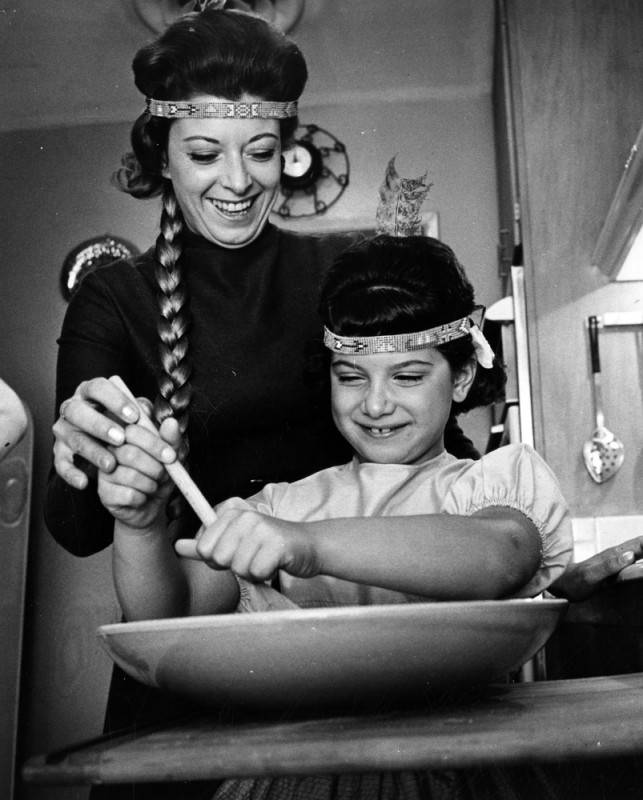
November 21, 1956: Mrs. John A. Gallagher prepares turkey for her grandchildren, Donna Lyn Dumont, 8 and Glenn Dumont, 4.November 17, 1953: Puritan Hat Decorations to symbolize founding fathers’ generous spirit. Las Candelas party for children at Camarillo Hospital. Mmes: Guy M. Bartlett, Lemon Blanchard and Eugene H. Dyer, of North Hollywood.November 23, 1964: Mrs. Seven and daughter Laura prepare Thanksgiving meal with their new feathers and headbands worn as a salute to the Indians who ate with white settlers on the holiday. November 18, 1961: Actor Gerald Lazarre seems to be trying something new: drying dishes as he assists his wife, actress Julie North, in preparation for Thanksgiving dinner at their home in North Hollywood. November 23, 1961: The Sawlsvilles of Sepulveda. After their parents died, these seven grandchildren were adopted by their grandparents. The elder Sawlsvilles also have three children of their own. 1968: Salvation Army 1954: Children pray before meal at Salvation Army.
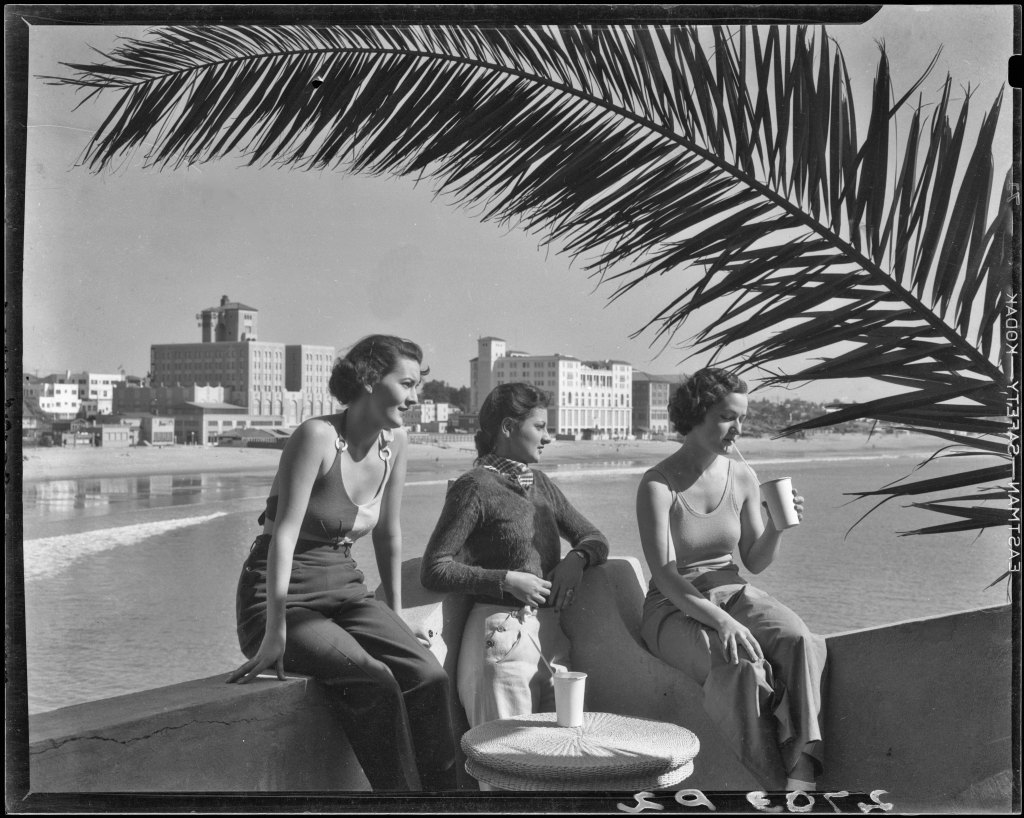
Members of Santa Monica College Women’s Row-A-Way Club, Santa Monica, 1935
House with tiled roof, garden, and gated wall, Palm Springs, [1930s or 1940s?]
California Bank, Brentwood office, Brentwood, [1957]
Prefabricated steel home, [1930s?]
UCLA’s Adelbert Bartlett Collection has superb, hi-resolution images from the work of a commercial photographer who lived from 1887-1966 and worked in Southern California in the 1920s through the 1960s.
It was a time when this state was considered the pinnacle of glory, a place where aviators, sportsmen, golfers, movie stars, and athletes played and worked in brilliant sunshine under smog-free skies; swimming, water skiing, boating and hiking through deserts, mountains and parks.
El Kantara, house with onion dome, horseshoe arches, and tiled roof, Palm Springs, [1930s or 1940s?]
Santa Monica shoreline, Santa Monica, 1934
Santa Monica College Women’s Row-A-Way Club, Santa Monica, 1935
Bungalow court, The Town House and Bungalows, Palm Springs, 1936
Coastal view from hill towards house under construction in the Rancho Malibu la Costa development, Malibu, circa 1927
El Kantara, house with onion dome, horseshoe arches, and tiled roof, Palm Springs, [1930s or 1940s?]
As we endure cataclysmic natural disasters and allow unnatural disasters, such as homelessness, to overtake our state, we have to look back to how the Golden State operated when economic conditions were truly bleak.
We have brought ourselves, by our own powers, to a time and place of our own creation, and our California is a product of our human strengths and weaknesses, a society which can go up or down, in a natural environment which is now turning deadly as it is heated up by carbon.
Way before people understood that our planet might perish by our own hand and not God’s, California took stock of its good fortune and erected a real place out of fantasy.
How did such phenomenal architecture, science, sports and innovation happen here in the early and mid 20th Century? What can we do to restore the optimism and leadership that once made California the envy of the entire world?
Can we bring back the pristine, polished, glimmering, spotless world that once existed?
Woman and girl on dirt road, Santa Monica, 1928
Spanish-style house, Santa Monica, 1928
Mullen Bluett building, Wilshire Boulevard and Ridgeley Drive, Los Angeles, 1949
Group on dock and on Sikorsky S38-A
Ann Pruden and Mary Conners in outdoor area with palm trees, Palm Springs, 1940
El Kantara, house with onion dome, horseshoe arches, and tiled roof, Palm Springs, [1930s or 1940s?]
The old Los Angeles, the city of streetcars, steel signs, orange trucks, red cars, brick buildings, men in hats, ladies in skirts and high heels; the city of overhead wires, decorative lampposts, cops and conductors, kids on bikes, corner drugstores, ice cream parlors, neighborhood movie theaters; they are all alive and bustling and visible on the pages of the Pacific Electric Railway Society.
The dismantling and destruction of public transportation and the elevation of the automobile to the status of a deity has destroyed the richness and civility that once characterized the City of Angels.
Go visit the page, make a contribution, and gain some understanding of what we lost and what we might try to rebuild as we again go back to trains.
In the words of the organization:
“It is a non-profit association dedicated to the preservation of the memory of the Pacific Electric Railway. The goals of the PERyHS are: to preserve and maintain historical documents, visual images, oral histories, and historical studies; to make these materials available to the general public via publications (monographs), presentations and displays to non-profit groups and organizations and to assist other non-profit organizations in their efforts to preserve the legacy of the Pacific Electric Railway.”
You must be logged in to post a comment.