Navigating Public Space in Marina Del Rey.


In the 1960s, the swamps of south Venice became a multi-million dollar building project that culminated in what we now call Marina Del Rey.

Pleasure boats, yacht clubs, nautical facilities, circular high rises with balconies overlooking the harbor, landscaped roadways with palm trees, office buildings, pharmacies, tennis courts, a hospital, a fire station, a library; and many restaurants overlooking the yachts, sailboats and motor boats.

A district devoted to tanning, drinking, carousing, love making, and living the good life amongst airline pilots, stewardesses, restaurant workers, aspiring actors, and retirees. The 1960s dream of accessible pleasure for anyone white with a convertible.

They even built the 90 Freeway to get people in fast, before the boat left the dock. Imagine the high quality of life 60 years ago, when a new freeway was affordable and considered the highest and best use of land.

From its inception, Marina Del Rey feigned a public purpose while raking in the dollars fencing off the best parts for private use of yacht clubs and apartment dwellers. Docks are locked up and there are many barriers to prevent the use of the harbor for the general public unless you are there to purchase a dinner and drinks on a boat, bar or restaurant.

Over the years, there have been community projects to create usable public space, such as Yvonne B. Burke Park on the north side of Admiralty Way which has athletic equipment, bike roads and jogging paths. That park too has recently been incarcerated when Bay View Management built a cinder block wall that closed a public access point behind a Ralph’s store on Lincoln Boulevard. 

God forbid a pedestrian in a park might access a supermarket on foot.

Other luxury apartments, understandably fearful of crime, vagrancy and violence, have illegally built obstructions along their land to prevent the park from becoming a way to enter their properties.

Every few hundred feet, the green parks become parking lots. An athlete running, riding a bike or rolling skating will eventually stop at a busy road where vehicles speed by at 60 miles an hour. And other cars and trucks will be entering the parking lots or exiting, creating additional hazards for the non-driver.

The big, popular restaurants, anchored in seas of asphalt, offering seafood, steak, alcohol, valet parking, and private parties to corporate diners and red nosed, melanomatous men in Tommy Bahama, have all gone out of business. Café Del Rey and Tony Ps with their crumbling, dated, Brady Bunch style restaurants are empty. The cigarettes, cigars, Aramis and lounge singers gone with the wind.

The great pandemic meltdown which has stolen our lives, taken our movie theaters, pillaged our department stores, and defecated upon our civic dignity, has now obliterated the big dining establishments of Marina Del Rey.

These popular places, that seemed immune to time, forever serving enormous plates of grilled lobster, prime rib, baked potatoes, cheesecake, ice cream sundaes and voluminous cocktails are now dead. Silent as Hiroshima after the bomb, these outposts of high on the hog, intoxicated living were ailing, out of fashion, and are now exiled from our spartan, self-consciously healthy era.


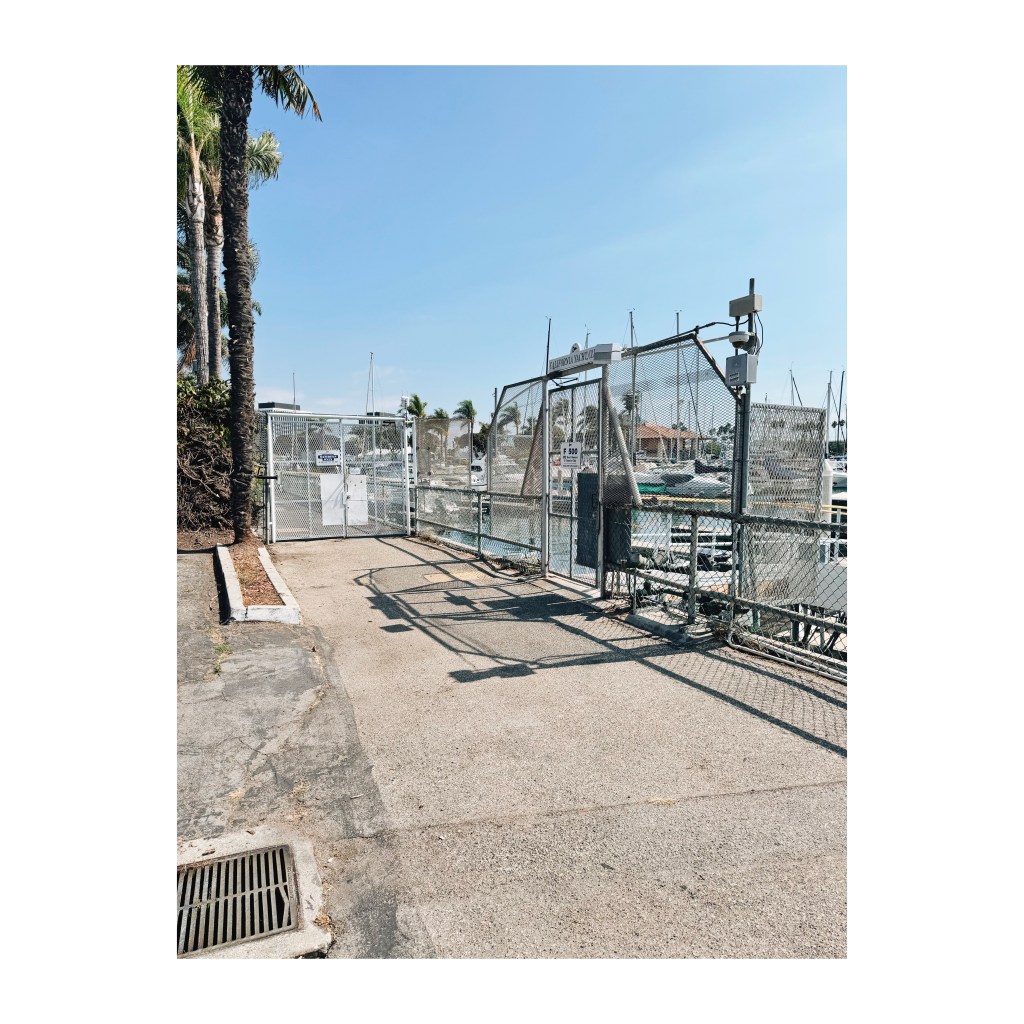
For a pedestrian who is trying to stroll one mile of the harbor west from Bali Way to Palawan Way, with the boats in view along the south walkway, there are several private obstructions that make it impossible to complete the walk.

I speak from experience as my friend Danny and I did the walk today.

The California Yacht Club locks up the walkway with their own use of the property. 

One is forced to detour to Admiralty Way with the unused parking lots of the long-gone restaurants on one side, and the near-death experience of speeding cars on the other.

To reenter the harbor walkway, you find the Los Angeles County Fire Department Station #110 (4433 Admiralty Way) and walk behind the building to rejoin the path along the water to once again enjoy the public recreational qualities that are supposedly there for everyone to enjoy, not just yacht members.

The Marina City Club encompasses three early 1970s high rises which are entered securely by several guarded driveways on Admiralty Way. This complex has swimming pools, tennis courts, a convenience store, but is threatened by similar structural defects that brought down the Surfside, Florida condominium in 2021, killing 98 persons.

For now, residents who own property there pay high HOA fees, and even those who bought in cheaply face repairs that will surely cost collectively in the hundreds of millions of dollars to make these three, 55-year-old buildings safer in a location where tsunamis and earthquakes are always visiting unexpectedly.  

Concluding the walk today, we went north along a dirt path on the west side of the Oxford Basin “Wildlife Refuge” which connected to Washington Boulevard.

As we passed a vagrant man sprawled on wall, shopping cart and garbage nearby, my friend Danny shouted, “Get going, walk faster.”

Danny had spotted a handgun in the vagrant’s hand.  

Just another reminder, if any is needed, that nobody should assume that this is a safe area, regardless of how much homes sell for. The demoralizing and unsanitary aspects of Los Angeles are all around, because we live in perhaps the dirtiest metropolis in the United States, one that believes public trash camping is a civil right and mental illness is only a danger after it kills.

How this city will present during the 2028 Olympics is something Orwell would have pondered.

1986 LAPD Bomb Squad Killings


On Friday, July 18, 2025, three LA Country Sheriff’s deputies, handling explosive material taken from an apartment garage in Santa Monica, were killed in an explosion at the department’s Biscailuz Center Training Academy in East Los Angeles.

The deputies had been called to 800 Bay Street last Thursday after the Santa Monica police requested assistance in safe removal of the explosives. The FBI and LAPD’s bomb squad are assisting with the investigation.


This tragedy reminded me of a documentary I had worked on about 18 years ago for the History Channel called “North Mission Road,” concerning true crime investigations inside the LA County Coroner’s Office.

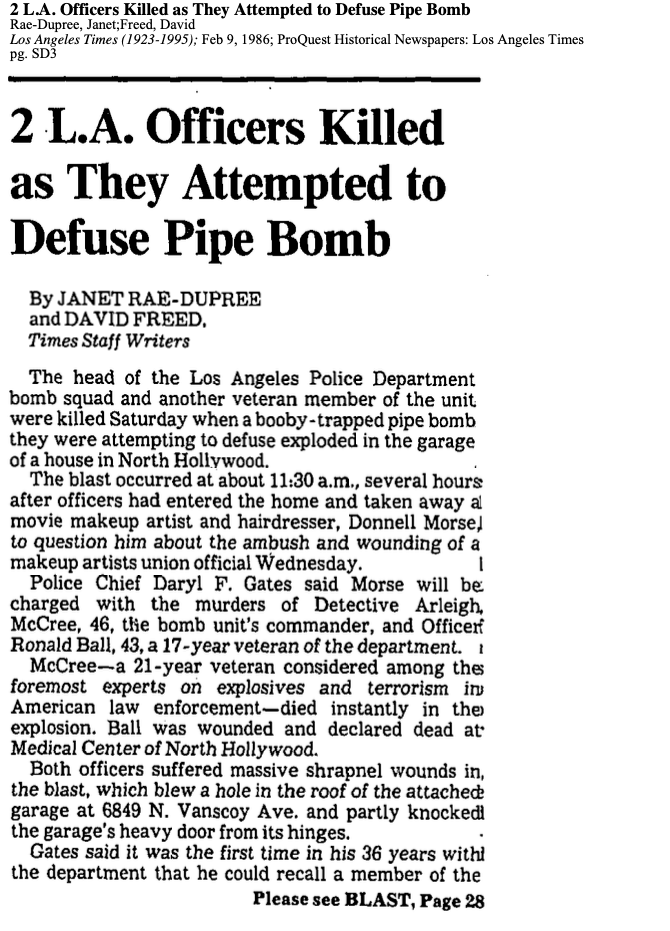
The story involved the February 9, 1986 deaths of two highly experienced LAPD Bomb Squad officers who were defusing a homemade pipe bomb in a home garage at 6849 N. Vanscoy Avenue in North Hollywood. 

Detective Arleigh McCree, 46, the bomb unit’s commander, and Officer Ronald Ball, 43, a 17-year veteran of the department, suffered massive shrapnel wounds and died instantly in the explosion.

McCree headed the Police Department’s bomb squad unit for seven years. He was head of security for the 1984 Summer Olympics and had been an investigator in the 1983 US Marine Corps bombing in Lebanon which killed 241 marines and sailors, the largest loss of life for the Marines since WWII.

It was the first time LAPD bomb squad members had been killed in the line of duty.

The bomb had gone off in the garage of a home where a suspect lived, a man named Donnell Morse, 36, a disgruntled makeup artist who was suspected of an ambush shooting against Howard Smit, the 74-year-old business manager of the Makeup Artists and Hair Stylists Union Local No. 706 as Smit left headquarters on Chandler near Tujunga at midnight. Smit was wounded by sniper, who fired several shots and then drove off, and who police believed was Morse. 

In 1989, Morse was sentenced to life in prison without parole for the deaths of the two officers, and possession of explosives.

When we made the 2007 documentary, we recreated the investigation and the explosion, using our rudimentary low budget actors and non-union special effects. I cast dozens of young actors, rented police uniforms, and booked my neighbor’s house to recreate the deadly event. PAs built a realistic, non-functioning homemade pipe bomb from an illustration inside a 1960s anarchist book found at a used bookstore in Glendale.

As associate producer I also had to find the experts, family members and living victims of the crime to interview.

We took a crew up to the Studio City home of elderly Howard Smit, then about 96, who still lived in the late 1940s Blairwood Drive home he built during his long, illustrious career that included The Wizard of Oz (1939), The Birds (1963), Marnie (1964) and Planet of the Apes (1968). 

He was gracious and entirely lucent, recalling every detail of his bizarre brush with death outside of the Chandler Boulevard offices of his union.


The bomb squad was shaken by the deaths of the two men, and some of the department could not quite grasp the horrific fact that an amateur bomb making criminal, who worked as a makeup artist, could somehow kill the top police experts in bomb making and bomb defusing. 

The effeminate, artificial image of make-up artistry was contrasted with the brutality of war, as if the power of movie illusion had somehow fought a real-life battle with veterans from law enforcement ….and won.

I have pasted some LA Times articles about the 1986 murder investigation and bomb squad killings below:

What the Hell Has Happened to Santa Monica?


Purse Snatchers and Parking Lots. (Chinatown Part 2)


On the day we walked here, a few hours after we left, a 68-year-old woman, fighting a purse snatcher, was stabbed 8 times but survived. Her attacker was tackled by others and kept down until police arrived and arrested him.

One can sense the presence of danger here even though it may not be knifing you in the chest. You wouldn’t just rationally wander here at midnight. Maybe if you were drunk. 

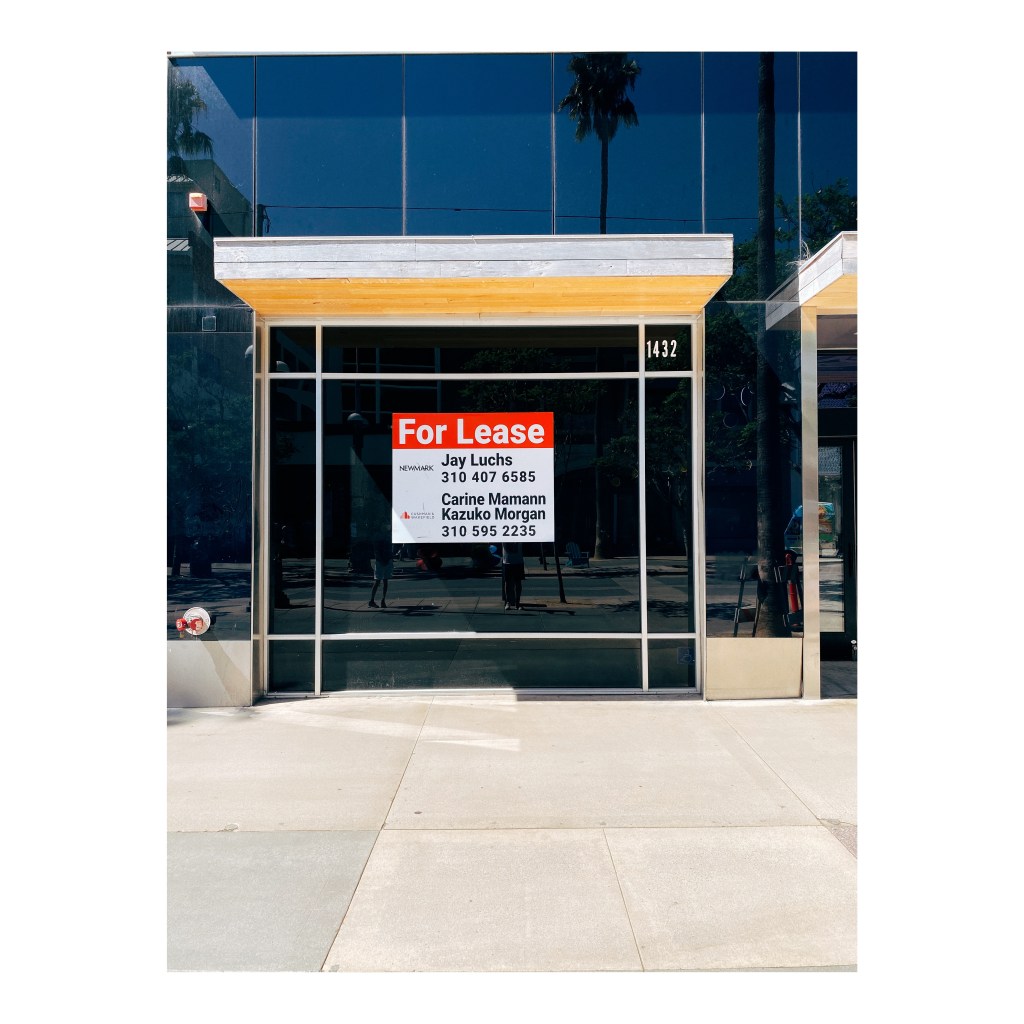
North Spring Street is neglected. There are burned out buildings, empty storefronts, and lots waiting for life to return. New High Street between Alpine and Ord is made of one-story buildings and 50% asphalt parking lots. 

What a struggle to run a business in Los Angeles, especially a restaurant. How have any survived the pandemic, taxation, crime, inflation, food costs, employee wages? It’s a wonder anything is functioning.

My architectural imagination wonders why many streets in this district, adjacent to downtown, are so depleted of apartments above stores, why there are still one-story buildings and acres of parking lots all around. 

Along Alameda Street, there are gas stations, and a concrete building from the late 1960s housing The Los Angeles County Fleet Services. Against the brutal and blank façade are shrubs, a mid-century idea of environmental eyeliner. 

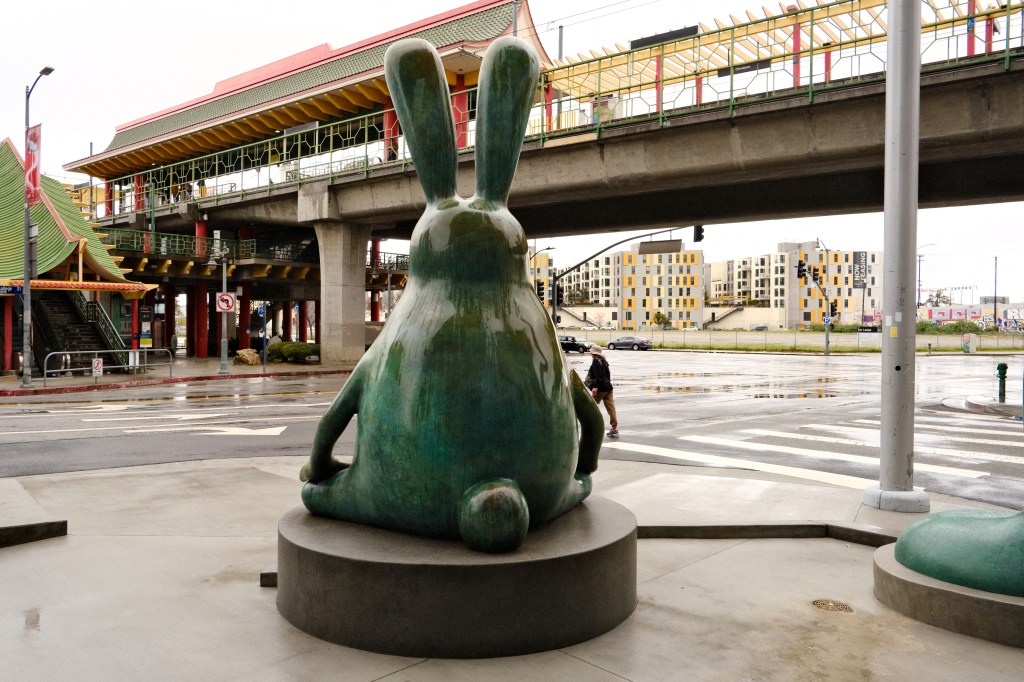
The light rail station is good looking with bright colors of red, green and yellow and decorative chinoiserie. There is a whimsical, large bunny statue on a pedestal standing guard across from the train.

There are handsome new buildings nearby but I hadn’t taken any photos of them. I will, perhaps, return here and photograph them someday. 

Walking Along the 6th Street Bridge.


I finally made it down to the 6th Street Bridge.

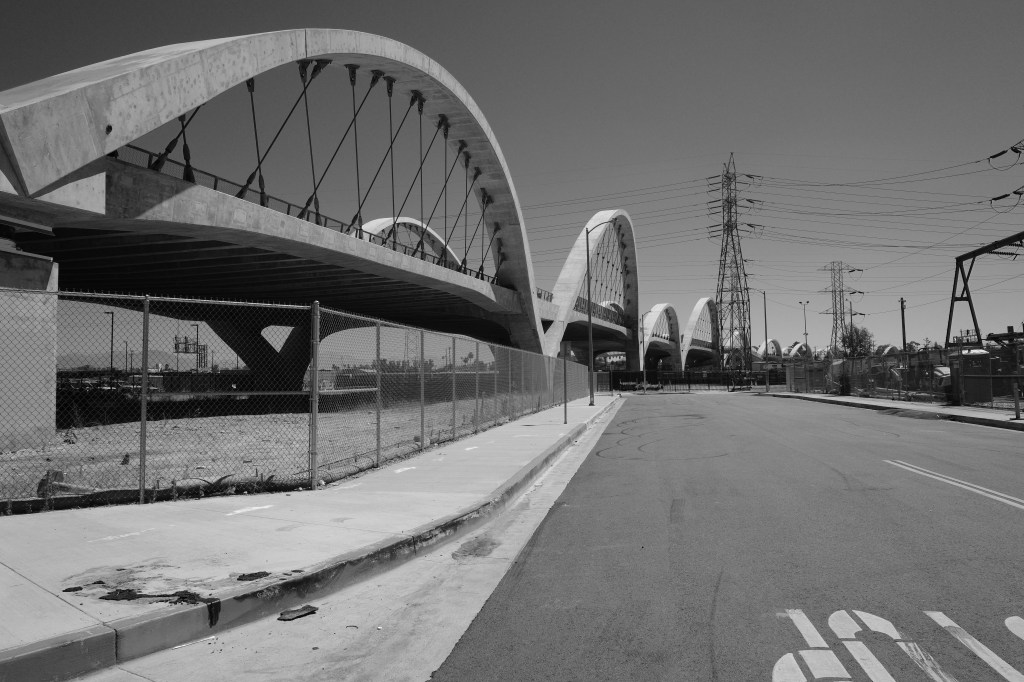
It’s an impressive structure that leaps and struts and flies over rail tracks and factories, electric yards and the river. It is startlingly plain, almost crude in its sculpted mass and bending arches. There are raw bolts attaching the cables to the concrete. Steel fences stretch along the pedestrian walkway. Dark shadows and blinding sun mark the bridge from beginning to end.

Unyielding in substance, rigid, unforgiving, brutal; it is a stage for fast cars, reckless driving and unintentional suicide. But also a balletic performance of geometric shapes and unexpected revelations along the way.

Mute yet expressive, untested in the long term, it is a baby of this metropolis. And born to a city that abandoned it to a wasteland which one day may be remade with trees, parks and apartments; or left behind to become yet another great, unfulfilled California promise.

Walking here last Saturday, August 26th, I thought of the late Mike Davis (City of Quartz) who wrote brutally and trenchantly about Los Angeles.

I don’t have his exact words, but in that book he described an architecture of barbed wire, steel gates, security cameras, the way this city is set up like a penitentiary with hostile inmates surrounded by deterrents, police and threatening lethality.

The 6th Street Bridge, ironically, has earned a reputation for criminal mayhem: daredevil driving and people who climb upon the arches to show off. I saw no rowdiness, in fact the road was remarkably empty and we only passed a few pedestrians. But in all directions artificial and man made structures are the entirety. Absolutely nothing is natural. The lone exception I saw was a cellphone tower who identified as a palm tree.

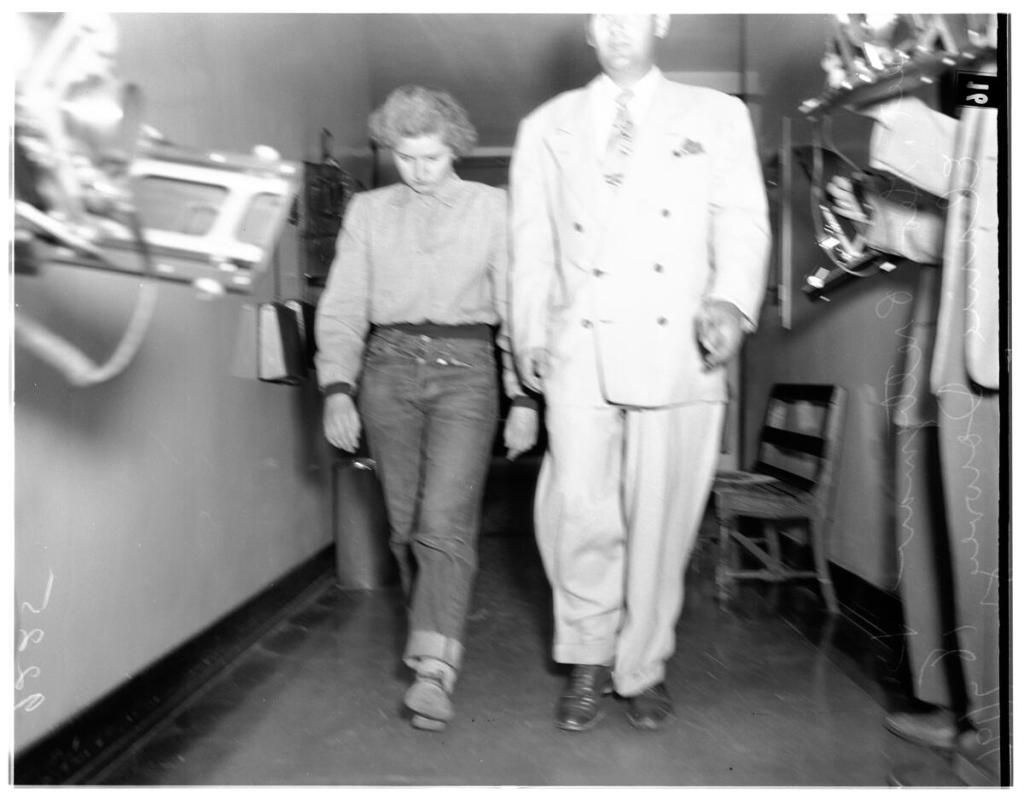
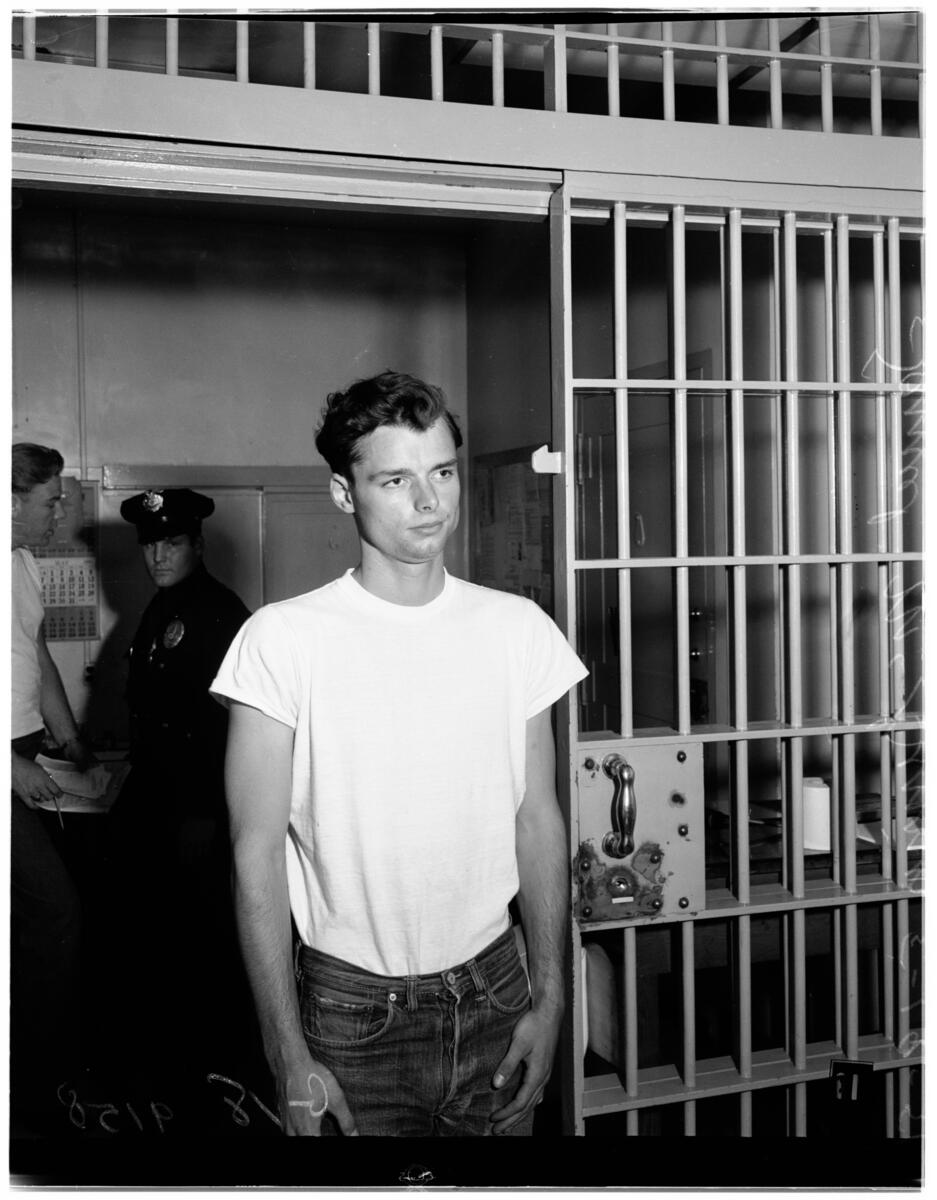
“Girl Stick-Up Artist” Van Nuys, 1951


“Girl stick-up artist (Van Nuys Jail), July 19, 1951. Detective George Pettyman; Elaine Downey — 18 years (suspect); Detective Guy Moulder; Janice Hays (caught with Elaine Downey); Officer K. L. Crondell (bitten by Hays).”

Source: LA Herald Examiner