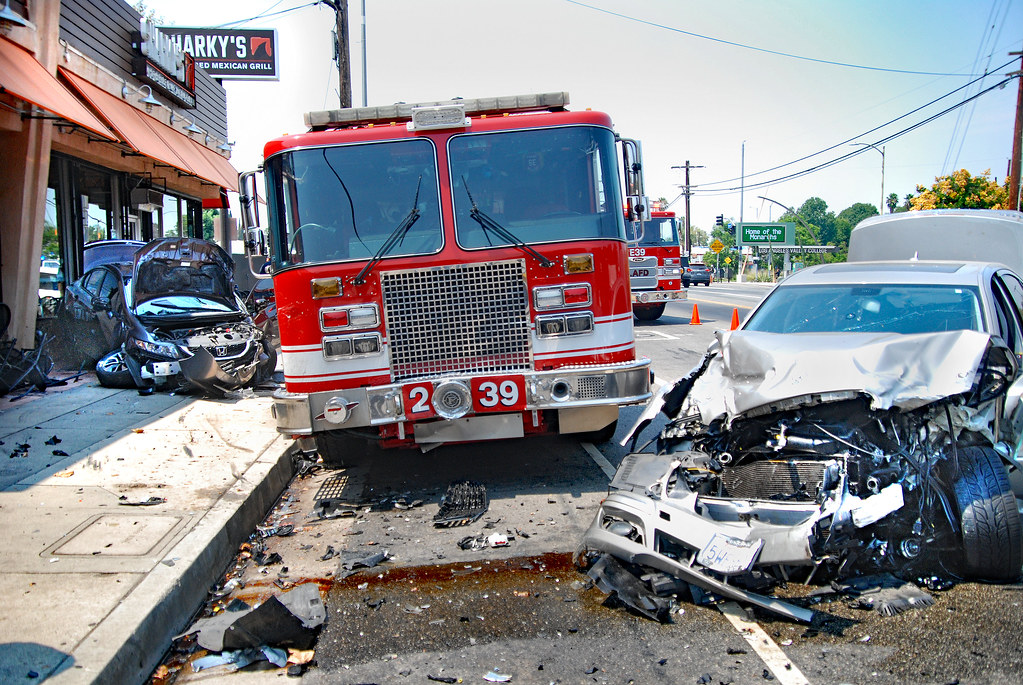
Speeding, eight lane wide streets, bike accidents, car accidents, injuries and death.


© Photo by Mike Meadows via Flickr.

Essay reprint.

Why Do Firefighters Oppose Safe Streets?

By Josh Stephens  

February 25, 2024

Ballot Measures StreetsWalkability

A few days ago, I drove from west Los Angeles to Whittier, a leafy suburb founded by Quakers on the eastern edge of Los Angeles County. Just east of downtown Los Angeles, I got on the 60 Freeway and took it to the 605.

I kid you not, every single billboard along this route advertised one of two things: insurance or accident attorneys.

I lost count of the latter. There was Jacob Imrani, Anh Phoong, Sweet James, Morgan & Morgan, and the dean of Los Angeles accident attorneys, Larry H. Parker, who’s been “fighting for you” seemingly since the days of covered wagons. Pirnia Law sponsors UCLA athletics and appeals to the fraternity crowd with the most bro-y slogan in legal history: “putting the ‘lit’ in litigation.” The Pirnia billboard I saw on Friday promised, “We run L.A.,” whatever that means.

(An aside: if you’re going to be an accident attorney in Los Angeles, it is, apparently, mandatory for you or your avatar to have facial hair, ideally a goatee.)

These billboards all make for an ugly drive. Granted, it wouldn’t have been any less ugly if they advertised something else, like soda pop, cigarettes, or, well, cars. What’s remarkable is that, in a county with a $750 billion GPD, these are the only businesses that seem willing to spend money on outdoor advertising. Sadder still: there is a robust market for their services.

Our society is as litigious as it is dangerous.

Between 2013 and 2022, Los Angeles County averaged around 54,000 fatal or injury crashes annually (the vast majority being injury-only crashes). I’m pretty sure the only people who celebrate those statistics are the attorneys. And yet, the crashes persist.

One city in Los Angeles County is attempting to do something about car accidents and, especially, the hazards they pose for pedestrians. On March 4, voters in the City of Los Angeles will consider Measure HLA, an initiative that would force the city to implement its Mobility Plan 2035, which was adopted in 2015. Backers of Measure HLA say that the city has implemented as little as 5% of the plan. Meanwhile, some 300 deaths take place annually on the city’s streets.

HLA promises a revolution in active transportation and the pedestrian realm. We’re talking about enhanced sidewalks and crosswalks; street furniture; trees; dedicated bus lanes and upgraded transit stops; bike lanes; traffic calming; and more. It’s the sort of mobility bonanza that activists and progressive planners have dream about. It could turn at least a few of Los Angeles’s ugly, dangerous thoroughfares into places that people where people just might want to hang out.

HLA will not be cheap. A recent analysis by Los Angeles City Administrator Matt Szabo estimates it will require $3.1 billion. Supporters dispute that number and, of course, argue that the promise of lives saved and streets beautified justifies a major investment.

Now, our friends on the billboards haven’t come out against Measure HLA, as far as I know. Even they aren’t brazen enough for that. And yet, someone else has — the firefighters of the Los Angeles Fire Department.

Let that irony sink in for a moment.

The firefighters claim that many of these street improvements could interfere with emergency responses. “Every second counts. The road diets slow down our firefighters,” Freddy Escobar, president of the United Firefighters of Los Angeles City Local 112, told the Los Angeles Times. “And it will be so much worse with HLA.” In other words: we don’t want a hook-and-ladder truck getting hung up on a bulb-out or squeezed by a bike lane.

I give due respect to emergency responders, and I get that the firefighters have their priorities–especially when it comes to saving lives. But the mobility plan isn’t merely about aesthetics. Its point, in fact, is to save lives: not by responding to accidents but by preventing them in the first place.

In 2023, 336 people died in traffic-related deaths in the City of Los Angeles (half were pedestrians). Meanwhile, between 2014 and 2019, the average number of deaths from accidental structure fires was 14. I hardly want to pit one sort of tragedy against another. But, let’s face it, governance is always about priorities.

And, indirectly, Measure can improve public health by promoting walking and biking and even by fostering social relationships. It’s a lot easier for neighbors to get to know each other when they’re walking down the same sidewalk than when they’re both racing to make the yellow light. And, however harrowing a fire may be, at least most of them are accidental and isolated. Measure HLA attempts to undo an entirely intentional, nationwide disaster.

The firefighters thus miss the city for the buildings.

It’s not the first time, though. Many cities’ street dimensions are already dictated by the size and performance of fire trucks. And, last year’s successful AB 835 made the case that fire codes that require most multistory buildings to include two stairways (for emergency egress) severely constrain the way residential buildings can be designed and, indirectly, make California cities uglier and more expensive than they’d be if buildings were allowed to have only one stairway.

I’m not an expert on emergency response. But I’ve been involved in urban planning long enough to know that, in too many instances to cite, the very people who are trained, paid, and empowered to design our cities somehow get shoved aside. Meanwhile, veneration for emergency responders — much of it well earned — has often given them, and their unions, unduly loud voices in the civic discussion.

Not this time, though.

What’s especially bonkers about the firefighters’ opposition to HLA is that they are almost alone. The list of groups that have endorsed it is not just long — it’s also among the most diverse you could ever imagine in Los Angeles. Plenty of other unions support it, including the SEIU and the teachers union. Elected officials have lined up in favor of it. Seemingly every mobility, environmental, and social justice organization has too. Democratic groups support it, and so does the Los Angeles County Business Federation. If ever a group could be expected to oppose a measure that de-emphasizes the use of cars, it would be the United Autoworkers — but, no, they’re on the list too.

For all of this enthusiasm, I’m not sure that the mobility plan will cure all that ails Los Angeles’s streets, even if it’s supercharged by Measure HLA. And I certainly don’t know if $3.1 billion — or whatever the true amount is — would be a sound investment. But, the fact that concepts once as obscure and forlorn as “complete streets” and “active transportation” are on the ballot in a famously car-centric city has to be good news, for planners and pedestrians alike. It has at least a chance of making the city safer and more attractive.

Of course, I don’t expect those billboards to come down any time soon, and we’re probably stuck with the freeways too. But we can at least hope that some of those attorneys go out of business.

Scenes Around the La Brea Tar Pits


Before the rains came, we went to visit the La Brea Tar Pits and the outdoor grounds adjacent to the Los Angeles County Museum of Art and the new Academy of Motion Pictures.

Despite having lived in Los Angeles, close to 30 years, I don’t remember ever walking around the La Brea Tar Pits.

It was Christmas Eve and there was parking along 6th Street just east of Fairfax, past many homeless tents. We pulled into a free spot, got out of the car and walked into the park.

The first thing we encountered was a man under the giant rock screaming his head off while two amused security guards watched him from a distance.

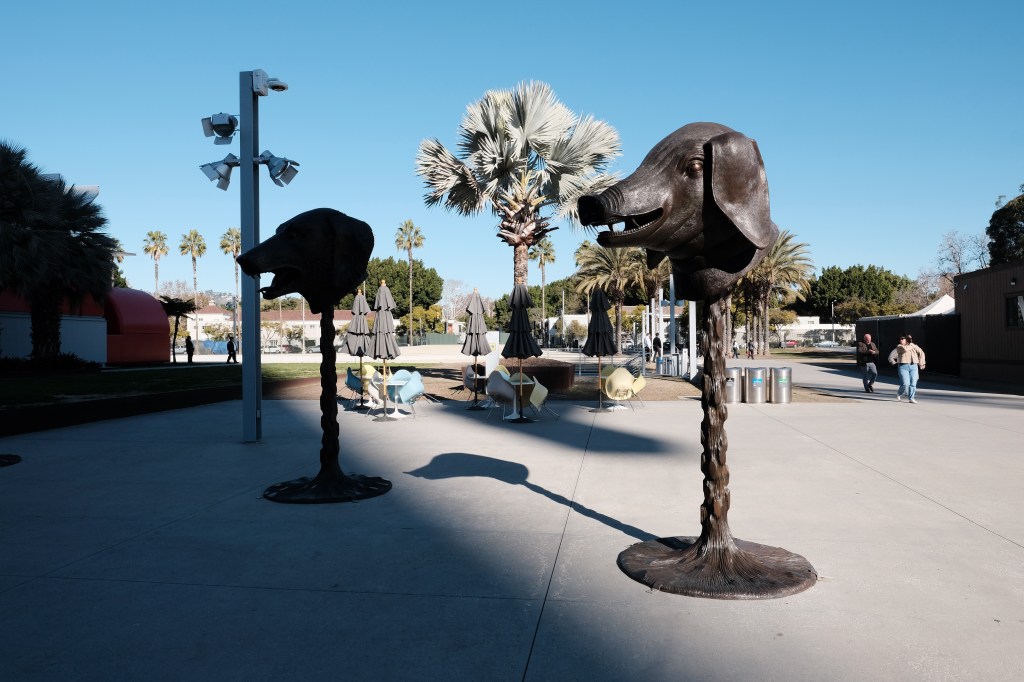
We walked on, into a sculpture garden of enormous steel animal heads on steel posts arranged in decorative circles around a concrete patio. (The Zodiac Project by Ai Weiwei, his first major public sculpture.) It felt like a religious installation but the gods were animals, toylike and comical. Their creator is currently in prison in China. We are free to laugh at his genius and liberated to be ignorant of its meaning.

Further we went along the red columned walkway that connects various art galleries and the new Academy of Motion Pictures built inside the old May Company Department Store where Bette Davis played a washed-up actress working as a sales clerk in “The Star” (1952).

There were nice looking families dressed in nicer clothes, out for a holiday walk or visit to the museums or motion picture halls. You could believe right there that LA was a normal city with civilized citizens taking part in the arts like people do in any other city outside of the United States, forgetting the woman on life support shot in her car, December 17th, on the 101 in Tarzana, a kind of gruesome violence that is our everyday normality, and nothing special to speak of, only one human life.

The crazy screaming man walked past us still screaming, trailed by two security guards, and there were so many security guards in every part of the property, inside museums, at the entrances, around the park, and you knew they were there to provide security in an insecure city where mad people wander and sleep in tents and on bus benches in the tens of thousands. And drivers fire guns at other drivers.

We saw many smiling, delighted Indonesian tourists taking pictures next to the decorative lampposts on Wilshire near Ogden. Their bus waited with open door as the happy group posed in the sunshine. What did they think of this city and this nation, so much abundance, so much squalor?

The future of Wilshire was all around us: the demolished museum buildings and the new construction for the concrete exhibition rooms that will catapult over Wilshire and connect via an indoor sky bridge filled with rooms of paintings. 

The new subway is pummeling along below, and there will soon be underground trains taking people from east to west and west to east just like every other modern city around the world where people take public transport to get around. But here it was a novelty, opposed for years by the most powerful and influential leaders in politics and business, but somehow, now, in the 2020s, we are getting a subway along the most important boulevard in Los Angeles.

Priorities of this city. So meaningful and so confounding. What we hold dear, what we think matters.

Traffic, car chases, murders, helicopters, homeless.

We walked west and saw the ugly but beloved, closed down coffee shop on the corner of Wilshire and Fairfax where Senator Bernie Sanders had a campaign office in 2016. His name and murals still decorate the building. 

Into the Academy of Motion Picture Museum we went, past more friendly, young security guards, (aspiring screenwriters?) guiding us to a gift shop where they sell “The Godfather” memorabilia and nice sweatshirts, t-shirts, film posters and music albums.

The Renzo Piano designed lobby is perfectly proportioned modernism with crisp polished concrete floors and exposed steel ceilings, pipes and vents. There are also many precisely hung blood red signs to bring life to all the gray steel and tan concrete.

It’s all very well done, very architectural and quite elegant. In Copenhagen or Stockholm this would probably be a subway station. 

There are some very nice restrooms and we went down to use them, past many masked security guards who ensure that urinating visitors come, like us, from the proper stratum of society. (I have a BA from Boston University.)

After peeing and handwashing we went outside in the La Brea Tar Pits Park walking past fenced in oil pools with signs explaining the stories of animals who walked here 10,000 or 20,000 years ago and were caught unwittingly in the tar for eternity.

Almost all the old LACMA buildings from the 1960s, 70s, and 80s have been torn down to make way for the latest incarnation of faddishness, but they somehow allowed one of the ugliest to escape death: the Pavilion for Japanese Art, a monstrously grotesque, green rocked assemblage of artificiality, concrete ramps and gigantic shoji screens; asymmetric, tangled up, psychotic and tortured, mumbling to itself, whose only real quality is being outdated.

The George C. Page Museum at the La Brea Tar Pits was our last stop. “A fiberglass frieze depicting Pleistocene mammals runs around the top of the building, held up by a black aluminum web called the “space frame,” writes the LA Conservancy.

It is also a 1977, Charlie’s Angels era building sunk into the ground and rising up with a sculpted mural along the horizontal façade, kind of monumentally casual and pop art significant in the mode of Hall and Oates in concert or Kristy McNichol skateboarding.


1977, 1957, 1937, 2001, 1985, 2022, 2032, 2055, 2077, 15,000BC.

What are these years and what do they matter? And what are the plans for Los Angeles and what do they matter? 

Tear down, erect, tear down, erect, tear down, erect. Make big plans, wait a few decades. Discard. 

Spend millions, spend billions, spend it lavishly, tell a story about a story and what have you got for a city?

The dead animals in the tar, the homeless on the streets, and the fenced in realm of enlightenment.

This is our civic space: a tar pit, an old department store, and a policed park. Maybe one day it will evince as much humanity as it aspires to, but for now, the answer to what Los Angeles will become is buried with the fossils.

A Morose Echo


A doctor from Downeytown, Pennsylvania, called me last week to talk about my 53-year-old brother Jimmy, a mentally retarded adult who lives there in a group home.

Jimmy, he explained, had been on a diet and lost 15 pounds. But the rapid weight loss was sudden, not normal. And the physician observed that my brother was clingy, hanging on to people close to him, and he seemed weak and vulnerable.

But nobody knew for sure because Jimmy cannot speak in complete sentences. He is neurologically impaired and has no more articulation than a two-year-old.

After some tests it was determined Jimmy may have cancer in his abdomen and possibly in his seventh rib. A CAT scan and an evaluation with an oncologist is scheduled “to determine the source of the cancer,” a nurse later explained.

There was, in this call, a morose echo, a continuum of a family story that went silent after my mother died of lung cancer on September 1, 2014.

The description of Jimmy, holding on, grabbing someone’s arm, sensing, without understanding, that something was not quite right, reminded me of our father, who succumbed to a fatal brain illness in 2009 that first struck him when he lost his balance in 2005.

There again was that morose echo, a recollection of key people in my family: my father, my mother, and now my middle brother, struck by sickness, but first assaulted by something pernicious and internal whose development would grow to overtake their bodies and later kill them.

I had listened carefully to the doctor and took notes as he spoke, a crutch of rationality to ward off emotion.

I sat in my late morning living room in Van Nuys, where no matter the life event, the aura is cheery, the mood bright, the surfaces clean, vacuumed, and dusted.

But then the doctor asked me about my family history, exactly what illnesses my parents had, and how they died.

His medical inquiries, combined with Jimmy’s new cancer prognosis forced me to cry hard, the way I did when I knew my father was fatally ill, the way I did a few weeks before my mother died, when the tumor on her neck grew to the size of a golf ball.

I was sobbing, alone, with nobody to comfort me. My parents, who would have been devastated by the news about Jimmy, were dead.

Perhaps that was a good thing.

After I hung up I blew my nose and drank a couple glasses of cold water, exhausted at 11:30am.

Jimmy and Me, 1992.

To speak of Jimmy now, a brother whom I haven’t seen for many years, and carry in me some measure of guilt and helplessness concerning him, the news is bitter and factual and true.

He is my missing brother, yet I know exactly where he is.

Jimmy lived in our house from 1964 to 1978, and then he was removed, like a cancer, never to be mentioned by name, only spoken of by the city or state in which he was institutionalized, first in Milwaukee and then, later, Pennsylvania.

“Milwaukee is on the phone,” was how we handed the phone to my mother when Jimmy’s caregivers called.

My father arranged the details of Jimmy’s transfer and care. He worked with pipe in hand, composing notes on yellow legal pads in his artful script. He wrote succinctly typewritten letters, arranging with the State of Illinois and later the State of New Jersey to pay for his son’s care and housing.

In 1979, we moved from Chicago to New Jersey.

Every other year or so, my parents would steel themselves and see Jimmy. They drove a few hours from home in their brown Delta 88 sedan, down to Eastern Pennsylvania, getting lost in the hills and turnpikes, finally proceeding up that wooded, semi-circled, asphalt driveway to enter a wooden building where the residents sat all day in a dark room watching television.

Walking in trepidation, my father would feign self-assurance and place his hand on my mother’s shoulder as their retarded son emerged from the room with the flickering blue light.

One of the caregivers would bring Jimmy over, and he would jump up and down and put his hands on my mother’s face and utter, “Mom! Mom!” Each short reunion with him bore the enormity of a long tragedy.

They went to eat lunch. They went to the park. They tossed a football in the field. They went to the mall and bought him new shoes.

Those long afternoons with Jimmy were spent watching the clouds pass by, for in his presence, time was rendered meaningless, without markers or milestones.

Then they took him back to his facility.

And after a tiring, draining, sad day, both of my parents would cry in the car. They knew there was no end to The Jimmy Story, except in death, for his brain impairment rendered him a child for life. There would be no Jimmy graduation, no Jimmy wedding, no Jimmy career, no Jimmy grandchildren.

The first way they dealt with their sick child was to do everything they could to save him, to find him treatment, to keep him in our family. They exhausted their savings of $10,000 (2017 dollars=$75,000).

In Chicago, in the late 1960s, there was little treatment for autistic and retarded children. Some mental health experts blamed maternal “lack of affection” for Jimmy’s condition.

He broke dishes, he screamed uncontrollably, he bit his arm, he started fires, he pulled all the railings out of the banister, he ran away and hid in neighbors’ backyards, he jumped out of the backseat of the convertible and my mother had to chase him before he leapt into the murky waters of the North Shore Sanitary Canal.

When he behaved he still had to be watched all the time. He could never be left alone.

The second step was to save our family by taking him out of the house. And then trying, in their daily lives, to place his existence in a locked, hardened storage unit of the mind, where his screams, and their pain, were stored and quarantined.

Last week the dormant and dried underbrush of memory was set on fire again, and I was trapped, with nowhere to run, in that family melodrama produced and directed by fate.

Postscript: Jimmy’s doctor called after the latest CATscan. He reported this may not be cancer, but what it is has yet to be determined.


Paris


Paris

First there was youth and young people, fresh faces, and smiles. There was festivity and the night, wine and laughter, the scent of exotic perfumes, the smell of jasmine, vanilla, sandalwood, tuberose and citrus, the flirtations and sensuality of life, the swing of partiers having fun. Music and entertainment and the dark, gathered inside a red Chinese concert hall built in the 1860s, some place historic, cultural, significant, simultaneously frivolous and majestic.

And there was the stadium, and players and the cheering crowds, the fast game, the movement up and down the field, the lines and the rules laid down, with everyone playing fair, and the adjudication of sport overseen by referees, players, spectators and cameras.

November in Paris, a Friday night, and the restaurants were full, and diners were devouring mushrooms in wine sauce, risotto, saffron flavored rices, rare beef, sautéed spinach and roasted garlic; red wine, sparkling wines and many glasses of beer and whiskey.

There were lights, and people holding hands, and lovers kissing, and boats sailing down the Seine, and the monuments lit up and illuminated and beloved.

And anger was nowhere to be seen because it was extinguished in warm fragrant showers, in grassy burning candles, or under blankets where people made love in bedrooms where the windows were swung open and the drapes swayed in the breeze.

Chocolate cake and buttered bread, hot coffee and cream, soft cheeses; and women with red lips and tousled hair and cashmere scarfs tied around their necks, and young bearded men with long hair and a long life ahead of them.

Children only yesterday, born after 1990, so young and so unaware of the temporal and the fatal; and perhaps they died as they lived, in a spasm of ecstasy, with no foreshadowing or fear of the barbarism that would end their brief lives within seconds.

Why, why, why, why, why, why?

Why, why, why, why, why, why?


In a Grieving Mood


The first anniversary of her death will be on September 1st.

In the year since my mother died, I have experienced days of grief that just came over me, an intense sadness: unshakeable, persistent and gripping.

And then, inexplicably, the darkness leaves and I’m set back into temporary equilibrium. I no longer cry easily and my laughing is real.

But the fragile happiness goes away again, and then the days of moodiness, anger, sadness, loneliness, self-destructive thoughts and a yearning to have someone hold and comfort me, comes back.

These are those days: these late August days.


Since I was a kid I’ve always hated August.

I hated its hotness and its humidity. I hated its interminable thirty-one days of family beach vacations. I hated coming back to “reality”, to school and to work. I hated August holding us in its grip of tall corn and short tempers, melted ice cream and burning asphalt. August is the threat of impending hurricane, school, and work held back by the ruse of calendar.


There is really nobody close to reach out to.

The advice, always, is to just get busy with something. If you had a full-time job, if you had kids, you wouldn’t be in this state-of-mind.

I think of that stinging indictment delivered by a friend in Chicago: “You’ve chosen a selfish life.”  How selfish to feel.

So I go to MacLeod Ale and have a few beers and talk to people I know, not about anything deep, just something human and non-virtual.


I hire a model and take photos and think I’m taking great photos. He puts them on his Instagram and I put them on mine. And then he takes my photos off his Instagram. And I close down mine.

There is no solace or satisfaction in art when you go online. What seems great to you is crap if it doesn’t garner 8,000 likes.

There is a mighty fine job interview with some super smart people and the opportunity to work on something interesting. It pays well, it’s nearby, it might turn out to be stimulating.

So I go in for the job meeting and then I wait for an answer.

And I must stop myself from imagining the rejection, even though that is what happens most of the time.


This morning I wake up and see a gruesome news story about the killing of a news reporter and her photographer, the wounding of another woman, and the pursuit and eventual death of the suspect.

It is just another morning of murder in America, refreshed every single day by the shooting of some other strangers in some other states.

I follow the story of the news crew killings on Twitter. They reveal the identity of the killer. Then he posts his POV video on Facebook and I watch it.

What kind of madness is this?

Is social media making people ill?

We are all enraged by something. The ubiquitious gun and smart phone make our most bestial and primitive urges possible. We can act, produce and distribute our own unspeakable fantasies for the world’s consumption and entertainment.

In this new epoch of human life we are  all Gods stage managed by the Devil.


I decide the cure is to lessen my place in the virtual world. I will delete something, I will stop doing something online, I will take my eyes and thoughts out of the Internet.


When you are in mourning, they say there is no time- table for recovery. You imagine that the hour will arrive where grief, a monster of no particular form, shall scatter and take with it remnants of memory, love, and attachment.

You go through the day, in motions: working, cleaning, driving, shopping, cooking, and watching television.

You drink a beer or two and feel something elating, calming, relaxing and pleasurable.

And when the beer wears off, you are deep in touch again with something you tried to forget. And you cry and cry but there is nobody to pick you up and hug you.

You are alone, facing something final.

You are in a grieving mood.

Awaiting redemption and answers and the return of normal life.


The Retraction From Life


Weaker, yet still alive, still able to speak, Louise M. Hurvitz was in her wheelchair, in the sunshine near the glistening Marina boats, when she told me she wanted to eat a steak.

That was on Monday, August 18th. She ate a hamburger that night, and a slice of pizza on Tuesday night. She was 8 months into her Stage 4 lung and bone cancer.

Nurse Linda said she was looking great.

Then on Wednesday she began to call for her sister “Millie”. She was up all night, and then asleep all day by morphine and Lorazepam. In periods of wakefulness, her glazed eyes no longer looked at me, but out into nothing.

She was no longer able to speak. I went every other day to see her, knowing she was entering death.

A blue booklet left by hospice, Gone From My Sight, explained how the bedridden dying walked out of life. We noted her symptoms mirrored in the book.

The late afternoon sun was bright in her bedroom on Friday, August 22nd. She screamed that her head hurt, her back hurt, everything hurt. She wanted me to shut all the drapes. I abided and put the room in darkness. Foreshadowing.

She was in her last days. Nurse Bertha said if she ate she would stay alive. And then on Friday, August 29th, Labor Day weekend, hospice came and said, “no more food or water”. She was given 72 hours.

All weekend were the pleasures of Los Angeles, the beach and the beer, the walks along Abbot Kinney, the barbecues, I partook of some haunted by an upcoming phone call.

And then on Sunday, August 31st at 11:30 PM we were called and told she was breathing irregularly. We got in the car and rushed down to the apartment. My brother and sister-in-law were at her bedside. A nurse helplessly held the nasal end of the oxygen tube against her open mouth.

She was gray faced.

She was gasping for breath.

I replaced the nasal oxygen with a whole nose/mouth mask. Nurse Linda arrived. The hospice nurse came. It was about 2am and we did not know how long she would live. Exhausted we left. And an hour later I was in bed when my brother called.

“I hate to tell you this but Mom has passed.”

All the fighting for her life, all the medications, the food, the physical therapy, the chemotherapy, the consultations with UCLA medical doctors, the cat scans and the other radiology, the organic smoothies packed with nutrients; all the equipment, the oxygen, the ointments; everything done to keep her alive and going. Done.

Her body was pronounced dead by a doctor. The cremation company came to the apartment to wrap up and remove her.


DSCF1114

We held a home service for her, almost a week later, on Saturday, September 5th.

Andreas Samson, my friend who writes Up in the Valley, attended and wrote a touching description of the bittersweet “party”.

There was food and drink, old photos on the flat screen television, a Spotify soundtrack of her beloved music (Frank Sinatra, the Fifth Dimension, Herb Alpert). Relatives who had never seen her sick, showed up to pay their respects.

And her life was presented selectively, with an emphasis on the young, beautiful, vivacious, pranking, intelligent, subversive sorority girl and network executive.

She, who died at 80, mothered a retarded boy, took care of an epileptic and ill husband, worried and fretted over children, finances, nightly meals, laundry and cleaning, her daily travails were wiped away or spoken of in one sentence salutes at our remembrance.

For 52 years, I had grown up and grown old with her. I knew her love and her craziness, her exasperating circular questions, her sparkling memory for names, faces, and events.

She, who drank vodka and grapefruit juice, and later switched to red wine, was probably an alcoholic. She was full of shame over events she had no power over, castigating and punishing herself.

But she fought hard to protect and to nurture, and daring to venture out of Lincolnwood, IL, moving to suburban NJ where she set up a new life with her family at 47, exploring Manhattan, New England and the East Coast with the curiosity and passion of a young woman starting out life.

2714559104_e8fd12d4a0_o

She sold airplanes with a male friend, a pilot and airplane broker who lead a life outside of norms, a man who was later convicted of stealing money from his customers. He flew Louise and our family, often, to Albany, Boston, Martha’s Vineyard, Manahawkin Airport, Miami, East Hampton, Nantucket, Block Island, all around the Eastern Seaboard. American life was seen from 8,000 feet, little houses and little lives across the vast expanse.

She went into the city to see plays with my father, to walk neighborhoods, to buy groceries at Fairway, see exhibitions at the Metropolitan, attend concerts and events at Lincoln Center.

She read the NY Times and Bergen Record voraciously, keeping herself informed on culture and politics. The papers piled up in wet and musty mountains stacked in the garage.

2650903946_43c1926371_o

She loved her new home in the woods, a place where the windows were always open and the rooms smelled of rain and leaves and florid humidity. In the spring, summer and early fall, the back deck, suspended on the second story of the house, was her outdoor space, a place of reading, eating, entertaining and midnight conversations by candlelight.


275609573_2d9e3f1b83_o

She lost my father after his long and agonizing brain disease, an illness that took 4 years to progress, rendering him an invalid.

But after he died, in her apartment in the Marina, she became a devoted grandmother and somehow earned the respect and awe of children who had once only seen sadness and burden in her exhausted eyes.

She was valiant onto the end; never giving into death, never acknowledging that life was less than the entirety. An iron dome of denial was her shield.

She was more than she ever admitted to being. She was magnificent in her life force, in her refusal to die, in her love for life.