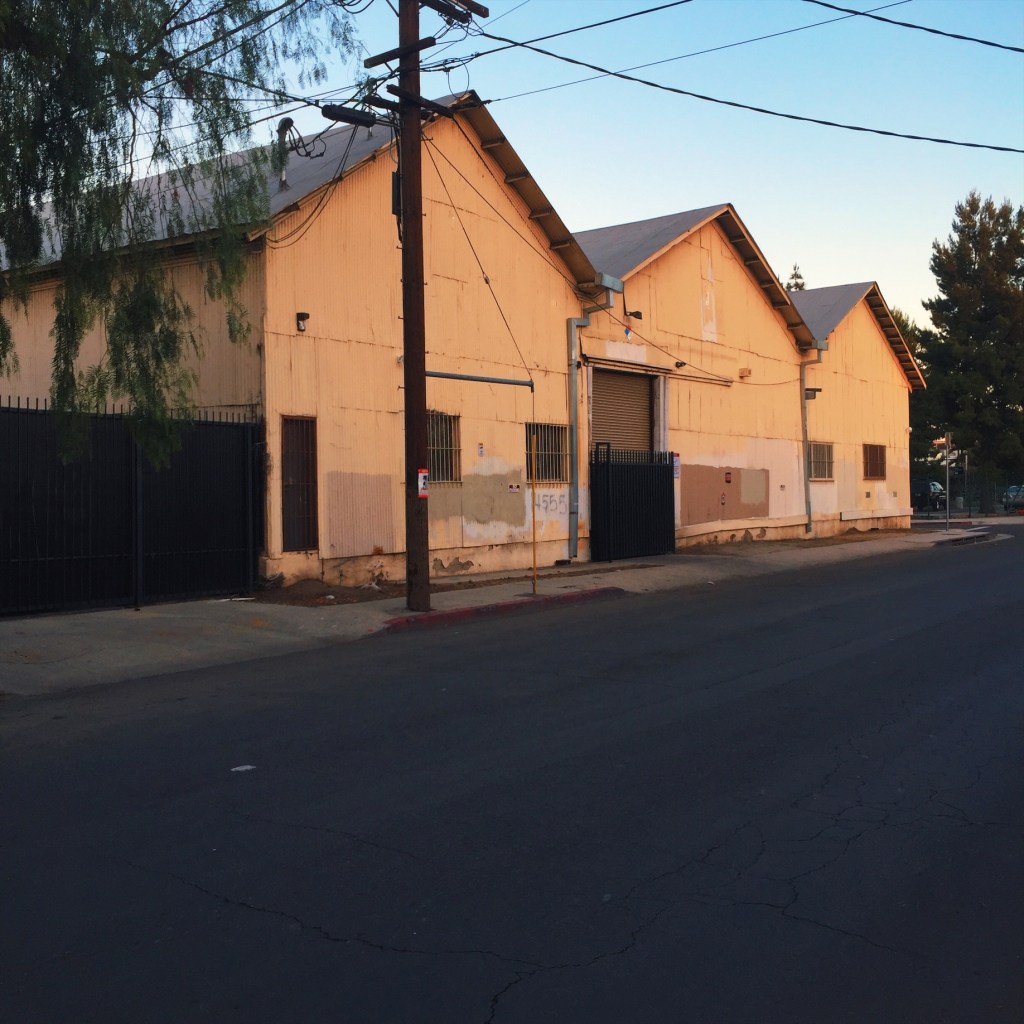
Valley Feed and Fuel


14551 Bessemer St. (Photo by Andrew B. Hurvitz)
Map 14551 Bessemer

On the NE corner of Bessemer and Vesper, here in Van Nuys, there is a steel walled storage warehouse with three pitched roofs.

Unmarked with any signs, it seems to have been there many years, and is characteristic of structures that once stood alongside rail lines to receive and to send out produce, grains, and manufactured products to faraway markets.

I dug up information from the city and found that “14551 Bessemer St.” was built in 1922, at a cost of $4,000, for the Fernando Feed and Fuel Co. It stood alongside the freight lines and was serviced by a dedicated Southern Pacific rail spur that went right into the property.

6/22/1922: 14551 Bessemer St. Van Nuys, CA Dept of Buildings Application

By 1925, chicken ranches were a big business in the San Fernando Valley, with an estimated 1,000,000 laying hens in the valley producing some 12 million eggs at a gross return of $5 million dollars. (In 2019 dollars, about $72 million.)

A 1925 LA Times article said that the Fernando Feed and Fuel Company started in 1916 as a feed store, but grew, in nine years, to 1,500 customers, large and small. Several other facilities for warehouse storage were located in Owensmouth and Van Nuys with a crew of 45 men and 15 trucks delivering feed and other orders to customers.

Chicken ranches, on one, two or five acres were a type of housing development that sprung up all around Southern California. They allowed families to feed themselves and also make a living selling chickens and eggs. At that time, other orchards grew oranges, walnuts, lemons, avocados, asparagus, and strawberries. 

A 1916 LA Times article praised “rose lined Sherman Way” (later renamed VNB) and the white feathered leghorns that dotted recently established (1911) Van Nuys.

“White Feathered Leghorn” Chicken. (source unknown)

Scientific work to bolster the agriculture industry and  promote poultry farming was often shown. 

In 1920, a four-day poultry institute was given at Van Nuys High School, by Prof. Dougherty, head of the poultry division, college of agriculture at U of CA, under the auspices of the LA County Farm Bureau and the Van Nuys Poultry Association.  A vaccination to fight chicken-pox was demonstrated there. 

Entrepreneurs and peripatetic innovators flocked to Van Nuys to raise chickens in advanced ways.

At a five-acre ranch on Woodman Avenue, in 1925, a recently transplanted Englishman, JCF Knapp, who had run plantations in Sumatra and India, had finally realized his lifelong dream to become a poultry farmer in Van Nuys. His operation had the capacity for 4000 chicks, and Mr. Knapp confidently asserted that he had not only a successful business model but a new kind of assembly line efficiency [for producing Grade A chickens on the scale of Model A’s.]

Also in 1925, WW Todd Realty Co. reported that a new set of chicken farms, totaling five acres, were to be built on Ranchito Av. near Tulare St. in Van Nuys. Some 100,000 laying Leghorn hens were expected to arrive in the valley within six months. 

[Ranchito Av., for the geographically ignorant, runs parallel to Woodman and Hazeltine, halfway between both. I found no modern maps with a Tulare St. however]

A 1920s aerial photograph of downtown Van Nuys shows the Fernando Feed and Fuel storage warehouse and the combination of commercial buildings along “Sherman Way” (renamed in 1926 Van Nuys Bl.) and orchards that were planted right inside the middle of town. VNHS is in the upper center/right of the photo. (below)

Van Nuys Feed and Fuel 1925, view NW

The chicken farms of the 1920s, which boosters never stopped boosting, gradually died out when the Great Depression hit after 1930 and sank agricultural prices.  By the late 1930s, suburban development came to the San Fernando Valley, and during the war (1941-45), industrial and defense plants, soldiers, military hospitals and the urgencies of war supplanted the rural way of life raising chickens. 

After 1945, the San Fernando Valley was the fastest growing place in the world, and every acre of land was transformed by housing developments, shopping centers, and car centered designs. 

The chicken farm, with its odors and mosquitos was now a menace, and housewives in Reseda were scared to let their children play outside.

Lost in the stories about the chicken farms is an old America that valued challenges and thought itself capable of surmounting them.  Poor, barely educated and hard-working people came here and somehow transformed Los Angeles into an advanced city that also grew its own food and sold off the surplus to an amazed and grateful nation.

Van Nuys, once a proud and admired center of advanced agricultural innovations, committed civic suicide. It destroyed its downtown by ripping up diagonal parking, widening the road to freeway widths, removing the streetcar, tearing down old buildings and replacing them with empty plazas and zombie moonscapes of trash and concrete. It embarked upon decades of laying down asphalt and laying out the red carpet for criminals, malcontents and derelicts.

Porn, marijuana, prostitution, bail bonds and slumlords were the largest industries by year 2000. Hopelessness replaced optimism and dystopia seized this district like an incurable disease. 

And politicians were thought worthy, not for their works, but only if their last names ended in the letters S or Z.

At least we have the Internet to thank for a glimmer of what it once was.

Demolition Days.


Across Van Nuys this winter, they are demolishing some large buildings.

Prominent among the big, ugly ones now being hacked away and dumped into large containers, is the former Wickes Warehouse Furniture Store on Sepulveda Blvd. north of Oxnard.

The white, windowless, concrete structure, which housed perhaps the world’s ugliest collection of overstuffed and ungainly furniture, was “going out of business” for many years now. Down to only a few 15-foot leather sectionals, Wickes was doomed. Death came quickly. And the little old lady in Burbank cried for days in her beloved Barcalounger.

Located next to the Busway, on land where Metro once promised to develop housing near the bus, it is near many acres of unused Metro parking, within sight of Wendy’s, Costco, Fatburger and the Chevron oil storage yards. The enormous parcel could be the future sight of a walkable, green, agricultural and urban mass transit project.

But this is not Japan or Switzerland, Dubai or Chile, Italy or France, Canada or Australia, Malaysia or Singapore, India or China.

This is the United States of America. There is nothing we can accomplish if we keep talking and keep electing Congress. We talk big and build small.

To refute other’s grand visions and my own authorial imagination, this promising parcel will face insurmountable hurdles. Those obstacles will include tens of millions of dollars in legal, environmental and political challenges. Surely, it will one day emerge resplendent…..as an asphalt parking lot, perhaps to be rented by Costco for the convenience of its customers.

Chevrolet R.I.P.

On Van Nuys Boulevard at Burbank, near where they have just planted eternally green Astro-Turf, the old Chevrolet dealer building is a carcass of bent metal, piles of stucco, and spongy insulation hanging on steel rafters like just killed sharks on dockside hooks.


This is another prominent corner, where Van Nuys Boulevard becomes Van Nuys, and where the street is eight-lanes wide, full of cars and trucks who out-speed each other. No pedestrian enjoys walking here. The sad people on plastic benches, who wait so many hours a day for the bus, they are watched with pity by those sitting inside their car.

The Piano Store Reborn

And on the NE corner of Van Nuys Boulevard and Burbank, the former piano store, where no shopper shopped and no pianist played, has been emptied and is now under construction to become something that is only one story tall, on a street whose width is five times the height of any building on it.

Retail watchers are anticipating the opening of something small and forgettable!
The excitement of waiting for monotony has whetted the appetite of many a passerby.

What will open here? A yogurt store! A nail salon! Or maybe another uniform store! Nothing with any imagination or ambition would dare show up here or it might suffer the fate of the ¾ empty Smoke City Market down the street.

It is like 1939 again in Van Nuys. The Depression is ending and the ones with money are tearing down, speculating, building and buying at depressed prices, banking on a recovery that will once again make Van Nuys safe for bad cooking and fast cars.

The Holdouts.


Not far from my house in Van Nuys, there is an unimproved street without gutters or sewers, where the blacktop was probably laid down 80 years ago, past large parcels where grew walnuts, oranges and figs.

On Columbus Avenue, there are perhaps five properties of 20-30,000 square feet each. Most of the houses are rented, ramshackle places with overgrown weeds, dry grasses, cyclone fences, trucks parked on the meridian, and slanted roof cottages housing lawful people and unindicted felons who hide behind tall lumber and cinder block and eek out a living as gardeners, actors, piano tuners and truckers.

Up until the last wave of prosperity crashed into itself, speculators had bought up some of these places, intending to tear them down and stack together stucco developments.

Some of these places, which nobody can sell, might be worth $300,000. But a few years ago they were asking $700,000 and now the owners are defaulting and trying to unload their gambles.

I rode my bike last week and passed a man who I see once a year at my neighbor’s Christmas party and he invited me into his compound where I met dozens of cats, picked figs off the trees, and walked into a Depression Era scene that might have come out of Bonnie and Clyde.

While we talked, another man, a younger man, carrying a Canon DSLR, walked up the very long driveway, and joined us. He was a location scout interested in photographing the place.

There is a lot of filming in our area. A show called “Workaholics” is shooting here now, on a street where many people are jobless but where some young post-collegiate comedians posted a Youtube video and sold a show to Comedy Central.

One might drive past the Workaholics House and see a horse and carriage, or a rowboat tacked up on the roof, and on other occasions I may have seen an elephant hosing down a car, and some old lady with a broom chasing straw hatted kids on skateboards.

Every other week, dozens of trucks and hundreds of crew- members come here, and film a fiction about life in Van Nuys, using our real world as a cheap and ironic backdrop for the callow humorlessness of modern hip Hollywood.

My idea of funny is still “The Dick Van Dyke Show” or “All in the Family” just as my idea of a film is “The Best Years of Our Lives” and my favorite singer is Frank Sinatra and I don’t think any house built after 1945 is attractive.

So I live in the past and I run from the present and wander through this city with a camera and a laptop computer. And hope that someone will anoint me with gold dust.

And escapism, and the ability to dream and imagine, and produce and prosper, that is only for a lucky few in Van Nuys.

The rest are holdouts, living in rented places, or hanging onto places they own but will never own and may lose before they die.

For photographers and graphic artists, not a pretty picture out there – latimes.com


For photographers and graphic artists, not a pretty picture out there – latimes.com.

Culver City Mazda.


Culver City Mazda.

Photo: Here in Van Nuys

Very soon, sooner than we might imagine, there will most likely be hundreds of dealerships, all over California, whose vast acreage will be emptied.

People are simply not buying or leasing as many cars. Auto companies are not producing. There is a depression in the car industry.

What can we do with the leftover land underneath these closed dealerships?

I wish that these enormous plots of oil soaked asphalt, which once existed and thrived as a testament to our voracious hunger for cars, would somehow be converted back to orange groves or some agricultural use.

Culver City has a wonderful farmers market, that comes here Tuesday afternoon. What if this “progressive” city were to tear up this defunct auto dealership and plow its asphalt into dirt and grow organic fruits and vegetables here?

Humans will always need to eat. Our appetite for the gasoline powered automobile is not eternal.

Can the Rich Make it?


Photo by Andy Hurvitz March 2009 Studio City, CA.
Photo by Andy Hurvitz
March 2009
Studio City, CA.

Can the Rich Make it?, originally uploaded by here in van nuys.

For the past decade, this domestic scene was unremarkable.

An enormous modern home with a three-car garage.

Somehow we imagined that this was attainable and desirable.

The market goes down and down and nobody know where it will settle.

Speculation in stocks and housing has now proven to be good for very few, and a losing scam for millions more.

So, one has to wonder: can the rich make it?