Best Boxes


On the west side of Columbus Avenue, between Hamlin and Kittridge, are some six contiguous properties that were subdivided in the 1930s and, until this year, remained largely undeveloped beyond their original single-family homes.

Their combined total square land footage is 156,035 SF with the properties ranging in size from 19,931 SF to 27,783 SF.

The backs of all these properties face the rapidly redeveloping Sepulveda Boulevard corridor with its new white apartment towers looming overhead into the old ranches.

In all the years I’ve lived here (since 2000) Columbus Avenue was a blight, a ragged and torn sleeve on the arm of neatly pressed neighborhood. No sewers, no sidewalks, and helicopters that flew overhead weekly.

There was the drug house, the abandoned house, the house that stored 100 inoperable vehicles in back. There was the foreclosed house, and the house that put up a paved parking lot in its backyard.

There was the vagrant who moved into an empty house and put a moat of 50 trash filled shopping baskets around the property to keep out intruders. There was a completely empty property whose owner was happy to hang on because his taxes were $400 a year and his house with broken windows was worth $500,000+.  

There was another property with a mad dog that sometimes went out and menaced other dogs and people and was kept by undocumented immigrants who ran a nursery and installed artificial grass . That is still going on.

All of these semi-criminal and wholly-criminal activities were reported to law enforcement, and eventually some of them found their way into the court system, but correction, penalty and punishment are often wrist slaps or take many years to enforce.

______________________________________________________

Now there is development in earnest. 

It’s 2019 and even Van Nuys deserves to have what Studio City got in 2013, and West Hollywood in 2009.

Mr. Boaz Miodovsky of Ketter Construction is putting up four modern garages with attached houses along 6537. They will have their own private road, Solomon Lane.  

And Mr. Nick Shoshan of Innovation Design and Construction bought 6505 and is demolishing the single-family home there, dating to 1936, and erecting four houses.   They once kept horses here, another neighbor grew walnuts, there were backyard pools, lemon, orange and lime trees. Now this parcel will have four houses and two streets and look west into the back of a seven-story apartment building.

6505 is next to the dead-end street where Hamlin once cut through to Sepulveda before it was walled off, in 1994, and the public way sold to the Kar Fung Company which owns the 99 Ranch Market “Signature Plaza” shopping mall.

Preposterously, 6505 will have to build its own private street because Hamlin Street is no longer available as a public way. It is owned and supposedly maintained by Kar Fung, though they have allowed it to denigrate into a tagged, trashed and overgrown weed lot out of utter neglect and indifference.

The new houses at 6505 will be bookended by two streets, one in their front yards, and one in the backyards.  The owner, Kar Fung Company, for reasons only known to God herself, has never wanted to sell their section of Hamlin Street to anyone.

Incidentally, Kar Fung Company is run by Angela Chen Sabella, who is the daughter of “Chen Din-hwa (simplified Chinese: 陈廷骅; traditional Chinese: 陳廷驊; pinyin: Chén Tínghuá; 1923 – 17 June 2012). He was a Hong Kong industrial tycoon, billionaire and philanthropist. He was known as the “King of Cotton Yarn” in Hong Kong.[2]”. When he died he had a fortune of over $2.6 billion dollars.  Which may explain why money to paint the shopping center or repair the 1994 cyclone fence on Columbus is quite impossible to come by. 

In Van Nuys, the vast majority lives close to ruination, but absentee slumlords who live in Bel Air, Beverly Hills and Hong Kong squeeze out money from a community starving for investment and civic decency.  What could $50 million from Kar Fung could do to alleviate the homeless blight in Van Nuys? 

To imagine what could be done with proper architectural designs over the totality of Columbus Avenue with its 156,035 SF is to entertain dreams of parks, of gardens, of towering oak trees, fountains and benches surrounded by nice homes. The way they might have built in South Pasadena in 1910.

But instead, it will go the low-brow, ugly way, the only path that ever gets paved in Van Nuys, with cheapish houses along asphalt driveways, stuck along Columbus Avenue like a pocket comb. These boxes will be so compressed, and so tightly sited, that there will be no room for shade trees. And overlooking every private property will be hundreds of prying eyes from new apartment dwellers.

Parking for cars will be provided in the two car garages in each home, but if you have lived in Los Angeles long enough you know that 90% of all cars are never parked in garages. On my street, me and my partner are the only residents who use their garage for auto storage.  It will transpire that each new home will have four drivers, and a garage full of belongings, and guess where the vehicles will sleep every night?

If this were a well-run city of neatness, law, order, and regulations (which it is not) then new housing would be a great blessing. But as it drops around here I know the future.

The new residents will probably include renters, perhaps four or five unrelated adults sharing a home, paying $1500 each so that the owner can pay off their $5,000 a month mortgage on their $900,000 house.   And these private lanes will have gated entrances, understandably, because it takes two hours for LAPD to respond to anything other than murder.

I don’t have all the answers, I’m merely describing reality as I see it in front of me.

We desperately need new housing in Los Angeles, but does it all have to come forth like this?  Aesthetically dismal, organizationally atrocious, environmentally destructive.

Van Nuys: 2030


In 2030, Van Nuys is expected to complete perhaps as much as $3 billion dollars in new construction. Offices, apartments, multi-family dwellings, parks, schools, health care facilities, all of it is going into that area between Oxnard and Sherman Way along Van Nuys Boulevard.

A light rail line, carrying 50,000 passengers a day, travels down Van Nuys Boulevard, and a unique partnership of politicians, multi-national industries, local artisans, architects, planners and residents has come together to upgrade and invest in the area.

The Republican Mayor, Juanita Sanchez Garbanzo (b.1988), elected in 2028, is the daughter of immigrants, and is a strong, well-educated, imaginative leader who lived in Los Angeles during its worst period from 2010-2025, when trash camping by tens of thousands of derelicts was promoted by city government, and astonishingly, all types of illegalities were turned into law among them health care benefits for non-citizens, and voting privileges and drivers licenses for unlawful residents.

Sanchez-Garbanzo, and her wife, Alexa Siri O’Really are the proud parents of two self-described young boys, Martian, 3 and Vendo, 5, and live in one of the new developments along Van Nuys Boulevard near Kittridge. “We don’t think being a gay couple means supporting policies that make the city a slum. In fact we believe that being progressive means encouraging small business, and plenty of new housing for all people,” Alexa said. “We believe that law abiding citizens who respect each other and the city are the foundation of a civilized nation.”

Crime has dropped significantly since the the LAPD added 25 new officers in Van Nuys and boosted the Los Angeles police force by 5,000. Security cameras monitor people who walk and drive in the area, and there has been a drop of 75% in felonies and misdemeanors since traffic enforcement raised moving violations fines to $4,000 for red-light running and $2,500 for speeding. Van Nuys Boulevard has also benefited from bike lanes, and traffic modifications that put walking, biking and light rail in the same category as private vehicles.

One of the interesting multi-cultural additions to the area are Koban stations which are LAPD booths modeled on Japanese style law enforcement. They are inserted into the street life, rather than the old LAPD station in Van Nuys which stood half a mile back from Van Nuys Boulevard in a forbidding building. The idea for the Koban stations came from Lisa Kinoshita-Horowitz, an architect from Reseda who studied law and architecture in Kyoto in the 2020s. She brought the idea home to LA and proposed it to her good friends, the Mayor and her wife.

With investment strong in Van Nuys, and the whole area coming along as an experiment in density, bike/train/walkability, real estate values are booming. Houses that sold for only $4 million last year, are now going for $6.5 or even $7 million. But there are also some 11,000 new housing units for rent in the area, and landlords are offering three months free rent to new tenants.

23-year-old writer and cyber security actor Gretchen Dynamanski grew up in rural Nebraska but always dreamed of living in LA. She was thrilled to find a community of young, creative people in Van Nuys and the fact that she can get around the city without a car, and even ride to LAX by light rail and monorail convinced her to move to Van Nuys. “I think Van Nuys is probably the most gorgeous section of LA and I love what they are doing here,” she said.

Mayor Sanchez-Garbanzo says part of the reason Van Nuys is thriving is because the mayor herself lives right here. “When you are in power, frankly, it’s important to put yourself right in the area where you can make a difference. Someone offered me a mansion in Hancock Park, and I turned it down. I want to be where I can help my constituents and live with them on a day to day basis and know what struggles and what triumphs they are experiencing. As a mother and a wife and a professional, I share those stresses and hopes and dreams with all my beloved people in Van Nuys. And I am thrilled that our work has really paid off!”

(All photos in this essay come from the website Architizer.)

Van Nuys: City of Parking Lots


Between Oxnard and Vanowen, on either side of Van Nuys Bl. fully 75% of the land is taken up, not by buildings, but parking lots.

Near Oxnard, on both sides of the Busway, parking lots are used mostly for storage of unsold, new cars from nearby Keyes dealerships.

Along the civic center, there are enormously underused concrete parking lots, several stories high, built in the 1960s.

Civic Center Parking

Moving north, beyond Vanowen, near Kittridge, there are wide open parking lots behind shuttered businesses where perhaps 25% of the spaces available are used for cars.

Think about these parking lots when people complain that Van Nuys is too crowded, that we don’t have room for more apartments, that we don’t have space to house homeless persons, that we cannot find room for parks, that we simply don’t have land for urban gardens or nature spaces.

Think about these parking lots, see them in your head, when people complain that there is nowhere to park, that we spend too much time in traffic, that our air quality is low, that we are baking in a hot area where there are not enough trees even as the Earth warms.

Our Lost Vitality


Sepulveda and Erwin, Van Nuys, CA.

Housing, it seems, is everything these days, the foremost topic on the minds of Angelenos. 

Those who can afford it fear those who cannot.

Fearsome, it seems, is our ragtag army of many thousands of un-housed vagrants who have established anti-communities out of shopping carts and tents, and made bedrooms, bathrooms and living rooms out of bus benches, trains, bridge underpasses and alongside our freeways. Covered in dirt and tortured by circumstance, pulling three bikes with two legs, they remind our fortunate ones that life often goes bad even for the good.

3/5/18 Bessemer at Cedros.

SB50, the state proposed override of single family zoning, struck terror into the hearts of many in Los Angeles who feared that the single family home, housing twelve unrelated people, might soon be replaced by twelve unrelated people in four houses on one lot.   

“Leave it to Beaver” (circa 1959) the imaginary ideal of Los Angeles.

“Leave it to Beaver”, “Dennis the Menace”, “Hazel” and the rest of the 1950s and 60s back lots of Columbia and Warner Brothers are how many, now aging, but still ruling this city, think of Los Angeles, and how it should look. 

When Dennis the Menance came home he didn’t enter into a lobby with an elevator. When Dr. Bellows drove up Major Nelson’s street, it was clean, tidy and sunny. 

Home of Major Anthony Nelson, “I Dream of Jeannie” (1965-70)
The cast and crew of the remodeled “Brady Bunch” home in Studio City, CA. (HGTV)

HGTV is now remodeling the real life home in Studio City that was used as the location for Mike and Carol Brady and their bunch, recreating in reality a 1970s home, inside and out, following an architectural blueprint from the set pieces of an inane, 50-year-old television show that seemed saccharine the night it premiered in 1969.

It is heartwarmingly creepy to see the now white-haired kids throw a football in an astroturf backyard, retirees feigning juvenile excitement as a synthetic reality show impersonates their old sit-com and pumps new advertising blood out of Geritolized veins.

____________________________________________________________________________

Woodley Park, 2018.

But life is not a syndicated sitcom. What’s on TV is not what’s beyond our windshield.

We live in Los Angeles, and die a bit here, day by day. The city is getting worse in every imaginable way: housing, health, transportation, taxes and education.

Homeless on Aetna St. Feb. 2016

On the roads, in real life, in 2019, cars are now parked and packed alongside every obscure street because it takes four working, driving adults to afford one $3,200 a month apartment.

Building more apartments doesn’t mean more cars, it simply means less apartments. And less apartments means more rent, so Los Angeles keeps eating itself up in contradictions of cowardice and myopia.

__________________________________

Japan

As I travel around Los Angeles and see all the enormous parking lots and one-story buildings alongside eight lane wide roads, I wonder why we are so unable to build enough houses to house everyone.

California is not nearly as crowded as Japan, yet that country ingeniously designs small dwellings that artistically and creatively provide homes for every type of person.

On the website Architizer, I found the work of a firm called Atelier TEKUTO.

Homes shown on Architizer by Atelier Tekuto are really tiny, but they are built solid, with each dwelling quite individual in style and form, an irony in a country where every black haired man coming from work is dressed in a white shirt and dark suit.

But Japan somehow pulls together the artistic and the structural to provide enviable and well-designed homes in well-protected, spotless communities. Violence is rare, except yesterday, but nobody goes out at night fearing random mass shootings, it is safe to say.

We can’t, or should not, want to remake the depravity of our dirty, violent LA into clean, peaceful, obedient Japan, with its fast trains and scrubbed sidewalks, but we might borrow some of their ideas. After all, we conquered them in 1945, can’t we take home some intellectual souvenirs?

Imagine if Van Nuys took the courageous and innovative step to redo the large, unused parking lots behind all the abandoned shops on Van Nuys Boulevard with a mix of little houses like these and perhaps some larger structures several stories high?

What we have now is this:

Don’t we have a Christopher Hawthorne now, Chief Design Officer, working under Mayor Gar[BAGE]cetti? Former architecture critic at the LA Times, he may know one or two architects from his old job. Perhaps Mr. Hawthorne can take action?

What have we got to lose? 

We are so far down in quality of life that we must engage our energies to pursue a remade Los Angeles.

A city that does not harm us but lifts us up.

As Japan shows, you can have enlightened ideas without living alongside mounds of trash and outdoor vagrancy.

There is no logical connection between toleration of outdoor garbage dumps and political tolerance in general. In fact the worse our surroundings get, the more people will turn right and maybe even hard right.

New Housing at Old Bank.


Last week, the LA Planning Commission approved 179 townhomes and 8 low-income apartments built partially out of the old North Hollywood Savings and Loan (later Chase) Bank at 4445 Lankershim Bl. at Riverside Dr. according a recent story in the Daily News.

The 1961 building will be readapted for residential use, and include over 5,000 SF of ground floor commercial space along with 263 car spots and 237 bike spaces. The architect is Winston Chang, principal of Next.

For years I have driven past this building as I traveled on the 134 or along Riverside Drive. 

Curious about its history, I dug up some old LA Times articles.

Roscoe W. Blanchard, Sr. (1882-1977) owner of the Blanchard Lumber Company, founded the North Hollywood Savings and Loan in 1923 when the San Fernando Valley was in its earliest boom days. 

Here is his 1977 obituary:

After WWII (1945), the boom in residential building made the bank prosperous, and in 1960, with over $40 million in assets, they announced a new $2 million dollar, six-story tall skyscraper with 73,810 SF of space. Earthquake resistant and fireproof, it was also the tallest structure in the San Fernando Valley. 

In a 1963 ad, the bank stated they would pay depositors 4.80% interest, a tidy amount for the time. In 1969, they promised 5% interest for new deposits.  Those were the days when a person could save money by opening a savings and loan account, and count on a guaranteed level of annual growth.

But the go-go 1960s ended with a decline in the Los Angeles realty boom. And the days of a secure savings and loan specializing in residential housing loans was numbered.

A Feb 9, 1969 LA Times article entitled, “Realty Boom is Fading as Prices Stay Stable” lamented high interest rates of 7-8%, and the inability of many families to afford the average $25,000-$35,000 SFV home, with more than 2/3 of SFV families earning less than $10,000 a year.

Overbuilding in 1965-66 had resulted in rental vacancies of 22% and almost 2,000 new homes unsold. One-third of the new, un-bought homes in Los Angeles were in the San Fernando Valley.

In 1969, both rents and residential prices fell as supplies increased, a widely accepted fact of economics which seems to have been forgotten by modern Angelenos who believe that building more housing is only for “greedy developers.” 

But back when the developers were allowed to develop, this was the result:

1970: In Woodland Hills, the average rent was $172, the highest in the Valley. 

Encino had the most expensive homes, averaging $50,000 in value.[1]

Today we have this:

According to CoStar, the price of an average apartment in the Woodland Hills sub-market—which includes Warner Center—stood at $2,200 per month. 

In 2018, Redfin said the average Encino home was $980,000.

In 1979, Proposition 13 froze property tax rates at the original level a home was sold at, not currently assessed at. Lucky owners of homes bought in 1974 for $40,000, which became $300,000 properties in 1980 (or $3,000,000 in 2019) were still taxed at 1974’s $40,000 purchase price. 

The tax rebellion was partially a white reaction against the increase in illegal migration and resentment in paying taxes for darker complexioned students. Today, most people who can, drive their children out of “bad” school districts to “good” ones thus exacerbating our air pollution and traffic problems. 

People who once rode the bus now take Uber or Lyft, thus exacerbating our air pollution and traffic problems.

We don’t build enough housing. Our housing is in short supply because many of the occupants here don’t legally have a right to be here. But that is stating what should not be said.

Part of our hypocrisy is being liberal and being racist and wanting good education for our children. And none of these traits can co-exist in modern Los Angeles without being hypocritcal. This is not an indictment, just merely a statement of fact from speaking to white parents who live on my street in Van Nuys and drive their kids out of the area to attend school.

The great shortage of homes in Los Angeles began its 40-year ascent and has now culminated in the lovely sight of human beings, unable to afford shelter, sleeping under bridges and along sidewalks. 

Mental illness is blamed for some of this but I wonder how mentally healthy I would be after eating out of garbage cans and sleeping in an alley for a year.

That some of the fortunate inheritors of parental properties, and low property taxes, are also some of the biggest opponents of new residential construction, especially in wealthy sections of Los Angeles, is a cruel irony. 

In the 1980s, the Savings and Loan crisis, brought on by government policies that bankrupted local S&Ls, resulted in the consolidation of many small banks into the large regional ones such as Chase or Bank of America.

In 1976, North Hollywood Savings and Loan was incorporated and merged into San Diego’s Central Federal Savings and Loan Association. 

So in the next few years, a building that once housed a savings and loan which played an instrumental role in lending money to young families buying homes in the San Fernando Valley, will become itself a home for some 179 families, (and 8 units or 4% of the total units will be low income).

Los Angeles, here in Van Nuys, and here in North Hollywood, and all around the city, will move along and build expensively and sluggishly until its leaders accept that it must become denser, higher, and less car dependent. An enormous push for more affordable and multi-modal transport accessible housing is paramount for our survival as a viable metropolis. 

Because we don’t build enough housing, we cannot afford to live in areas we might want to, which leads to more segregation and more bitterness and more helplessness in a city where homelessness is never far off and being housed is conundrum of insanity and indebtedness.

That we need to build more was something Roscoe W. Blanchard, Sr. would have understood with his expertise and success in building materials and financing homes 100 years ago.

We are trapped between the reality of our city and our dreams of its potential. We know what it is. We see this place with our own eyes.

But we really don’t want to accept its degraded condition, or the responsibility for how grotesque, unequal, cruel, barbaric and sadistic it often is. To look at the ugliness in this city we would have to accept that ugliness in ourselves. And why we make illogical and self-destructive choices and choose prerogatives that hasten the decline of Los Angeles.


[1]Valley Population Near Million; Growth Slows

–LA Times, April 29, 1971

The Insane Present


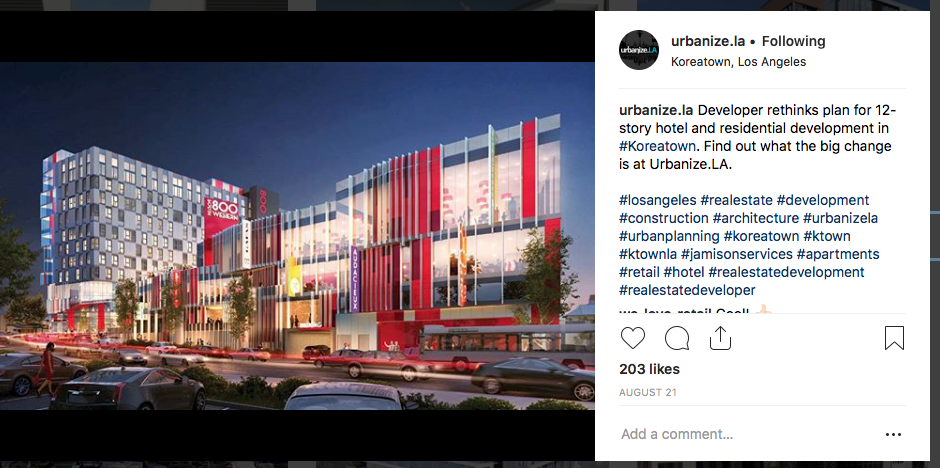
“Next week, the South Los Angeles Area Planning Commission will consider an appeal of Buckingham Crossing, a proposed small lot subdivision near the Expo Line.

The proposed development from Charles Yzaguirre, which would replace a single-family home at 4011 Exposition Boulevard, calls for the construction of four small lot homes.  The houses would each stand four stories in height, featuring three bedrooms, two-car garages, and roof decks.

Los Angeles-based architecture firm Formation Association is designing the project, which is portrayed as a collection of boxy low-rise structures in conceptual renderings.

The appeal, which was filed by residents of a neighboring home, argues that the project does not comply with the City of Los Angeles’ Small Lot Subdivision guidelines, and have bolstered their case with a petition signed by nearby residents, as well as a letter of opposition signed by City Council President Herb Wesson, who represents the neighborhood. 

However, a staff response notes that the project was filed with the Planning Department before the new regulations were adopted, and are thus not subject to them.  The staff report also rejects claims that the four proposed homes would increase traffic congestion and create a “‘wind tunnel’ spreading toxins” through the passing of Expo Line trains.”-Urbanize LA

_____________________________________________________________

As this blog has shown, many times, we live in a city of homelessness for those who cannot afford a home, or are too sick to attend to the normalcy of paying rent.

At the same time, the dire need for housing continues to be opposed by vast segments of the city who will take any proposed multi-family dwelling, even one as small as four stories, and attach some fear-mongering lawsuit against it.

The condition of Los Angeles in 2018 is comedic in its insanity, with ostriches of all sorts screaming about “overdevelopment” inside the second largest city in the United States, a spread out sprawl of parking lots and shopping centers where residents complain about lack of space, lack of parking, and too much traffic. Yet lack the political and moral will to remedy an ongoing tragedy.

These same NIMBYs oppose even the tiniest increase in density, along light rail lines and public transport, refusing to allow the city to progress economically and logistically, and also, quite cruelly and callously, perpetuating the expensiveness of all housing, by limiting its supply.

One-hundred years ago, Los Angeles was a much more modern and progressive city than today, a place where tall apartments were welcomed, possibly because they looked aristocratic, well-proportioned, and they brought economic growth and well regarded architecture to a growing city starved for development.  They wore their best European tailoring, even if they were overdressed, because they had pride and self-worth and a city which respected those qualities.

By contrast, many of today’s multi-family dwellings are self-effacing, timid, obsequious, broken up into many little pieces to ward off attackers, erased of any individuality or identity.  So even when the architects surrender to the bullies, that cannot mollify the attackers. The NIMBY mob wants the city to stay exactly as it is, even if that means that 100,000 people sleep on the sidewalk every single night.

Imagine the screaming in Encino or Palms or West Adams if anybody proposed the old styles seen below next to any existing single family homes. (source: LAPL)

Chateau Elysee