Option A: Good News From Nury.


Options B, C and D
Option A: Destruction of 186 companies and 58 buildings and 1500 jobs.

Over the past few weeks, this blog has been engaged in enlightening the community about a potentially lethal plan, proposed by Metro, to construct a light rail service yard over the graveyard of 33 acres of businesses radiating NE from Oxnard and Kester.

“Option A” would bulldoze four blocks of small, family run companies, employing over a thousand people, demolishing 58 buildings and as many as 186 companies. This walkable, affordable, diverse area would become a vast zone of silence, blocks from Van Nuys Boulevard, and diminish hopes for a revival of Van Nuys which light rail could bring.

I met a group of fascinating entrepreneurs who build fine cabinetry, record music, restore vintage Vespas, repair racing boats; and service, sell and refurbish antique Ford Mustangs. I toured impressive shops and interviewed artisans who make exquisite glass and fine decorative metals forged with advanced machinery and human hands.

These people are overwhelmingly locals, they own or rent homes nearby, many chose to live here to be close to work. And they are first or second generation immigrants from Mexico, Armenia, Lebanon, Germany, and Norway as well as Reseda, North Hollywood and Lake Balboa. They are all struggling to make a living, but many are doing very well, and some own their buildings. Others rent space, but pay reasonable prices and would be finished if they were forced out.

All along I wondered why their elected representative, Councilwoman Nury Martinez, was not acknowledging their plight.

Now it seems she has heard the cries from people who are in fear of seeing their livelihoods decimated.

Jim Dantona, Chief of Staff for Ms. Martinez, sent me an email today. Attached was an official letter from the Councilwoman’s office to Metro in which she lays out why she opposes “Option A” and thinks “Option B” is a better choice.

Written in political diplomatic politesse, it acknowledges that the most negative impacts will fall on the “Option A” neighborhood. The word “impact” is used often, to describe the ruins of businesses…..just as our federal government concocted the phrase “collateral damage” to describe non-combatants killed in war.

“Option B”, near the existing Metrolink train tracks and Van Nuys Boulevard, is a far more sensible place to construct an additional train yard. New train yards fit best next to old train tracks.Metro will not make an official decision until January 2018. But for now, Councilwoman Nury is no longer silent. She has voiced, in print, her opinion that Option A should not happen.

Option A: An Open Letter to Ms. Sheila Kuehl


“Sheila James Kuehl (born February 9, 1941) is an American politician and former child actor, currently the member of the Los Angeles County Board of Supervisors for the 3rd District. In 1994, she became the first openly gay California legislator and in 1997, she was the first woman to be named Speaker pro Tempore in California.[2] Kuehl most recently served as a Democratic member of the California State Senate, representing the 23rd district in Los Angeles County and parts of southern Ventura County. A former member of the California State Assembly, she was elected to the Senate in 2000 and served until December 2008. She was elected to her supervisorial post in 2014. In her capacity as Supervisor, she also sits on the Metro Board, First 5 LA, and is the County appointee to the South Coast Air Quality Management District.” – Wikipedia


Thursday, October 26, 2017

Metro Los Angeles Board

Re. Metro “Option A” Plan for Light Rail Yard in Van Nuys


Dear Board Members:

As you are aware, Metro Los Angeles is planning to erect a light rail service yard in Van Nuys. “Option A” is one of four sites proposed by the agency.

“Option A” would seize land NE of Kester and Oxnard, along four blocks, covering 33 acres, and demolish 186 buildings straddling the Orange Line Busway. For the purpose of this letter the area will be called “Kesterville.”

We are vehemently opposed to this plan. Here is why:


  • 186 small, family run businesses, employing an estimated 1,500 workers, occupying affordable, mostly rented space would be destroyed.
  • It would leave a gaping hole of emptiness blocks from downtown Van Nuys, obliterating plans for a denser, walkable area.
  • Option A will take out yet another engine of well-paying, highly skilled jobs and products, made in America, employing many immigrants and local residents.
  • It needlessly destroys a successful, close-knit pocket of creativity and commerce, manufacturing, and makers of unique goods and services found nowhere else in Los Angeles.
  • It will reduce fair priced, rentable industrial space in a city starved for it, in an area that is already served by public transport and contains more affordable housing.
  • Option A will subtract from the city what it is seeking to promote region wide: affordability, mobility, economic innovation, small business, local industry, ethnic diversity, and community cohesiveness.
  • The Van Nuys Neighborhood Council opposes Option A.


Within this dense, vital district are found a historic music recording studio, a maker of top quality metal hardware utilizing 3-D printers and advanced machinery, several fine custom cabinet builders and their craftsmen, an expert stained glass artisan whose work embellishes homes, churches and historic buildings, a restorer of Vespa motorbikes whose facility is the only one of its kind east of Pennsylvania, and a 20,000 SF shop where vintage Mustangs are serviced and restored. There are painters, carpenters, builders, and experts repairing racing boats, and several professional recording studios for musicians.

MacLeod Ale, a craft brewer of UK style ales, opened in 2014 and has become a highly successful and respected beer maker. They are located on Calvert St. adjacent to the Option A area.

Kesterville is a place of creativity, productivity, sustainability and viability. Organically, without government coercion or corporate ownership, it is an incubator of ideas and products. It has been alive for decades, growing more prosperous and doing well in the heart of the oldest part of the San Fernando Valley.

If Kesterville is destroyed, it will recall the most heartless obliterations in Los Angeles history: the razing of Chavez Ravine for Dodger Stadium, the flattening of historic Bunker Hill for corporate behemoths, and the bulldozing of West Adams for the Santa Monica Freeway.

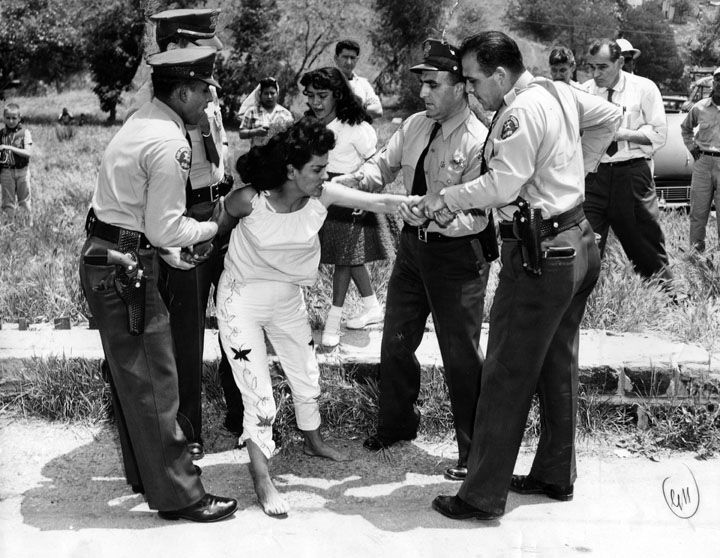
Dodger Stadium, 1961. On land formerly housing poor Mexican families at Chavez Ravine.
1959:Evictions from Chavez Ravine.
1959: Families are Forcibly Evicted from Chavez Ravine to Make Way for Dodger Stadium.
1935: Boys in Chavez Ravine

Van Nuys has already suffered social, economic and environmental neglect. Why compound the injury by robbing it of yet another burgeoning and blossoming area that could become a new district of small businesses, restaurants, cafes, and even urban, in-fill small housing?

We urge you to respond to this civic emergency by opposing “Option A” and the demolition and eviction of sound businesses that support many thousands of families struggling to survive in a brutal time of economic insecurity.

We are in favor of light rail, and public transportation in general, but ask that it be constructed with greater sensitivity to the community so that it is compatible within the urban landscape and causes the least amount of damage to communities within our city.

Sincerely,

The Business District of “Option A”

Van Nuys, CA

91411


The Battle of Alta Loma Terrace.


In early 1964, Steven Anthony, 33, a Barney’s Beanery bartender and ex-marine, his wife Elona, 22, and three young children, Steven,2½ Deborah, 1 ½ ; and Pam, 5 months, were living, just south of the Hollywood Bowl, in a bucolic 1920s English cottage at 6655 Alta Loma Terrace.

Then they were served with an eviction notice. And told to vacate their home because it stood in the way of a proposed $6.5 million Los Angeles County-Hollywood Museum.

(2017 Dollars: $51,492,200.65)

When LA Sheriff Deputies arrived Saturday, February 8, 1964 to evict the family, Mr. Anthony, “cradling a shotgun in one hand and a baby in another,” held the deputies at bay for seven hours and won a reprieve to stay in the home for a few more weeks.

The case of the shotgun wielding marine, Brylcreemed, burly and courageous, seems to have captured the support of his neighbors, and sympathy from a wide variety of Los Angeles, a city, that saw a little guy battling forces bigger and better financed.

If the Sheriff returned to evict him, Mr. Anthony promised that he would have a dozen ex-marines at his side. His attorney, Paul Hill, filed a brief with the US Supreme Court. While the motion was being considered, deputies were told to stay clear and allow the law to adjudicate.

LAT/LAPL


The county argued that the new museum was a public project and they had the right to seize an obstructing private home. A jury awarded Mr. Anthony $11,750 for his “half” of the home but he thought it was too little. He sent his wife and kids out to Big Bear City while the matter boiled. The US Supreme Court turned down the review.

Now Mr. Anthony waited….

On the evening of Monday, April 13, 1964, as the 36th Annual Academy Awards aired, Mr. Anthony welcomed two “pals”, ex-marines he thought, into his home, along with a woman, and another attorney. The bartender trusted the men because he had met them at Barney’s Beanery, and later at a Young Republican’s meeting where he was honored.

At the same time, some 30 deputies, and a moving truck, all under the cover of darkness, gathered outside.

Quickly, Mr. Anthony was slugged in the jaw by one of the “marines” (really an undercover mercenary), taken down, law enforcement stormed the house and he was taken into custody and jailed. The ruse finally got him.

LAT/LAPL


The movers quickly emptied the house, and the structure was soon demolished. Neighbors raised money for bail and Mr. Anthony was released. But he was soon put on trial.

He was sentenced to serve six months in jail, and afterwards he sued the county of Los Angeles for two million dollars. His family moved up to Sonora, in central California, where he made a living building houses. Tragically, in 1976, his 15-year-old son Stephen fatally shot himself.


After spending $1.2 million for a public-private venture with film mogul Sol Lesser, a three-man committee, headed by the late financier Bart Lytton, decided the Hollywood Museum project was unfeasible and would not pay for itself.

In a 1976 interview, Mr. Anthony, who was even accused of having Communist sympathies for standing up to the so-called law and the so-called Hollywood elite, said: “Wherever we go, people mention it. But we had to fight the system. Otherwise they’d take anything they want under eminent domain. We were harassed, just like in a Communist country.”

LA Times 12/8/1976

It seems quaint now, really, to imagine a lone, shotgun-wielding bartender holding off law enforcement, if only to keep his house and family intact. The lethality of modern weapons, the electronic spying tools of our government, the drones, the copters, the smart phones; in the militarized nation of America, would this drama, re-enacted today, ever end so peacefully, a potential mass killing tripped up by two phony men play acting?

What seems even more improbable today is that anyone would demolish an artsy English cottage in the Hollywood Hills. Anyone lucky enough to own one would probably be a millionaire. The fight, if any, would be over the house: who could keep it, who owned it, who could restore it.

Timing is everything in life. A family was evicted, they lost their home, they had to move out of the city. And the museum that instigated the exile was never built.

Yet a parking lot was.

It’s a fitting memorial for Los Angeles. The car always win in the end. We have no controversial statues to pull down. Our history is the parking lot. It rules over us all.


SaveSave

SaveSave