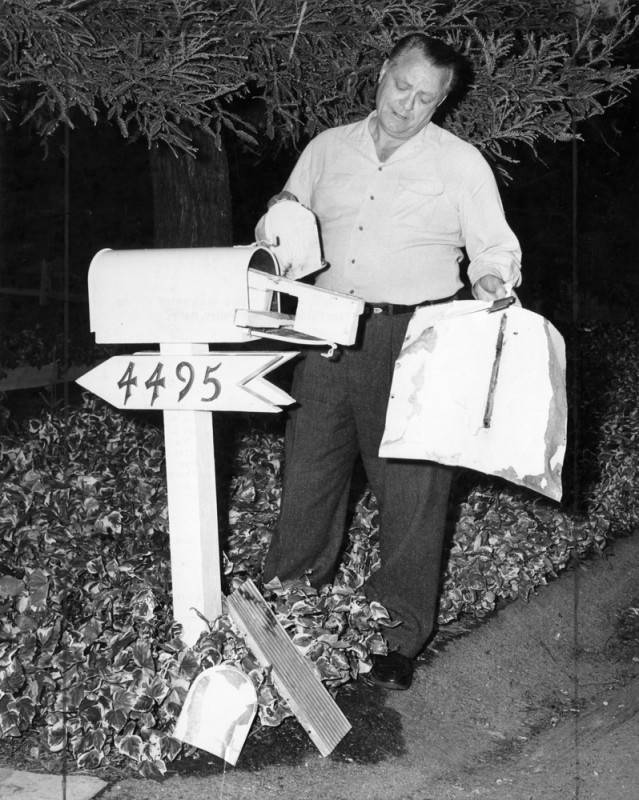
Exploding Bomb in Encino Mailbox.


Photograph article dated March 9, 1961

“Exploding mailboxes in an exclusive Encino residential neighborhood are arousing a vigilante-type reaction in some homeowners. The latest victim, Frank A. Fuller of 4495 Libbit Ave., whose mailbox was blown from its curbside mounting Friday by some kind of explosive, said: “I own this place, I pay taxes and I’m going to protect myself and my property.”

The explosive that shattered Fuller’s rural-type mailbox was powerful enough to hurl the tin-sheeting across the street, throw part of the mailbox onto the roof of the Fuller home and splinter a two-inch thick piece of wood.

Mr. Fuller, West Coast representative for three Philadelphia-based electronics firms, said the exploding mailbox was part of continuing vandalism that has plagued his neighborhood.”

Source: LAPL

Sunday Errands


Yesterday, Sunday, there were no evident calamities around us. Tragedy took a day off. The air was clear from fire smoke, some blue showed in the sky, and we went for an air-cooled drive around our San Fernando Valley behind tinted windows and masked faces.

We passed Woodley Park, once a bird sanctuary, now just a burned-out bunch of fields with blackened pieces of wood and broken fences, shopping carts of trash and an air of war, desolation and defeat. 

There was the farm stand at Tapia Brothers and we stopped to buy tomatoes, Anaheim peppers, carrots and peaches, standing six feet away from other masked shoppers. Pulling out of the dusty lot there were two choices: drive somewhere else or go home. We chose the former.

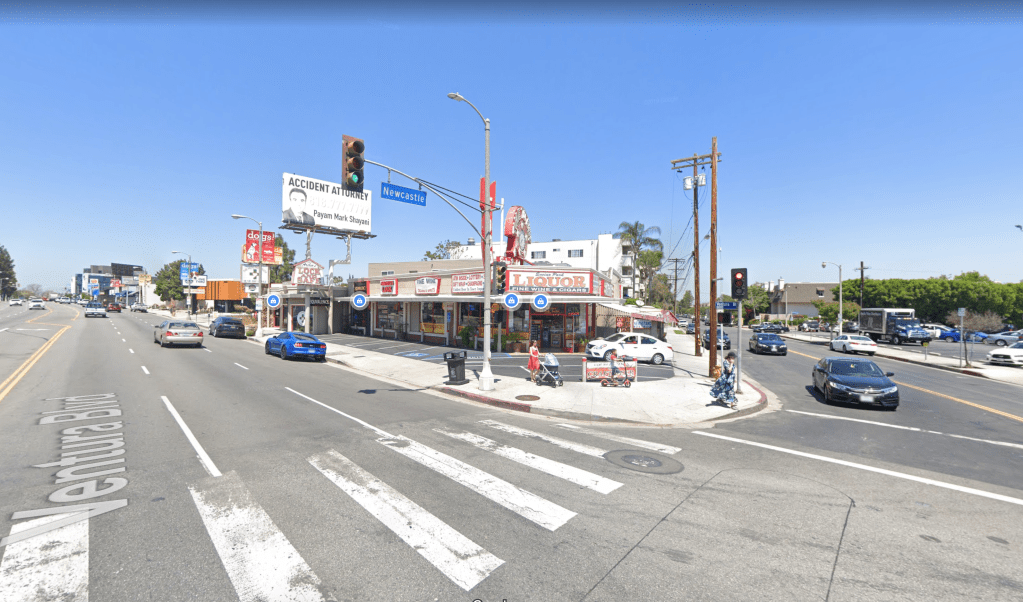
We went for a drive west along Ventura Boulevard through Encino and Tarzana, past those billboarded and plastic signed points of shlock and tackiness beloved by many, demoralizing in a good year, demoralizing in a bad one.

At Newcastle, groups of Jews in masks, yarmulkes, and tallit, walked with prayer books, dressed in their Rosh Hashana suits and dresses. A mentally ill Black man, without a shirt, danced obliviously in front of the liquor store as the faithful passed by him pushing baby carriages, on their walk home.

Further west, a homeless woman emerged from a tent parked along a concrete channel behind the prow shaped Encino/Tarzana library, temporarily closed. A blue sign hung along the fence on Ventura, “NO DUMPING: This Drains to Ocean.”

We drove all the way to Shoup Avenue in Woodland Hills, a district of Los Angeles where people once moved to get away from everything bad in the city. Under the 101, dozens of men and women were set up in a trash camp, living under tarps, in tents, the public sidewalk their front lawn.

At Woodland Hills Park, where Uncle Paul, Aunt Frances, Cousins Barry, Helene, Julie, Jason, Delaney and Courtney, spent many days of the past half century in the world of juvenile baseball and softball, homeless RVs parked. I wonder what flowered apron and blue rubber gloved Aunt Frances, who died in 2012, would say. She kept a spotless house, even telling me she would not eat dark raisins because they reminded her of little bugs. 

“Oh, Andy you’re so funny,” she would often say.

We turned down Erwin Street just to look at the corner ranch Aunt Frances and Uncle Paul bought for $63,000 in 1973. Uncle Paul is 99, a widower, still living there. The stucco is faded pink, there are bars on the windows, and Zillow estimates the house could fetch close to a million. Property taxes are about $800 a year, eternally fixed at the purchase price, a good deal for the retired soldier who fought at Iwo Jima and Leyte Island.

We didn’t go in but I thought of the inside I first saw in July 1974.

The Barcalounger, the brown carpet, the brown paneling, the yellow wallpaper, the cottage cheese ceilings, the dining room with the glass shelved cabinets full of Lladros and ceramic poodles and carved children with fishing poles, a room nobody ate in; the other dark rooms with the Roman shades or pleated drapes always pulled down against the sun, the bathrooms with wall-to-wall carpeting and mylar wallpaper, the rooms full of family photographs, the 1,762 square feet of living space without one book; the air-conditioning that ran year round, and the garage housing the Buick LeSabre, full of power tools and Leslie Pool Equipment, the refrigerator packed with Costco frozen foods, bottles of cold water and diet sodas, the TV always on for baseball and Fox News, these are the moments one cannot easily forget.

Then we turned around and drove east along Victory Blvd. passing the empty weed infested parking lot at temporarily closed Pierce College. We drove down Winnetka to get to the 101 and again passed another encampment under the freeway, more men and women living outdoors without housing in Los Angeles. 

When I go out these days, leave my house for a drive, I am in another nation, not my own, a scarred and withered place of broken people, angry and exhausted, in a city unclean and unjust. And ominously, seemingly, frightfully just about ready for a violent revolution. 

Last Night I Left My Smart Phone at Home. And it was Glorious.


Last night, I did something quite daring. 

I left my smart phone at home, intentionally, and it was frightfully glorious to go out, un-tethered. 

I felt guilty, as if I were doing something quite illicit, not certain if I were violating the law, or taking advantage of my own autonomy by robbing tech companies, influencers, governments and corporations of a means of controlling me. I was alive without geographic monitoring, without something measuring my drive time, my mileage traveled, my steps walked, my calories burned.  None of my actions or activities would be used to sell any product, and nothing I did or said or saw was promotable when my phone and I were apart. 

On the road, it was just me in the car, behind the wheel, foot on the accelerator and the brake, going where I wanted to go, without mechanically voiced narration.

Childishly, I used my sense of direction to find my way, going back to those old 1960s concepts of navigation through landmarks, buildings, and street signs. I hadn’t a drop of alcohol in me but I was drunk with liberation, with the thrill of looking out the windshield the entire time I was behind the wheel! It was an extraordinary feeling!

Later, I learned that while my phone was off Rachel Maddow was tweating about climate change, and my cousin Ryan was completing his yoga degree in the Bahamas, and my niece Ava was on a hike in Marina Del Rey, and Jesse Somera, model, was eating eggs for breakfast at the Hotel Piranesi Duequattrosei in Milan.

I drove to California Chicken Café on Ventura Bl., about two miles from my house in Van Nuys and I went there without my phone, turning right on Victory, and left on Sepulveda, and right on Ventura, completely without voice or visual guidance.

I parked in the lot and went into the restaurant and ordered food, paid, sat down, and had nothing to do but look and think and wait.

Then the food came. 

I ate my salad, chicken and rice without an electronic device, and it was a revelation of existence, an empowering feeling, that I, a lone human in his own life with his own tastes, appetites, desires, and freedoms was allowed to go and have dinner and go about my night without notifications popping up every two minutes.

I dipped my chicken leg into barbecue sauce and ate buttered rice and stared at my food. And then I looked around at other people, and all the things I saw were right there in front of me and actually existed in their living form and material substance.

I was a freed slave and only I knew it.

Enslaved people walked into the restaurant staring at their phones, and they waited to order looking at their phones, and they walked to fill their water cups looking at their phones, and they sat down at the table and waited for their dinner to arrive while looking at their phones.

Outside the sun was setting and the golden rays were hitting the red bricks of St. Cyril of Jerusalem Catholic Church across the street. But I took no photo, because I had no phone, so I merely observed it. I watched the act of sunlight on a building without capturing it and storing it on a digital device.

Service was slow at California Chicken Café and they forgot my whole-wheat pita and I was tempted to post a review on Yelp, but I had no phone, and no app to open, and my private reaction to the gross disappointment of the missing pita bread was not posted online.

Back home, the dead phone was still off, and still plugged into the wall. 

And urgent, unseen messages from the actor’s agent directing me to shoot “shirtless” and “sexy” and “six looks” went unseen and unheard and unanswered for another twelve hours until I woke up the next morning.

With the phone still off, I knew nothing of the 39 strangers on Instagram who liked my photo of an orange tree. I heard nothing about the story on Next Door of that poor woman on Kittridge Street whose cat went missing, and I missed out on that long string of an argument about homeless people in Woodley Park, and I didn’t read that article Andreas sent me about a conservative activist who was once a leftist, and I didn’t answer those messages from Beth about what movies were worth watching on Netflix in July. 

I washed my face and brushed my teeth and turned off the light and did not look at my smart phone before retiring.

Before I went to bed, I turned on the fan and opened the window and the bedroom smelled of mint and lavender and I could hear the sound of the water fountain on the patio.

And then I fell asleep, and slept only dreaming of dreams that belonged to me and nobody else.

More Postcard Observations


Budweiser FrontBudweiser Back


The Joseph Schlitz Brewery on Roscoe in Van Nuys was an especially popular destination in the 1950s through the 70s.

The adjoining Busch Gardens, with its array of exotic birds and lush waterfalls, was another fantasy environment of natural artifice, like Disneyland or Knotts Berry Farm, a fake beloved world for visitors to Southern California to write home about.

I have scanned many cards (owned by Valley Relics) of the famed gardens, and one in particular caught my eye.

Postmarked March 4, 1960, it was addressed to Miss Donna Friedl, 1921 Maynard Avenue, Cleveland 9, Ohio.


It read:


Hello Donna,


I did not pay for this card they give it to you for visiting the brewery, from Grandpa Friedl.

Something in his wry comment leads me to imagine Grandpa Friedl as a white-haired, humorous, kind man who might have snuck past his wife to offer his granddaughter Donna some candy before dinner.

That was a long time ago.

Nobody has a young daughter named Donna any more.

Busch Front


Fabulous SFV Front

“The Fabulous San Fernando Valley” is another postcard unintentionally funny.

For here is a view of what looks like Sepulveda Boulevard, somewhere east of the 405, (today’s Galleria) with the dam and mountains in the distance, and thousands of cars packed into the foreground.

Fabulous? The grandiose superlatives of Southern California (best weather, best women, best bodies, best schools, best place to live) were spoken of so often, that the actual truth seemed blasphemous. It was, and is, sometimes very ugly here, boring beyond belief, polluted and blindingly plastic. An early 1960s walk up a Sepulveda, north of Ventura, would lead you past auto junkyards and tacky motels, but you were in a “fabulous” place, didn’t you know it?


Saddle and Sirloin Back


Sixty or seventy years ago, many restaurants fashioned themselves as Western places, with steaks on the menu and wagon wheels on the wall.

Saddle and Sirloin was a small chain with “steaks aged to tenderness” and at their Palm Springs location, in 1949, Daddy and Mother were sitting down to eat a steak and found time to write to their daughter Florence in Newcastle, Indiana and tell her just that.

“We’re about to eat a steak, it’s balmy outside,” Mom wrote. Her appetite and her temperature lead one to salacious thoughts. Perhaps she looked like Jane Russell, with dark red lipstick. With love and dinner and hot weather….. could the bedroom be far behind?


Otto's Pink Pig Restaurant Back


Otto’s Pink Pig Restaurant at 4958 Van Nuys Boulevard was another well-known place whose warmhearted postcard promised “Otto’s Famous Baked Ham Sandwich, Best in the US” and “Mike O’Shea’s Special Salad Supreme.”

Their motto: Big Enough to Serve You- Small Enough to Know You.

Eating out, dining in a restaurant, was not done several times a week, as is the case today. People ate at home. They ate what Mom cooked.

So it was a special treat to go to Otto’s and dine on such fare as Filet of Sole Marguery or Roast Long Island Duckling (shipped fresh by refrigerated freight train?).

Hearty, friendly, generous with drink and food, sensibly priced: was it all of those things?

Long gone and obliterated, the neighborhood, an off-ramp of banality, is now home to strips of office buildings, medical offices, and Sherman Oaks Hospital. There is nothing exotic, fun or magical here as there was when Otto’s Pink Pig lived here.


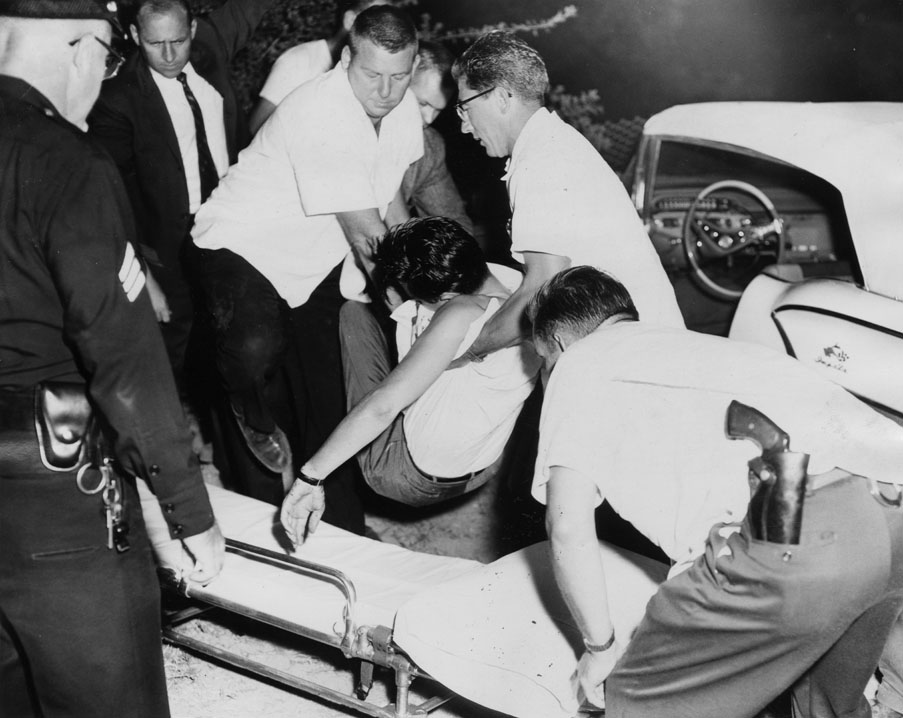
Death Ends Police Chase: August 24, 1959.


00084161

00084159

From the LAPL files:

“Robert Lee Daily, aka John M. Savage, aka George R. Gibb, was being sought in connection with over 60 burglaries in the Hollywood and Beverly Hills areas. He was shot dead by Investigator James McGrath when Daily tried to flee from McGrath in Encino. Detectives carry body of Robert Lee Daily, burglary suspect, from car in Encino after he was shot by district attorney’s investigator when he assertedly tried to get away. Police found nearly $15,000 in loot in his Woodland Hills home.”

Modernity and Kitsch.


I recently came across these 50-year-old photographs by Allan Grant that were published in the November 23, 1962 Life Magazine.

They show a brand new supermarket, Piggly Wiggly,that had recently opened at 15821 Ventura Blvd. in Encino. The structure is now gone, replaced by a long, white office building.

What surprised me most was seeing the blend of modernity and kitsch, an architectural and marketing precursor to present day Gelson’s.

There is a view of the exterior, decorative concrete canopies, very 1962. But in front are also 19th Century street lamps, an old wagon, and even trees.

Signs are in decorative fonts.

Inside there is the astonishing sight of butchers in straw hats and bow ties; in another photo is a large sign: “Foods of the World”; and in one image… diagonally stacked shelves of barware: highball, martini and wine glasses, ice buckets, long tapered candles and ash-trays.

Female clerks, done up in beehive hairdos and made up faces, sell cosmetics beside a Victorian wood turret front display case. Lady shoppers (were there any other kind?) could stop off here, pick up a bottle of Shalimar and run home to take a dip in the backyard pool, then broil some lamb chops, and have the table set before Leonard or Irv pulled up in the driveway.

And behind a glass counter, a behatted chef shows off pots of soups to women in pearls and old retired gentlemen peering over.

A lineup of cashiers, stand in formation under the watchful eyes of their male bosses, next to carriage lamp lit checkout lanes. The girls wear puffy shouldered, black and white dresses with their names embroidered on lace.

These photos are fine testament that they had perfected, half a century ago, the California ideal, blending kitsch fantasy with cold, hard business acumen.