Rebuilding for Sustainable Reasons


The fire ravaged hills of Pacific Palisades and Altadena not only cry out for rebuilding. But cry to rebuild in a better way.

Especially in Pacific Palisades, the only way back (as imagined by those in power) is to rebuild the gargantuan single family home. How these can be afforded, let alone insured, is the new mystery of 2025, for very few will want to spend the next decade constructing McMansions that may burn down in the next fire.

Insurers are fleeing California, as the pool of “safe” properties dwindles, and the rates they can charge are understandably limited. A low cost insurance would not even replace a burned down tool shed.

And then there are the philosophical and political battles raging from those who only want luxury housing to those who believe it is a moral imperative to provide a percentage of “affordable” housing to Angelenos.

Somewhere in the middle is the moderate case to be made for developments that mix commercial and residential in the same walkable community. For here, there may be defensible lines for firefighters to use to battle the next conflagration. Up in the hills, next to the wild lands, is where the greatest danger lies.

The safer alternative is a denser community of pleasant surroundings with apartments and homes near stores, and walkable streets with cafes, restaurants, hardware, shoe repair and bookstores. Yes, we have to make room for Lululemon, Alo and skin clinics, but they should not occupy the entirety of every single commercial space.

There should be a plan for rebuilding in an architecturally coherent way, one that actually puts living residential spaces above the stores along the sidewalk, rather than fake windows as one sees in The Grove and Disneyland.

And if a plan is selected, it should be in styles that evoke what made old California beautiful.

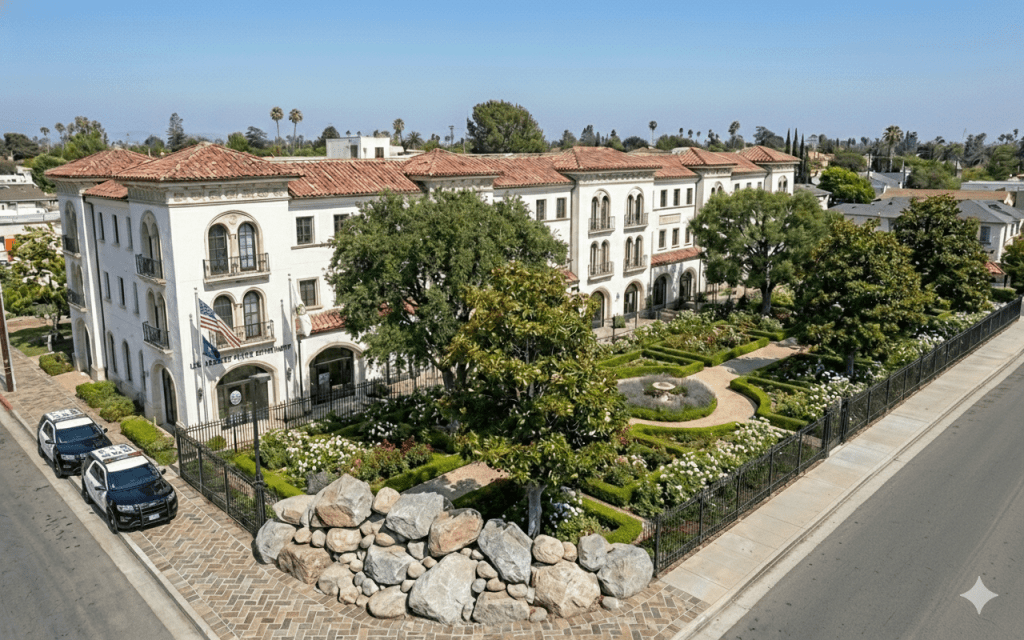
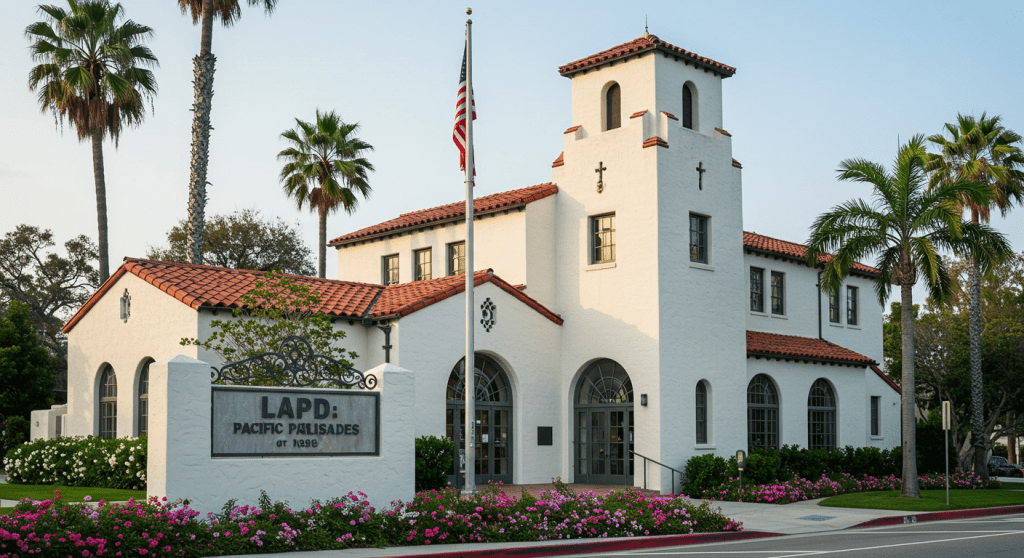
What follows are imagined architectural designs for rebuilt fire zones in Pacific Palisades and Altadena.

Mayor Garbageciti’s Los Angeles


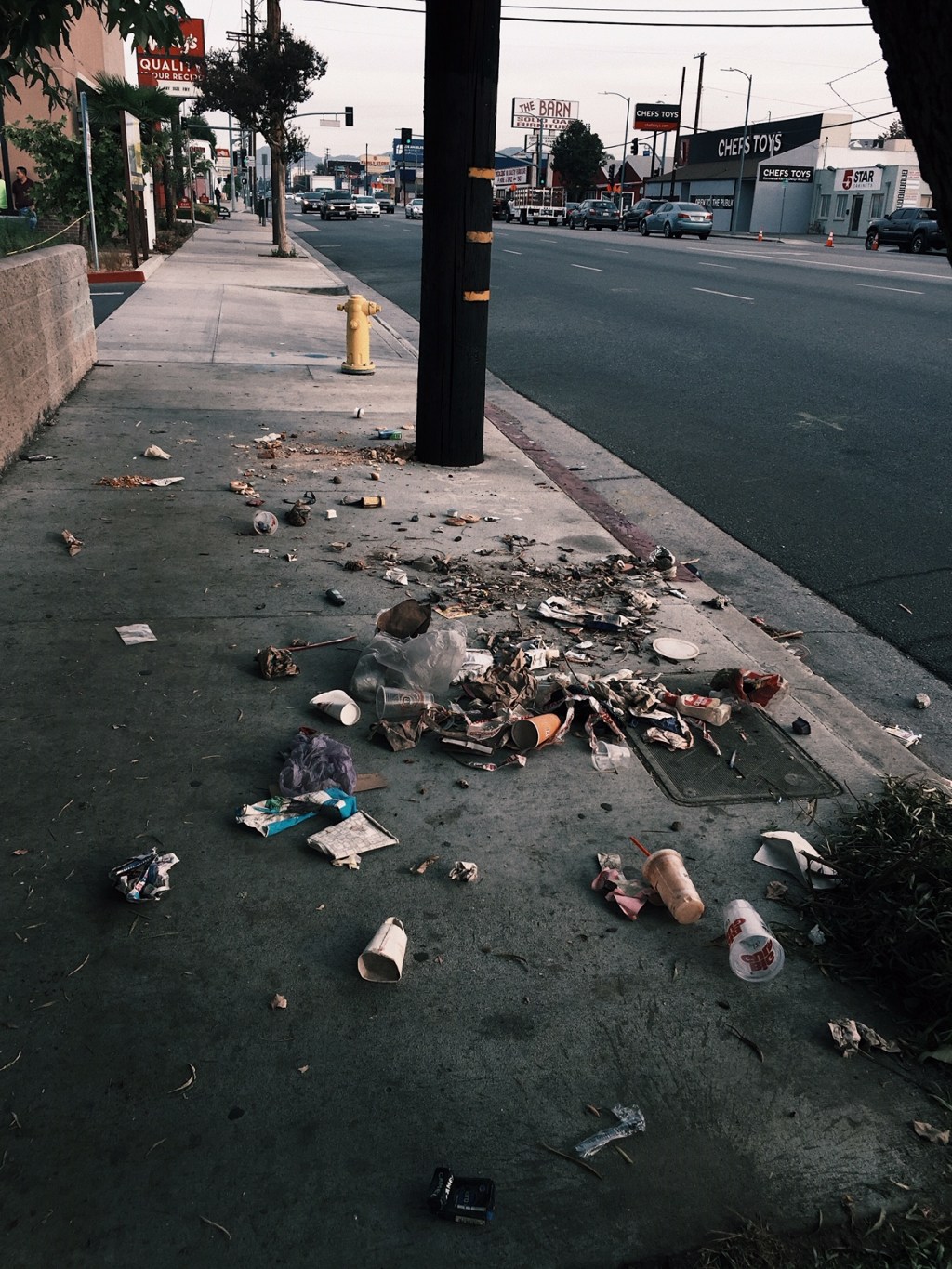
It is probable and likely and arguable that Los Angeles is perhaps the dirtiest large city in the United States.

Gilmore near Columbus, Van Nuys, CA.


Near LA Fitness, Sepulveda Bl. Van Nuys, CA.

New York, Chicago, Houston, Atlanta, Denver, Dallas, Miami: they do not have the amount of illegal dumping, trash, shopping carts of garbage, furniture, mountains of debris and litter in every park, street, and parking lot.

A morning walk to the gym, encompassing half a mile along Columbus, Victory and Sepulveda in Van Nuys brings one past neglect on a large and small scale, from the homeless taking over bus benches, to the non-homeless indifference to sanitation which is a hallmark of Los Angeles.

Los Angeles does not present a picture of a civilized city to anyone. Besides our nightly news of shootings and car chases, we have transformed our environment into a city where it is embarrassing to show visitors around, where the infrastructure, from pollution to transportation to parks, is sub-standard.

Put aside the yellow air, and the starter homes for $1.2 million next to a freeway. Put aside the sprawl of mini-malls and billboards and car washes and marijuana clinics and muffler shops and junk food. Put aside the speeding cars running red lights, the people, one to a car, driving to work at 5 MPH. And, of course, little spoken of…. the morning rush hour of white parents taking their kids to a school 25 miles away from home because the local school is too darkly complexioned for many liberals to bear.

The Bus Bench Near Victory at Sepulveda


Normality in Modern Los Angeles.

Yes, dismiss all that and just focus on the trash, the trash everywhere, the trash that is all around us. 

Are you listening Mayor Garbageciti? Or are you on a flight to somewhere to lay the groundwork for your presidential run?

Along Sepulveda. Nobody’s responsibility.

1949: A $72 Million Dollar Flood Control Plan to Waterproof SFV


Van Nuys Blvd. 1938 flood


Flooded area at Ventura Boulevard and Colfax Avenue in Studio City. 1938 (LAPL)

After March 1938 Flood: Lankershim Bl. looking north near Universal City. Photo: by Herman Schultheis


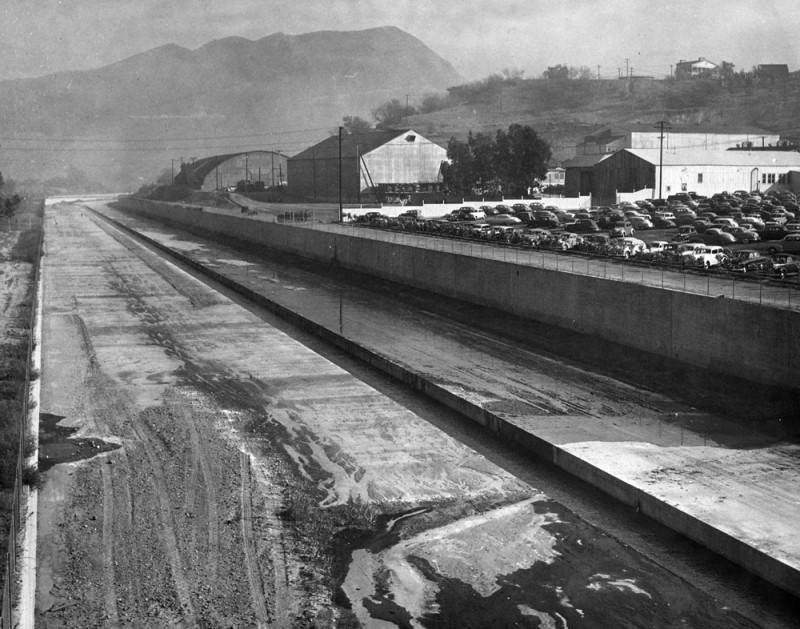
After the disastrous 1938 floods, the City of Los Angeles worked with the State of California and the Federal Government, specifically The Army Corps of Engineers, to encase the rivers of Los Angeles in a waterproof lined concrete sewer to expel waters during the rainy season.

These December 1949 photographs, archived at the LAPL in the “Valley Times Collection”, show the splendid progress of turning natural riverbeds into something distinctively man-made without natural life.  The cost, at the time, was $72 million, which is perhaps $800 million today, but sounds like a bargain, since the Getty Center mountaintop gouge and railroad itself cost $1.3 billion dollars upon completion in 1997 and the widening of the 405 five years ago was a $1.6 billion dollar project that has since added one lane in each direction and shaved 10 seconds off each commuter’s journey.

And let us ponder that our latest crisis, homelessness, will be remedied by taxpayer dollars close to $5 billion.  Not the Federal Government, not the State of CA, but taxpayers, you and me will shell out to well-meaning bureaucrats and post-collegiate interns, $4.6 billion to build housing — 10,000 units in 10 years — and “provide supportive services” for homeless people.  When every person in need on every continent around the world, every down and out person from every state, city and town in the US, Canada and Mexico, arrives in Los Angeles, we will see how well this plan goes down.  It once was against the law to dump garbage in parks, to set up tent cities on sidewalks, to sleep on benches, under bridges, but now this is a behavior eliciting “compassion” because that’s how you are directed and asked to speak of it. You must not condemn what your own eyes tell you is wrong.  Let it grow, let it expand, then create new programs to fight it, until it becomes unstoppable.

A city that once built hundreds of miles concrete rivers to stop flooding, cannot erect temporary shelters and police the filth and disorder and rampant grossness of the ever growing homeless situation. 1949 was a different time, for Angelenos were not intimidated and cowered into attacking threats that endangered the growth, health and well-being of this city.

Lankershim and Cahuenga

Riverside and Whitsett

Laurel Canyon Bl. near Ventura.

The concreting of the LA River in the San Fernando Valley allowed the development of housing right up to the edge of the old slopes. No longer would houses and apartments face potential destruction from heavy rains and overflowing waters.  Soon the freeways would come through, another onslaught of concrete that helped transform the San Fernando Valley from a place of horses and orange groves to one of parking lots and 10-lane local boulevards.

Today, in many parts of the LA River, most notably in Frogtown and along some sections of Studio City, there are naturalizing effects going on, and residents are biking, hiking, and even boating where it is permitted in the once fetid waters of the river.


Can You Tell if a Street is Safe Just By Looking? – Technology – The Atlantic Cities


Can You Tell if a Street is Safe Just By Looking? – Technology – The Atlantic Cities.

Architects in Mexico Design Homes that Help Women and Families.


While America enters what seems like a permanent decline, Mexico, long poor and often derided, is moving ahead with progressive architecture and social innovations.

Adobe for Women is constructing twenty sustainable houses in  San Juan Mixtepec, in the south Mexican state of Oaxaca.

Read more about the project here.

Pedestrian Friendly LA?


Century-City-Condo, originally uploaded by Here in Van Nuys.

From Project for Public Spaces:

“L.A. County has begun to rewrite the “DNA” of its streets with a new Model Streets Manual that will set guidelines to support improved safety, livability and active transportation options.

This effort was supported through a grant from the Los Angeles County Department of Public Health, through its RENEW initiative. RENEW stands for “Renewing Environments for Nutrition, Exercise and Wellness.” It’s inspiring to see a health-focused organization embrace a leadership role in Placemaking by broadening the scope of its concern to include planning for the built environment.

There is a growing understanding that streets configured to support an active lifestyle can lead to positive community health outcomes.

As Streetsblog reports, team lead Ryan Snyder of Ryan Snyder Associates has said the manual is like “the DNA of our streets, and it defines everything from where to place bike lanes to how wide a roundabout should be.”