1975 Los Angeles by Ed Ruscha


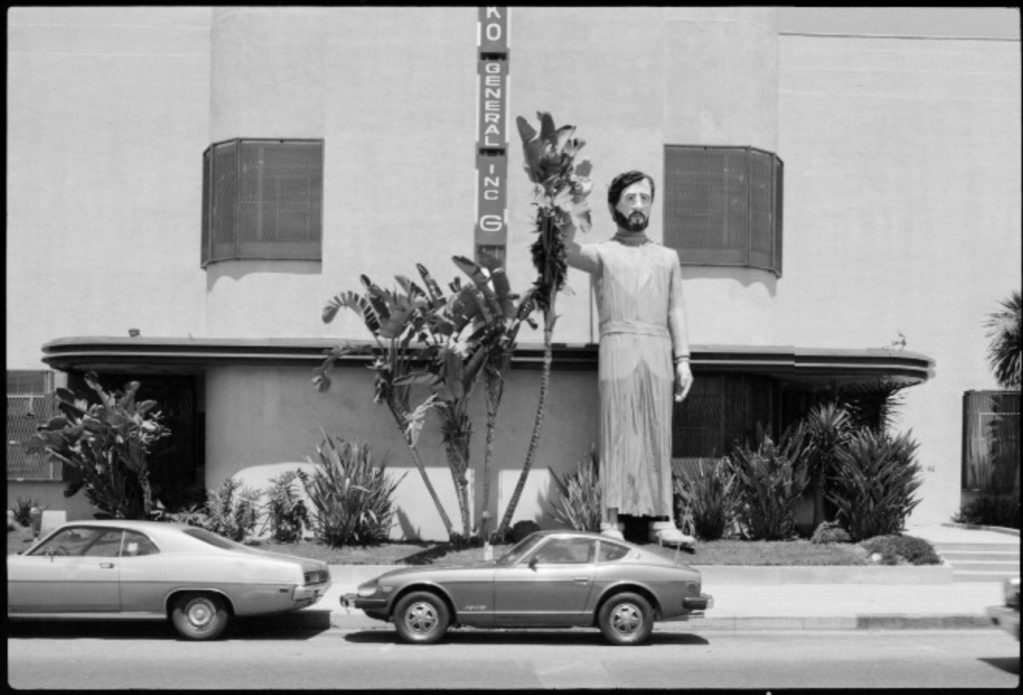
The Getty has 45,856 digitized photographs of Los Angeles by Edward Ruscha.

I went to look at just a part of it, May 1975 (3,724 images). 

There are black and white photographs of entire stretches of streets in our city, for example every structure along Melrose Avenue for miles.

Many who possess far greater insights than I will concoct profundities about these pictures, connecting them to politics or music or the decline of the West.

They will project onto the photos whatever template of modern ideology they wish. 

But I think these photos just are. They are the exact thing they show. And that is what makes them brilliant. For they are the essence of Los Angeles, a homely and free place of ambition and anomie.

There is 3910 Melrose Avenue with a circa 1964 Pontiac parked in front of a 1920s Spanish Style house with arched windows, topiary and a cement walled lawn.

At 7168 Melrose there is a commercial building, with a 1960s decorative screen covering over a 1920s red tiled roof and stucco façade.

Most of the photographs juxtapose car and architecture. That is the recipe. It makes us long for youth, ache for what has passed, and imagine what it might be like to drive a ’74 Camaro down spotless Melrose, listening to a Doobie Brothers 8-Track, and stopping off to pick up a bag of gourmet Brazilian nuts at Iliffili.

Sex was open and advertised in 1975. Cock of the Walk had live sexy males in private rooms. It was next door to Madam’s Cat House with sexy girls in private rooms. If you messed up your clothes you could slip in quickly next door and change into a new pair of old jeans at Hollywood Used Clothing

Bundi’s at 8525 Melrose had stylish looking clothes. Just outside, a bus bench advertises the Jewish funeral services of Malinow Silverman.

Along 8650 Melrose, a 1969 Cadillac convertible, and a 1964 Chevy Impala coupe, are parked on the curb in front of several young, hip stores offering haircutting, needlework, a rock gallery, and Ruthe Lee Richman’s Art in Flowers.

A few doors down, Irving’s Coffee Shop served Pepsi-Cola. What kind of menu did they have ? Imagine your dining choices in 1975 Los Angeles, a 90% white city prior to the mass immigration and cuisines of Vietnamese, Filipino, Burmese, Persian, Haitian, Korean, Guatemalan, Honduran, Brazilian, Malaysian, and Sri Lankan peoples.

Imagine a city where so much was tolerated but where nobody lived under bridges or slept alongside freeways, and bus benches were used by bus riders.

Having trouble sleeping? Stop by International Water Beds. Writing letters to friends? Pick up some custom letterhead at Melrose Stationers. Is your cane chair falling apart? Frank Lew at 706 N. Orange Grove will repair it.

There are a lot of photos to look at. Like everything else these days we compare it to 2020. Even 2019 seems more like 1975 in the take-for-granted-liberties we had before the pandemic. 

And now we close with these lyrics:

Freedom’s just another word for nothin’ left to lose

Nothin’, don’t mean nothin’ hon’ if it ain’t free, no no

And, feelin’ good was easy, Lord, when he sang the blues

You know, feelin’ good was good enough for me

Good enough for me and my Bobby McGee[1]


[1] Kris Kristofferson-songwriter

Janis Joplin-singer

The Getty: Light, Line and Texture.


Getty Textures 3 Getty Textures 7 Getty Textures 12

The Getty Museum is one of those destinations in Los Angeles tourists come to see. I played a tourist yesterday and went there.

I entered into the parking lot via a new automated system where one pays at the end of the visit and no interaction with a human is necessary. It cost $15.

A tram transports you to the top. You ride up in it, like a European, secure in its cleanliness, safety and recorded instructions.

The plazas and the sculptures and the architecture are still here, but the water had been turned off, in deference to the drought.

Getty Textures 17 Getty Textures 18 Getty Textures 22

There were two exhibitions going on which I walked through quickly. One was full of drawings and paintings from the studio of Andrea del Sarto who lived in early 1500s Florence. Exquisitely wrought chalk portraits reminded me of what my father, who studied at the Art Institute in Chicago, used to aspire to.

“Light, Paper, Process: Reinventing Photography” was an exhibition of various experimental, often abstract, tactile printed photographs from dozens of artists. Blotches on one print read, “chromogenic print soaked in Rainbow Lake water.” Another showed concentric circles, still another was shadows, and another drops of black splotches.

These were selected by experts, curated by intelligentsia, and worked in their incomprehensible oddity to expel me quickly.

The rooms where the prints hung were crowded and hot. Suffocation soon got the better of me and I ran out into the light and air as I always do when I visit the Getty.


Getty Textures 32 Getty Textures 36 Getty Textures 38

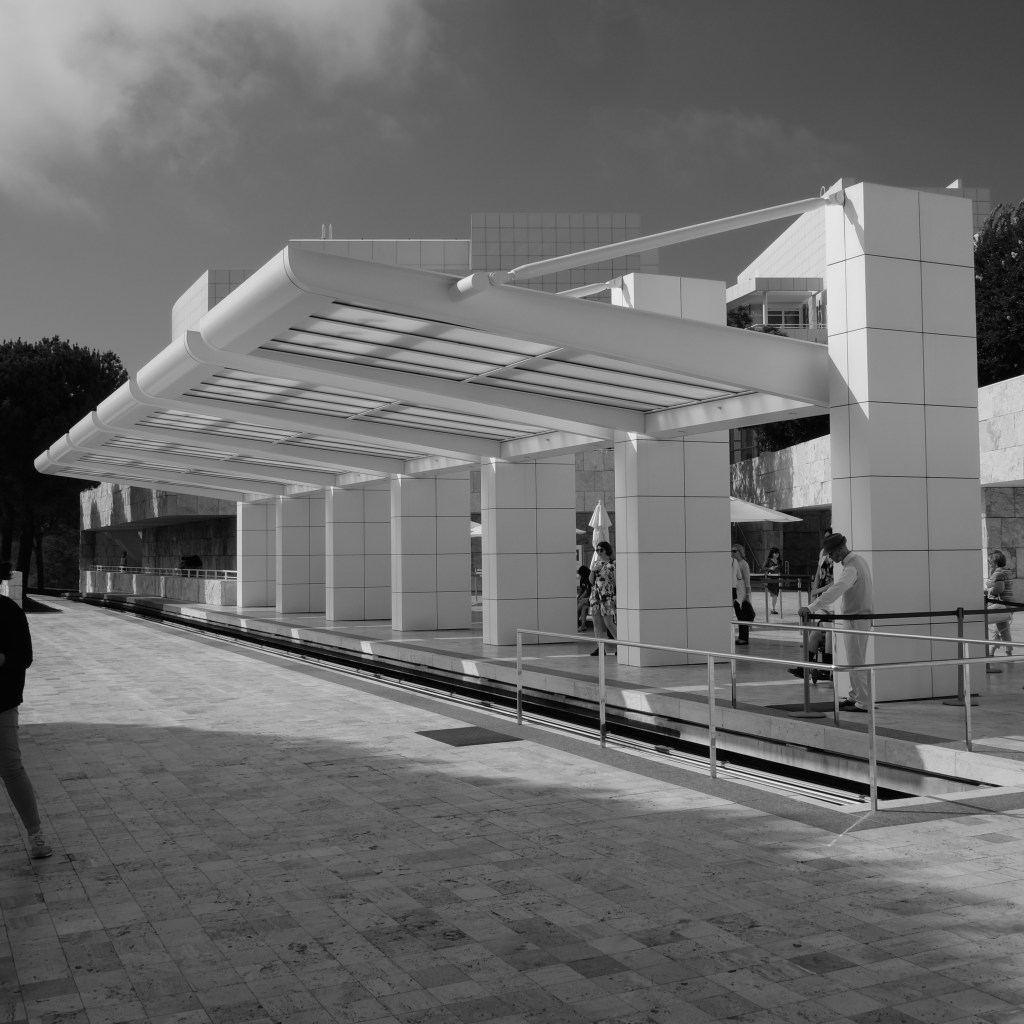
Better to me than seeing French tapestries in dark rooms is to walk outside and observe the light, line and textures of the Getty buildings and grounds.

The Getty design is now more than 20 years old, and just as a 1955 design looked old to 1975 eyes, so the architecture, with its squared and rectangular lines, seems dated in our present biomorphic era of computer generated forms and origami like skins.

Perched on top of the Sepulveda Pass in arrogant modesty, the buildings transformed the rural aura of the pass into something of a gaudy parade of wealth, equaled by the Skirball and its cold, pink, granite towers.

Getty Textures 41
Students from Brazil.

Getty Textures 44
David Cu

Getty Textures 52

The $1.3 billion dollar Getty, whose funds might have worked to transform a gritty neighborhood in South Central into something better, was also used to plant thousands of oak trees along the hillsides. The lands around the museum are now verdant and shaded.

$1.3 billion was spent on the museum. And twenty years later people sleep on the streets of Los Angeles. But art is safe, secure and protected.

Such are our priorities.

But that is another discussion.

There are still, to the photographic eye, many lines and textures and shadows dancing all over the buildings and grounds of the Getty.

These are some I captured.

Getty Textures 53 Getty Textures 61 Getty Textures 65

Getty Textures 78
Alessandro Borsani, Student, Visting from Milan.

Getty Textures 68 Getty Textures 69

Getty Textures 86
Elliott Kai-Kee, Educator

Getty Textures 84