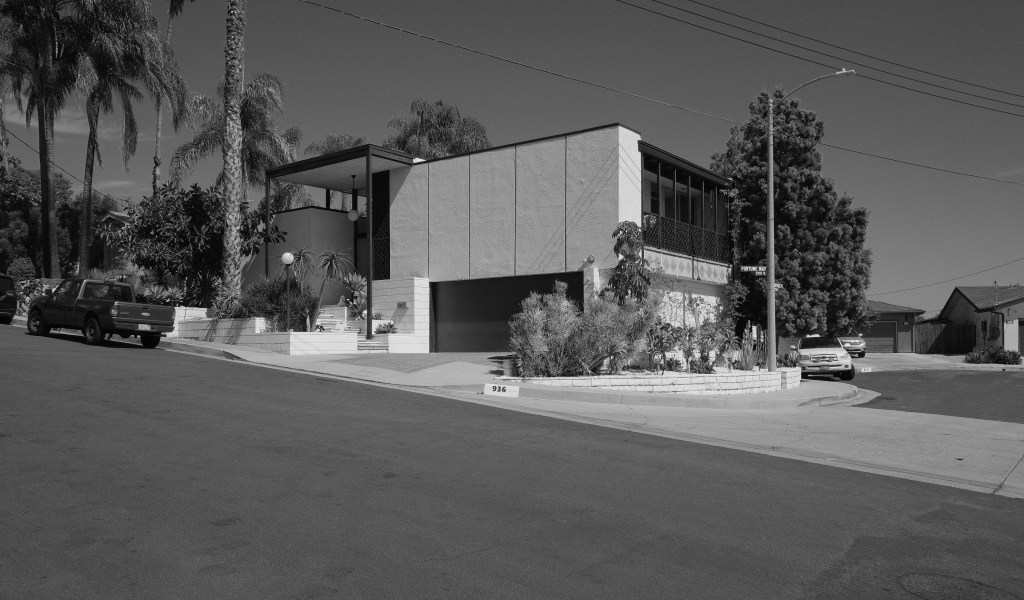
Fortune Way.


Returning from Pasadena last Sunday, we crossed into Highland Park and randomly drove up N Avenue 66, a street along the Arroyo. 

There were old houses, once gracious houses, that a century or more ago were single family residences with wide gardens and porches and plantings. Most had been disfigured and broken up into rooming houses or torn down for crappy apartments in the 1950s.

Climbing into the hills we entered into another sub-district of mid-century ranches on small plots on curving streets, one, perhaps jokingly named Easy Street.

Then we stopped to admire 936 Fortune Way, a 1966 home built for $40,600 by architect PJ McCarty. 

A box on concrete blocks with decorative panels and metal screens, it has a large, flat roofed portico supported by two tall steel posts with hanging globe light, concrete steps and a second floor balcony shaded by the overhanging roof and privacy screens along the rail. 

Though there are palms and desert plants implanted into the blocks, the overall effect of the surroundings of the home is one of deadness in the hot, blinding, relentless sun; lifeless streets without pedestrians, enormously wide for maneuvering and parking enormous vehicles; and the strange, atomized artificiality of suburban numbness, a place where the people are inside in darkness and air-conditioning, on digital devices, high, drunk or napping.

Trained by media to desire and salivate for now unaffordable homes like this one, we don’t often think how very weird and self-destructive LA is, where multi-million dollar houses can exist without anywhere nearby to walk to, without any sense of community, only a coming together to fight crime or development, actions which make people feel better without accomplishing anything significant, lasting or beneficial. 

The Mad City.


Road-rage-1

Road-Rage

road-rage-hypermiling-001

iStock_Road-rage-man-680x452

la-freeway_wide-54feb58cfa3c8a6197f191011cfc25b305be9e36-s6-c30

0

They were two men in neckties, enraged and ready to attack as they emerged from their cars on the crowded bridge over the 405 at Burbank. Punching, shouting, tackling, they were justifiably angry over something that happened on the freeway. Someone captured the incident on their phone. And soon it was launched into cyber space.

They were two cars going over Beverly Glen two Sundays ago. One was a man coming from Century City. He had just enjoyed a leisurely walk around the mall and was driving back to Van Nuys. As he drove across the mountain pass, a woman driver came up behind him, her car inches from his. When he accelerated, she did too. When he slowed down, she showed him her middle finger. She smiled maliciously and taunted him, pleasuring herself by daring him.

Jeff_Garlin

He is a famous comedian, enormously talented and enormously sized. He lives in Studio City and flew into a rage when he was cut out from a parking space. He got out of his car and smashed the windows of the other car. And later on was arrested, thrown into jail, posted bail and was released.

The incidents described here are the better ones from the world of road rage since they did not end in murder. But those that do are also evidence of the crazed deformity of life lived in cars, the mad rhythm of moving along slow, crowded, packed streets to get somewhere we sometimes do not want to go to: work, school, home.

Los Angeles is ugliest and most violent on the road. Whatever romantic attachment to the car that once existed here, expressed in the fast poetic prose of Joan Didion or Bret Easton Ellis, is gone.

Two nights ago, on Highland in Hancock Park, a speeding car driven by journalist Michael Hastings hit a tree and burst into flames, its driver killed and neighbors awakened by the impact of death. Alcohol, drugs, suicide? The cause has not been determined.

Gary Grossman, a former TV producer employer of mine, (“America’s Funniest Home Videos”) lives nearby, walked into the aftermath of orange flames and burning flesh in the night, and gleefully spoke on camera, describing it as “like a movie” and “I couldn’t have written it better”.

Our city and Mr. Grossman’s, where violent death fuels the imagination, awakens ideas for stories that might turn into good TV or film.

Our imagination is more important than our reality. The city can go to hell as long as we are entertained.