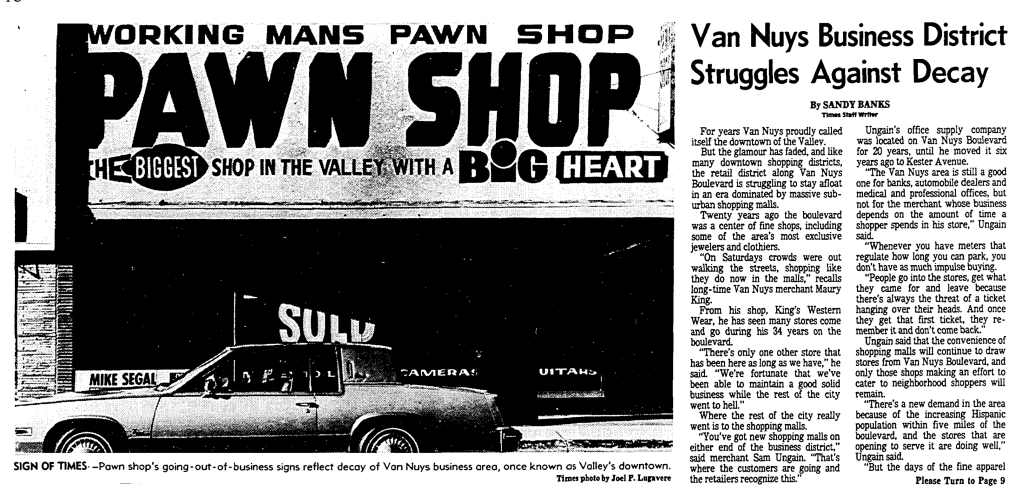
43 years ago the situation of the Van Nuys Business District was quite abysmal. The good shops had closed down and the street was full of bail bonds and pawn shops. Merchants complained about street racing, and the negative affects of parking meters which discouraged shoppers from spending more time in stores.
On Wednesday nights the street came alive as thousands converged to watch cruise nights. But the crowds blocked streets and left behind trash. The businesses didn’t like it.
In 1977, “Vitalize Van Nuys” began, a privately financed, community-based redevelopment organization. It sought to revitalize businesses, generate more employment and upgrade the surrounding residential community.
34-year-old Bruce Ackerman operated the Greater Van Nuys Chamber of Commerce after working with the San Fernando Chamber of Commerce. He promoted a resurgence of retail.
“Van Nuys really hit rock bottom in 1977,” recalled Dick Lithgow of Agency Insurance.
There were 23 massage parlors back then.
Hopeful signs in 1979 included a $14 million dollar government complex with new courthouses, post office and police station. There were also new studies forecasting “a tremendous demand for office space in Van Nuys.”
Legitimate businesses such as Nahas Department Store complained that vagrants harassed customers in the parking lot.
Owner Richard Smith said the neighborhood was increasingly elderly and Hispanic. “We were concerned with the growth of the barrio around 1975-76, but that has not caused any problems for us,” he said.
Another positive sign for Van Nuys in 1979 was the 100 businesses that had spent more than $4 million dollars ($4,000 per business) upgrading their properties.
In 2022, it is hard to imagine the challenges Van Nuys faced in 1979.
Fortunately, those far sighted visionaries gave us a truly spectacular urban boulevard we can all be proud of: clean, safe, thriving, walkable, architecturally magnificent, the jewel of the San Fernando Valley.
Thank you especially goes to Councilwoman Nury Martinez and Mayor Eric Garcetti for their leadership!
Metro is planning a light rail train down the center of Van Nuys Bl. extending from Pacoima to Van Nuys, stopping at Oxnard St. Less probable is a dedicated bus line.
Their final decision, as to what type of transport to build (bus or train) and where to service these will come in June 2018.
Four areas in Van Nuys are under consideration for eminent domain demolition and the building of a light rail maintenance yard.
These are called the “Option” areas and they are A, B, C, and D.
Options B, C, and D
B, C, and D all straddle the existing Metrolink heavy passenger rail tracks along Raymer St. near the former GM plant on the Van Nuys/Panorama City border.
OPTION A:
Option A
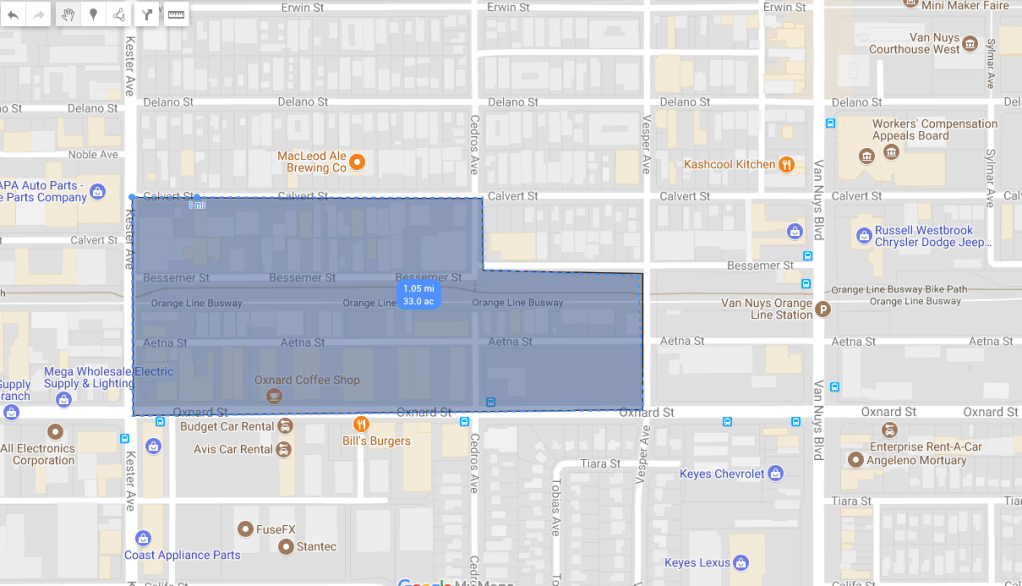
Only “Option A” is located in another area: this is a 33-acre spread of light industry comprising 186 businesses, 58 structures and as many as 1,000 workers who are located NE of Oxnard and Kester along Oxnard, Aetna, Bessemer and Calvert Streets.
This blog has reported extensively, since September 2017, on the “Option A” community: a unique, productive, and innovative group of entrepreneurs who make fine decorative hardware, custom shelving; record music, weld metals, clean carpets, fashion artistic stained glass, and restore vintage Mustangs, Vespas and large yachts.
Skilled craftsman at Pashupatina
Garrett Marks, CEO, Mustangs, Etc. (est. 1967)
Peter Scholz, owner Showcase Cabinets (est. 1987)
Simon Simonian, Progressive Art Stained Glass Studio
Kristian Storli, Owner: Bar Italia Vespa
Steve Muradyan of BPM Custom Marine
They employ local workers, many of whom walk to work. There are immigrants here, but there are also people who started companies 30, 40 and even 50 years ago who would be forced to move from their little supportive community and fight to rent new space competing against cash rich marijuana growers who are swallowing up space for their noxious, lethargy inducing, industrial scale weed.
I was curious what residents in the area think of “Option A” so I went online and visited Next Door.
My Next Door app page has 2,000 community members from Burbank Bl. north to Roscoe, from the 405 to Hazeline.
I posted a question asking if people opposed or supported “Option A.” Overwhelmingly, by a vote of 87% to 13 (94 total votes), they said they were against it.
Peter Scholz and employee at Showcase Cabinets
Here are some of the comments:
“It seems like a giant repair yard would be an eye sore and would attract litter, homeless encampments and shady activities since it will have very little activity especially at night. I don’t see how that is worth uprooting all these businesses who contribute to our community and have been here for all of these years.”
“I prefer local businesses any day. Plus, with numerous new apartment buildings popping up all around the area, we have potential for more retail/cafes to move in to the buildings up for lease. However, if all of that space gets used up by ugly rail yards, then the Van Nuys economy will never thrive to its full potential. I’m sick of this city being treated as a dumping ground.”
“The downside of Option A is not only a large rail yard in main area of Van Nuys (which MTA promises would be modern and attractive) but as well, that it would take out approximately 200 small and thriving Van Nuys businesses that each employ, one, two, three, five or more employees, whereas the other two main options hold a minuscule number of businesses. Eminent domain [against] all these businesses in the heart of VN would hurt us in several ways, besides uprooting the businesses and the citizens who work there, there are limited number of commercial properties currently available close by, so many of the businesses could not relocate close by, would not be able to keep locale clientele. For many who live nearby, if new properties could be found, commutes would be added. And for all those businesses relocating outside our community, or for those that would simply be forced to fold, Van Nuys would lose a healthy business tax base. Again, the other two options provided by the city for the yard (if needed based on what the final decisions are) do not suffer from anywhere near the same extent of overall downside.”
“I own a house on Hatteras near the Option A area. And I also rent a building on Aetna which would be demolished. If this happens I will sell my house, which I just purchased two years ago and I will move out of Los Angeles. There is not a reason in the world to pick our district for demolition when so many jobs and lives are at stake. If Nury Martinez allows this she should be recalled.”
Clearly, people who live near the Option A zone are insightful and understand how important it is to preserve small business in Van Nuys. They know that an enormous, gaping hole would not revitalize Van Nuys, but further degrade it.
The community residents, as well as the businesses near Kester and Oxnard, are united in opposing the destruction of viable businesses and local jobs.
Two people, a Guatemalan born man, and his wife, raised three girls and one boy in this 1933 Van Nuys house.
The children grew into adults. They went to college, then graduate or medical school, and became highly educated professionals.
The parents, and another relative, stayed behind in the old house, a Spanish style ranch with a red tile roof and backyard full of fruit trees, and numerous potted, flowering plants.
All the old people died a few years ago. Now the house is being prepped for an estate sale. The lady running the sale is my friend. She invited me into the home to survey it.
It seems that nobody ever threw anything away. And every square space of the property was full of mountains of metals, tools, cans, bottles, wood, and machinery.
Packed tight in the front of the house was a tiny kitchen, dining room, living room and a two bedrooms. But in the back was a secret, unofficially constructed warren of rooms and an old patio converted to an indoor sewing room, and another bathroom, added on.
Outside, a jerry-built outdoor sink was plumbed up to an exterior wall. External electrical outlets taped up to live connections was nearby. A family of raccoons made their home above old lawn mowers and a rusted gasoline blowtorch. Any space that could store things, did.
Yet, these people were not pack rats or hoarders. They were, most likely, born poor, and through thrift, industry, and hard work, and a strong dose of Catholic faith, they persevered and prospered.
The front of their home has always been neat. The lawn is cut, the driveway swept, the cyclone metal fence keeps guard along the street. Birds of Paradise have grown large and cover the front living room window.
And when this house is sold, and the contents banished or transferred to new owners, the life of people who once inhabited this home will be erased forever.
You must be logged in to post a comment.