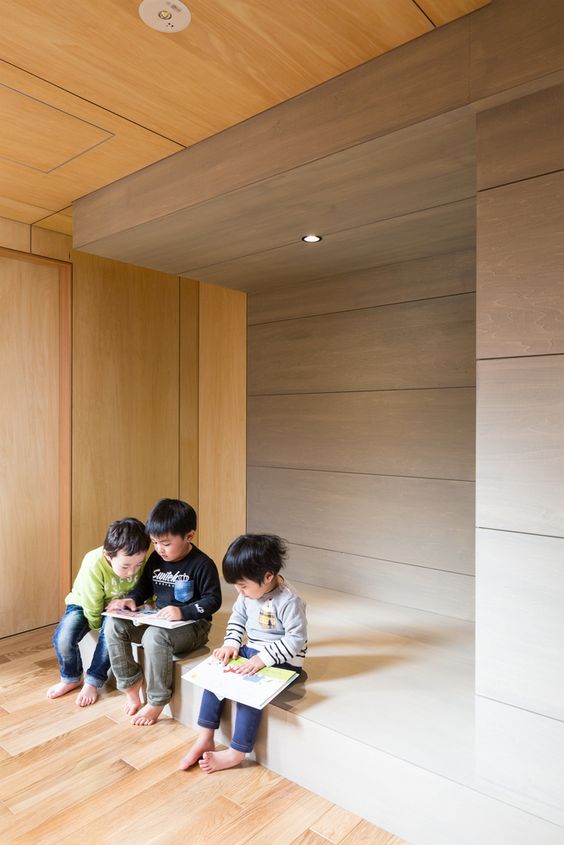
From Dwell Magazine, an example of a tight, urban house in a densely populated area of Osaka.
As I have asked many, many times: why can’t this type of housing be constructed in the commercially zoned areas of Van Nuys? Near the Orange Line? Near the Civic Center?
Imagine this fitted behind an alley in Van Nuys? As a modern, clean, civilized upgrade for the slum housing one sees along Bessemer, Calvert, Delano, Cedros, Erwin, Friar.
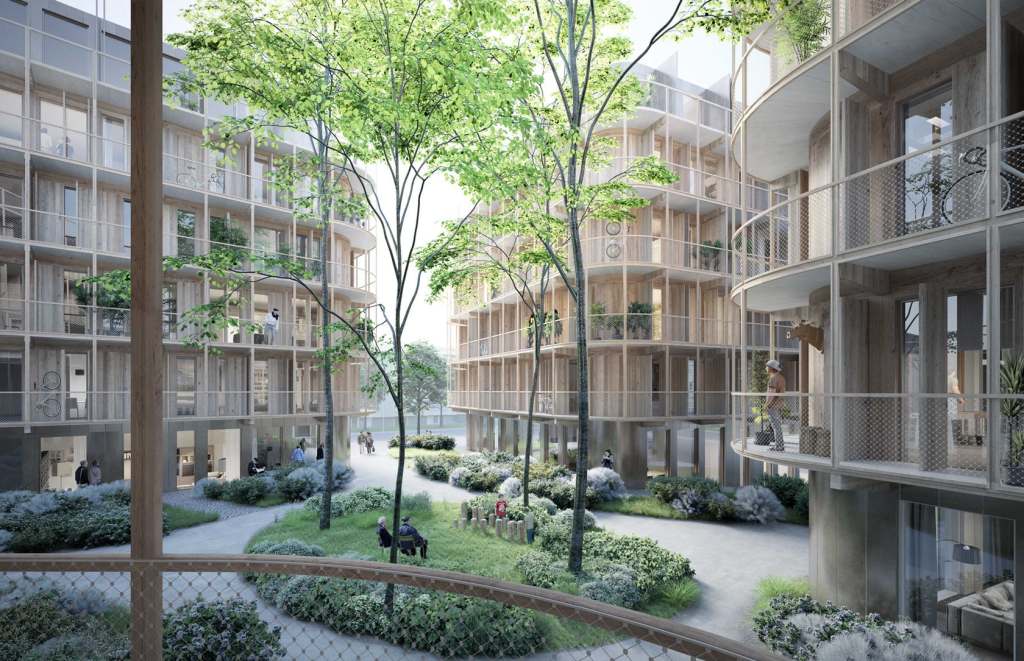
Photo by Kwasi Boyd-Bouldin.Imagine a grouping of twelve of these around a garden on a former parking lot? On a lot that was once a gas station.Slum Housing on Cedros.
“At first glance, it can be hard to spot the Toolbox House. Tucked away on a long, narrow lot in the downtown area of Osaka, Japan, the silvery home sits much lower than its high-rise neighbors. Yoshihiro Yamamoto of the local firm YYAA designed the dwelling for a couple and one of their mothers, who sought a single-story house that is “compact and easy to use, like a toolbox.”-Dwell Magazine.
“In a motion entitled “Building a Livable City,” Martinez instructs the Planning Department and LADOT to take stock of the number of parking spaces needed to serve Van Nuys City Hall and other government functions in the Van Nuys Civic Center, and lay out a plan for consolidating parking onto a smaller footprint. This would clear the path for redevelopment of the complex’s remaining parking lots with a mixture of affordable housing, open space, retail, and other community serving uses. Likewise, Martinez proposes that any scheme also incorporate amenities for pedestrians and cyclists.”
Must we endure these promises again? Here is what they were writing 31 years ago this month:
January 27, 1991Van Nuys Blvd. at Friar (circa 1950). Notice diagonal parking and streetcar wiring.
Downtown Van Nuys, due to 70 years of misguided “redevelopment”, has obliterated itself and now crawls along at the lowest condition in its history. Homelessness, abandoned storefronts, and an eight lane wide highway are what it looks like.
Ms. Martinez has occupied her office, figuratively and literally, for over 7 years and during that time she has spoken up about all the ills of Van Nuys and the NE SFV: human trafficking, crime, housing, drugs, homelessness.
Yet, still the tent cities remain. The shopfronts are no more. The entire area looks like hell.
Building the LAPD Van Nuys 1962.LAPL: 1958 plans for Valley Administrative Center in Van Nuys
And at the center is the 1958 planned Van Nuys Civic Center, a ghost land of courthouses, library and police station all populated by vagrants, trash, emptiness and hopelessness. Surrounding the area are many tens of thousands of parking lots, enormous concrete fiascos erected 50 years ago to provide dignified places for vehicles to live. They are mostly empty now, and should be destroyed and replaced with housing, housing, housing!
But this requires a plan, an architectural plan, and there is never, ever any architectural thought put into any structures that go up in Van Nuys. Instead, a crooked and semi-literate group of grifters with dough show up at planning board meetings and offer up the shit boxes that are shoved into the poor streets nearby. And VNB remains the center of dysfunctional governance in the SFV.
In past “great plans”, the Orange Line bus and and bike path was supposed to revive Van Nuys. But next to the path, are parking lots, rented out by nearby car dealers to store their unsold vehicles. This land, paid for with public tax dollars, is instead being exploited by for profit auto dealerships.
Orange Line Metro Parking Lot at Sepulveda/Erwin
So I’m cynical.
Our present condition as a city, due to the horrendous tenure of Mayor Garcetti, normalized everything wrong, illegal, dirty and dangerous.
But let’s try again. Keep trying. We have nothing to lose. But our minds.
“The Los Angeles Department of Building and Safety (LADBS) implemented the Standard Plan Program to provide LADBS customers a simplified permitting process for the design and construction of ADUs that are built repeatedly. The use of standard plans reduces the time required for plan check resulting in faster permit issuance.
Under the Standard Plan Program, plans are designed by private licensed architects, and engineers to accommodate various site conditions. Plans are then reviewed and pre-approved by LADBS for compliance with the Building, Residential, and Green Codes. When the applicant selects an approved Standard Plan, LADBS staff will review site-specific factors for your property, including compliance with the Zoning Code and foundation requirements.” -LADBS
Mayor Eric Garcetti and Christopher Hawthorne, Chief Design Officer.
Under the authority of Mayor Garcetti’s Chief Design Officer Chris Hawthorne, a whimsical man, a new menu of backyard house designs, produced by various local architects, has appeared like magic. Mr. Hawthorne was previously involved in architecture writing at the Los Angeles Times and in the re-design of our civic lampposts. He is a frequent guest speaker at international architectural events from New Zealand to Miami and a recurring guest on KCRW Frances Anderton’s radio show on design.
Rather than concentrate on coming up with emergency housing for 100,000 unhoused Angelenos who live in trash piles and tents inside parks and along freeways, mayoral efforts were waged to come up with ironic design concepts in lighting.
The International House of ADU Menu seems to be an attempt to inject some fashionable urgency, flavored with irony, into the critical need of providing housing for a city where it is expensive and rare.
Pre-designed and pre-approved, these ADU (Accessory Dwelling Units) are intended to hurry up the construction of the second house in back of the first house transformation of Los Angeles.
Let’s look at what the architects have come up with.
Welcome Projects “The Breadbox”
Is a play on the traditional mission house with an oversized arched roof. Perhaps the closest to classic of all the designs, it has a cute appeal for those who are tired of the box.
Abou
A 1967 Laurel Canyon type intoxicated with rough wood siding and a slanted roof, not especially pretty to look at, but outfitted in white interior with blond wood floors. Picture Janis Joplin in a hot tub drinking whisky out of the bottle with Abby Hoffman and Jimi Hendrix.
Taalman Architects’ IT House
Perhaps the most Bauhausian of the group, this glass and steel box will allow its inhabitants full exposure to sunshine during the day and illuminate inside activities for outside spectators and neighbors at night.
Amunátegui Valdés ADU
Los Angeles zoning allows ADU’s to be built four feet from the back of property line.
So imagine how delightful it will be for neighbors who encounter a 15’ foot high building with an outdoor roof deck allowing partygoers and drunk revelers to float above all adjoining backyards like devilish angels? Here the architect has abandoned all pretense to privacy by designing a house where dozens of people can look down other people’s backyards from the top of a badly conceived back house. Imagine a house of YouTube influencers living here. What fun!
LA Más
“is a non-profit based in Northeast Los Angeles that designs and builds initiatives that promote neighborhood resilience and elevate the agency of working-class communities of color.”
Here virtue signaling meets up with 1980s post-modernism in gaily painted houses whose designs look like fast food outlets along the boulevard. The golden arches, the multi-colored column (kids eat free?), the decorative woodwork, these are FUN places with bright colors. And even if they are not especially attractive, and look like Walmart brand doll houses, they are immune from criticism by a vaccine of political correctness.
When Los Angeles is done bulldozing every backyard to “produce more housing” will the net effect be to put more cash in the pockets of those who already own houses?
Why not up-zone the miles and miles of one-story commercial buildings and huge parking lots that blight our city?
Why not leave in place the gardens, which are the only park system we have, and really ramp up the production of moderately priced residential units near public transportation?
Something to think about.
Below, in B&W, are current aerial photos of “downtown” Van Nuys.
On the west side of Columbus Avenue, between Hamlin and Kittridge, are some six contiguous properties that were subdivided in the 1930s and, until this year, remained largely undeveloped beyond their original single-family homes.
Their combined total square land footage is 156,035 SF with the properties ranging in size from 19,931 SF to 27,783 SF.
The backs of all these properties face the rapidly redeveloping Sepulveda Boulevard corridor with its new white apartment towers looming overhead into the old ranches.
THE 1994 FENCE OWNED BY BILLIONAIRE ANGELA CHEN SABELLA OF KAR FUNG CO.
In all the years I’ve lived here (since 2000) Columbus Avenue was a blight, a ragged and torn sleeve on the arm of neatly pressed neighborhood. No sewers, no sidewalks, and helicopters that flew overhead weekly.
There was the drug house, the abandoned house, the house that stored 100 inoperable vehicles in back. There was the foreclosed house, and the house that put up a paved parking lot in its backyard.
There was the vagrant who moved into an empty house and put a moat of 50 trash filled shopping baskets around the property to keep out intruders. There was a completely empty property whose owner was happy to hang on because his taxes were $400 a year and his house with broken windows was worth $500,000+.
There was another property with a mad dog that sometimes went out and menaced other dogs and people and was kept by undocumented immigrants who ran a nursery and installed artificial grass . That is still going on.
All of these semi-criminal and wholly-criminal activities were reported to law enforcement, and eventually some of them found their way into the court system, but correction, penalty and punishment are often wrist slaps or take many years to enforce.
It’s 2019 and even Van Nuys deserves to have what Studio City got in 2013, and West Hollywood in 2009.
Mr. Boaz Miodovsky of Ketter Construction is putting up four modern garages with attached houses along 6537. They will have their own private road, Solomon Lane.
And Mr. Nick Shoshan of Innovation Design and Construction bought 6505 and is demolishing the single-family home there, dating to 1936, and erecting four houses. They once kept horses here, another neighbor grew walnuts, there were backyard pools, lemon, orange and lime trees. Now this parcel will have four houses and two streets and look west into the back of a seven-story apartment building.
6505 is next to the dead-end street where Hamlin once cut through to Sepulveda before it was walled off, in 1994, and the public way sold to the Kar Fung Company which owns the 99 Ranch Market “Signature Plaza” shopping mall.
Hamlin St. Beyond the Fence. Owned by Kar Fung Co. Ltd.
Preposterously, 6505 will have to build its own private street because Hamlin Street is no longer available as a public way. It is owned and supposedly maintained by Kar Fung, though they have allowed it to denigrate into a tagged, trashed and overgrown weed lot out of utter neglect and indifference.
The new houses at 6505 will be bookended by two streets, one in their front yards, and one in the backyards. The owner, Kar Fung Company, for reasons only known to God herself, has never wanted to sell their section of Hamlin Street to anyone.
Incidentally, Kar Fung Company is run by Angela Chen Sabella, who is the daughter of “Chen Din-hwa (simplified Chinese: 陈廷骅; traditional Chinese: 陳廷驊; pinyin: Chén Tínghuá; 1923 – 17 June 2012). He was a Hong Kong industrial tycoon, billionaire and philanthropist. He was known as the “King of Cotton Yarn” in Hong Kong.[2]”. When he died he had a fortune of over $2.6 billion dollars. Which may explain why money to paint the shopping center or repair the 1994 cyclone fence on Columbus is quite impossible to come by.
In Van Nuys, the vast majority lives close to ruination, but absentee slumlords who live in Bel Air, Beverly Hills and Hong Kong squeeze out money from a community starving for investment and civic decency. What could $50 million from Kar Fung could do to alleviate the homeless blight in Van Nuys?
To imagine what could be done with proper architectural designs over the totality of Columbus Avenue with its 156,035 SF is to entertain dreams of parks, of gardens, of towering oak trees, fountains and benches surrounded by nice homes. The way they might have built in South Pasadena in 1910.
But instead, it will go the low-brow, ugly way, the only path that ever gets paved in Van Nuys, with cheapish houses along asphalt driveways, stuck along Columbus Avenue like a pocket comb. These boxes will be so compressed, and so tightly sited, that there will be no room for shade trees. And overlooking every private property will be hundreds of prying eyes from new apartment dwellers.
Parking for cars will be provided in the two car garages in each home, but if you have lived in Los Angeles long enough you know that 90% of all cars are never parked in garages. On my street, me and my partner are the only residents who use their garage for auto storage. It will transpire that each new home will have four drivers, and a garage full of belongings, and guess where the vehicles will sleep every night?
If this were a well-run city of neatness, law, order, and regulations (which it is not) then new housing would be a great blessing. But as it drops around here I know the future.
The new residents will probably include renters, perhaps four or five unrelated adults sharing a home, paying $1500 each so that the owner can pay off their $5,000 a month mortgage on their $900,000 house. And these private lanes will have gated entrances, understandably, because it takes two hours for LAPD to respond to anything other than murder.
I don’t have all the answers, I’m merely describing reality as I see it in front of me.
We desperately need new housing in Los Angeles, but does it all have to come forth like this? Aesthetically dismal, organizationally atrocious, environmentally destructive.
In early 1993, I was visiting Larry and Kay, who lived in a beautiful home in Woodland Hills, south of Ventura, of course. They were around the corner from the last large orange grove in the San Fernando Valley.
They were Hollywood people, who had moved out to the SFV, in the late 1960s, from Michigan.
The husband was a TV producer who had success on ABC in the 1970s. The wife played tennis with “Happy Days” star Marion Ross. They had three children. I was friends with their middle daughter Beth, who I had gone to college with.
Their house was up on a hill, atop a long driveway, in a bed of ivy and surrounded by mature trees. There was a large, life-sized cow in front, so you were assured this was a place of wit and irony.
The expansive, beamed, rustically casual interior with a wall of patio facing French doors was paved with polished bricks. A two-story tall front hall, with plants growing up to the ceiling along an open riser staircase, extended back into an amorphous pool that was surrounded by terraced, green hillside and more vintage signs from old roadside advertising.
That year I was considering moving from New York City to Los Angeles. And then, the next year, I did.
The husband was a gregarious, self-confident, big Midwesterner who liked practical jokes, loved making television, and loved Los Angeles. He would have made a good poster child for the LA Chamber of Commerce: family man, in a spectacular house, having fun earning a living in entertainment.
During one conversation Larry said he liked LA because when you drove to the airport “you never had to go through a bad neighborhood.”
Kay said she loved LA because she loved her house, “It’s paradise here in my home and garden,” she said.
I thought then, 26 years ago, how odd and how normal these remarks were, how characteristic of Los Angeles, and a certain kind of person these impressions of life here were. For who would argue, especially in 1993, that a nice home was not the entire object of life and the culmination of Los Angeles dream?
Who cared if there was nowhere to walk, if “Main Street” was a 15-mile-long wreckage of parking lots, junk food, car washes, shopping centers and ugliness; and your downtown was a vacated, forgotten and despised urban renewal zone, strangled by bad air and wide freeways, where lost people wandered aimlessly?
And you never knew your neighbors’ names, and you only saw them from behind your tinted, electric windows.
If you bought a nice ranch house south of Ventura Blvd. you were really set. The city and its attributes or lack thereof were of no importance. The sun always shined on your pool and your garden.
I have lived in this city more years than other city, and still I wonder what I am doing here.
Like Larry and Kay I have a nice house, perhaps not on the scale of their house, but it’s a good, clean, comfortable house, and I like it.
But beyond this house, a few houses down, here in Van Nuys, one encounters a city where 58,000 people live on the streets, and traffic, billboards, mini-malls, illegal dumping, air pollution, and crime are profuse.
A great house would be a great if it were in a great city that took great care of its environment.
The Perfect House could never exist in a city where 90% of the people who can, drive their children to schools in other school districts, because the local schools are inferior, because the nearby, walkable schools are populated by less advantaged kids. What fine city sends its’ kids far away to go to schools in other places?
In our city, desperate for housing, people with homes protest housing for homeless seniors. It reminds me of a man with epilepsy, and an autistic boy, who protested a memory care facility for Alzheimer’s patients near his home in NJ.
The Perfect House would not exist in a city with scattered, garbage-filled carts on sidewalks. And a bus bench shelter was not for bus riders, but a bed for a man without a bedroom.
Los Angeles promotes self-destruction of self and city as public policy. It allows vagrancy, dumping and human defecation into local rivers that empty into the ocean. And its leaders ask you to understand and accept the degradation of a city as the natural order of business.
Straws are banned, smoking is banned, but tens of thousands of trash campers can set up their tents anywhere in Los Angeles.
How are we not calling this an emergency?
14030 Valley Vista, Sherman Oaks, CA. by Gal Harpaz.
In the photo above is a version of The Perfect House at 14030 Valley Vista, Sherman Oaks, CA by Gal Harpaz, photographer.
The architect was born in Ferrara, Italy, a Jew who escaped when Mussolini came to power. Edgardo Contini, (1914-90) who was a founder of Gruen Associates and a planner in many projects in this city including the Pacific Design Center, the Fox Hills Mall as well as President of the Urban Innovations Group, the practicing arm of the UCLA Graduate School of Architecture and Urban Planning. He worked with Architect Charles Moore and participated in the Grand Avenue proposal for California Plaza on Bunker Hill.[2]
And during his lifetime in Los Angeles, Mr. Contini seemed to think that this city was in need of urban preservation, reuse of older buildings rather than outward sprawl. He wanted to end our wasteful, continual destruction of historical structures and our voracious consumption of wild lands and agricultural fields beyond the city.
He saw Los Angeles as more than the ideal house. He imagined a city where the health and well being of all was the optimal.
What would he think of Studio City today where $3 million dollar houses are constructed steps away from people sleeping on mattresses along the LA River? Or of Van Nuys Boulevard with its’ boarded up businesses, homeless encampments, and dismal condition?
In 1972, he wrote, “We should place the emphasis on recycling, no further withdrawl from our resources of open land would be required/ and we will not leave urban litter behind.”
Are we better off today than we were in 1972? Or are we still, like Mayor Garcetti, just talking a virtue game and living in a cesspool?
Where are all the big plans for humane and just architecture to heal all the atrocities of modern Los Angeles? Can we just survive and continue to build a city of flat-topped McMansions, backyard garage add-ons and $3500 a month apartments?
Is any large city in America as dirty as Los Angeles? Is any booming and billionaire saturated city in Europe? One looks to India to imagine our dystopian future.
The Perfect House is beyond most of our reach, but the better city should not be.
[2]Obituaries: Edgardo Contini, Architect, Urban Planner; by Leon Whiteson; LA Times, May 1, 1990.
Erwin at Sepulveda, Metro Orange Line Parking Lot.
When the Metro Orange Line opened in October 2005, it was a stunningly different type of transport system which combined a bus only road with a landscaped bike path that ran alongside. It cost about $325 million.
It connected North Hollywood with Woodland Hills, and eventually carried over 30,000 riders a day. Since 2015, due to Uber and Lyft, ridership has fallen to about 22,000 a day.
Hundreds of homeless encampments have sprung up on the bike trail.
But Metro forges ahead!
There are plans to create gated crossings at intersections to speed up bus travel. There are long-term ideas to convert the entire system to light rail and also build elevated bridges over Van Nuys Boulevard and Sepulveda.
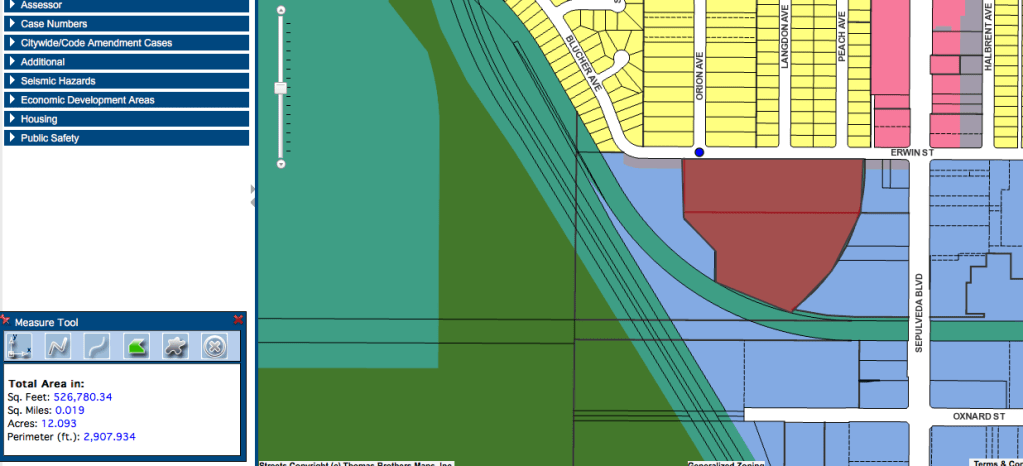
In Van Nuys, at Sepulveda and Erwin (north of Oxnard), there is a car parking lot for the Orange Line Metro riders. It is over 526,000 square feet, paved in asphalt, planted with trees and shrubs, and comprises over 12 acres.
Today, over 2/3 of it is used as an outdoor storage lot for Keyes Auto.
Red area is the parking lot of the Orange Line. It is now used predominately to store autos from Keyes Audi. (Source: ZIMAS)
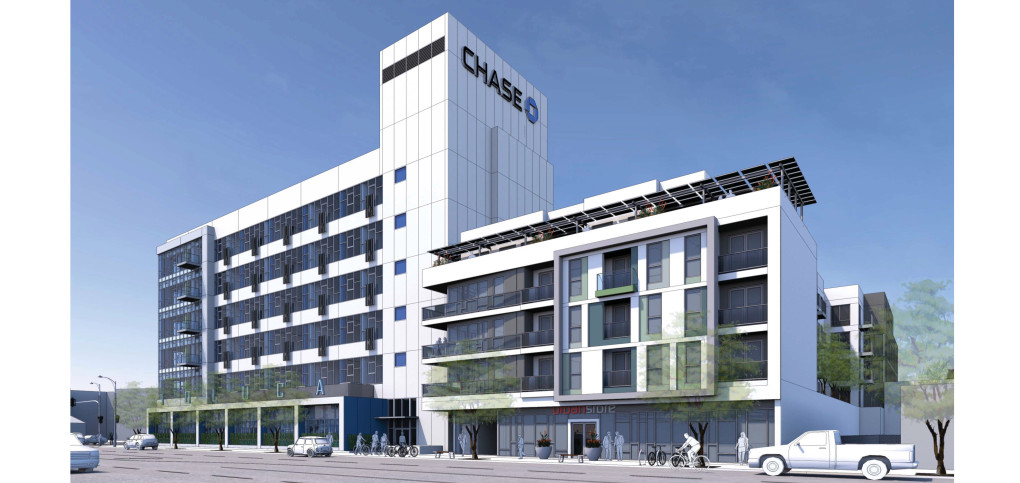
The Sepuvleda/Erwin site is “Exhibit A” in the DNA of Los Angeles, because the right thing to do would be constructing 10-20 story apartments along the public transit route and creating incentives for residents to ride buses, take trains and use bikes for daily commuting.
Singapore Housing Estate with parks and nearby public transportation.
If LA were Singapore, Tokyo or Toronto we would do that.
Instead our city languishes and fights and wishes to preserve a 1950s idea of everyone going somewhere by car.
And thousands of new cars are lovingly housed on land paid for by public taxes which should be used as housing and parks for the greater good of this city.
Nothing beneficial for Los Angeles ever happens overnight. It takes years of planning and legal battles, for example, to build assisted or low cost housing, or parks.
One can imagine the fury and fear that might arise if a 12- acre park and housing development were planned on this parking lot ranch.
Imaginery view from Sepulveda and Erwin looking west. In reality, Singapore.
What, by miracle of God, might be possible here in terms of a park or high-rise group of apartments, placed near the bus line, with a buffer of trees, water features, and gardens between the new residential city and the single-family houses to the north of the site?
Yet here, alongside a public transit route, taxpayer funded Metro Los Angeles chooses to rent its land for an auto dealership. How does that benefit the surrounding residents?
For people who are obsessed with traffic, imagine that thousands of vehicles are parked here ready to be turned on and put onto the roads. How does that feel Van Nuys?
If the new planned housing estate were policed, regulated, secure, and it also provided a new park wouldn’t that be an improvement?
You must be logged in to post a comment.