Best Boxes


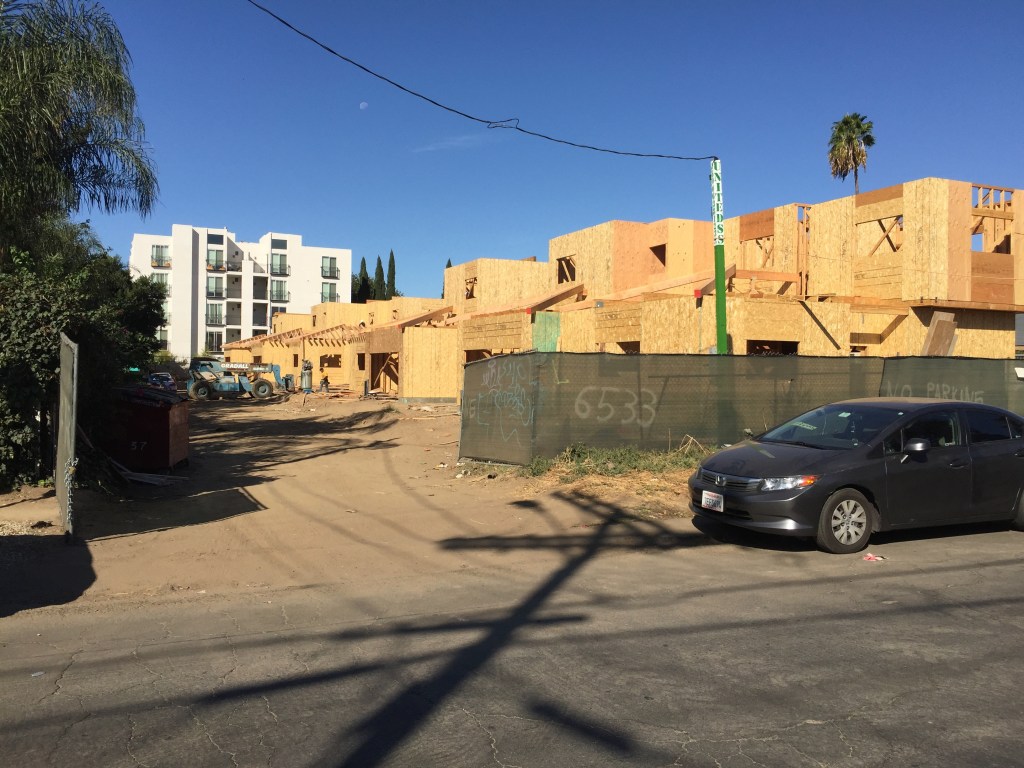
On the west side of Columbus Avenue, between Hamlin and Kittridge, are some six contiguous properties that were subdivided in the 1930s and, until this year, remained largely undeveloped beyond their original single-family homes.

Their combined total square land footage is 156,035 SF with the properties ranging in size from 19,931 SF to 27,783 SF.

The backs of all these properties face the rapidly redeveloping Sepulveda Boulevard corridor with its new white apartment towers looming overhead into the old ranches.

In all the years I’ve lived here (since 2000) Columbus Avenue was a blight, a ragged and torn sleeve on the arm of neatly pressed neighborhood. No sewers, no sidewalks, and helicopters that flew overhead weekly.

There was the drug house, the abandoned house, the house that stored 100 inoperable vehicles in back. There was the foreclosed house, and the house that put up a paved parking lot in its backyard.

There was the vagrant who moved into an empty house and put a moat of 50 trash filled shopping baskets around the property to keep out intruders. There was a completely empty property whose owner was happy to hang on because his taxes were $400 a year and his house with broken windows was worth $500,000+.  

There was another property with a mad dog that sometimes went out and menaced other dogs and people and was kept by undocumented immigrants who ran a nursery and installed artificial grass . That is still going on.

All of these semi-criminal and wholly-criminal activities were reported to law enforcement, and eventually some of them found their way into the court system, but correction, penalty and punishment are often wrist slaps or take many years to enforce.

______________________________________________________

Now there is development in earnest. 

It’s 2019 and even Van Nuys deserves to have what Studio City got in 2013, and West Hollywood in 2009.

Mr. Boaz Miodovsky of Ketter Construction is putting up four modern garages with attached houses along 6537. They will have their own private road, Solomon Lane.  

And Mr. Nick Shoshan of Innovation Design and Construction bought 6505 and is demolishing the single-family home there, dating to 1936, and erecting four houses.   They once kept horses here, another neighbor grew walnuts, there were backyard pools, lemon, orange and lime trees. Now this parcel will have four houses and two streets and look west into the back of a seven-story apartment building.

6505 is next to the dead-end street where Hamlin once cut through to Sepulveda before it was walled off, in 1994, and the public way sold to the Kar Fung Company which owns the 99 Ranch Market “Signature Plaza” shopping mall.

Preposterously, 6505 will have to build its own private street because Hamlin Street is no longer available as a public way. It is owned and supposedly maintained by Kar Fung, though they have allowed it to denigrate into a tagged, trashed and overgrown weed lot out of utter neglect and indifference.

The new houses at 6505 will be bookended by two streets, one in their front yards, and one in the backyards.  The owner, Kar Fung Company, for reasons only known to God herself, has never wanted to sell their section of Hamlin Street to anyone.

Incidentally, Kar Fung Company is run by Angela Chen Sabella, who is the daughter of “Chen Din-hwa (simplified Chinese: 陈廷骅; traditional Chinese: 陳廷驊; pinyin: Chén Tínghuá; 1923 – 17 June 2012). He was a Hong Kong industrial tycoon, billionaire and philanthropist. He was known as the “King of Cotton Yarn” in Hong Kong.[2]”. When he died he had a fortune of over $2.6 billion dollars.  Which may explain why money to paint the shopping center or repair the 1994 cyclone fence on Columbus is quite impossible to come by. 

In Van Nuys, the vast majority lives close to ruination, but absentee slumlords who live in Bel Air, Beverly Hills and Hong Kong squeeze out money from a community starving for investment and civic decency.  What could $50 million from Kar Fung could do to alleviate the homeless blight in Van Nuys? 

To imagine what could be done with proper architectural designs over the totality of Columbus Avenue with its 156,035 SF is to entertain dreams of parks, of gardens, of towering oak trees, fountains and benches surrounded by nice homes. The way they might have built in South Pasadena in 1910.

But instead, it will go the low-brow, ugly way, the only path that ever gets paved in Van Nuys, with cheapish houses along asphalt driveways, stuck along Columbus Avenue like a pocket comb. These boxes will be so compressed, and so tightly sited, that there will be no room for shade trees. And overlooking every private property will be hundreds of prying eyes from new apartment dwellers.

Parking for cars will be provided in the two car garages in each home, but if you have lived in Los Angeles long enough you know that 90% of all cars are never parked in garages. On my street, me and my partner are the only residents who use their garage for auto storage.  It will transpire that each new home will have four drivers, and a garage full of belongings, and guess where the vehicles will sleep every night?

If this were a well-run city of neatness, law, order, and regulations (which it is not) then new housing would be a great blessing. But as it drops around here I know the future.

The new residents will probably include renters, perhaps four or five unrelated adults sharing a home, paying $1500 each so that the owner can pay off their $5,000 a month mortgage on their $900,000 house.   And these private lanes will have gated entrances, understandably, because it takes two hours for LAPD to respond to anything other than murder.

I don’t have all the answers, I’m merely describing reality as I see it in front of me.

We desperately need new housing in Los Angeles, but does it all have to come forth like this?  Aesthetically dismal, organizationally atrocious, environmentally destructive.

Van Nuys Savings and Loan.


1 3 54b.jpg
LA Times 1 3 54

1 3 55.jpg
LA Times 1 3 55

In 1954, architect Culver Heaton’s design for the Van Nuys Savings and Loan, with interior murals by artist Millard Sheets, rose at 6569 N. Van Nuys Bl.

Along with other financial institutions such as Jefferson Savings, Lincoln Savings, Great Western Bank and Bank of America, they served the local community of hard-working people who opened accounts that paid 3% or 4 1/2% interest and where polite tellers, dressed in pearls and high heels, addressed customers by their last (never their first) name.

photCL_MLP_0551_003

photCL_MLP_0551_008 photCL_MLP_0551_007 photCL_MLP_0551_006

Photographer Maynard Parker shot these images of the bank exterior and interiors. They bespeak a dignified and progressive institution whose architecture was as up-to-date as its vision of a prosperous, safe Van Nuys. A sign on the outside of the building reads “The Home of Security” leaving no doubt to depositors about the solidity of the S&L.

photCL_MLP_0551_005 photCL_MLP_0551_004

Mr. Sheets was a prodigious artist whose work can be seen all over Southern California, most notably on the exteriors of many of those white, marble clad, Home Savings of America buildings that resemble mausoleums.

Architect Culver Heaton designed many Mid 20th Century churches in Southern California in a style of expressionistic eccentricity long departed from our stripped-down imagination. His Chapel of the Jesus Ethic in Glendale (1965) is almost campy in form with its prayerful red roof, rising like hands, above a turquoise reflecting pool and a statue of Jesus on water fashioned by Herb Goldman.

Photo by Michael Locke

In the 1980s, there was a national scandal and shakeout in the savings and loan industry and many closed down. The de-industrialization of Van Nuys, and its decline as a manufacturing and commercial center, coincided with a tremendous increase in immigration from Central America.

Today, a Guatemalan market, La Tapachulteca, occupies the old bank property.

2014/ Image by Andy Hurvitz

But last year, in a hopeful sign of better times, Boaz Miodovsky of Ketter Construction, who is the new owner, plans on demolishing the old bank which has now been degraded from its original condition. His company will design and erect a multi-story apartment house with ground floor retail. The front, on VNB, will be five stories tall and taper down to three stories in back.These illustrations, which he sent to me, are preliminary and will be further refined to include landscaping and additional detail.

View 0 View 0_3

Nostalgist and Van Nuys Neighborhood Council member John Hendry, who grew up and still lives in Van Nuys, alerted me to the impending demolition and asked me to research the origins of the historic structure. Quirino De La Cuesta, another VNNC member, stepped in and purchased these images from the Huntington Library.

And Mr. Miodovsky, in a nod to the old murals, will have new artwork painted within the new structure. It will be created by local artists and reflect the continuing development of Van Nuys which hit its bottom and is now climbing out parcel by parcel.