A Twelve-Acre Parking Lot


Erwin at Sepulveda, Metro Orange Line Parking Lot.

When the Metro Orange Line opened in October 2005, it was a stunningly different type of transport system which combined a bus only road with a landscaped bike path that ran alongside. It cost about $325 million.

It connected North Hollywood with Woodland Hills, and eventually carried over 30,000 riders a day. Since 2015, due to Uber and Lyft, ridership has fallen to about 22,000 a day.

Hundreds of homeless encampments have sprung up on the bike trail.

But Metro forges ahead!

There are plans to create gated crossings at intersections to speed up bus travel. There are long-term ideas to convert the entire system to light rail and also build elevated bridges over Van Nuys Boulevard and Sepulveda.

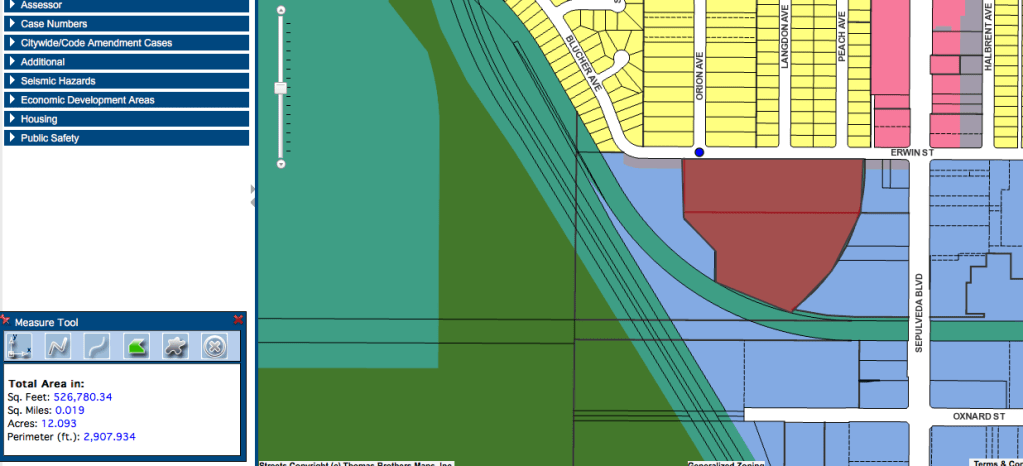
In Van Nuys, at Sepulveda and Erwin (north of Oxnard), there is a car parking lot for the Orange Line Metro riders. It is over 526,000 square feet, paved in asphalt, planted with trees and shrubs, and comprises over 12 acres.

Today, over 2/3 of it is used as an outdoor storage lot for Keyes Auto.

Red area is the parking lot of the Orange Line. It is now used predominately to store autos from Keyes Audi. (Source: ZIMAS)

The Sepuvleda/Erwin site is “Exhibit A” in the DNA of Los Angeles, because the right thing to do would be constructing 10-20 story apartments along the public transit route and creating incentives for residents to ride buses, take trains and use bikes for daily commuting.

Singapore Housing Estate with parks and nearby public transportation.

If LA were Singapore, Tokyo or Toronto we would do that.

Instead our city languishes and fights and wishes to preserve a 1950s idea of everyone going somewhere by car. 

And thousands of new cars are lovingly housed on land paid for by public taxes which should be used as housing and parks for the greater good of this city.

Nothing beneficial for Los Angeles ever happens overnight. It takes years of planning and legal battles, for example, to build assisted or low cost housing, or parks. 

One can imagine the fury and fear that might arise if a 12- acre park and housing development were planned on this parking lot ranch.

Imaginery view from Sepulveda and Erwin looking west. In reality, Singapore.

What, by miracle of God, might be possible here in terms of a park or high-rise group of apartments, placed near the bus line, with a buffer of trees, water features, and gardens between the new residential city and the single-family houses to the north of the site?

Yet here, alongside a public transit route, taxpayer funded Metro Los Angeles chooses to rent its land for an auto dealership. How does that benefit the surrounding residents?

For people who are obsessed with traffic, imagine that thousands of vehicles are parked here ready to be turned on and put onto the roads. How does that feel Van Nuys?

If the new planned housing estate were policed, regulated, secure, and it also provided a new park wouldn’t that be an improvement?

Orange Line Metro Parking Lot at Sepulveda/Erwin

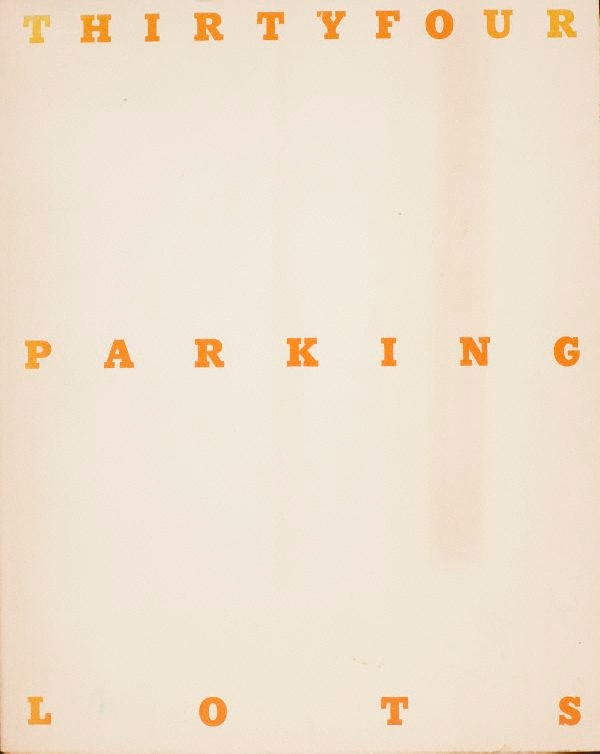
Thirty-Four Parking Lots in Los Angeles (1967)


Thirty-Four Parking Lots in Los Angeles (1967)

I previously wrote about this topic in 2014, but bring it up again as Los Angeles, and the State of California, are now in a furious debate about housing, cars, homelessness and how best to build.

All B&W photographs below are by Ed Ruscha. 


Ed Ruscha’s “Thirty-Four Parking Lots in Los Angeles” was published 51 years ago.

The artist, born in Nebraska in 1937, came to this city in 1956 to study at the Chouinard Art Institute. He also had an apprenticeship in typesetting.

Graduating in 1960, only 23 years old, he started working at an advertising agency doing graphic design. Influenced by the works of Jasper Johns, Robert Rauschenberg, Andy Warhol and Roy Lichtenstein, Ruscha was featured in a 1962 survey called “New Painting of Common Objects.”

That year he published “Twentysix gasoline stations” and later “Every Building on the Sunset Strip.” (1966)

He was the first, or perhaps the most notable artist, to create a deadpan, earnest, unesthetic photography of built Los Angeles. He looked, without pretense, at the sprawling, cheap, roadside city of billboards, car washes, instant apartments and filling stations and wrapped up his black and white photographs into little, smart, best-sellers.

Ruscha was talented and knew how to sell things, always a winning combination in the city of angles. (intentional)

The 1960s was a dirty flood of bitter reckoning that hit America and threw cold water on its made-up, powdered face.

Assassinations, sexual relations, racial issues, drugs, protests, music, environmental desecration, Vietnam: the entire decade blew up a contented self-image.

A nation, which thought itself a beacon of light onto the world, was forced to reconsider its own grotesque violence and misunderstand it.

Confronting Los Angeles, Ruscha presented a homely city with a picture book full of raw honesty.

State Board of Equalization 14601 Sherman Way, Van Nuys, CA.

May Co. 6150 Laurel Cyn NH

Inside “Thirty Four Parking Lots in Los Angeles” are some aerial shots of ordinary Van Nuys, North Hollywood and LA in 1967, with those enormous oceans of parking lots floating boat-like buildings.

Up in an airplane, looking down, Ruscha captured lines and boxes transposed upon the land, asphalt which looked, on its surface, much like the curtain-walled office buildings of that era.

Goodyear Tires 6630 Laurel Cyn NH

Good Year Tires at 6610 Laurel Canyon in North Hollywood occupies only a dot atop a long “I” shaped land-mass of parking.

Dodger Stadium

Dodger Stadium is buried deep within the hot skins of asphalt, a vaginal shaped structure where men played ball.

7101 Sepulveda, Van Nuys, CA.

And 7101 Sepulveda, a now abandoned office tower near Sherman Way, has trailers and motels on its perimeter, as well as plenty of free parking. Today, this area often hosts large encampments of homeless people, so the peripatetic ways of Van Nuys have historical precedent it seems.

Eileen Feather Salon 14425 Sherman Way, Van Nuys, CA.

14425 Sherman Way was called the “Eileen Feather Salon” and has but one long building fronting Sherman Way with parking in back.

Today, that corner is a cacophony of grossness and visual pollution including donuts and Denny’s. Signs are everywhere. And the weary eye becomes nostalgic for the simple joy of a lone building and its parking lot set down on arid land in the once less populated San Fernando Valley.


7128 Van Nuys Bl. 8/5/14

We are now engaged in a great civic debate about housing, and public transportation, and some voices hope (mine included) that denser buildings along bus and train lines will help alleviate high rents and homelessness.

Yet we never quite escape the trap set by the automobile: where to drive it, where to park it, how to best accommodate its needs.

Every single debate about new buildings always begins and ends with parking. Tens of thousands sleep on the street, families cannot afford rents or mortgages, developers are hamstrung providing parking for everyone and their guests, and Los Angeles dies a little each day from auto related illnesses.

Every time we think we are biking or busing more, something sinister comes onto the scene, and we now have 100,000 Ubers and Lyfts clogging the roads, and making our lives more hellish even as we praise their conveniences.

We plan a light rail down Van Nuys Boulevard and the auto dealers like Keyes stop it at Oxnard. They still run things. They destroy the city, and they are congratulated and worshipped for it. Thousands of their new cars are stored at outdoor transit adjacent parking lots built by Metro with taxpayer funds. Ironic.

Every time we imagine we are free of the car, we are forced back into it to chauffeur little white kids to school in better neighborhoods, to commute to $10 an hour jobs, to spend three hours every day in our vehicle so we might live in a house that consumes 50% of our income. Madness.

Ed Ruscha’s simple aerial photographs of parking lots are still a fact-based statement of what this city is. And how we are all swallowed into it.

Goodyear Tires 6630 Laurel Cyn NH

Keyes Van Nuys Rents METRO Busway Parking Lot.


DSC_3232

DSC_3233

DSC_3235

DSC_3238

screenshot_279

The publicly financed METRO has found a new way to earn some cash.

They are renting out about one-third of the Orange Line Busway parking lot to Keyes, Keyes, Keyes, Keyes in Van Nuys.

The lot, at Erwin near Sepulveda, was built, in the LA way, for bus riders to park their cars while they ride their bus and bike.

Someone very wise and very powerful at METRO must have concluded that most bus riders don’t own automobiles. So why not earn some bucks renting an enormous expanse of asphalt, planted with many hundreds of trees that lies fallow and unused?

The lovely neighborhood which abuts this lot to the north has been justifiably paranoid about proposed development plans which have included hundreds of town homes, office buildings, and potential additional retail stores. Hemmed in by the 405 Freeway, nightly helicopters, noxious fumes, prostitutes, trash, illegals and pimps on Sepulveda; oil storage tanks, psychics and speeding psychotics, the homeowners in these rose-covered cottages can do little about their immediate environment but rent out their properties to movie companies.

Perhaps a very large car park, rented out on public land to private industry, is a good thing. Nobody makes noise. Parked cars are silent and quite neighborly.

So for now the publicly paid for land is being used in that most characteristically Angeleno way, as a home for cars.

Car dealer expanding in Van Nuys


Car dealer expanding in Van Nuys.

Looks like the won’t be growing fruits and vegetables here after all.