In the 1950s and early 60s, the expansion of the Ventura and Hollywood Freeways was accomplished by massive bulldozing of parks and houses.
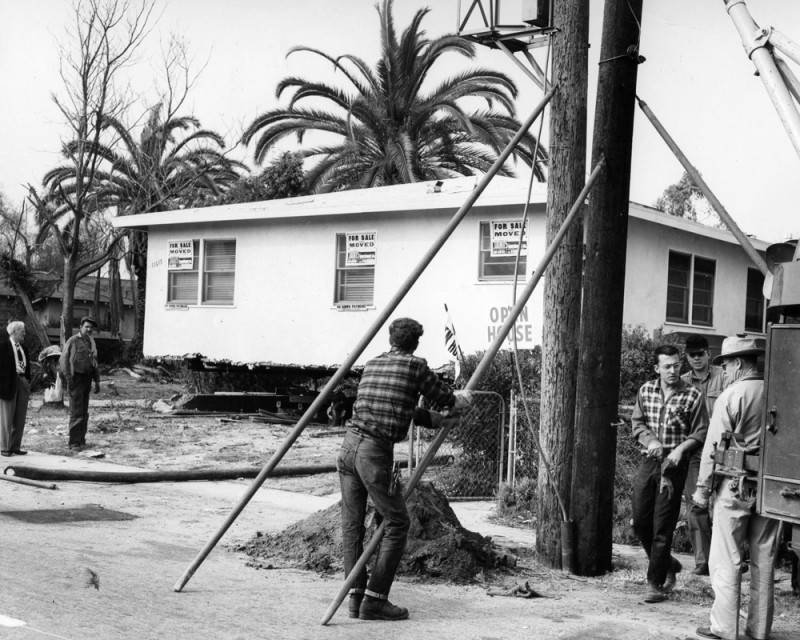
May 11, 1961 reads “The view from the tip of North Hollywood Federal Savings and Loan Association building currently shows a westward view of unfinished freeway ramps and and [sic] cleared ground. Construction is expected to be completed on this last remaining gap in the Ventura Freeway, connecting the Golden Gate [sic] Freeway and the Valley extension of Hollywood Freeway, by late 1962. The project will provide a second freeway route into Los Angeles for Valley motorists without their having to use the usually congested Hollywood Freeway. Officials expect Hollywood Freeway traffic will be cut 15 per cent by the addition.”“Photo shows the $3,300,000 next link in the Hollywood Freeway that is now under construction. Link will cross over Vineland Avenue at Acama St., about half a mile north of Ventura Boulevard. Motorists who use Vineland Avenue will be glad when this section is finished, for the underpass will be six lanes wide instead of the present two lanes. The Hollywood Freeway bridge already is completed and the cement forms are being removed. Beyond this, at Moorpark, a cloverleaf will be built. Photo dated: December 14, 1956.”February 17, 1956 reads, “Telephone company workers in foreground take out pole to facilitate removal of apartment house building from 11017 Acama St., North Hollywood, as work progresses on structures which will carry extension of Hollywood Freeway across Los Angeles river at Lankershim boulevard and across Vineland avenue above Ventura boulevard. Structures must be built before work begins on freeway itself.”August 10, 1960 reads, “Movers star in ‘The Apartment’ – There’s a 12-family vacant lot at the corner of Magnolia and Westpark in North Hollywood after building owner Ben Joseph of Studio City House Sales Co. took his 12-unit apartment house up the street to Burbank boulevard. Building moved because of planned freeway extension.”November 7, 1957 reads, “Nearing completion – Looking southeast toward Cahuenga Pass and Hollywood Freeway, this view shows nearly completed bridge over Vineland avenue on North Hollywood extension of freeway, which will be opened to traffic near end of month. Vineland Avenue and Moorpark Street will both be widened to accept heavy flow of vehicles when section is opened. Freeway will eventually extend 6.8 miles across Valley and connect with Golden State Freeway. All photographs in this series were taken from helicopter piloted by Bob Gilbreath of Southwest Helicopters Inc.”
North Hollywood, never rich in parkland, suffered the loss of some 20 acres of parkland to accommodate the construction of the 170 which today slices through and forms a new border between more affluent “Valley Village” and less wealthy North Hollywood.
It was cheaper to take parks than pay private property owners to seize land for the highways. Yet there were also many thousands of buildings moved or destroyed when California embarked on its mad program to make us completely dependent on motor vehicles.
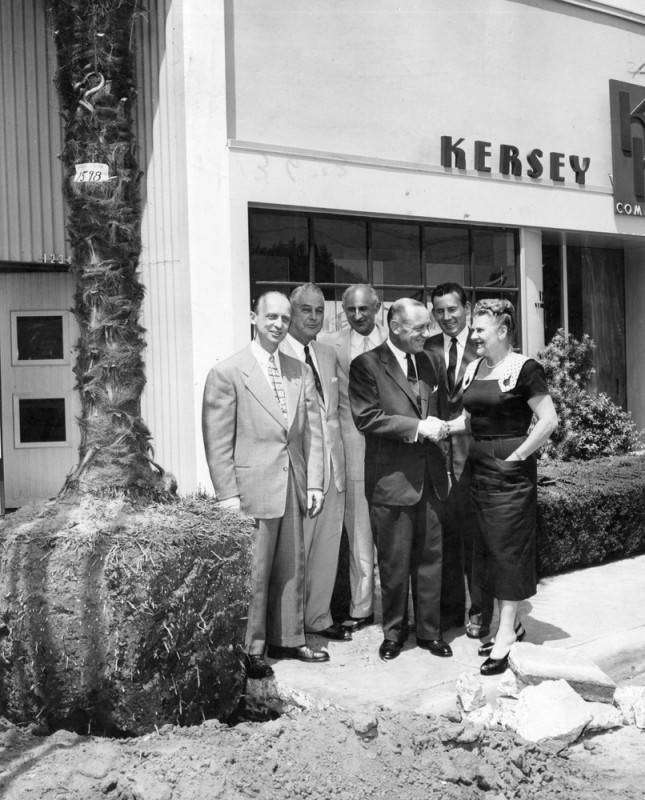
September 9, 1961 reads “Community and city officials dedicate the last of the municipal parking lots to be constructed in the North Hollywood business area. Participating in the ceremonies at the Magnolia boulevard lot, west of Lankershim boulevard, are (from left) Everett M. McIntire, North Hollywood Chamber of Commerce president; Verna Felton, honorary mayor of the community; Ted Rathbun, parking chairman, and Everett Burkhalter, First District councilman.”Pictured are several vehicles preparing a 20-acre parcel of North Hollywood Park for construction of the Hollywood Freeway extension. The park strip, approximately 250-ft. wide, is located on the west side of the park between Chandler and Magnolia Blvds. The $3 million segment will extend from the new Ventura Freeway to Magnolia Blvd., and will include several bridge structures. The eight-lane freeway will ultimately join the Golden State Freeway north of Roscoe Blvd. in the vicinity of Laurel Canyon Blvd. Photograph dated September 13, 1961. “Lou Kerekes, 5004 Bakeman, North Hollywood, on his daily walk with his dog, Cheeko at North Hollywood Park. On this day, they stop to contemplate a portion of the 20-acre parcel of North Hollywood Park, which is being used in construction of the Hollywood freeway extension. The park strip, approximately 250-ft. wide, is located on the west side of the park between Chandler and Magnolia Blvds. The $3 million segment will extend from the new Ventura Freeway to Magnolia Blvd., and will include several bridge structures. The eight-lane freeway will ultimately join the Golden State Freeway north of Roscoe Blvd. in the vicinity of Laurel Canyon Blvd. Photograph dated September 13, 1961.”February 17, 1956 reads, “Salesman S. E. Stafford, from Janis Investment Co., ponders sale of buildings being moved within next two weeks to make room for Valley extension of Hollywood Freeway. Agreement for construction of freeway is to be submitted to Los Angeles City Council within six weeks.”
Today we live in a reality that we think is normal but was paved and paid for by our elected ancestors. Car chases, global oil with wars and climate change, air pollution, shopping centers that took away orange groves, every five-minute traffic reports, the self-defeating obsession with oil prices, the decline of walking and the promotion of obesity are all linked in some way to the freeway system.
Our fervor to ride our cars to the Starbucks and drop our kids off at school, empowers Saudi Arabia, Russia, Iran.
Our question for every apartment building and every house built in California: where will they park? Nothing architectural or aesthetic, nothing about the urgency of housing, only one thing on everyone’s minds:
Where will they park? Where will they park? Where will they park? Where will they park?
If by some miracle there was a proposal to build Rockefeller Center in the middle of a parking lot in Van Nuys behind rows of empty storefronts, there would still be only one question: where will they park?
We would rather live in environmental degradation than rethink our freeway and road addictions.
But in the 1950s every destructive program was considered an improvement.
In the archives of the Los Angeles Public Library are many old photographs from defunct newspapers such as the Valley Times and the Herald Examiner.
Thanksgiving is always a holiday where family, togetherness, food, and feeding the hungry are foremost.
The old ways of thinking about this holiday are on display in some of the images below, taken in the 1950s and 60s.
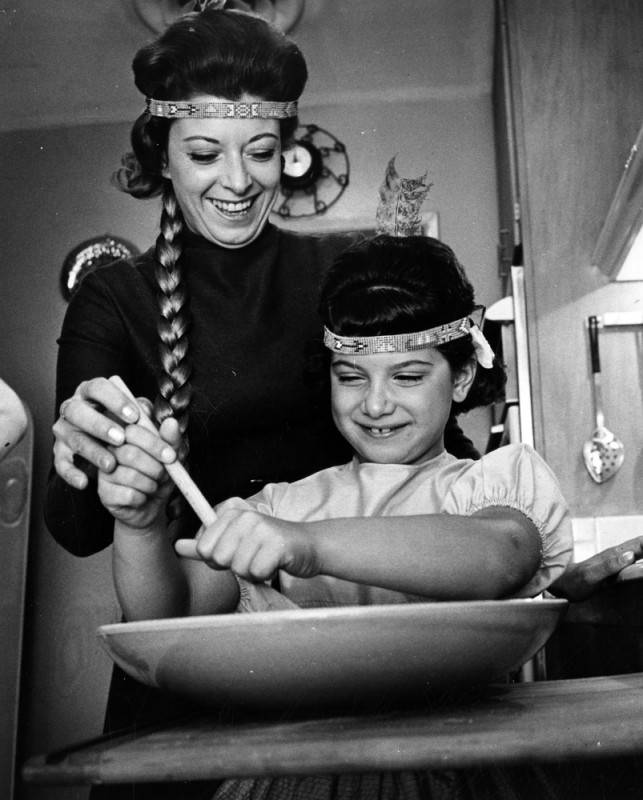
November 21, 1956: Mrs. John A. Gallagher prepares turkey for her grandchildren, Donna Lyn Dumont, 8 and Glenn Dumont, 4.November 17, 1953: Puritan Hat Decorations to symbolize founding fathers’ generous spirit. Las Candelas party for children at Camarillo Hospital. Mmes: Guy M. Bartlett, Lemon Blanchard and Eugene H. Dyer, of North Hollywood.November 23, 1964: Mrs. Seven and daughter Laura prepare Thanksgiving meal with their new feathers and headbands worn as a salute to the Indians who ate with white settlers on the holiday. November 18, 1961: Actor Gerald Lazarre seems to be trying something new: drying dishes as he assists his wife, actress Julie North, in preparation for Thanksgiving dinner at their home in North Hollywood. November 23, 1961: The Sawlsvilles of Sepulveda. After their parents died, these seven grandchildren were adopted by their grandparents. The elder Sawlsvilles also have three children of their own. 1968: Salvation Army 1954: Children pray before meal at Salvation Army.
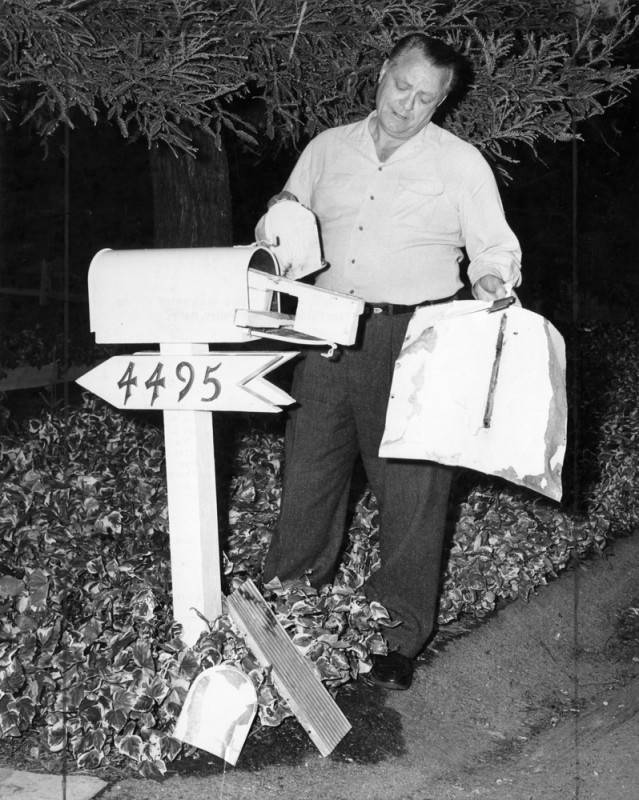
“Exploding mailboxes in an exclusive Encino residential neighborhood are arousing a vigilante-type reaction in some homeowners. The latest victim, Frank A. Fuller of 4495 Libbit Ave., whose mailbox was blown from its curbside mounting Friday by some kind of explosive, said: “I own this place, I pay taxes and I’m going to protect myself and my property.”
The explosive that shattered Fuller’s rural-type mailbox was powerful enough to hurl the tin-sheeting across the street, throw part of the mailbox onto the roof of the Fuller home and splinter a two-inch thick piece of wood.
Mr. Fuller, West Coast representative for three Philadelphia-based electronics firms, said the exploding mailbox was part of continuing vandalism that has plagued his neighborhood.”
Sometime in late 2018, early 2019, I’m not sure exactly when, they created a pedestrian crosswalk, with flashing lights, across Ventura Boulevard. at Ventura Canyon Avenue. The crossing is about a block east of Woodman and a few doors down from Yok Ramen at 13608 Ventura where I go about once a week.
This is in the heart of Sherman Oaks, where stores that paint your nails, sell used records or live birds are sprinkled along the boulevard along with massage, dry cleaners, and laser skin treatments. And Floyd’s 99 Barbershop where every customer from 18-80 is a rock star.
I’m familiar with this area and its friendly banalities.
About 20 years ago, I knew a divorced woman in her 40s, with a little girl’s voice, who spent most weekday mornings at the location where the ramen place is now.
Back then it was a bakery and a coffee shop with big muffins and big mugs, chocolate croissants and caloric treats. She sat at a table with her journal and wrote music and poems. Today she is retirement age, married and living in rural England. And that’s how I got to think about the time passing and the way people pass time on Ventura Boulevard.
As Orson Welles once said, “The terrible thing about L.A. is that you sit down when you’re 25 and when you stand up you’re 62.”
And if you spent a couple of decades eating chocolate chip muffins on Ventura Boulevard what have you got to show for it?
To keep people alive, and moving, mostly in cars, the people and “leaders” of Los Angeles have devised, through the years, the same kinds of ideas to make safer the naked and shameful stunt of walking across Ventura Boulevard. These include longer pedestrian signals, traffic islands, and painting the street with lines or figures to indicate that humans on foot also roam in the land of cars.
We tweet in seconds about trivialities like nuclear war, impeachment or the fires in Australia but we cannot assume that six decades will correct the urban failures of Los Angeles. Photographs from the past prove my point.
On November 30, 1959, Dr. Louis Friedman, Dentist, painted his own crosswalk, with a corn broom, on the pavement at Murietta and Ventura, to protect his patients. He had unsuccessfully asked the city to do so but his requests were ignored. So he took the initiative and laid down the lines.
That same year, Carl Stezenel, 10, of North Hollywood stood at the corner of Radford and Ventura and tried to cross in the time allotted, 9 seconds. If a 10-year-old boy found that challenging, imagine the typical woman of that era in high-heeled shoes, gloves, hat and a cigarette pushing a baby buggy?
Carl Stezenel’s plight may have influenced a December 1, 1960 dedication for a new landscaped traffic island at that same location. Men in suits (a sure sign of importance) attended the event, in a district whose distinguished architecture featured auto dealerships and gas stations.
Five years earlier, in 1955, motorists on Ventura near Dixie Canyon Avenue were warned that they were approaching a nearby school by a painting on pavement of a running boy with a ball.
People who worked and shopped in the area did care about how it looked. Years before it was considered normal and decent to allow tens of thousands of intoxicated and mentally ill people to live on the streets with garbage filled shopping baskets, the issues of why there was no tree cover on the boulevard haunted the civic minded.
The palm tree, with a trunk so skinny it could never crowd out a Cadillac at the curb, was the obvious solution.
Studio City is now lined with palm trees, a species that provides no shade to sidewalks that are baked in sunshine 350 days of the year. In 1954, the first palm trees were planted as part of a beautification scheme. Fully grown, their trunks look like posts without billboards, a perfect style for this city.
The sameness of businesses in the late 1950s along Ventura Boulevard presented problems. We, who are of CVS, Starbucks and Chipotle, may understand that historical plight.
Studio City and Sherman Oaks had a competitive streak.
To bring customers between the two districts, a special free bus was introduced on February 18, 1959. If you had a watch that needed repair, wanted to purchase panty hose, a typewriter ribbon, or a cigarette case, now you had a no fare bus to take you up and down Ventura Boulevard, opening up a world of possibilities.
That bus must have been cancelled after 10 episodes.
Further east, at Balboa and Ventura in Encino, the traffic situation was already dire in late 1953 when work-bound suburban residents were forced into only two lanes of eastbound road, while the westbound, going into less populated Tarzana and Woodland Hills was free of congestion. The solution: three lanes in the morning, and then move the cones and make it three lanes westbound at night.
Eventually, the current road was widened into three lanes in each direction, with an advanced staring-into-the-sun design for morning and afternoon drivers.
High rise office buildings sprung up in the 1960s and 70s, some as high as 15 stories, but nobody in the single-family neighborhoods nearby cared because the occupants were white and well-paid. Today, a four-story tall apartment with 130 apartments, and 3 affordable units is considered social engineering and overcrowding by many in Encino.
We are now into the third decade of the 21st Century and Ventura Boulevard still lacks safe pedestrian crossings because most drivers and pedestrians are looking into their mobile devices.
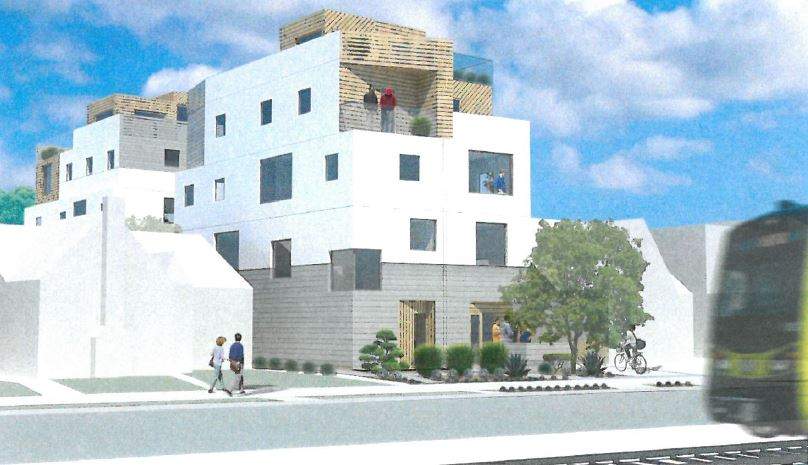
“Next week, the South Los Angeles Area Planning Commission will consider an appeal of Buckingham Crossing, a proposed small lot subdivision near the Expo Line.
The proposed development from Charles Yzaguirre, which would replace a single-family home at 4011 Exposition Boulevard, calls for the construction of four small lot homes. The houses would each stand four stories in height, featuring three bedrooms, two-car garages, and roof decks.
Los Angeles-based architecture firm Formation Association is designing the project, which is portrayed as a collection of boxy low-rise structures in conceptual renderings.
The appeal, which was filed by residents of a neighboring home, argues that the project does not comply with the City of Los Angeles’ Small Lot Subdivision guidelines, and have bolstered their case with a petition signed by nearby residents, as well as a letter of opposition signed by City Council President Herb Wesson, who represents the neighborhood.
However, a staff response notes that the project was filed with the Planning Department before the new regulations were adopted, and are thus not subject to them. The staff report also rejects claims that the four proposed homes would increase traffic congestion and create a “‘wind tunnel’ spreading toxins” through the passing of Expo Line trains.”-Urbanize LA
As this blog has shown, many times, we live in a city of homelessness for those who cannot afford a home, or are too sick to attend to the normalcy of paying rent.
At the same time, the dire need for housing continues to be opposed by vast segments of the city who will take any proposed multi-family dwelling, even one as small as four stories, and attach some fear-mongering lawsuit against it.
The condition of Los Angeles in 2018 is comedic in its insanity, with ostriches of all sorts screaming about “overdevelopment” inside the second largest city in the United States, a spread out sprawl of parking lots and shopping centers where residents complain about lack of space, lack of parking, and too much traffic. Yet lack the political and moral will to remedy an ongoing tragedy.
These same NIMBYs oppose even the tiniest increase in density, along light rail lines and public transport, refusing to allow the city to progress economically and logistically, and also, quite cruelly and callously, perpetuating the expensiveness of all housing, by limiting its supply.
One-hundred years ago, Los Angeles was a much more modern and progressive city than today, a place where tall apartments were welcomed, possibly because they looked aristocratic, well-proportioned, and they brought economic growth and well regarded architecture to a growing city starved for development. They wore their best European tailoring, even if they were overdressed, because they had pride and self-worth and a city which respected those qualities.
By contrast, many of today’s multi-family dwellings are self-effacing, timid, obsequious, broken up into many little pieces to ward off attackers, erased of any individuality or identity. So even when the architects surrender to the bullies, that cannot mollify the attackers. The NIMBY mob wants the city to stay exactly as it is, even if that means that 100,000 people sleep on the sidewalk every single night.
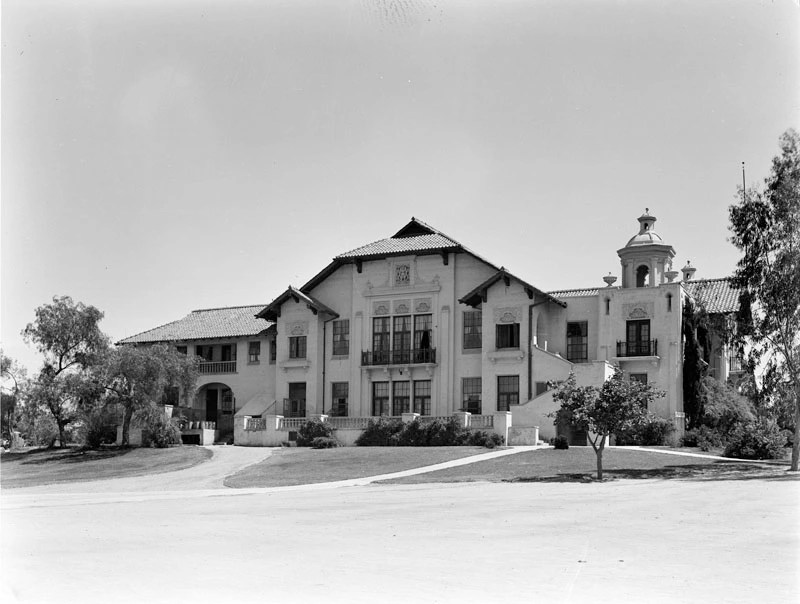
Imagine the screaming in Encino or Palms or West Adams if anybody proposed the old styles seen below next to any existing single family homes. (source: LAPL)
Chateau Elysee
Ravenswood and El Royale, Hancock Park, Los Angeles.
He is 21, dressed in a Hawaiian shirt with a cotton bomber jacket and button front denim jeans. She is 19, holds a Boxer pup and wears a leopard print coat and appears somewhat sad and disturbed.
They are Alvin and Beverly Turnmire, recently married.
Their address is a home in Studio City at 4232 Goodland Ave. near the golf course. They probably live with his parents, but they want to get out and get an apartment.
And Burbank police said they committed a string of burglaries in order to furnish their new place.
November 5, 1947 is the date of their arrest. They were caught 71 years ago, and are probably dead. But their reincarnated young beings still walk Ventura Boulevard.
Studio City people: in love with dogs and exotic clothes, chasing goods and desires beyond their reach, a place of happiness and meltdowns, a magnet for dreamers, a trap set in the San Fernando Valley for aspirational types who fled from somewhere else, a district where many survive by impersonation, wearing costumes and carrying animals and evading responsibilities.
1954: Cop with Five Truckloads of Stolen Building Material
And then Alvin Turnmire, 27, is arrested seven years later. For white people back then there were always second chances.
Photograph caption dated March 8, 1954 reads “Officer Thomas Quarles examines king-sized wire snips as he stands amid five truck loads of building material loot alleged stolen by Alvin R. Turnmire, 27, and found by officers at the suspect’s Sun Valley home. Goods was (sic) valued at $20,000.” The article partially reads: “A Sun Valley father, who seven years ago looted Burbank stores to set up housekeeping, is back in jail today for a fantastic nine-month series of burglaries.”
1957: Cops with stolen loot.
Alvin Turmire, now 31, is arrested again, ten years later, in 1957, now living in Pacoima. He is still committing burglaries. For white people back then there were always third chances. Maybe it helps that he was a Marine, fought in WWII, earned a Purple Heart, “got a Jap bullet in the leg at Iwo Jima, as his wife explains.”
Photograph caption dated August 1, 1957 reads, “T. E. Holt, left, checks stolen property at Valley station with Det. John Sublette after police picked up two truckloads of stolen goods at home of Alvin Turnmire, 31, 8969 Snowden Ave., Pacoima. More than $10,000 worth of various equipment was picked up. Turnmire was booked on suspicion of burglary and is scheduled to be arraigned today.”
You must be logged in to post a comment.