You March That Way, You’ll Live This Way


1955.

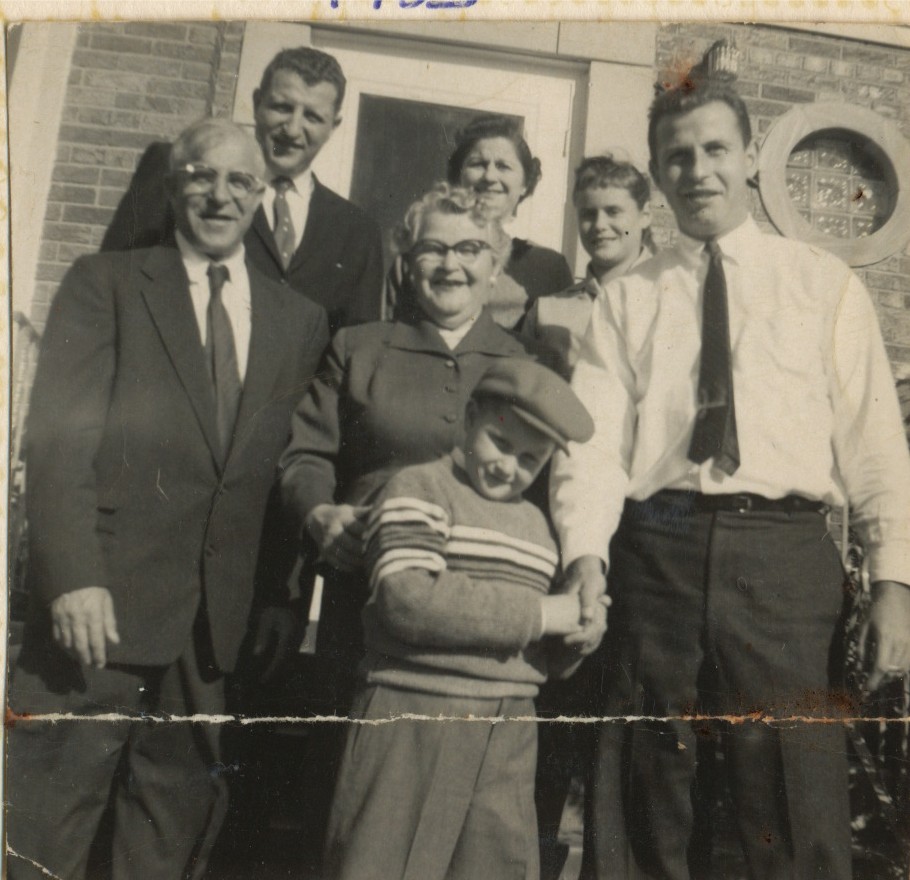
Once upon a time, my father’s family lived on the South Side of Chicago.

Grandpa Harry and Grandma Fanny had their little house on 88th and Clyde, a squat brick home built in 1950 with a back porch and a spotless kitchen. 

Uncle Paul, Aunt Frances and Barry lived on Luella, not far from Grandpa Harry.

And Uncle Harold and Aunt Evie lived with their children, Adrienne, Michael and Bruce in expansive, grand old apartments overlooking Lake Michigan along the South Shore.

Harold and Paul had both been soldiers during WWII, married young, and came back home. Harold was an engineer, so he started a heating/air-conditioning company that installed systems in many buildings in Chicago. Paul (1921-), veteran of Iwo Jima and the Battle of Leyte, worked as a plumber and electrician. He is still alive at 99 and lives in Woodland Hills, CA.

In 1968, after the assassination of Martin Luther King Jr., there were nationwide riots. And the stores on the south side were burned down and looted. And my grandfather’s new 1968 Chevy Impala, parked on the street, had its antenna broken off by a vandal. That’s when everyone sold their houses and moved up north to Rogers Park and Lincolnwood, North Lake Shore Drive, Deerfield and Highland Park. 

Because they were safe there. 

There were federal investigations by the Kerner Commission, whose findings were released in 1968, to get to the root causes of rioting from 1967, the year before. And they found, (surprisingly!), that segregation, poverty, discrimination, poor jobs and broken families contributed to unhappy lives. 

_______________________________________________________________________-

After every insurrection, after every march, after every episode of mass looting, there comes a vow to move forward and make certain that this time, this time for sure, these events will not happen again.

So the streets in major cities were renamed Martin Luther King Jr., and on television Norman Lear created “The Jeffersons” and “Good Times.” And Hollywood and the media proclaimed that justice would reign over all the land.  See the diversity!

And then there is a reaction, a call for law and order, new laws for harsher sentencing, new reforms for welfare, and progressive ideas to rebuild the cities (Brooklyn, Venice, South End Boston) by making everything safe for tech and shopping and historic renovations, and guess who will be removed again? 

Giuliani is the king. Love what he’s done! This city is the best it’s ever been. We’ve been through 9/11 and now we are never going to be down and out again!

_____________________________________________________________________

Who gets shot and who goes to fight the wars and who dies in the streets and who dies on the battlefields and whose population is dying today of Covid-19 and why is it always the same answer?

Why is it still terrifying to drive through the west side of Chicago before you reach Oak Park and tour Frank Lloyd Wright’s houses? Who lives there and who kills there and who suffers there? It’s always the same answer.

Let the looting and fires and protests begin! America don’t you see what’s going on! 

You are violent by custom, and this is another type of violence. How dare they smash shop windows and steal what isn’t theirs!

___________________________________

Note:

Estimated U.S. military spending is $934 billion. It covers the period October 1, 2020, through September 30, 2021. Military spending is the second-largest item in the federal budget after Social SecuritySource.

That works out to about $2,838 per person in the US. Or about $236 a month for every man, woman and child in the country.

We aren’t even at war. But you could argue we are always at war.

__________________________________

People of pinker pigmentations are again woken up and made to face the suffering of some of their fellow, darker citizens. And every year the same old story is retold, just with new clothes, new celebrities, new movies, and now, a new hashtag, #oscarsowhite or #blacklivesmatter. 

And a silent majority, one whose all-white room I sometime inhabit, deplores criminality, violence, and looting; and I’m locked in there in that all-white room; I can’t get out, because I like the all-white décor that tells me that some people are violent and barbaric and have the wrong values. I feel better about myself, in that all-white room, knowing I’m law abiding and that should be end of the discussion. I’m suffocating in there, I can’t breathe, but I am relaxed in my self-assurance and high self-esteem.

Because if you get in trouble you are a troublemaker. 

_________________________________________________________________

Where I came from is some of who I am.

I grew up in 1970s Lincolnwood, IL and there were no black people other than domestics who worked in people’s homes. 

In 2017, Lincolnwood was racially composed of 57% whites, 30% Asian, and 6.2% Latino or other.  I didn’t see a mention of African-Americans.

There was once a way to run away from troubled places, and seek refuge in a safer neighborhood, but I think we have run out of hiding spots.

They have come to Beverly Hills and Buckhead and Santa Monica, and they is us. 

In 1992, I worked in the Polo Ralph Lauren mansion on 72nd and Madison in New York. There was no social media, no Twitter or What’s App, only rumor.

So as Los Angeles burned, New York City trembled, and rumors of mobs attacking Herald Square and other locations were falsely spread. There was not mass violence or destruction in New York City, that year, and it remained largely in Los Angeles, mostly, infamously, in South LA and Koreatown.

The Polo Store had wooden doors with glass windows, and the security guards pulled the cloth window shades down. They turned the lights off, and we all went home around 3pm on Friday, May 1, 1992. I walked through Central Park in my linen suit and back to my little apartment on West 96th St. to sit in the air-conditioning and wait out the troubles. 

Until this past week I thought we lived in a new time of toleration and nobody was that angry and the times I saw horrendous videos of police brutality seemed the exception and not the rule. And I lived, because I am allowed to do so, in a bubble of wishful thinking and fantasy, in a country that mistreats others but not me.

I thought Barack Obama was the pinnacle of we shall overcome. 

And I was wrong. Dead wrong. 

I was naïve. 

Me? 

Naïve? 

No. 

Just white.

I’m protected from the injustices perpetuated by a system designed to give me a boost up, a feeling of betterment, because others are down there, and can’t be as good as me, no matter how spectacular they are, by virtue of their inherited DNA.

That’s really the truth. Because you might have an MBA, or be the CEO of a company, and if you go running as black you might be shot dead. So why bother to be the best if your country already decides you are the worst? That is the quandary of racism, it rips down the individual to a category, incarcerating her within a foul story of failure. 

It takes a remarkable concentration of effort for the protagonist to overcome her role as the demon in a bad fairy tale.

Like an Obama or Oprah or any father or mother of color in North America.

______________________________________________________________

We are at a point that is not only about the murder of the man by copper knee in Minneapolis. 

There is the small matter of our chief executive, a corrupt ignoramus, who came to power, by questioning the birth certificate of our black president.

We are sick, we are unemployed, we are uninsured, we are scared. 

We were kept home, kept in fear, brought out in mask, and indoctrinated to wash hands. We stayed home and got our groceries delivered, and got a check from the government, and some people got sick, some died, and the nation looked in vain for a leader who could not lead, a savior who could not save, and today we are waking up in the wreckage of our homeland.

A virus still stalks the Earth and lives in our saliva.

When Los Angeles was at its richest and most prosperous, three months ago, there were 100,000 homeless. And that was permitted, by the leaders, the citizens, and the public. 

When Los Angeles was at its most diverse, the whitest among us drove our children to school districts that were majority white, and our morning and afternoon traffic was largely made up of children riding to and from whiter schools with their parents. 

And that was toxic and unjust, racist and unfair, blatantly racist. When you think about it.  Public schools where no children walk to school. Public schools, not of neighborhoods, but of magnets propelled to collect like particles to adhere with.

And what have we done to change education, health inequalities, housing shortages, racism itself? Because it all circles back to race when you ask people where they want to live or go to school.

We have an invisible problem right before our very eyes. 

Our feet stand on blood-soaked soil. But we don’t see under our white sneakers.

We are striving to succeed, we want our children to succeed, but what is personal success if our nation is a failure?

So many marched, that way this week, holding up signs: impassioned, motivated, angered.

It was a religious fervor of moralism sweeping the country. 

But nothing has changed, really. Stores are burned and looted, cops get down on their knees, mayors and governors call for a new dawn of tolerance and kindness.

The new plate glass windows go up, the tags scrubbed off the buildings, and surely Oprah will find a new heartwarming book to promote by a young black author.

Instagram will black out, and hash tag, and celebrities will proclaim they stand with the oppressed and the hated, and vow that a new day is here.

And new laws will get passed. And everyone will listen to great podcasts about race and police. And eventually the marchers will not march. They will go home, or get jobs, or go back to school, and the national hibernation will end, and the fast, furious ambitious race to get more for me will resume. 

The next time someone dies unjustly, Our God, Lord Smartphone, will record it. 

But Lord Smartphone cannot right a wrong. Only we can.

We marched that way, but we’ll live this way.

Impressions of Chicago (Part II)


I was born and raised in Chicago.

How I thought of that city, which I left before I became an adult, was cloaked and colored under the family who brought me up there and who soaked their biases into my head.

That Chicago, more specifically Lincolnwood, became a suffocating, judgmental, intolerant and petty landscape of cruelty, snobbery, and competitiveness in which I, and my family, were on the receiving, and losing end.

In light of the present, where I know of the real atrocities around the world, the things that happened back then in Lincolnwood were small and fleeting and insignificant.

But they still stung me. And have stayed with me.


A few months ago, I did one of my Facebook searches for people I once knew in Lincolnwood.

One infamous and notorious name came up. To protect the guilty I will call him Arthur Knox.

A blue-eyed, athletic, deviously charming and good-looking kid, he was the child of a Highway Construction Foreman who washed his Black 1963 Fleetwood Cadillac on the driveway every Sunday.

Arthur ran faster than everyone. In his bedroom he hung posters and pennants of his favorite heroes from the Black Hawks to the Cubs. In school, he was the captain of any team in gym class.

By contrast, my own disinterest in sports grew as I was pushed into Little League. I hated standing in the hot, humid sun waiting in center field for someone to hit a ball out to me.

I also had not a single interest in any Chicago sports team: a fatal flaw in The Windy City.

Instead, I read from my 1960 World Book Encyclopedia while Arthur Knox and other boys set up ball games on the street and played football on nearby lawns.

Gradually, my lack of interest in sports worried and angered my mother. She may have perceived a dark funnel cloud of homosexuality on the horizon.

Arthur Knox bullied me on the bus. He called me “the world’s suckiest athlete.” I went home and told my mother about it. She replied, “I don’t even know what that word suck means. Forget about it!”

At the bus stop, Arthur taunted me and another girl with dog shit on a stick. On another day, he rode after me on his bike, with his pal Keating, tackling me near the Devon Avenue Bridge and beating me up in the dirt. Nothing had provoked it. He just felt like it.

Was I shot? No. Was I bloodied? No. The scale of violence was mild, but my rage was deep.  Arthur was terrifying. He had to be avoided but he ruled over the street.

40 years later, he was a “Life Coach” and a father, married, and had competed in a triathlon in which he apparently almost lost his life, later revived by paramedics. He went on to tell his resurrection story on a nationally broadcast program.

On Facebook, the accolades of praise for Arthur Knox poured in. “World’s Best Father”, “The Man who Taught Me What it Means to be a Man”, “The Greatest Friend Anyone Could Have.”  Arthur had posts against bullying, posts about gratitude, posts about love, family and life.

His life of conformity to alpha male values was vindicated. Competitive in sports and business, he basked in praise. Millions knew his outer accomplishments. Only I remembered his temper and violence.

And the popular kids, the ones who I used to call “The Snob Club”, they were all his friends on Facebook. And the virtual world of 2015 was as alive with sycophants as the real one of 1975.

Why bring up the story of Arthur Knox? He is nobody important. He just seemed important back then. And some think he’s important today.


On my recent trip to Chicago, one sunny late July afternoon, I went down to Montrose Harbor.

Everything was in primary colors.

The day was glorious and the setting magnificent: the blue sky and the white clouds, the enormous grassy lawn park, the yachts and the boats moored at their port, the skyline in the distance, the red lighthouse and white sailboats, the bleached rocks on the shore and turquoise tinted Lake Michigan.

A tall, tanned young man in board shorts was hoisting a sailboat off its trailer and attempting to attach it to a steel armed lift that he would use to crank and lower it into the lake. I asked him what he was doing. He asked me if I would help him.

Processed with VSCOcam with a6 preset
Alex Jan, Montrose Harbor, Chicago, IL 7/29/15

I jumped in and directed him as he steered the boat on wheels and hooked it onto the crane. We pushed, pulled, and guided the vessel into the water.

After we were done he told me he worked at Mariano’s in the western suburbs. “Dude, I’m a butcher!” And on his day off, he eagerly came down to work at the Chicago Corinthian Yacht Club at Montrose Harbor. Sun burned butcher on the dock on his day off….

He picked up a cold can of Colt 45 and drank it. He thanked me for helping him and asked me if I had to use a bathroom or anything. I said yes, and he let me go into the clubhouse facilities.

We said goodbye and I told him I would put his photo up on Instagram.

Something about that day seemed intrinsically Chicagoan: friendly, un-menacing, bonding, open- hearted, fun, casual, and unaffected.

Maybe there are people and moments like that in Los Angeles, but they are often colored by ulterior motives, either sexual or vocational.

Am I being too generous to Chicago? Is there anything truly odd or notable about that day on Montrose Harbor?

Is it logical to bestow attributes on someone just because of where they live?


 At lunch, Judy Mamet, lifelong Chicagoan for eight decades, said her city is often “judgmental.”

She was speaking to me, an Angelino, who often hears that everything is “cool”.  On the West Coast we hide our indifference by calling it toleration.

Maybe what I remember most about Chicago was its judgments.

I think of that stern Lutheran neighbor in the knee socks who walked her girls to church every Sunday. She came to say good-bye when were moving out and told my Mom that she was glad my retarded brother had been institutionalized because she pitied watching Jimmy and my mom played catch.  My mother later said she wanted to throw acid in her face.

I think of Mrs. Libman, my 6th Grade teacher who taught the subject I could never learn: math. I grew to dislike her.

One day, my friend and I rode our bikes in front of her house, yelling out “Mrs. Libman! Mrs. Libman!”  She came out of the side door and yelled at us. Later on my friend apologized to her. But I never did. Then my Mom and I bumped into Mrs. Libman at Marshall Field & Co. at Old Orchard. “Howard Kenneth apologized to me but your son never did,” she said. “I’m sorry Mrs. Libman,” I said.

Think about how un-criminal our behavior was. Yet it was scandalous. And that old Chicago standard of judgment still haunts my morality.

And those small lives predicated on big morality, they seem to still thrive in the Windy City, those people who have never left there, who exist in the mental and geographical landscape of the Middle West where you cut your lawn because your neighbors would look down on you if you didn’t. And you go to work everyday because if you didn’t you would not only starve but be banished out of the family of normality and acceptance.

Embarrassment and shame, the cabal of middle-aged moms and dads who enforce good behavior, the presumption that there is a right and a wrong, the correctness and goodness of the white race, the idea that life goes off the rails because of moral defects, these are deep in the DNA of Chicago and the Middle-West. Pope John Paul II and Mayor Rahm Emanuel have called Chicago “The Most American of Cities.”

They said it patriotically. I quote it ironically.

Proudly, Chicagoans will show off their lakefront, their new parks, their “architecture” and their feats of engineering and artistry. But what they are also saying is that their city is who they are. And that is why, when a Chicagoan is told that his city is racist, or a murder capitol or not as good as New York, he reacts with anger and hurt. You are hurting the Chicagoan to speak against Chicago.

And that is what makes it unlike any city in America. The city and the man in it are the same.

Impressions of Chicago (Part 1)


IMG_8818
Louise and Millie

When she was alive, before she was sick, my late mother Louise (1933-2014) was asked by her older sister, Millie (1924- ), to come visit Chicagoland.

My mom, who had moved from Illinois to New Jersey, and now (reluctantly) California, did not want to come to Lincolnwood where her sister had moved into an assisted living facility.

My mother imagined that the weight and sadness of going back to the town where she had spent most of her life would be an arduous and morbid visit.

In August 2014, Louise went into her final weeks of life, her body ravaged by lung and bone cancer. She drifted in and out of consciousness. And cried out, only one word, over and over again: “Millie! Millie! Millie!”

Chicago 7 28 Visit Aunt Millie 6

Instead, the visitor who came from California to see Aunt Millie last week was me.

I was on a trip visiting three cities where I had once lived: Boston, New York and Chicago.

And when I landed at O’Hare, I rented a car, and drove east on the Kennedy and exited at Nagle. I had GPS, but it was redundant.

Hungry, I stopped at a restaurant stand advertising “pop” and hot dog and fries for $4.99.

I was in Chicago. A man in the booth in front of me had tattoos on his arms: “Bears” and “Chicago”.

IMG_8813

The homely brick houses, the steel storm windows, the oversized green light poles, the neat stores, the spotless streets, this was my city.

But it felt strange. It was foreign. After all, I had moved out of here in 1979.

Lincolnwood Place, where Millie lives, is part of a remade industrial section of the village. It is next to a diagonally placed shopping mall with a Carson Pirie Scott and other stores, surrounded by mounds of watered and cut grass, acres of parking, and shaded by many trees.

It’s mediocre and modern with a plastic surface of prairie style. They once had trains and factories here, but that was long ago.

Across McCormick, the North Shore Sanitary Canal is now disguised by parkland with bike trails, trees, and further north, a sculpture garden incongruously placed near the sewage waters.

When I was young, an enormous, high, circular, green, natural gas tank, banded by red and white rectangular paint, stood near Pratt and the canal, looming over the flat lands like Godzilla. I imagined it was full of toilet water and feces that drained into the sewage canal.

I feared falling into that canal. I dreamed of it sometimes.

Maybe I had once heard a scary story.

Louise and Jimmy (1974)

In the early 1970s, one late afternoon, my mom was driving her convertible Delta 88 across the Touhy Avenue Bridge that crossed the canal, when my brother Jimmy jumped out of the open roofed car at a red light and ran down to the canal with my mother in chase.

There were always dramas like that in my family, so even last week, seeing my 91-year-old Aunt, living in the assisted living facility, right near the canal, I thought of those nightmares of shit and polluted water and the hideous gas tank, and my retarded and laughing brother as he ran down to the banks of the canal, terrifying my mother, but eventually getting caught, and dragged by his curly hair back up to the Oldsmobile.

Life was like that then. My mother worked hard at being a mother.

Louise loomed large, as she did for 52 years of my life, still haunting me in dreams, still imploring me to keep trying, to keep going, as if my life were meaningful because I was alive for her sake.

A cousin, a cynical and jaded cousin, who I adore, once called my mother “the injured party”. Meaning that my mother always assumed the injured role, wearing, with weary bitterness, a fatigue and an anger, pushed into martyrdom and meanness, her reaction to her position taking care of a retarded child and an epileptic husband.

She was always telling me how she was in labor for 19 hours before I was born, and that she would have become a famous soap opera writer if not for the fact that she chose to raise me and my brothers instead of working for the man, Bill Bell, who created “The Young and the Restless”. She knew him when she worked at WBBM-TV in the late 1950s and early 60s.

Some mothers will tell non-mothers, as parents tell non-parents, that all the hard work, all the suffering, all the sacrifice, means something. They will tell you, a childless man, that you are selfish, that your joy, earned without children, is meaningless. Those days of screaming, yelling, haranguing, they must mean something, as they once meant something to my mother who spent many days and hours throwing a whiffle ball back and forth with my retarded brother.

There were some mothers, back then, in Lincolnwood, who rode to the tennis court in their Cadillacs, who played cards, who had maids who cleaned their houses, and men who drove to The Corner Store on Cicero to get milk and ice cream and cigarettes. There were some mothers, back then, who vacationed in the Bahamas and Acapulco, whose kids came back tanned and freckled, just in time for the cold Chicago winter. And there were mothers who went out to eat, instead of cooking dinner every night. There were mothers who shopped at Old Orchard, who played golf at the club, who got their hair colored at Water Tower Place.

But my mother was not one of those mothers. And she let us know that she was better for not taking care of herself in pampering and luxury.

She ran up and down the stairs with loads of laundry.

And sometimes, at night, later, every single night, she drank vodka and grapefruit juice and smoked True Greens down in the basement with her friends Eve and Eli as the Fifth Dimension played.

But who remembers the mother who cared? Her ashes, her inconceivable death, sit in my garage, on a shelf in Van Nuys.


Chicago 7 28 Visit Aunt Millie 2


Aunt Millie is still funny, wise, and lovely. And living in an apartment where her paintings, books and photographs are basically the same ones she had when she lived in Glencoe in the 1960s and 70s. She never throws anything away.

She was so elated and thrilled to see me. And I felt the same way about her. After all, we both represent living embodiments of beloved dead people. She is the sister of the only mother I have. And the daughter of my favorite grandmother of all time: Bertha Lurie.

I had expected, from family reports, that Millie was “losing it”. But instead, her sagacity and intellect, even dimmed somewhat, outshone those of us who live in that bookless, vocabulary starved world of text messages, Instagram and Facebook.

91-years-old. Born 1924. Five years before The Great Depression. Seventeen years before Pearl Harbor. Thirty-nine years before Kennedy died. She was up and alive and breathing and living in Chicago when Al Capone was killing and Hitler was still in prison in Munich.


On Wednesday, I went to have lunch with two women who were old friends of my mom’s from the University of Illinois and Sigma Phi Epsilon: Judy Mamet and Jane Sherman.

I drove down to Lake Shore Drive, and exited Montrose, and found myself at Jane Sherman’s apartment. This was the same building, Imperial Towers, where she had lived in the 1960s and as a child I always drove past it thinking of her and that twin-towered, concrete and glass edifice tiled with aquatic, gray marine patterns. I later found out that Jane and her husband had only moved back here last year, in 2014.

I was truly in déjà vu land.

And more so when I parked on Hutchinson Street; a historic district full of Prairie Style homes.

Before I picked up Jane (what a“Mad Men” name!) I walked around the houses, shooting architectural photos.

As I looked through my lens at one property, a pillowy bottomed young woman in nylon shorts, walking two dogs, yelled out at me, “I do not give you permission to shoot photos of me!”

She came out of nowhere, and screamed it. And I told her I had no intention of shooting photos of her.

Later on, I was down the street still photographing houses, when she walked past, an enormous pink cased Samsung phone in her hand, filming me as she walked her dogs.

Imperial Towers and Hutchinson St.

I was in that familiar land of the crazy Chicago woman, the kind of female who was all around me growing up, like the neighbor who used to spit on our lawn when she drove up at night because she hated my parents.

But the other kind of Chicago woman, nearly rational, always romantic, the kind who still calls herself a girl at 80, dresses up for lunch, perfect hair and make-up, and orders a martini at 12:30pm, those were the two ladies who took me out to Gibson’s on Rush Street.

Judy and Jane had a purpose for bringing me here. My parents had first met here when this spot was a nightclub, Mister Kelly’s.

After lunch, we went inside, and looked at the old photographs on the wall of the former space. Glamorous, elegant, and legendary, it’s where you went to hear jazz, where you went to impress a date, it’s where you went to go out and have a grand time.

And somehow, in 1958, that is where my parents first found each other. And that’s how I got here. And that’s where I went back to when I went back to Chicago last week.

Chicago Wed 7 29 Gibson's Judy Mamet and Jane Sherman 10
Judy Mamet and Jane Sherman