Scenes Around the La Brea Tar Pits


Before the rains came, we went to visit the La Brea Tar Pits and the outdoor grounds adjacent to the Los Angeles County Museum of Art and the new Academy of Motion Pictures.

Despite having lived in Los Angeles, close to 30 years, I don’t remember ever walking around the La Brea Tar Pits.

It was Christmas Eve and there was parking along 6th Street just east of Fairfax, past many homeless tents. We pulled into a free spot, got out of the car and walked into the park.

The first thing we encountered was a man under the giant rock screaming his head off while two amused security guards watched him from a distance.

We walked on, into a sculpture garden of enormous steel animal heads on steel posts arranged in decorative circles around a concrete patio. (The Zodiac Project by Ai Weiwei, his first major public sculpture.) It felt like a religious installation but the gods were animals, toylike and comical. Their creator is currently in prison in China. We are free to laugh at his genius and liberated to be ignorant of its meaning.

Further we went along the red columned walkway that connects various art galleries and the new Academy of Motion Pictures built inside the old May Company Department Store where Bette Davis played a washed-up actress working as a sales clerk in “The Star” (1952).

There were nice looking families dressed in nicer clothes, out for a holiday walk or visit to the museums or motion picture halls. You could believe right there that LA was a normal city with civilized citizens taking part in the arts like people do in any other city outside of the United States, forgetting the woman on life support shot in her car, December 17th, on the 101 in Tarzana, a kind of gruesome violence that is our everyday normality, and nothing special to speak of, only one human life.

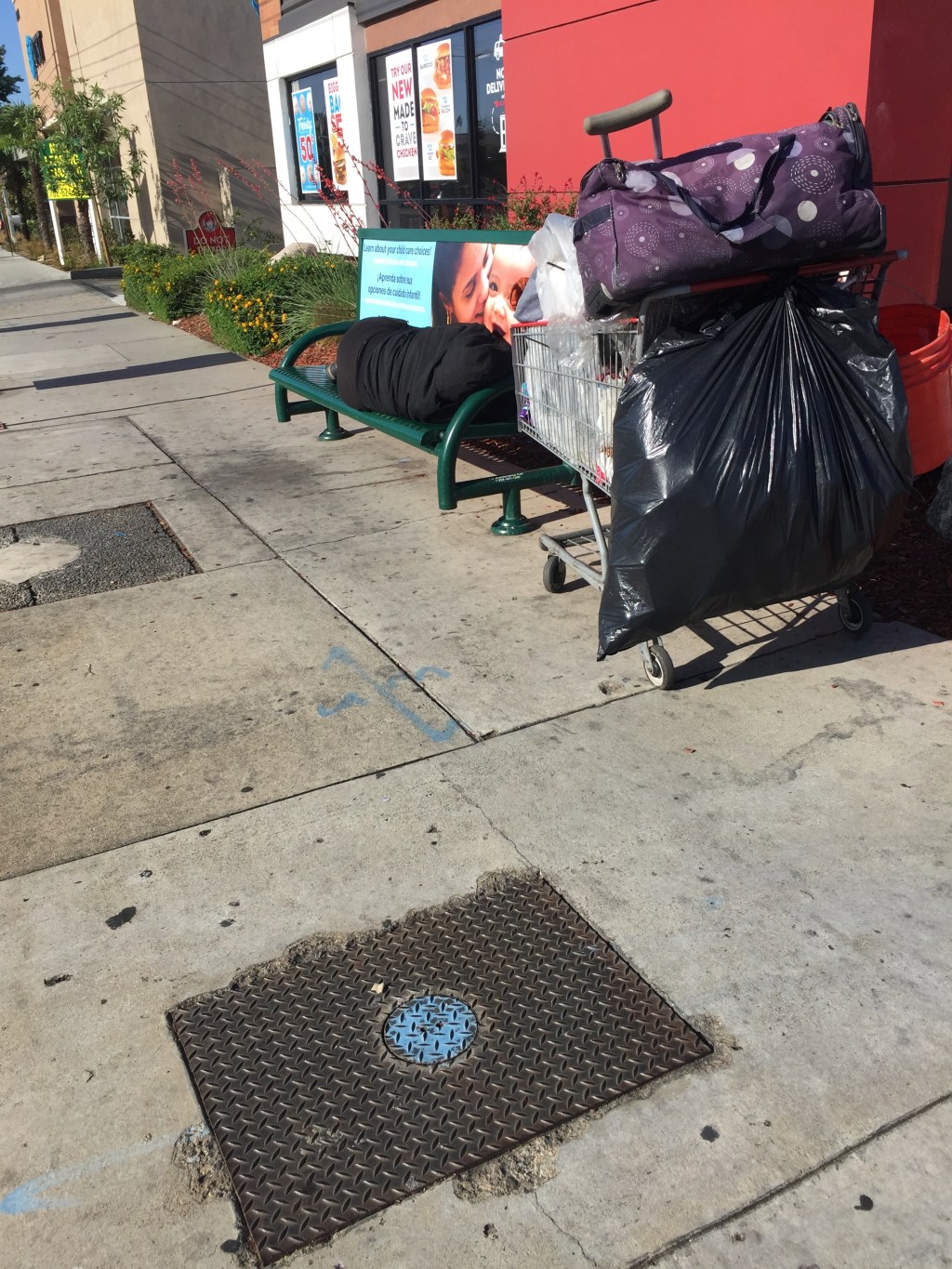
The crazy screaming man walked past us still screaming, trailed by two security guards, and there were so many security guards in every part of the property, inside museums, at the entrances, around the park, and you knew they were there to provide security in an insecure city where mad people wander and sleep in tents and on bus benches in the tens of thousands. And drivers fire guns at other drivers.

We saw many smiling, delighted Indonesian tourists taking pictures next to the decorative lampposts on Wilshire near Ogden. Their bus waited with open door as the happy group posed in the sunshine. What did they think of this city and this nation, so much abundance, so much squalor?

The future of Wilshire was all around us: the demolished museum buildings and the new construction for the concrete exhibition rooms that will catapult over Wilshire and connect via an indoor sky bridge filled with rooms of paintings. 

The new subway is pummeling along below, and there will soon be underground trains taking people from east to west and west to east just like every other modern city around the world where people take public transport to get around. But here it was a novelty, opposed for years by the most powerful and influential leaders in politics and business, but somehow, now, in the 2020s, we are getting a subway along the most important boulevard in Los Angeles.

Priorities of this city. So meaningful and so confounding. What we hold dear, what we think matters.

Traffic, car chases, murders, helicopters, homeless.

We walked west and saw the ugly but beloved, closed down coffee shop on the corner of Wilshire and Fairfax where Senator Bernie Sanders had a campaign office in 2016. His name and murals still decorate the building. 

Into the Academy of Motion Picture Museum we went, past more friendly, young security guards, (aspiring screenwriters?) guiding us to a gift shop where they sell “The Godfather” memorabilia and nice sweatshirts, t-shirts, film posters and music albums.

The Renzo Piano designed lobby is perfectly proportioned modernism with crisp polished concrete floors and exposed steel ceilings, pipes and vents. There are also many precisely hung blood red signs to bring life to all the gray steel and tan concrete.

It’s all very well done, very architectural and quite elegant. In Copenhagen or Stockholm this would probably be a subway station. 

There are some very nice restrooms and we went down to use them, past many masked security guards who ensure that urinating visitors come, like us, from the proper stratum of society. (I have a BA from Boston University.)

After peeing and handwashing we went outside in the La Brea Tar Pits Park walking past fenced in oil pools with signs explaining the stories of animals who walked here 10,000 or 20,000 years ago and were caught unwittingly in the tar for eternity.

Almost all the old LACMA buildings from the 1960s, 70s, and 80s have been torn down to make way for the latest incarnation of faddishness, but they somehow allowed one of the ugliest to escape death: the Pavilion for Japanese Art, a monstrously grotesque, green rocked assemblage of artificiality, concrete ramps and gigantic shoji screens; asymmetric, tangled up, psychotic and tortured, mumbling to itself, whose only real quality is being outdated.

The George C. Page Museum at the La Brea Tar Pits was our last stop. “A fiberglass frieze depicting Pleistocene mammals runs around the top of the building, held up by a black aluminum web called the “space frame,” writes the LA Conservancy.

It is also a 1977, Charlie’s Angels era building sunk into the ground and rising up with a sculpted mural along the horizontal façade, kind of monumentally casual and pop art significant in the mode of Hall and Oates in concert or Kristy McNichol skateboarding.


1977, 1957, 1937, 2001, 1985, 2022, 2032, 2055, 2077, 15,000BC.

What are these years and what do they matter? And what are the plans for Los Angeles and what do they matter? 

Tear down, erect, tear down, erect, tear down, erect. Make big plans, wait a few decades. Discard. 

Spend millions, spend billions, spend it lavishly, tell a story about a story and what have you got for a city?

The dead animals in the tar, the homeless on the streets, and the fenced in realm of enlightenment.

This is our civic space: a tar pit, an old department store, and a policed park. Maybe one day it will evince as much humanity as it aspires to, but for now, the answer to what Los Angeles will become is buried with the fossils.

Advertising For Church and Everlasting Life


A friend told me he had gone for drinks in Glassell Park at a bar in a restored building, a renovated Spanish traditional like they once had all over Los Angeles.

I was curious if I could find out anything about the history of 3501 Eagle Rock Blvd. in the Los Angeles Times. I went online to the archives of the paper at the library and found out nothing.

I wasn’t really trying very hard. 

Instead, I got distracted by 1930s church advertising, display ads for places like Temple Baptist Church, April 15, 1933, “Was God Blowing Soap Bubbles When He Created a Sea!” 

There were Christian Scientists, Theosophists, Episcopalians, Presbyterians, Catholics, Congregationalists, Lutherans, and Swami Yogananda who would give a free lecture on “How to Analyze People at Sight.”

The variety, the selections, the choices were endless, a feast for the soul and the imagination. Out there, beyond you and the mirror and your mind, was a divine world of love and community.

Day Memorial Church said Jesus Christ, son of God, God the son, was not crucified on Friday, according to the scripture.  That church was Independent- Fundamental-Baptist Doctrines. Dashes and precepts.

First Methodist Episcopal advertised itself as “The Church with the Revolving Cross” on December 5, 1931. On that day you could also go to the First Unitarian Church on West Eighth Street, just east of Vermont to hear a lecture by Dr. John R. Lechner about Communism in America and “The Dilemma of the Liberal.”

July 30, 1932 advertised Dr. G.A. Briegleb from St. Paul’s Presbyterian. “Another Mountain Peak From Acts,” KFVD radio, Fridays at 10pm.

Electric signs, radio broadcasts, neon lit dreams and full color visions; everlasting life, the answers to life, the origin of life, the meaning of life; the answers to why we are here and where we are going and how we can get there.

It was all over Los Angeles, all you had to do was go and get it. 

“You’ll Fell a Little Bigger and Better!” proclaimed the LA Times, “When the church bells peal out Sunday morning, select your church and attend it. Don’t consider yourself a stranger, you’re not. The church owes you spiritual enlightenment and instruction. It’s your duty to receive it.”

North Hollywood After WWII


Of all the areas of the San Fernando Valley, perhaps North Hollywood has undergone the most drastic changes, for better and worse.

The Los Angeles Public Library has thousands of images online of North Hollywood.

I pulled a few from the period 1948-1962.

California was undergoing convulsive expansion as the state population skyrocketed, and millions moved here for a better life. Freeways, schools, housing, shopping centers, all of it exploded in only one decade.

After WWII North Hollywood’s commercial area was centered along Lankershim Blvd. There were many locally owned shops, and they took pride in their windows and customer service.

The 1950s was also a time when public presentation of improvements was staged and photographed.

The widening of a street, a freeway that blasted through a park, an orange grove obliterated with thousands of new houses, the demolition of old houses for shopping centers, these were all accompanied by ceremonies with well-dressed men in suits, and the ladies in their hats, veils, dresses, pearls, earrings, lipstick, high heels.

In that time, 75 years ago, nobody imagined that one day parks would become homeless encampments, that vagrants would live in libraries and sleep on sidewalks, that marijuana would be as common as soda.

There was still an innocence about this country, a belief that people in power had the best interests of everyone in mind.

North Hollywood: High and Low.


East of Vineland Avenue, along or near Burbank Blvd, North Hollywood has a collection of small businesses, creatives, prop houses, and studio related companies that turn out goods and services, real and virtual.

On a windy, clear, cool Saturday we came to walk around. We explored Satsuma, Chandler, Cumpston and Riverton Avenues.

At 5453 Satsuma, a small, white, mission style stucco church was transitioning to secular renovation for a company called Spacecraft. The site was an otherworldly juxtaposition of architectural divinity and outer space travel.

In the 1946 North Hollywood Street guide, it seems that Santa Susana Catholic Church was the center of a Spanish speaking community along Satsuma that was strictly encased (segregated) between Chandler and Burbank, but not one house north of Burbank, or one house south of Chandler. All the old houses were knocked down and replaced by industrial concerns in the 1950s. Only the church survived but not as a church.

At 5416 Satsuma, a black and pink cinderblock building stood behind a chain link fence laced with reeds. A decapitated palm tree and wooden power pole completed the scene.

We walked along the Chandler bike path, next to a Robert Spiewak mural painted on a building in 2000, during the reign of Mayor Richard Riordan (1993-2001).This Angeleno themed artwork is a dystopian, militaristic vision of power poles, mountains, sky, missiles, and skyscrapers entangled in traffic or the internet. 

My masked, hand sanitized friend Danny stood in front of the mural, marking our own pandemic time as we are poised on the brink of a potential world war and nuclear holocaust. 

On the north side of Chandler, a half-completed structure (for USPS?) is going up with lots of steel and diagonals, in an aggressive, edgy, industrial style that looks like what they were building in West Los Angeles twenty-five years ago. 

At 10747 Chandler, one story buildings from the 1950s, for lease, are neighbors with a homeless tent. And adjoining the block is a clay-colored stucco, streamline modern building, with mean little windows guarded by frilly iron bars, also for lease.

Praxis Custom Frame & Upholstery is housed, anonymously, in a deep teal and decoratively topped structure with brown awnings at 10717 Chandler.

This was once the location of Triple C Polishing and Plating Company according to a 1946 North Hollywood Phone Directory.

A matte finish, gray, Toyota Tacoma 4 x 4, pumped up and preening, was parked in front.

Steel Lighting is a new design on an old building, crisp and clean, black and white, with a cornice of black barn lights extending across the facade. 

Martin Iron Design (est. 1990) is hidden away at 10750 Cumpston. An American flag droops over a wall like a sad, lonely dog. HOLLYWOOD is crafted in metal over a steel walled security gate. 

Curving Riverton Avenue is half industrial, half little houses from the 1940s, a street like a small town, with tiny (million-dollar) residences that face west, into the sun and the new sidewalk, the parking lots and the shadow emitting steel plates that protect VFX Video Services at 5543.

Arxis Design Studio is at 10800 Burbank Blvd. corner of Riverton.

WE ARE ARCHITECTS!

They shout.

Their firm is housed in a torturously proportioned building punctured with a whacko assemblage of exaggerated, protruding windows with monstrous, robotic, tinted glass eyes that scan a parking lot. 

All who look up at the misshapen, off-kilter windows know they are entering a hallowed kingdom of architecture.

That concludes a sampling of North Hollywood, High and Low.

Thanksgiving Archives.


In the archives of the Los Angeles Public Library are many old photographs from defunct newspapers such as the Valley Times and the Herald Examiner.

Thanksgiving is always a holiday where family, togetherness, food, and feeding the hungry are foremost.

The old ways of thinking about this holiday are on display in some of the images below, taken in the 1950s and 60s.

The Pink Oasis: Time Magazine, July 4, 1949.


“That amazing mechanism, the human eye, adjusts itself to Los Angeles in a matter of hours. The optic nerves grow submissive before the red glare of geraniums, the flash of windshields, the sight of endless and improbable vistas of pastel stucco. Even on his first, casual, hundred-mile drive the pilgrim achieves a kind of stunned tranquillity, and gazes unblinkingly at palace-studded mountains, rat-proofed palms, and supermarkets as big as B-2Q hangars.

This surrender of the senses is seldom averted by the city’s more conventional scenery. Downtown Los Angeles has genuine smoke-stained old brick and stone buildings, jammed together as tightly as those of Philadelphia or Baltimore. Hundreds of old-fashioned clapboard houses stand uneasily in the sun along its older residential streets. But the visitor in 1949 is apt to stare at them less in recognition than in disbelief, like a wanderer pushing through the vine-hung ruins of Angkor-Thorn.

They are obviously the work of a dead race—the people who thought Los Angeles was going to be a Cleveland with orange trees. After four frantic years of war and four wild years of peacetime boom, it is plain that Los Angeles will never be like anything else on earth.

More Fish then Boston.

By now it is probably the third biggest city in the U.S. —more than 2,000,000 people live within its far-flung city limits, more than 4,000,000 in its metropolitan area—and it has gotten pinker, more sprawling, more like a Los Angeles promoter’s dream with every advancing mile.

It has given the lie to the starched double-doubters who had cried that Los Angeles was a gaudy but impractical contraption which would inevitably collapse, trapping swarms of blondes and bare-toed yogis in its wreckage. It has become an industrial giant, has attracted not only new people (949,585 in Los Angeles County since Pearl Harbor), but new money, new business, and $450 million in factories and machinery since V-J day.

Its economy no longer depends directly on its basic industries—oil, oranges, motion pictures and aircraft. It lands more fish than Boston or Gloucester, makes more furniture than Grand Rapids, assembles more automobiles than any other city but Detroit, makes more tires than any other city but Akron. It is a garment center (bathing suits, slacks, sports togs) second only to New York. It makes steel in its backyard. Its port handles more tonnage than San Francisco.

It has built 240,000 new houses and apartment units in the last four years. Whole new villages have sprung from its brown plains, some lush and expensive, others as starkly laid out as well-planned graveyards, all equipped with their own highly colored, glass-heavy shops and markets. Enormous, gleaming new branch department stores have sprung up, not only along Wilshire Boulevard’s fabulous Miracle Mile, but in virtually every suburban area. A city ordinance requires that new stores have parking lots; most are as big as football fields.

Los Angeles has finally forced the East to go West and do business. Many firms have surrendered to it completely, have moved their headquarters to Los Angeles. Among them: Rexall Drug, Inc., Carnation Co., American Potash & Chemical Corp. With all this, Los Angeles is the richest agricultural county and the most productive dairying county in the nation. As an afterthought it raises 3,000,000 rabbits, 10,000 chinchillas and most of the country’s cymbidium orchids.

In a Little Spanish Town.

It has reached this state of supercharged development through a process as astonishing as a Cecil B. DeMille production. Los Angeles began life in 1781 as the Spanish pueblo of Nuestra Señora la Reina de Los Angeles de Porciúncula —a comatose village of 44 souls, surrounded by arid plains and arid mountains. It dozed for a century, hardly opening an eye when four square Spanish leagues of its dusty ground was incorporated into a U.S. city.

Then the West-reaching railroads got to Los Angeles—the Southern Pacific in 1876, the Santa Fe in 1885. New settlers came in expecting an oasis and found none. They set out to build an artificial one. They dug wells with imported picks, planted imported palms and eucalyptus trees, cultivated lemon, orange and nut groves and a thousand and one foreign flowers, grasses and grains. They built with imported brick and lumber. They had no domestic material but sunshine.

A city sprang up where no city seemed to belong. It built a 233-mile aqueduct, ruthlessly sucked away the water of the distant Owens River—a project which turned the verdant Owens Valley to desert and stirred its farmers to rebellion. It constructed an artificial harbor, hatched the motion-picture business and raised oil derricks and searchlight beams. Its full-voiced Chamber of Commerce ballyhooed to climate. The city gulped in armies of aging lowans, land-hungry Oklahomans and dazzled tourists.

It grew without inhibitions. It was fascinated by space, color, the vehement sermons of real-estate sharks and the horticultural efficacy of powdered cow manure. It developed into a new kind of city—a sprawling confederacy of villages, with five branch city halls and 932 identifiable neighborhoods, in which life is dedicated to the sun, the lawn sprinkler and the backyard grill, and in which the swimming pool is the mark of success and distinction.

Over the years it developed a new breed of Big Man. They were plungers, they were impatient of tradition, and they were fascinated by newness, bigness and the sound of battle. Director D. W. Griffith demonstrated that the jerky, flickering motion picture could be a dramatic form with sweep and magnificence. M.G.M’s Louis B. Mayer ran a cheap variety theater in Haverhill, Mass, into a cinema empire. Oilman Edward L. Doheny, a gold prospector from Tombstone, Ariz., found a fortune beneath his feet and exploited the vast oil wealth of Los Angeles. Donald Douglas and “Dutch” Kindel-berger built air armadas, and restless Henry Kaiser, fabricator of dams & ships, gave southern California its first complete steel plant.

City on Wheels.

Los Angeles became the first big city of the automobile age. Its citizens worship the fishtail Cadillac, use their cars for almost all transportation (there is one car for every 2.6 persons—the nation’s highest average), drive up to traffic lights like ballplayers sliding into second, and regard the pedestrian with suspicion and distrust.

A pearly industrial smog now hangs embarrassingly over the city for days at a time, dulling the sun and stinging the eyes of the population. It is no longer the great open-shop town—labor unions, which cracked its defenses during the war, have consolidated their gains in the years since. It has a new leavening of industrial workers. But its tone, spirit and huge aspirations are unimpaired.

Rich, booming, and afloat with dull-eyed suckers, it is an irresistible target for shady operators, con men, burglars, jewel thieves and tired Eastern torpedoes—all of whom slip into sport coats and slacks on arrival. Murders are often bizarre. Elizabeth Short, nicknamed the “Black Dahlia,” became the most highly publicized corpse in the country after a citizen left her slashed body on a vacant lot. A Mrs. Mary James was dispatched with more finesse—her husband thrust her foot into a box containing a rattlesnake, gave her a drink of whisky and then drowned her in the bathtub.

Los Angeles has its own odd set of local customs. It has few basements and fewer furnaces and almost every house has an “incinerator” in the backyard—a reinforced concrete stove with a screened stack for burning rubbish and gaper. Its real-estate men still hang up strings of flags to advertise a house for sale. Its love of the unusual extends even to the young —high-school boys at Van Nuys began dyeing their hair green this spring, to the dismay of parents and teachers.

It is movie struck, and its residents imitate and envy the stars of the screen— though members of “downtown” society and the rich of Pasadena enjoy bristling at them and Los Angeles society pages go out of their way to avoid printing a motion-picture person’s name. It is a city full of people from somewhere else and it still has little sense of tradition or of unity.

Dreadful Joy.

It has hordes of critics, and they damn it like Victorian belles stabbing a masher with hatpins.

Intellectuals, Easterners and British writers, many of whom have lived happily in its sunshine for decades,of Dreadful Joy [where] conversation is unknown.” H. L. Mencken handed down a one-word verdict: “Moronia.”

But Los Angeles has its own brand of magnificence. It is amazingly clean, awesomely spacious. It has ramshackle houses, but in comparison with other big cities, no slums. Its great boulevards wind through miles of windblown trees, bright flowers and sweeping, emerald-green lawns. It is a Western town, with the memory of Deadwood and Virginia City in its bones; in its love of display, its detachment from the past and its obsession with its own destiny, it is simply striking the attitude of the gold seeker and the trail blazer.

Nothing about the city is more surprising, at first glance, than the man it has elected and re-elected its mayor. This week he will be sworn into office for the fourth time.

Peace & Quiet.

At 61, after ten uninterrupted years in office, plump, greying, long-winded little Fletcher Bowron often seems oddly like a preacher running a wild-animal act. He is obviously appalled by the way his charges snap and yelp, and he says so—his remonstrative cliches have antagonized not only the City Council (a group which he is certain is plotting the city’s Downfall), but virtually every civic organization in town.

In throbbing, booming Los Angeles, he is a man who hankers after peace & quiet. Said he, sadly, last week: “The good Lord didn’t intend this to be an industrial city.” He is still apt to speak of automobiles as “chug wagons” and to recall with a reminiscent sigh the good old days when Santa Monica Boulevard was nothing but a dusty lane running between outlying farms.

He is the antithesis of the type which even Los Angeles fondly believes typical of its executives—the flamboyant figure in a shaggy sports jacket who barks decisions into three telephones. Fletcher Bowron wears dark suits, black shoes, and rimless spectacles. His desk, in Los Angeles’ 32-story City Hall (the 13- story limit in earthquake-conscious Los Angeles was relaxed to make it the highest building in town) is a hopeless clutter of papers and reports.

He is the slow-moving despair of complaining citizens, committees intent on getting information and newspapermen with deadlines to make. Three red chairs stand at attention before his desk: interviewers often sink into them like dental patients steeling themselves for a long, tedious inlay job.

Bowron listens politely to a question, tilts back, forms his hands into a steeple on his paunch, and answers —sometimes for half an hour without a stop. He seems to forget time, and his voice rises and falls as soporifically as the sound of distant surf. Said one defeated interrogator: “Asking him questions is like trying to bail out the ocean with a teaspoon.”

But for all this, Fletcher Bowron is the people’s choice. The town often ignores him—only three days before he was re-elected last month, the Los Angeles Examiner put him and his campaign back on an inside page, ran a Page One banner line which read ALY KISSES RITA’S FOOT. But his constituents know he loves them.

He is a fiercely honest man, and is eternally intent on protecting Los Angeles from itself. Last week, when one Brenda Allen, queen of Hollywood’s call girls, charged (from jail) that Los Angeles cops had accepted bribes from her, Bowron reacted less like an injured politician than a father whose children have been caught smoking cigars behind the barn.

Despite his misgivings about its didoes, he is fantastically proud of the city, and works 14 hours a day at his trying job. He seldom sees his wife, or his 15-year-old adopted son, Barry, except at breakfast. His most vehement critics agree that he would scrub City Hall down with a toothbrush if he decided, after thorough investigation, that the gesture would help Los Angeles.

Honest Mayor.

He became mayor almost by accident. A native son, he had started out in the world as a reporter on the San Francisco Sun after graduating from the old Los Angeles High School (now being torn down to make way for Hollywood Freeway) and spending two years at the University of California at Berkeley. He achieved his biggest youthful ambition in 1917; after years of studying law in his spare time, he was admitted to the California bar.

He joined the Army in 1917, served through World War I in a San Francisco Army office. In 1922 he got a job as a state deputy corporation commissioner; it seemed that he might jog on through life as an inconspicuous public servant. But California’s Governor Friend Richardson, impressed by his thoroughness, appointed him to the Superior Court bench. In twelve years as a judge his homely virtues and his obvious distress at civic corruption attracted the interest of Los Angeles reformers.

On Jan. 14, 1938, a tough, red-faced private detective named Harry Raymond indirectly did Bowron a good turn. Raymond, who had been loudly threatening to “blow the lid” off the city, walked out to his car, got in, stepped on the starter and detonated a bomb which someone had unkindly hidden under the hood. Bomb, car, detective and all went up in a fearful explosion. Raymond was not killed—although surgeons had to dig 122 separate slugs out of his torso.

Enemies. A police captain named Earle Kynette and another officer were sent to San Quentin for the crime, and the administration of Mayor Frank Shaw was doomed. Bowron was pressed into service as a reform candidate; he was elected on his 16th wedding anniversary in 1938,

Cautiously, but conscientiously, he set out to clean up a Los Angeles that had 300 gambling houses, 1,800 bookies, 23,000 slot machines and 600 brothels. He waited for seven months before he took steps to remodel the police department, but when he did, he kicked out 23 high-ranking officers. He appointed a college graduate as police chief, and a Rhodes scholar as fire chief.

He banished slot machines and pinball games—though most of them reap peared outside the city limits. He abolished other municipal evils—the sale of civil-service promotions and the use of the city zoning ordinance to squeeze bribes from commercial enterprises.

None of this was accomplished without Bowron’s tramping on sensitive toes; he made scores of enemies. He was accused of being arbitrary, tactless and indecisive, and was variously described as ‘Chubby Cheeks,” “Fumbling Fletch,” and “Bottleneck Bowron.” He was even attacked by Cafeteria Owner Clifford Clinton, a vociferous reformer and the man who spent $72,000 to put Bowron into office. “Drab . . . colorless … far from inspiring . . .” cried Clinton. “We were misled . . .” Clinton ran against him;—and lost.

To the majority of the citizens Bowron seemed to be just the fellow for City Hall —a man who would keep the city clean, cry out at its enemies, real and imaginary, and stay up nights worrying while it went about its noisy and exuberant business.

Last week, for all the forced-draft accomplishments of the years since V-J day, the city and its satellite towns were still grappling with a multiplicity of problems. The prosaic business of supplying new homes with gas, sewage lines and electricity had taken on the breathless urgency of a serum flight to Nome. Under Bowron’s administration 50 miles of cast-iron water mains had been laid every month to keep up with the city’s mushrooming growth. Los Angeles had built 34 new schools in ten years and still needed “a new one every Monday morning.” Though the Pacific Telephone & Telegraph Co. had installed 416,338 telephones since V-J day, it was 41,405 orders behind last week.

Los Angeles still had a vast supply of its most precious and vital commodity—water. It drew 255 million gallons a day from the Owens River. With its adjoining towns it sucked too million gallons through a 392- mile aqueduct from the Colorado River; despite the bitter interstate dispute between California and Arizona over the river’s output, Los Angeles expected to tap the Colorado more freely in the future.

But in common with the rest of arid Southern California, Los Angeles lusted for more. Its County Board of Supervisors eyed the ocean—it suggested a prize of a million dollars for the man who could provide a process for distilling sea water cheaply enough to make its use practical. It got letters from prison inmates, housewives, inventors, crackpots, from all over the country, from Holland, India, England, Australia and half a dozen other foreign lands.

None of them gave the right answer. But Angelenos were sure that the problem —and all the rest of the city’s problems—would be solved in good time. They had to be. City planners expect a population of 6,000,000 in greater Los Angeles by 1970. Less cautious citizens call the planners pikers, are certain that the city will eventually be the biggest in the world. And after that? Undoubtedly, its boosters mused, it would have another boom.”

Copyright 1949, © 2014 Time Inc. All rights reserved.