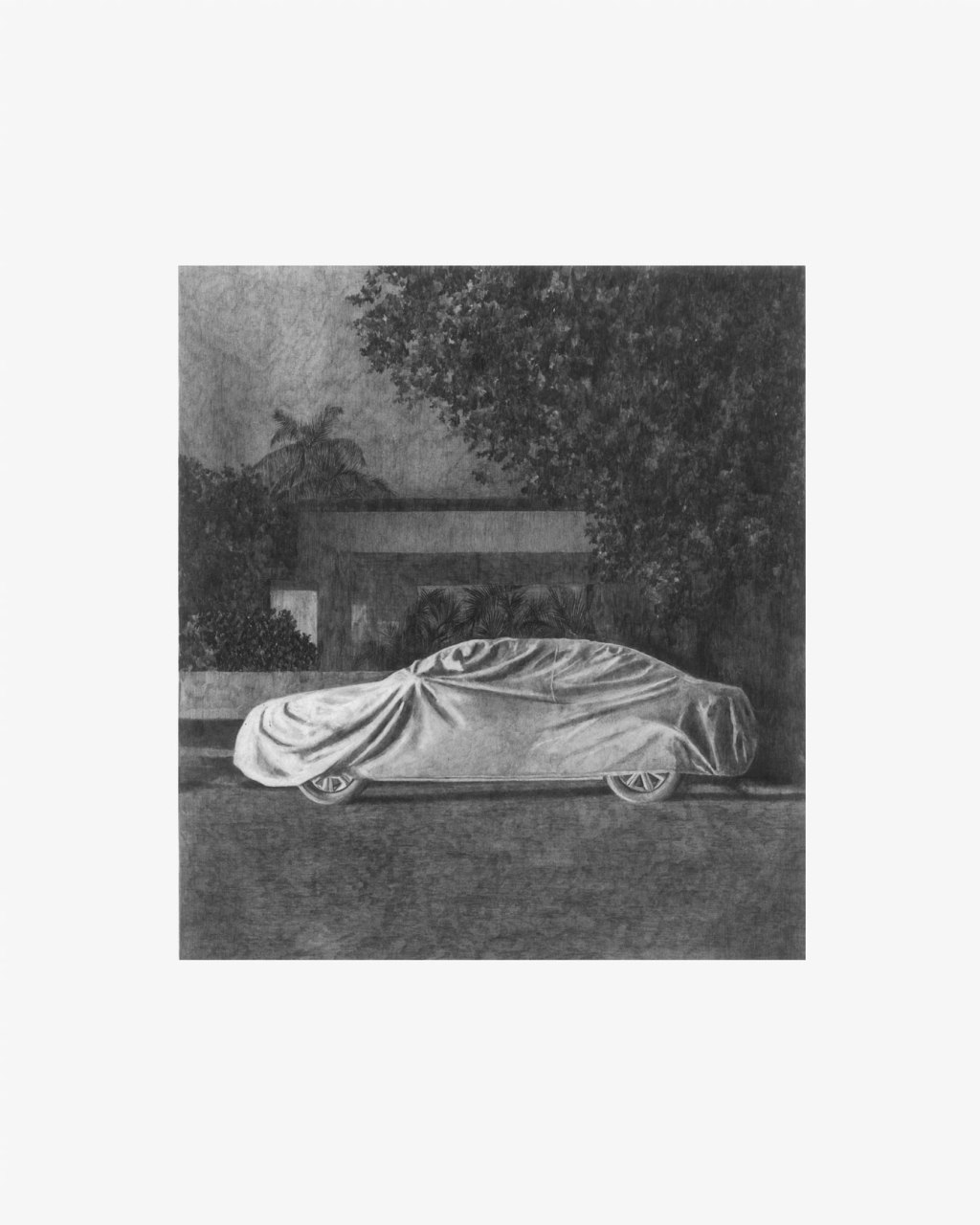
Zoé Textereau (b.1986) and Pauline Martinet (b.1987) are two artists from Paris, France whose oeuvre is composed of graphite drawings of many places they have visited, among them Los Angeles.
I found their work on Instagram. Their architectural drawings of Los Angeles find beauty in banality. Perhaps because there are no people in these images, they have an affinity with our present time of desolation and isolation.
They are all something marvelous, an illustration of our city, seen through the eyes of two French artists, a revelation of form, geometry, shadow, texture and shape.
Our built mistakes: the round driveways, the fake pillars, the long awninged walk into an apartment house, the vinyl window and vertical blinds on a stucco wall, the landscaped lake of gravel around a palm tree, the steel security door, the tarp covered car in the driveway of the deluxe house with arched porch and glued on stone walls, and the randomly laid flagstone wall illuminated at night; these are their subjects.
Los Angeles is an artificial encampment watered by imported irrigation, stitched together by freeways and endless streets, baked in sunshine, built in discordance, promoted and extolled for no good honest reason. We have no ensemble of unity in our buildings, no public squares, no grand arches, no central gathering place. Tens of thousands are camped out in trash along the roads and under the overpasses. Those who own property pave their gardens, puncture the skies with revenue producing billboards; they construct monstrosities and guard them with guns and security cameras, they venture out from patrolled properties in tinted windows, sunglasses, and breathing masks.
But Textereau and Martinet find beauty in our banality. We can too.
A photo I took, along with others, from a Thanksgiving weekend spent in the Palm Springs area.
Some people hate Palm Springs, saying it is too hot, too sterile, too artificial.
Perhaps it is, but at twilight, when the sun is setting behind the mountains, there is nowhere I’ve been that feels so calming, so warm, so otherworldly.
There is something special about the desert, even the irrigated desert, and along with the green golf courses and the stucco clone houses, there are also special and completely original neighborhoods, dating from the 1950s, where the fine art of strange architecture and sculpted plants transports one into a reverie of light and form, which I have tried to capture photographically.
The Almighty was merciful in creating only one place like Southern California. For better or worse….
And we who inhabit this imperfect, flawed and destructive region, we occasionally are seduced and awed by a light and a moment to realize that we are also blessed to live here amongst human creativity, human imagination and nature’s nature.
This was Palm Springs yesterday and this is the way it was and will always be.
California Lobster two-piece swimsuit, swim trunks, and man’s shirt Mary Ann DeWeese 1949 LACMA
Last week, mid-week, it rained. A storm started the way storms do in Southern California, by announcing its front three days before arrival.
It came down slowly, from the north, and the skies darkened, ever so perceptibly, on Sunday, and by Tuesday the rains poured.
When the storm blew out, on Wednesday, the air was clean and refreshed. And doughy white clouds marched across blue skies.
Three small trees, all oaks, arrived from the city, ready to plant. There was room for only one on our property: a Coast Live Oak, which will look quite magnificent on my 100th birthday.
The Puppy
I went down to my brother and sister-in-law’s house on Saturday and took photos and videos upon the arrival of their new brindle boxer puppy.
These are videos that will show a 2012 Prius on the driveway, and these are videos of my 7-year-old niece and my 5-year-old nephew and a two-month-old puppy.
In five years or ten or twenty years, people will watch these and marvel at unwrinkled and smiling faces of youth, beauty and innocence; days we all have and days we spend in childhood never knowing how ephemeral and passing and short it all is.
General Quarters
I left the Marina and drove east across Culver City on Saturday, along Washington, and turned north on Robertson and went east on Pico and ended up on La Brea at Blair Lucio’s store General Quarters.
Mr. Lucio, on his own, without partners, has opened a concrete floored, iron and corrugated steel men’s shop decorated with black and white photographs of motorcycles, Steve McQueen, and images of postwar life in Southern California.
He is a young, well-groomed man with impeccable taste and good manners who favors plain front khakis, single needle cotton dress shirts, worn leather and canvas knapsacks and pure pine athletic soap.
He worked at Nordstrom’s and that retailer’s high standards of etiquette and service seem to have been branded with a burning iron into Mr. Lucio’s character.
If I had more cash I would spend it here because everything is high quality, classic and well edited.
LACMA
LACMA has installed a show, Living in a Modern Way, devoted to the same place and era that Mr. Lucio adores: the post-WWII years, when California innovated in the arts, home furnishings, architecture, textiles, graphic design, automobiles and industrial products.
The exhibit has a full-scale reproduction of Ray and Charles Case Study House No. 8 in Pacific Palisades as well as an Airstream trailer and Avanti car.
Most interesting are the people who attend these events. They have artful, creative, charmed and haunting faces and they don’t look anything like the rest of the people who live in Los Angeles.
Wilshire Corridor
I went to see Luke Gibson’s architectural photography exhibit on the 8th Floor of the Wiltern on Saturday night.
It was dusk and the sun was setting and you could look north and see the Hollywood sign; and in the east the hills and houses were bathed in a sweet and gentle melon light.
The steel casement windows were open and I sat on an indoor ledge and looked down at a revitalized and busy Koreatown intersection with its new glass tower across the street and crowds pouring out of the Western/Wilshire Metro station; walking, using the city as a city should be used, on foot; with vigor, purpose and joy.
Luke’s aunt, an older and beautiful blond woman, came up to me and introduced herself. She was carrying an Ipad and remarked how proud her family was of their photographer nephew.
She had come up from Lake Forest in Orange County that evening, along with her daughter, son-in-law and two very tall young ladies, her granddaughters.
I told her that I lived in Van Nuys and she said she had graduated from Van Nuys High School. Her father had come from North Dakota and the family had lived on Ventura Canyon in Sherman Oaks.
We spoke about the mythical and magical days of yore, the California that really existed but really exists no more: orange groves and walnut groves; clean streets and unlimited opportunity for all. It was all gone now, except on DVDs and in our minds. And she was sweet and smart and savvy and even at seven decades, the ideal California girl.
And she knew how to how work that Ipad and had uploaded online Scrabble and Yelp.
Sunday
I had some work to do on Sunday and I went to meet someone at the Marriott across from the Burbank Airport, but before our meeting, I walked around Fry’s Electronics where the most advanced and latest technology is sold to the least educated and most obese.
Outside Fry’s, in the parking lot, the sun was brilliant, the heat was dry, the mountains were radiant, and the planes flew across the sky and down into airport, gliding into an atmosphere of calm, glistening, radiant, and intense light.
There was hardly any traffic on sun-bleached, treeless Empire Avenue, the service road that runs between the south side of the airport and the railroad tracks.
I thought of Amelia Earhart and Charles Lindbergh and all of the lesser-known war workers who once assembled planes here under a fake city blackout cover. Times past of productivity and progress.
After my meeting, I drove on that road, and over to Van Owen and down Vineland.
I was unaware that a few hours earlier, a distraught man, despondent over his finances, brandished a bb gun, called the police and told him he was armed. The cops came and asked him to disarm and when he refused, they shot him dead in front of his family.
The Madwoman
Hours later, I went to Ralphs on Vineland/Ventura to do some Sunday grocery shopping and got on the 101 at Tujunga, traveling west, back to my home here in Van Nuys.
I was in my Mazda 3, with my friend Danny, watching the road, navigating the heavy traffic, and preparing to exit the 101 near Sepulveda.
I wasn’t going fast or slow, just driving defensively, cautiously, courteously, speedily, not excessively, within reason, as one does when approaching an exit ramp.
And then the dissolve, the madwoman in the rear view mirror…
A wildly gesticulating female driver, in her white SUV, held up her two fingers in a double fuck you to me from her driver’s seat.
Her hands were making digit signs, signs that she emitted in a mad, contorted, deliberate, accelerating, irrational, insulting spastic performance. I watched her gesture fuck you, fuck you, and fuck you again from her car as we got off the ramp at Sepulveda.
And then I pulled up next to her. Again she pulled up her hands to signal numbers, fives and ones, supposing that I would know that she alone knew how fast I was going and it was not fast enough for her. And how angry, enraged and beyond reason she was. She was unashamed, unembarrassed, unhinged.
And tragically, she is what is called average or normal these days. An insane and out-of-control driver, furious when her 90-mile-an-hour motoring is temporarily impeded by another auto.
We waited at the light next to her. We yelled at her and my friend said she was “cuckoo” and then the light changed. And I turned right and she turned left onto Sepulveda, but I would not be lying if I said at that very moment I too was enraged. I was ready to assault or kill this woman who had destroyed my peaceful Sunday afternoon with her madness on the 101.
It has happened to me several times before when I was the target of a woman, always a woman, always white, always showing their fingers and their fuck-you on the road, behind the wheel, when I, obeying the law and doing absolutely nothing wrong, was just driving and being courteous.
I am not a person, I believe, who goes around with a vast arsenal of fury inside of me. I talk things out. I listen to Chopin and Bach and I exercise and run and drink wine and beer and laugh a lot.
But this is California these days. There are no rules for how to behave in public. The Grossest Generation: that is what this generation is.
She is the reason that I also sometimes hate Los Angeles and wonder if all of the nostalgia for the greatness of our past can make up for the uncivil awfulness that passes for civil society in the Golden State.
Well, at least we can remember how golden the Golden State once was.
It was a delightful weekend until I got on the 101.
All day long the sun beat down and broiled the city, blinding and exhausting it. You were either at the beach or in your house, air-conditioned. Napping was involuntary.
They were lighting off explosives all weekend here in Van Nuys, late into the night. I imagined a city all around me, of thousands of illegal aliens, doing illegal things, joyfully and recklessly.
Around 7 pm, the sun settled down, the temperatures cooled, and after a dinner of fried salmon and cold tomatoes with red onions, I put on my sandals, walked out into the dusk and found myself on Kittridge Street.
West of Kester, east of Sepulveda, there are a few neat blocks of solid, mid 20th-century houses, still well-kept and outwardly honorable. Lawns are trimmed, eaves are painted, and there are few broken down properties.
Too poor for renovation, too wealthy for destruction, these houses were not torn down and mansionized by investors, as one sees on many pockmarked neighborhoods in Sherman Oaks.
Instead, this tidy and sturdy pocket of bourgeois respectability, in the heart of Van Nuys, is sandwiched between Sepulveda’s whore show and Kester’s impoverished subculture.
At 15126 Kittridge, a pistachio green and vanilla trimed house, with vaulted ceilings, open carport, and welcoming courtyard, is for sale for only $315,000 or $190 a square foot.
Two friendly guys were working on a 1979 BMW, next door, when I approached the house. They told me to walk right into the courtyard and around the back.
First impressions: clean, solid, bright.
There was a private, enclosed, elegant front entrance under angled eaves.
Around the side yard, an old steel pole clothes-line was planted into the concrete, just outside the kitchen door. A green plastic chair, nearby, marked a place where a tired woman, no doubt, had rested, chores done, after she had pinned damp cotton clothes to dry in the eternal Southland sun.
There were leftover forms from the last century all around: a TV antenna, a backyard patio in zig-zag concrete pattern, and a tall drum shaded lamp in the side window.
And sliced into the stucco walls: high clerestory windows, everywhere, bringing light into the living room and into every bedroom; bedrooms where people, from Sputnik days to iPhone times, had slept, slept for 55 years, in suburban solitude, through war, riots, assassinations, movie premieres, and freeway pile-ups.
It was quiet here, peaceful, lovely. It was nothing fancy, just something inherently American and naively optimistic in design and intention.
Somewhere in America, long ago, people had built with confidence and care, incorporating the latest Space Age designs, but encasing them in tradition, in family, in expectation, that life could be orderly, well run and peaceful.
But the people of 15126 Kittridge had moved out of here, some time ago, so it was a preserved family house without a present day family, a mute museum of life, of time past and lost forever, and thus without love or conflict, laughter or pain.
Perhaps only the electric lamp on a timer and weekly visits from the gardener kept this home alive.
As I walked away from 15126 Kittridge, the sky dimmed, the moon came out.
And I heard the voice of Jo Stafford, sung to the words and music of Irving Berlin:
You keep coming back like a song
A song that keeps saying, remember
The sweet used-to-be
That was once you and me
Keeps coming back like an old melody
The perfume of roses in May
Returns to my room in December
From out of the past where forgotten things belong
You must be logged in to post a comment.