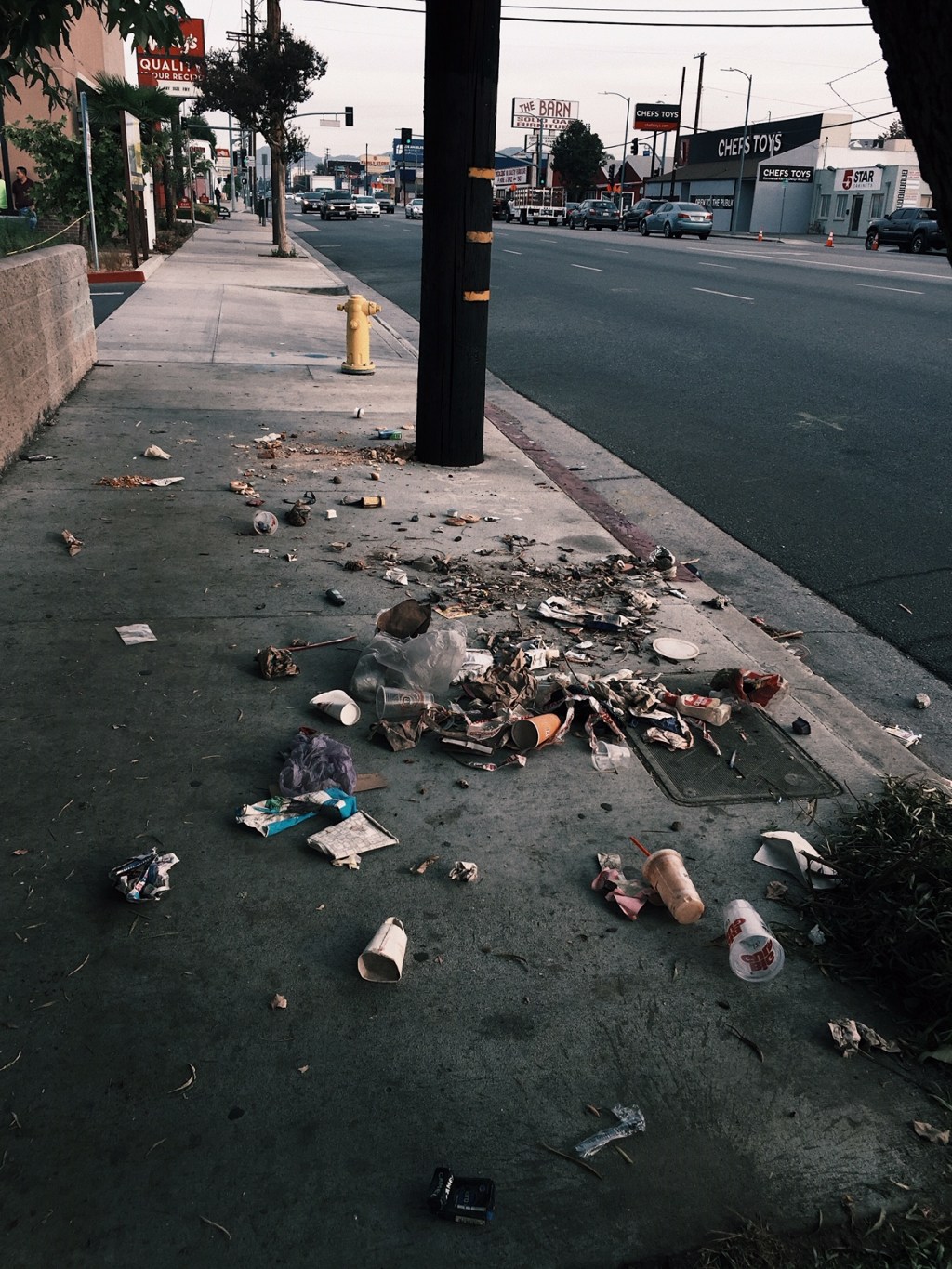
Yesterday, after eating lunch at Myung Dong Noodle House on Wilshire, we got into our car and drove south on Irolo St. and went east, along West 8th Street, for about two and a half miles.
Words cannot produce images that could equal the utter filthiness, horror, inhumanity and decay of the street. There were 10 foot high piles of garbage in alleys, people sleeping on sidewalks and bus benches. Shopping carts of trash in front of every store. Lost men and women, high, drunk, dirty, forgotten, mixed in with others who were not. And sidewalks full of new arrivals in the city, walking, working, eating; selling clothes on blankets or food from carts; pushing kids in strollers; striving to get by and survive in one of the most unpleasant and dystopian cities in the Western world.
As the road curved into the underpass that runs under the 110 freeway, dozens of people were living in encampments on each side of the street. A Ritz-Carlton luxury hotel glass tower loomed in the nearby downtown. Was this a joke?
It seemed that God had taken a leave of absence and left Satan in charge.

This is Los Angeles. This is California. This is the United States of America. In 2024.
What kind of government that is even half-awake, half-sentient and semi-moral allows an entire city to fall into a condition that might only exist in a place of war or extreme impoverishment?
There’s a baseline of governance. You keep the streets clean. You try and employ a sense of order and reason to public activities to ensure that life is reasonable, safe and decent.
You don’t allow chaos to reign knowing that revolution will surely follow.
In the depths of the Great Depression, in the 1930s, when 25% of this country was out of work, Los Angeles, west of downtown, the same place we drove in yesterday, looked like this:

Photograph of West 9th Street and South Hobart Boulevard intersection, Los Angeles, CA, 1931. “S. Hobart [ilg]” — intersection signage. 
Photograph of intersection of West 8th Street and South Carondelet Street, Los Angeles, CA, 1932. “[ilg] Market” — signage on building. “[South] Ca[ronde]let St[reet]” — on street sign. 
Photograph of the intersection of West 9th Street and South Berendo Street, Los Angeles, CA, 1940. “[ilg]feway; M[a]rgy’s” — signage on buildings. “S. Berendo St., 900 Blk.” — on street sign. “7C 54 10” — on license plate. 
Photograph of intersection of West 6th Street and South Hobart Boulevard, Los Angeles, CA, 1932. “safety first” — on road. 
Photograph of intersection, West 6th Street & South Grand View Street, Los Angeles, CA, 1933. 
Photograph of intersection of West 8th Street and South Carondelet Street, Los Angeles, CA, 1932. “7V 29 81” — on license plate. “Stop, Auto Club of So[uthern] Cal[ifornia]” — on street sign. “Slow” — on street. 
Photograph of Union Oil service station, West Eighth Street and South Western Avenue, Los Angeles, CA, 1933. “Washington B[ui]ld[in]g” — on billboard. ” ‘Stop Wear’, lubrication service, using union friction-pr[ilg] lubricants exclusively; Station no. 956; Stop your motor, no smoking; Union Co[mpany], 17 ¢ gasoline” — on signage. “Union Service Stations Inc[orporated]; – Wear, [ilg]ation service, batteries” — on station front. “Unoco gasoline, 4 tax; Union 76, 4 tax” — on gas pumps. 
Photograph of building on northwest corner of West 8th Street and South Western Avenue, Los Angeles, CA, 1931. “Beverly Arms; Manhattan Market P[hon]e F15617, Challenge Butter, [ilg] Milk; Beauty Parler; [ilg] Bottle Supply Co.; Hand Laundry” — singage on building. “Asable[ilg]; Shasta, [ilg]; Western [ilg]; Drugs” — street level signage on building. “[S]tandard Oil Products; [ilg] Atlas [ilg]; No Smoking, Stop Your Motor; Standard Gasoline” — signage at station. “Keep Your Eye on Chevrolet; Arrow Hits The S[ilg], Sandwich[ilg]” — signage in background. “Stop” — signage along street.
Credit: USC Archives/ Dick Whittington Collection.


You must be logged in to post a comment.