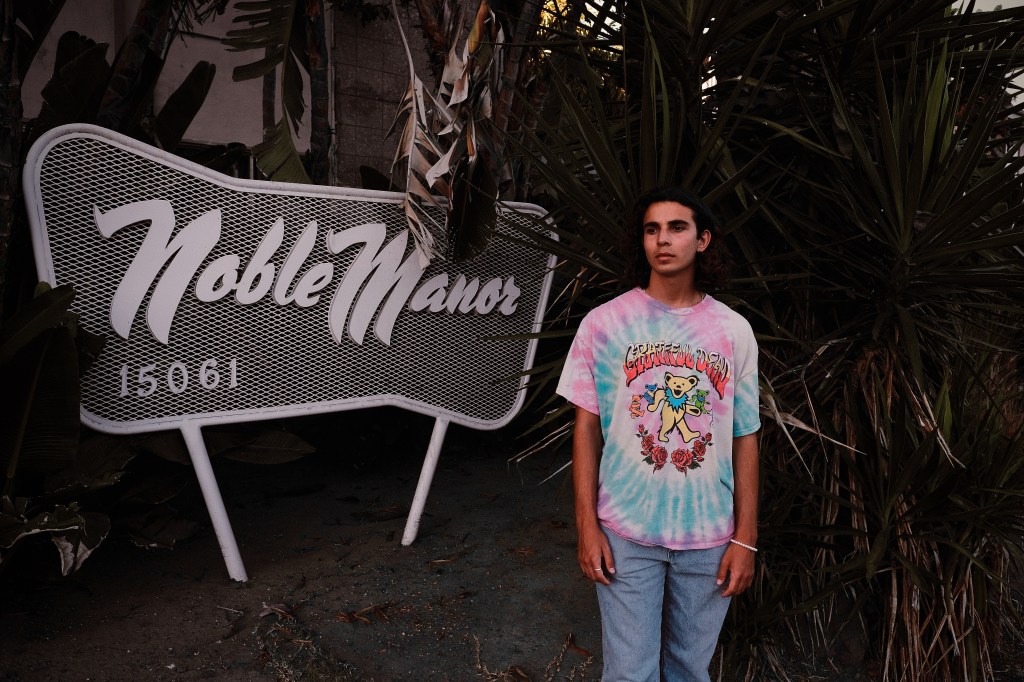
Actor Dovid K. was raised in Los Angeles, and he came over to our neighborhood last week for some agency photos.
The houses in our area (Victory/Kester/Columbus/Vanowen) were built in the 1950s, and due to the modesty of the neighborhood, many look roughly the same. There are the criss-crossed windows, the board and batten siding, the pastiche of architectural decorations that mid-century developers affixed to facades to make them warmer and more appealing.
The vintage styles have weathered six or seven decades and endured as archetypes of the San Fernando Valley. This section of Van Nuys was ideal because it was walkable, just across the road from the high school, near the shopping centers along Sepulveda. Those were the days when children rode bikes and walked to school and there was always someone home to greet them at 3pm.
Times change. Children don’t walk, they are driven.
Behind the house on the right someone is building an ADU out of an old garage. They installed solar panels like many of their neighbors.
This sign belongs in the archival collections of Valley Relics.
This totem statue was erected by a previous owner and still stands.
This house will have a new ADU in front, an adaptive revitalization of a classic Valley ranch house from the early 1950s.
There is something about the middle 1950s that endures in many of the houses, a cozy casualness of not so big houses with big lawns, semi-circular driveways, trees, hedges, and decorative lampposts. A lot of it is not so up-to-date. If this were Studio City or Brentwood these houses would have been long gone, demolished and replaced with white faced behemoths and tall gates and enormous SUVs on every property.
Sadly, many of these houses sell for over a million and are not quite starter homes. But they are home for many who inherited them from parents, with low property taxes and little or no mortgage payments. For the lucky ones who got lucky, this is kind of a paradise, guarded by NextDoor and patrolled by helicopter, seemingly an American paradise on the ground.
And it makes a good backdrop for a young man who channels the 1960s.
Last night, I attended a small neighborhood safety meeting with a group of perhaps seven neighbors and our LAPD Senior Lead Officer.
It was held at a home of the new liason between the cops and the community, a woman who speaks up and speaks often on issues affecting her street such as lighting, crime and people who don’t retrieve their trash cans after pickup.
I usually avoid these meetings out of trepidation. The ones I’ve gone to at the local school or hospital are full of anger and irrationality.
Not last night, but on other nights, I heard:
“Someone put a stoplight on my street at Vanowen and Columbus and now we have more traffic!”
“They planted these oak trees along the curb to provide shade and now they have cars parked there with people smoking and drinking. I say cut down the trees!”
“I’m completely against providing transitional housing for homeless veterans in our neighborhood. They get enough free stuff!” says the 65-year-old woman who inherited a 4-bedroom house from her WWII veteran father and pays $1,300 a year in 1967 rated property taxes.
“These developers are putting up apartments everywhere. I didn’t move to Los Angeles to be surrounded by crowds!”
Yet, last night, the mood was polite. A well-fed group of rouged and perfumed women from the Eisenhower Era gathered in an early American style den where dainty finger sandwiches with the crusts cut off were served.
Period references, for example, to Mrs. Kravitz from “Bewitched” (1964-72) were understood and appreciated.
Our petite and pomaded Sr. Lead Officer, wore a dark navy uniform and a very big silver badge, holster, gun and unobtrusive body camera. She spoke intelligently and sometimes ironically about the insoluble issues plaguing our community.
She broke the news that we seven folks in the den were probably not going to solve 100,000 homeless on the streets of Los Angeles or 10 million illegal aliens inhabiting our state of 40 million. Our system is so broken, so wrecked, our state so adrift in chaos and bad governance, that India, Nigeria and Pakistan seem models of order and stability.
She admitted that even her own husband often speeds down side streets, even as she enforces the laws against speeding while on duty.
She told us that 80% of major crimes such as assaults, murders, rapes and burglaries now come from the homeless community. She said that because Van Nuys has the only jail in the San Fernando Valley, when convicts are released they stay local.
She talked about Proposition 47, a voter passed initiative from 2014, to reduce penalties for certain non-violent crimes that now makes it nearly impossible to lock up the heroin user who shoots up in front of the grammar school. It’s now a misdemeanor to inject narcotics.
She said the homeless issue, which has now supplanted the prostitution issue, is a bigger problem than just our community. She advised electing officials above Councilwoman Nury Martinez, who would be devoted to law and order.
Whether her inference spells Democrat or Republican she did not say, but she seems to have a distaste for taggers, gang bangers, felons, and mentally ill murderers roaming the streets.
Mayor Garbageciti are you listening?
The host who invited us then passed out sheets of paper on which were shown our individual streets and the addresses that every block captain is assigned.
“Mona Castor Doyle[1], you have Columbus. Serena Pimpel you have Kittridge. Becky Shlockhaus you have Noble from Lemay to Kittridge. Miranda Beagle-Pinscher you have Lemona. Maria Copay you have Norwich. Sarah Choakhold you have Lemay!”
The methods advised were to go door to door and introduce oneself and say to each resident: “I am Zoe Bluddhound, your block captain and here is my LAPD letter and my contact information.”
Other methods of crime prevention were to send out group texts, say if you were home and heard an alarm, thus alerting your neighbors to a nearby illegality.
Living in Van Nuys requires a full time commitment to staying home and guarding your property 24/7.
Looking around the room I realized that everyone is trapped in their lives. These are women, now middle-aged or older, many of whom came here 30, 40 or 50 years ago and chose, for whatever reason, to stay here in Van Nuys. Some bought cheap, some inherited, nobody could afford to buy here now.
For some living here is an economical proposition when you bought your home for $35,000 or $126,000 and your yearly taxes are less than someone pays for the average ($2800 a month) two-bedroom rental in Los Angeles.
Yes, the environment beyond the little pockets of ranch houses is demoralizing, dirty, unsafe, ugly, violent, hideous, un-walkable and un-breathable. There are dumped couches, mattresses, fast food wrappers, cars and trucks speeding by, running red lights; there are grotesque billboards, car washes, parking lots, dog dumpings, discarded condoms and donut shops.
Nobody dines al fresco on Sepulveda Boulevard or drinks wine at an outdoor café on Van Nuys Boulevard. The Van Nuys Neighborhood Council, alive like a corpse, ensures that no progress is ever made on any community improvement and that all members are backstabbing one another.
So the community meeting, between neighbors, low-key and humble, without ego, is seemingly a better way to self-govern.
Last night, under the spiritual leadership of the Senior Lead Officer, an attempt at normality, order, safety, reassurance and camaraderie was attempted.
This is not Paris or Zurich or even Cleveland Heights. But we are not yet Aleppo.
[1]Personal names, not streets, have been changed.
Second Baptist Church 2412 Griffith Av. (1926, National Register of Historic Places)
Yesterday Andreas and I drove over to an old neighborhood to walk around and take photos.
The location was south of downtown, and the 10; east of the 110, and encompasses streets such as Washington Bl, Central, San Pedro and Maple.
Most of the houses were built in the early 1900s. They are wood cottages with ornamental embellishments, front porches, little yards, along streets punctuated by a variety of churches.
Lincoln Theatre (1926)
There are some glorious old theaters, including the Moorish revival style Lincoln (1926), which was once the heart of the black live performance music community along S. Central Avenue.
The long, distinguished history of black businesses, churches, educational institutions and artists who lived and created here is much too long to discuss in this short blog post, but this is where, from the 1920s to the 50s, much of African-American creative life was centered.
Today, the shops, the residents, the people on the streets, are largely Latino, though that designation is sweeping and generalizing too, and cannot describe the immutable variations of life here.
Washington & Central
On our walk we encountered friendliness everywhere, from people saying hello on bike, to men grilling sausages, to porch sitters waving and engaging in conversation. There is street life here that is supportive, engaged, healthy, perhaps more grounded and nurturing than one could find in any area of the San Fernando Valley.
There are fine murals on buildings, and most of the alleys we walked past were shabby but kept free of debris, cleaner, in fact, than some in Van Nuys.
Washington Bl.
722 Washington Bl. (2017)
On Washington Boulevard light rail zooms past architectural relics from the past century: the Scully Building at 725 was built in 1930 and is a spectacular “Gotham City” type of Art Deco with steel windows and vertically decorated brickwork and carved stone; 722 was built in 2017 and is a new 55-unit apartment with government backed funding providing decent housing in a city starved for it. A mural on the side of the building is spectacularly subtle, artist unknown.
725 Washington Bl. (1930)
(Stanford Av. Near 20th.)
2010 Stanford Ave. Site of a 1914 warehouse auction for the Arnold Furniture Co.
Many of the streets down here (excepting Washington Bl.) are narrower than most in modern Los Angeles, creating an enveloping and embracing closeness between pedestrians and businesses, and making biking and walking safer. Every car that we encountered at an intersection, gracefully and politely, ushered us to walk in front. Yes, it’s the law, but its routinely flouted in richer communities of Los Angeles, but not down below Washington Blvd near S. Central Ave.
Washington Bl.
Washington Bl.
Mid-Century Commercial Building along Washington Bl.
Washington Bl. Bridge
Our tour ended, and culminated, in the glorious Washington Bl. Bridge (1930) that crosses the LA River, its majestic classicism fouled up by graffiti. Yet its polychromatic terra cotta frieze panels, depicting the art of bridge building, are still present, if grimy, on the four pylons on each side of the structure.
At that bridge, as Mother Nature blew the waning candlelight out of the sky, ushering in the night, the remnants of some deceased industrial glory and aspirations of greatness still cried out for recognition.
Through a multi-pronged alliance between City Councilwoman’s Nury Martinez’s Office (CD-6), the Van Nuys Neighborhood Council, and neighbors who came together on Next Door, about 30 people gathered today between Haynes and Lemay on Sepulveda, and spent a good part of Saturday morning, raking, shoveling, pruning, digging, sweeping, and exhausting themselves to rid the dirt median of man made crap and improve a section of Van Nuys for at least a day.
Long an eyesore, the garbage strewn dusty, dry strip is a dumping ground of Carl’s Jr. burger bags, old condoms, half finished Styrofoam burrito plates, discarded diapers, tires, beer bottles, smashed soda cans, empty vodka bottles and anything else that might be dropped by an intoxicated prostitute at 3am.
Gloves, rakes, shovels, trash bags, water, all of it was brought along and given to the volunteers who included Field Deputy Guillermo Marquez, and Linda Levitan, both from Nury Martinez’s office; Penny Meyer, Howard Benjamin and Quirino De La Cuesta, all VNNC officers; and teenagers from Van Nuys. Families, older folks and an obscure blogger/photographer joined in to shovel and sweat.
Filled to the brim were garbage bags lined up along the curb and waiting to be picked up by the Department of Sanitation on Monday. Palm fronds, cut off from trees to reveal litter below, were themselves placed along the trash bags for disposal.
Work started around 8am, and by 11am the median had been raked and picked clean of garbage.
Yesterday, between the rains, after the air had been washed, the skies were radiant. And enormous cumulus clouds towered above, bottoms gray, tops white. The sun came and went. Streets of dark shadows ended in blinding light.
I walked in the wind up Sepulveda, north of Vanowen, and went left along Hart Street.
This is a neat neighborhood of mostly well-kept houses on generous lots. It is not rich here, but the general feeling seems contented. There are no sidewalks but lots of walkers.
Near Sepulveda, at 15322 Hart, there is a burned-out house with a lovely second floor balcony and no trespassing signs on a gate; secluded and romantic, it awaits rebirth from ruin.
At 15439 Hart, someone is selling a 1970 (?) Yellow Ford pickup truck.
15521 Hart (built 1952) is a white house with blue awnings. Though it faces south, into the hot sun, there are no shades trees in front.
Firmament Avenue is the last street in this neighborhood east of the 405 freeway. Large houses and empty lots, well kept estates, battered weed infested places, townhouses and bungalows, all are found on the block between Hart and Sherman Way.
These are the kind of typically Californian streets that make people from other states uneasy. They mix danger with intoxicating beauty, ruin next to richness. Is this a good or a bad place? In this area an old lady might come outside and offer you apple pie… or aim a gun at your head.
7110 Firmament could be a location in a 1940s Van Nuys movie with its roadside mailbox, cyclone fence, picket gate and wood houses set way back behind mature trees and overgrown ivy.
Next door, at 7128 Firmament, a brown stucco house with a red tile roof and white balustrade bedecked wall is carefree and liberal with its architectural elements. They are seemingly picked out of air and dropped onto a large lot hidden behind black screened fences and decorative lanterns. A Nury Martinez election placard is planted near the driveway.
Up at 15549 Sherman Way, Helen Towers (built 1972) is a large, 93-unit apartment building with a pool and lots of parking set on an acre and a half property right next to the on-ramp for the Northbound 405. Strangely bucolic, it seems well kept, if a bit dated.
At the Starbucks (15355 Sherman Way) a man ignited himself in burning flames last week and later died. I stopped off there for iced green tea. There were no signs of death, only life, and frozen faces glued to phone and screen.
My walk back home took me past the Royal [6920] Sepulveda Apartments, a “K” shaped, two-story complex frivolous in design, far from royal. Built in 1961, the 92-unit complex seems sex-soaked and secretive, untethered from anything around it, a floating, decadent motel of licentious and libidinous acts. Surrounded by parking, for quick escapes and quick arrivals, behind its closed drapes lie transient guests.
A block south of Oxnard, between Kester and Natick Avenues, four residential streets dead end at Califa.
A time capsule of a neighborhood; neat, tidy, middle-class, without trash, graffiti, mattresses and old sofas; this section of Posoville (Part of Sherman Oaks) is either Van Nuys or Sherman Oaks depending upon your biases.
The sunny aura along these streets, a dependable and somnolent monotony of the middle 1950s, is of people working and keeping up their homes, raising their kids and taking pride in their community. This could be Culver City or Burbank, so absent are those markers of decay that afflict Van Nuys only two blocks north of here.
Enormous landscaped parking lots, far too big for the modest amount of workers who work here, sit behind the white cinderblock boxes lining Oxnard.
In any European nation, or Japan, such decadent defacement of land would be unacceptable and put to denser use.
But in Los Angeles, the old American Way holds forth, but for how long?
In the future, an architect might imagine that the asphalt would be ripped up to grow local fruits and vegetables, and the acres of pavement would sprout little villages of modular homes, five or ten or twenty houses arranged around xeriscaped gardens. Residents would ride bikes, walk to the corner market and board the Orange Line to ride out to Woodland Hills, or east into North Hollywood and downtown. Shady spaces between buildings would provide great outdoor seating for cafes, benches and even fountains.
For now, the houses and the white cinderblock industries meet in oversized parking lots in an average place stripped of personality, but grateful for its fragile place on the social ladder.
You must be logged in to post a comment.