Clearing Away Parks and Houses for the Hollywood Freeway.


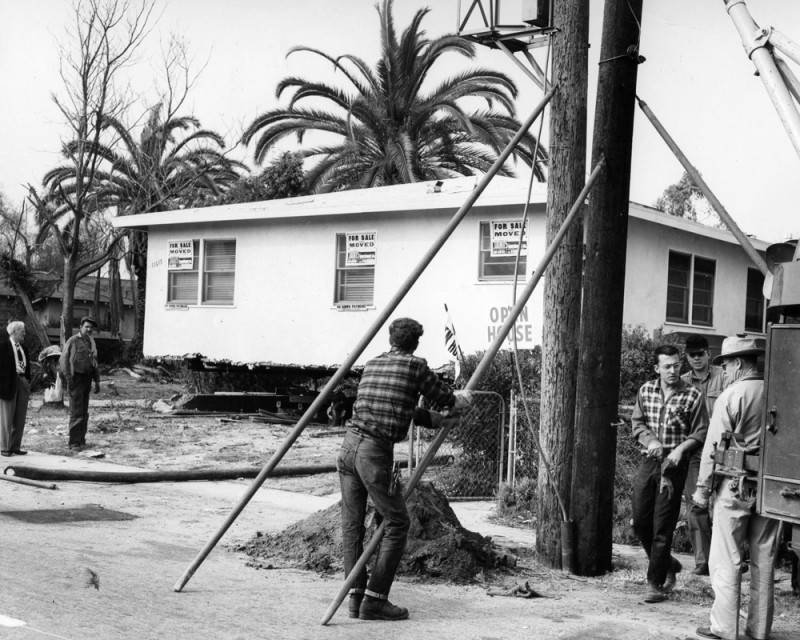
In the 1950s and early 60s, the expansion of the Ventura and Hollywood Freeways was accomplished by massive bulldozing of parks and houses.

North Hollywood, never rich in parkland, suffered the loss of some 20 acres of parkland to accommodate the construction of the 170 which today slices through and forms a new border between more affluent “Valley Village” and less wealthy North Hollywood.

It was cheaper to take parks than pay private property owners to seize land for the highways. Yet there were also many thousands of buildings moved or destroyed when California embarked on its mad program to make us completely dependent on motor vehicles.

Today we live in a reality that we think is normal but was paved and paid for by our elected ancestors. Car chases, global oil with wars and climate change, air pollution, shopping centers that took away orange groves, every five-minute traffic reports, the self-defeating obsession with oil prices, the decline of walking and the promotion of obesity are all linked in some way to the freeway system.

Our fervor to ride our cars to the Starbucks and drop our kids off at school, empowers Saudi Arabia, Russia, Iran. 

Our question for every apartment building and every house built in California: where will they park? Nothing architectural or aesthetic, nothing about the urgency of housing, only one thing on everyone’s minds:

Where will they park? Where will they park? Where will they park? Where will they park?

If by some miracle there was a proposal to build Rockefeller Center in the middle of a parking lot in Van Nuys behind rows of empty storefronts, there would still be only one question: where will they park?

We would rather live in environmental degradation than rethink our freeway and road addictions.

But in the 1950s every destructive program was considered an improvement.

Photo credits: LAPL/Valley Times.


North Hollywood After WWII


Of all the areas of the San Fernando Valley, perhaps North Hollywood has undergone the most drastic changes, for better and worse.

The Los Angeles Public Library has thousands of images online of North Hollywood.

I pulled a few from the period 1948-1962.

California was undergoing convulsive expansion as the state population skyrocketed, and millions moved here for a better life. Freeways, schools, housing, shopping centers, all of it exploded in only one decade.

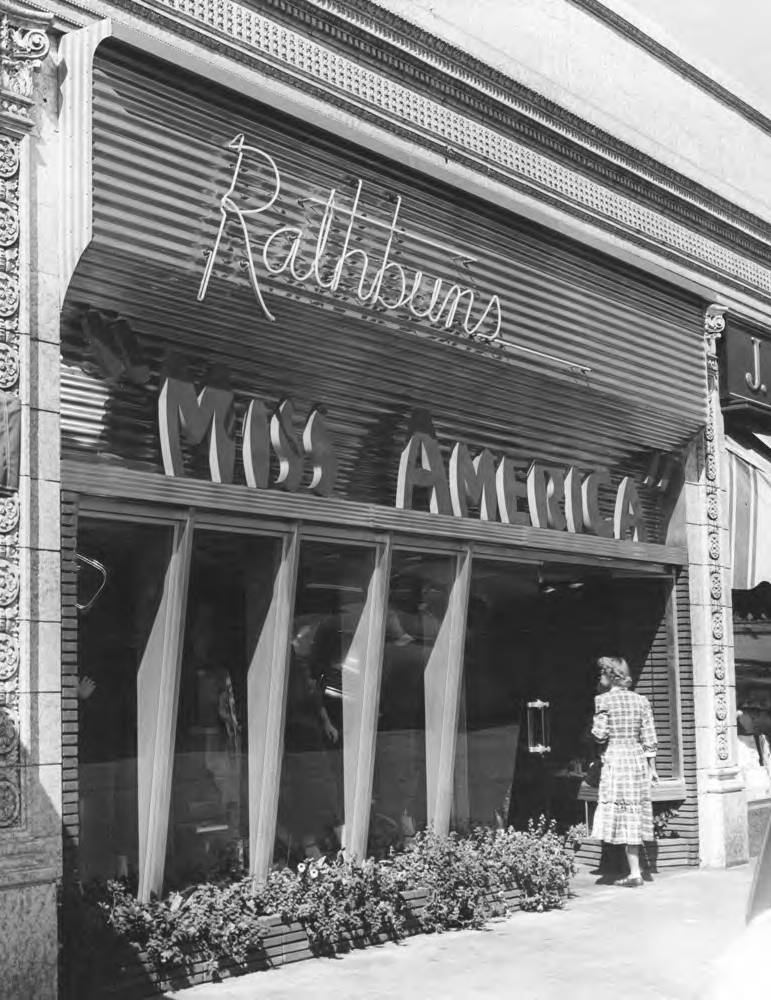
After WWII North Hollywood’s commercial area was centered along Lankershim Blvd. There were many locally owned shops, and they took pride in their windows and customer service.

The 1950s was also a time when public presentation of improvements was staged and photographed.

The widening of a street, a freeway that blasted through a park, an orange grove obliterated with thousands of new houses, the demolition of old houses for shopping centers, these were all accompanied by ceremonies with well-dressed men in suits, and the ladies in their hats, veils, dresses, pearls, earrings, lipstick, high heels.

In that time, 75 years ago, nobody imagined that one day parks would become homeless encampments, that vagrants would live in libraries and sleep on sidewalks, that marijuana would be as common as soda.

There was still an innocence about this country, a belief that people in power had the best interests of everyone in mind.

North Hollywood: High and Low.


East of Vineland Avenue, along or near Burbank Blvd, North Hollywood has a collection of small businesses, creatives, prop houses, and studio related companies that turn out goods and services, real and virtual.

On a windy, clear, cool Saturday we came to walk around. We explored Satsuma, Chandler, Cumpston and Riverton Avenues.

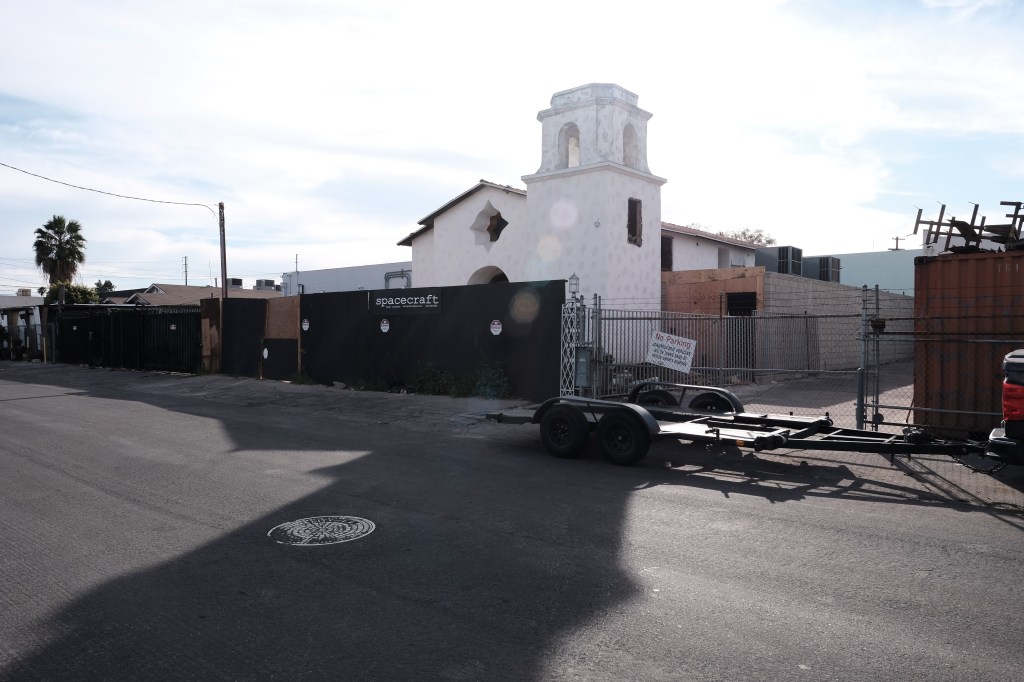
At 5453 Satsuma, a small, white, mission style stucco church was transitioning to secular renovation for a company called Spacecraft. The site was an otherworldly juxtaposition of architectural divinity and outer space travel.

In the 1946 North Hollywood Street guide, it seems that Santa Susana Catholic Church was the center of a Spanish speaking community along Satsuma that was strictly encased (segregated) between Chandler and Burbank, but not one house north of Burbank, or one house south of Chandler. All the old houses were knocked down and replaced by industrial concerns in the 1950s. Only the church survived but not as a church.

At 5416 Satsuma, a black and pink cinderblock building stood behind a chain link fence laced with reeds. A decapitated palm tree and wooden power pole completed the scene.

We walked along the Chandler bike path, next to a Robert Spiewak mural painted on a building in 2000, during the reign of Mayor Richard Riordan (1993-2001).This Angeleno themed artwork is a dystopian, militaristic vision of power poles, mountains, sky, missiles, and skyscrapers entangled in traffic or the internet. 

My masked, hand sanitized friend Danny stood in front of the mural, marking our own pandemic time as we are poised on the brink of a potential world war and nuclear holocaust. 

On the north side of Chandler, a half-completed structure (for USPS?) is going up with lots of steel and diagonals, in an aggressive, edgy, industrial style that looks like what they were building in West Los Angeles twenty-five years ago. 

At 10747 Chandler, one story buildings from the 1950s, for lease, are neighbors with a homeless tent. And adjoining the block is a clay-colored stucco, streamline modern building, with mean little windows guarded by frilly iron bars, also for lease.

Praxis Custom Frame & Upholstery is housed, anonymously, in a deep teal and decoratively topped structure with brown awnings at 10717 Chandler.

This was once the location of Triple C Polishing and Plating Company according to a 1946 North Hollywood Phone Directory.

A matte finish, gray, Toyota Tacoma 4 x 4, pumped up and preening, was parked in front.

Steel Lighting is a new design on an old building, crisp and clean, black and white, with a cornice of black barn lights extending across the facade. 

Martin Iron Design (est. 1990) is hidden away at 10750 Cumpston. An American flag droops over a wall like a sad, lonely dog. HOLLYWOOD is crafted in metal over a steel walled security gate. 

Curving Riverton Avenue is half industrial, half little houses from the 1940s, a street like a small town, with tiny (million-dollar) residences that face west, into the sun and the new sidewalk, the parking lots and the shadow emitting steel plates that protect VFX Video Services at 5543.

Arxis Design Studio is at 10800 Burbank Blvd. corner of Riverton.

WE ARE ARCHITECTS!

They shout.

Their firm is housed in a torturously proportioned building punctured with a whacko assemblage of exaggerated, protruding windows with monstrous, robotic, tinted glass eyes that scan a parking lot. 

All who look up at the misshapen, off-kilter windows know they are entering a hallowed kingdom of architecture.

That concludes a sampling of North Hollywood, High and Low.

New Housing at Old Bank.


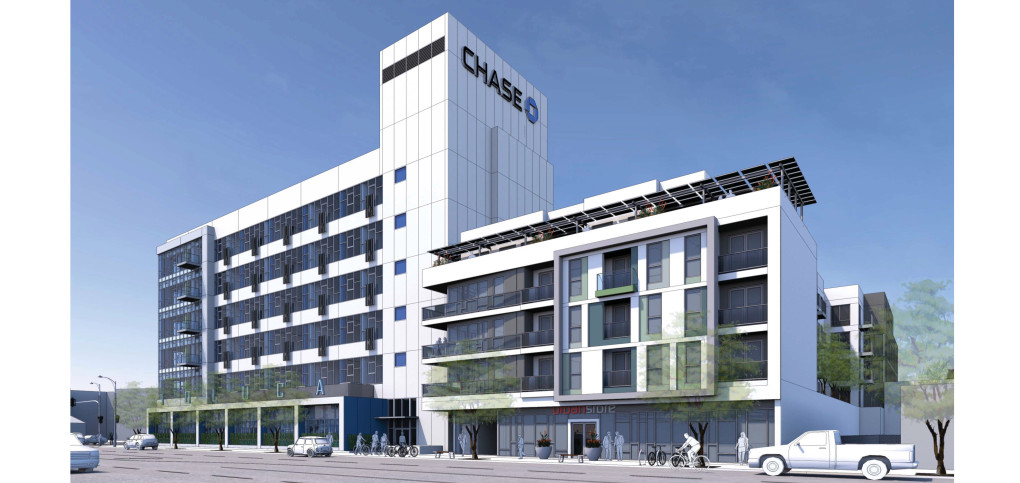
Last week, the LA Planning Commission approved 179 townhomes and 8 low-income apartments built partially out of the old North Hollywood Savings and Loan (later Chase) Bank at 4445 Lankershim Bl. at Riverside Dr. according a recent story in the Daily News.

The 1961 building will be readapted for residential use, and include over 5,000 SF of ground floor commercial space along with 263 car spots and 237 bike spaces. The architect is Winston Chang, principal of Next.

For years I have driven past this building as I traveled on the 134 or along Riverside Drive. 

Curious about its history, I dug up some old LA Times articles.

Roscoe W. Blanchard, Sr. (1882-1977) owner of the Blanchard Lumber Company, founded the North Hollywood Savings and Loan in 1923 when the San Fernando Valley was in its earliest boom days. 

Here is his 1977 obituary:

After WWII (1945), the boom in residential building made the bank prosperous, and in 1960, with over $40 million in assets, they announced a new $2 million dollar, six-story tall skyscraper with 73,810 SF of space. Earthquake resistant and fireproof, it was also the tallest structure in the San Fernando Valley. 

In a 1963 ad, the bank stated they would pay depositors 4.80% interest, a tidy amount for the time. In 1969, they promised 5% interest for new deposits.  Those were the days when a person could save money by opening a savings and loan account, and count on a guaranteed level of annual growth.

But the go-go 1960s ended with a decline in the Los Angeles realty boom. And the days of a secure savings and loan specializing in residential housing loans was numbered.

A Feb 9, 1969 LA Times article entitled, “Realty Boom is Fading as Prices Stay Stable” lamented high interest rates of 7-8%, and the inability of many families to afford the average $25,000-$35,000 SFV home, with more than 2/3 of SFV families earning less than $10,000 a year.

Overbuilding in 1965-66 had resulted in rental vacancies of 22% and almost 2,000 new homes unsold. One-third of the new, un-bought homes in Los Angeles were in the San Fernando Valley.

In 1969, both rents and residential prices fell as supplies increased, a widely accepted fact of economics which seems to have been forgotten by modern Angelenos who believe that building more housing is only for “greedy developers.” 

But back when the developers were allowed to develop, this was the result:

1970: In Woodland Hills, the average rent was $172, the highest in the Valley. 

Encino had the most expensive homes, averaging $50,000 in value.[1]

Today we have this:

According to CoStar, the price of an average apartment in the Woodland Hills sub-market—which includes Warner Center—stood at $2,200 per month. 

In 2018, Redfin said the average Encino home was $980,000.

In 1979, Proposition 13 froze property tax rates at the original level a home was sold at, not currently assessed at. Lucky owners of homes bought in 1974 for $40,000, which became $300,000 properties in 1980 (or $3,000,000 in 2019) were still taxed at 1974’s $40,000 purchase price. 

The tax rebellion was partially a white reaction against the increase in illegal migration and resentment in paying taxes for darker complexioned students. Today, most people who can, drive their children out of “bad” school districts to “good” ones thus exacerbating our air pollution and traffic problems. 

People who once rode the bus now take Uber or Lyft, thus exacerbating our air pollution and traffic problems.

We don’t build enough housing. Our housing is in short supply because many of the occupants here don’t legally have a right to be here. But that is stating what should not be said.

Part of our hypocrisy is being liberal and being racist and wanting good education for our children. And none of these traits can co-exist in modern Los Angeles without being hypocritcal. This is not an indictment, just merely a statement of fact from speaking to white parents who live on my street in Van Nuys and drive their kids out of the area to attend school.

The great shortage of homes in Los Angeles began its 40-year ascent and has now culminated in the lovely sight of human beings, unable to afford shelter, sleeping under bridges and along sidewalks. 

Mental illness is blamed for some of this but I wonder how mentally healthy I would be after eating out of garbage cans and sleeping in an alley for a year.

That some of the fortunate inheritors of parental properties, and low property taxes, are also some of the biggest opponents of new residential construction, especially in wealthy sections of Los Angeles, is a cruel irony. 

In the 1980s, the Savings and Loan crisis, brought on by government policies that bankrupted local S&Ls, resulted in the consolidation of many small banks into the large regional ones such as Chase or Bank of America.

In 1976, North Hollywood Savings and Loan was incorporated and merged into San Diego’s Central Federal Savings and Loan Association. 

So in the next few years, a building that once housed a savings and loan which played an instrumental role in lending money to young families buying homes in the San Fernando Valley, will become itself a home for some 179 families, (and 8 units or 4% of the total units will be low income).

Los Angeles, here in Van Nuys, and here in North Hollywood, and all around the city, will move along and build expensively and sluggishly until its leaders accept that it must become denser, higher, and less car dependent. An enormous push for more affordable and multi-modal transport accessible housing is paramount for our survival as a viable metropolis. 

Because we don’t build enough housing, we cannot afford to live in areas we might want to, which leads to more segregation and more bitterness and more helplessness in a city where homelessness is never far off and being housed is conundrum of insanity and indebtedness.

That we need to build more was something Roscoe W. Blanchard, Sr. would have understood with his expertise and success in building materials and financing homes 100 years ago.

We are trapped between the reality of our city and our dreams of its potential. We know what it is. We see this place with our own eyes.

But we really don’t want to accept its degraded condition, or the responsibility for how grotesque, unequal, cruel, barbaric and sadistic it often is. To look at the ugliness in this city we would have to accept that ugliness in ourselves. And why we make illogical and self-destructive choices and choose prerogatives that hasten the decline of Los Angeles.


[1]Valley Population Near Million; Growth Slows

–LA Times, April 29, 1971

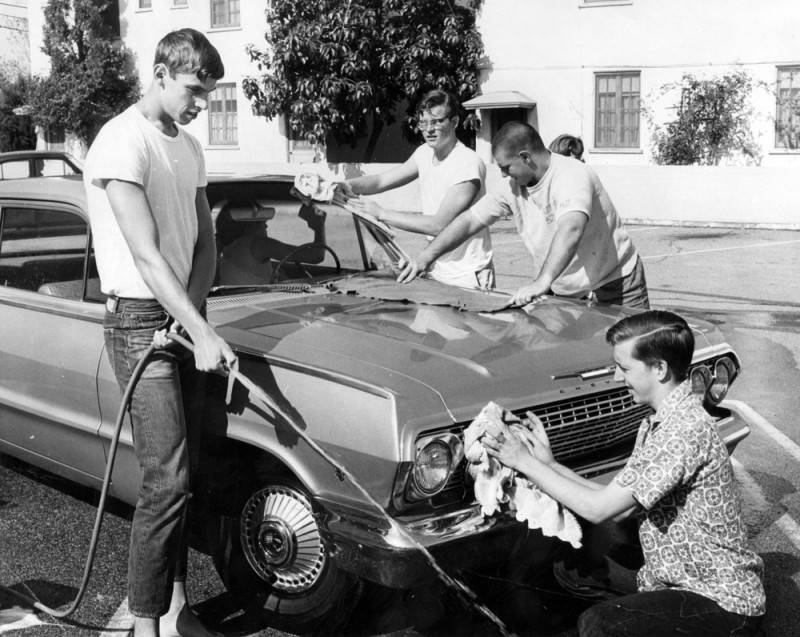
Vintage Car Washing: Los Angeles, CA.


The care, the compassion, the concern; the love, the affection, the authentic empathy for the automobile knows no bounds in Los Angeles. For here, the health and well-being of the car is of utmost concern to every red-blooded man, woman and child.

In our city, a neglected, dirty, abused, uncared for car is truly a moral crime, something that our citizens would not tolerate.

Since the car emigrated to Los Angeles, from France and Germany, early in the 20th Century, it has found a home here.  The sincere regard for all wandering vehicles has produced an outpouring of health care for all cars unrivaled by any civilized nation.  All races, creeds, religions, every poor and rich person, regards the vehicle as Their Supreme God.

And in every district of Los Angeles, outside of every school, restaurant, home, and hospital, the car is thought of first. Its needs are regarded before any triviality which might impede the happiness of the car.  Even when there are empty factories, abandoned malls, the car retains its parking lots. Even roads falling down, streets pockmarked by potholes, they are allowed to carry the car, because the supremacy of the auto goes before any other infrastructure needs.

When crazy buildings to house people are proposed by cowardly developers, the first question at community meetings is always the holiest and most sacred one:

“Where will they park?”  

No car ever goes without fuel, no car is ever without a parent looking after it, all precious water from our aqueducts is used to baptize and cleanse the car so that it can go on as the King of Los Angeles. Every drop of air we breathe, every sound we hear, every place we want to go, our car must come first.

Let the icebergs melt, let the polar bears and penguins die off, let 117 degrees become the new normal in Los Angeles, our car must continue to be our primary mode of life and liberty.

We know no other way. We will accept nothing less.

Following are some vintage car wash photos from the files of the LAPL:


Post WWII North Hollywood


The development of North Hollywood started in the early 1900s and was one of the earliest coherent towns in the San Fernando Valley.

Its commercial district, along Lankershim Blvd. was lively, prosperous, and safe.

After WWII, there was a brief flowering of progressive design along the commercial strip which sought to upgrade buildings and attract new customers.

In these photos, taken from the LAPL archives of the Valley Press, one can see a healthy and happy environment that, sadly, could not compete against large department stores and huge parking lots that were built, starting in the 1950s, near Victory and Laurel Canyon.

Ironically, the return of the Red Line subway to North Hollywood has spurred the renovation and rebirth of the Lankershim area into an arts district which is far more sustainable than an auto-oriented shopping mall.  Sears and the Valley Plaza are now the blighted ones who are on the verge of being redeveloped.

It takes a village to make a community, not just 3,000 parking spaces.

So here we look, with wonder and envy, at the North Hollywood that once existed.