Sentries of the Past.


There are ten houses along the west side of the 6600 block of Norwich in Van Nuys.

They are all ranches, built in the early 1950s, solid and compact.

Unusual for Los Angeles, the houses are all original. There are no tear downs. There aren’t any protective fences, walls or gates on any of the properties if I recall correctly. The front lawns are still grass. Not concrete, not RV, not Hummer.

Yesterday, I walked down the street, which has a real sidewalk, and on both sides of the block, two rows of identical tall trees, species unknown, currently bare of leaves, chopped up by Cortadores de árboles.

There is something midwestern about this street: sedate, well-tended and reserved. The only person I know who lived on Norwich was a blond-haired man who came from Ohio, married a woman, divorced, and moved back to Ohio. 

Norwich Ave. reminds me of Lincolnwood, IL where I grew up. Especially one thing….

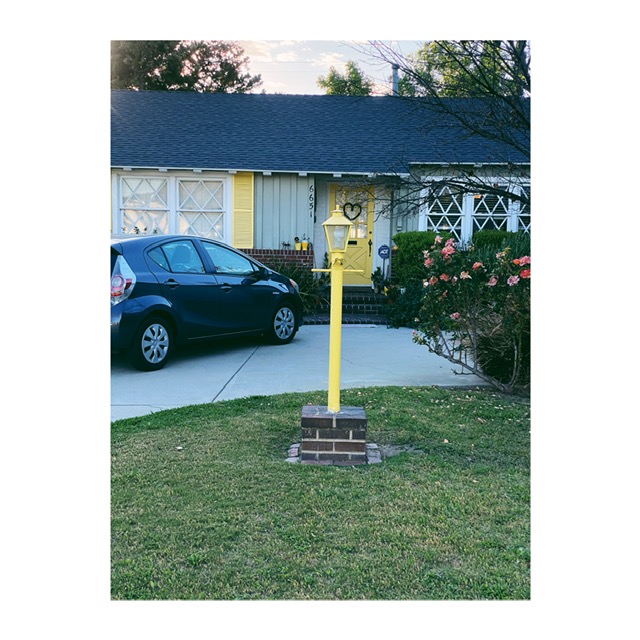
Each of the ten houses has a lamppost in front. 

You can stand on the end of the block, on the south, at Kittridge, and on the north at Lemay, and look straight down and see the lights lined up, like sentries, in front of each property.

These exterior lights belong to mid-20th Century suburbia. They functioned, in their time, as gracious servants who lit up sidewalk paths for evening guests, paths planted with geraniums, petunias or marigolds; illuminated walkways for the wintertime mailman, dad coming home from work, and junior on his Schwinn thrown down, rushing in for his dinner of fish sticks, tater tots and Kool-Aid.

Some of the posts have address numbers attached.

Like every other block, people see what their neighbors are doing to their homes and they copy it. 

The lamppost is a survivor from a domestic time seven decades passed. It has no real security value, and when it’s turned on during the day it indicates that nobody is home, thus negating its magical protection.

But walking past these homes and their lights, brings you back to the old days of bourgeois Van Nuys, when this district was neat, safe, and proud. And citizens thought that men in suits and uniforms, serving under sky god and nation flag, were looking over them and protecting their lives and family, fulfilling oaths sacred and lawful.

When the people, who always paid taxes and sometimes voted, discovered that nobody was in charge, that security was your own problem, that only wealth bought law and justice, the decorative lamppost went out of fashion.

And here we are today, in the new dark ages, monitored and terrified.

Old Style Street Signs.


I’ve long been an admirer of the older street signs in Los Angeles.

They emit the characteristic and regional style of a time and place. Their lettering is crisp, stylized, and easy to read.

According to this LA Times article, the city began to produce the distinctive shotgun shaped, dark blue porcelain, metal signs in the 1920s.

As the city grew, in the 1930s and 40s, the signs became markers of urbanism, uniting the vast region under a single style.

DSCF0004 DSCF0003 http://www.latimes.com/local/la-me-street-signs-20140816-story.html

Along Kittridge Street in Van Nuys, near where I live, I found this poetic sounding trio of survivors: Norwich, Lemona and Saloma.

Metal poles with decorative finials add elegance.

DSCF0006

Further east on Kittridge, a newer sign, in medium blue, looks cheaper and functional. It is attached to a plain metal pole.

It does its job, like a vinyl replacement window in an old house.

But a public sign should, in a civic sense, not only shout out a name, but do it with a flourish, and a sensibility.

50428205 sanfran

Imagine Berlin or San Francisco without their unique street signs.

The old sign makers understood that we as a city are lost without proper signage.