El Crappo


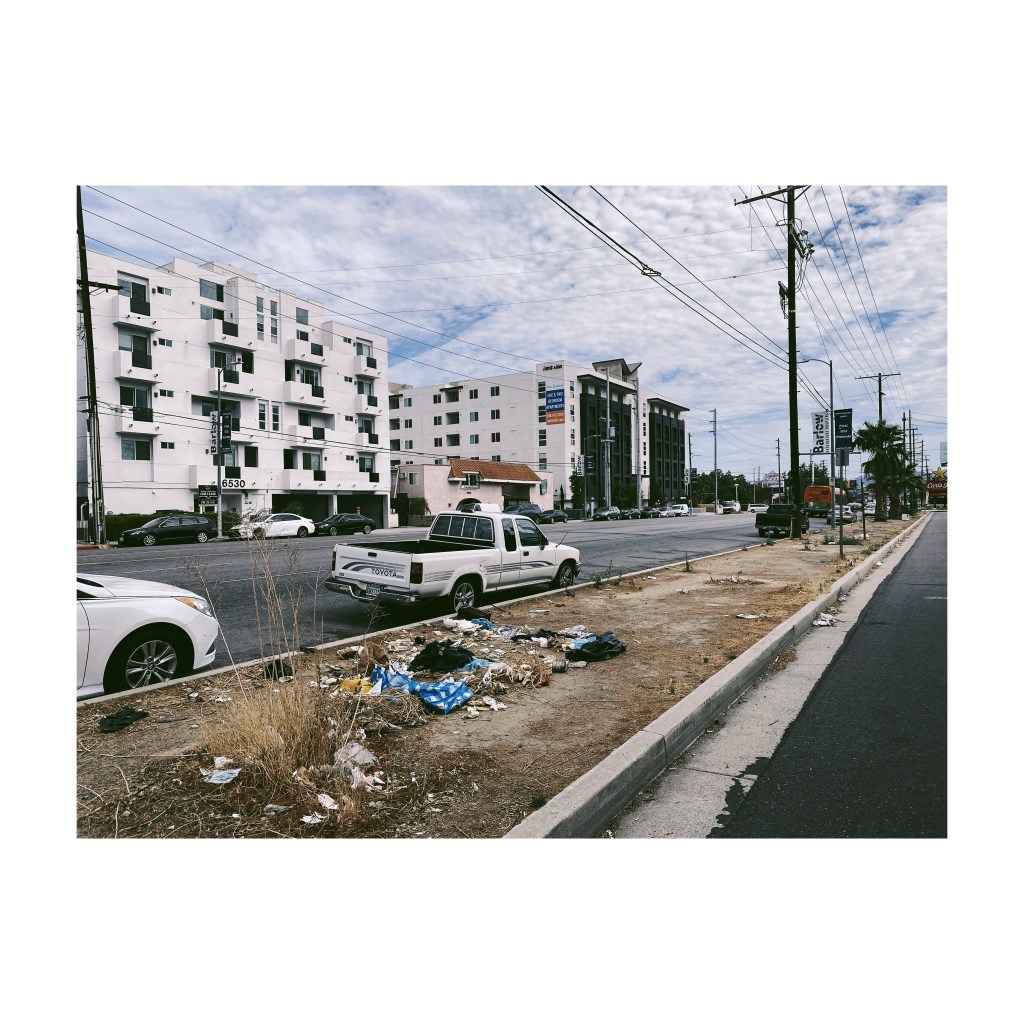
Running along the west side of Sepulveda Boulevard, from Haynes to Lemay Streets, is a traffic median, allegedly planted with trees, but mostly serving as a local dump for household refuse, a refuge for old couches, toys, luggage, mattresses, beer bottles, etc.

Nearby are new, gleaming, white paneled developments, including the rental apartments at IMT 6500, “with easy access to golf courses, tennis courts, jogging, bike paths and boating on the Balboa Lake.” With lush photographs and bucolic descriptions, one might mistake this online fantasy as Zurich, Switzerland.

Ugly before the pandemic, hideous now, it seems that the many unfortunate events of the last year will provide a generation of politician’s excuses for the deplorable environment Angelenos endure. Add in the presence of thousands of homeless, the daily fires in Balboa Park, the rancid smell of sewage, global warming, ever present violence, property crime, speeding cars and crashes, fireworks and pipe bombs,  and you have a drama that surpasses the worst conjurations of Hell.

But do not judge this district from the worst examples. There are lovely places nearby.

Just one block from here, at 15351 Haynes St. a home recently sold for almost two million dollars. 

On nearby Orion Avenue, a studio set neighborhood of picket fences, rose bushes and white houses earns many residents tens of thousands of dollars each month for commercial filming. And some of these glorious residences, worth millions, many inherited, pay less than $2,500 a year in property tax.

But few who live in the privileged homes venture out at night to stroll past Jiffy Lube, Dunn Edwards or Jack in the Box. And nobody has a picnic on the median. The pleasant events all happen behind tinted windows, in air-conditioned homes and vehicles, there is no pretty nature other than the yards dressed up for commercials.

And there is never any connection between the public, civic realities of life in Van Nuys and the private dreamscape of those fortunate enough to own a piece of paradise.

You end up in a mansion or dumped along the road.  Roll the dice.

Woodley Park, R.I.P.


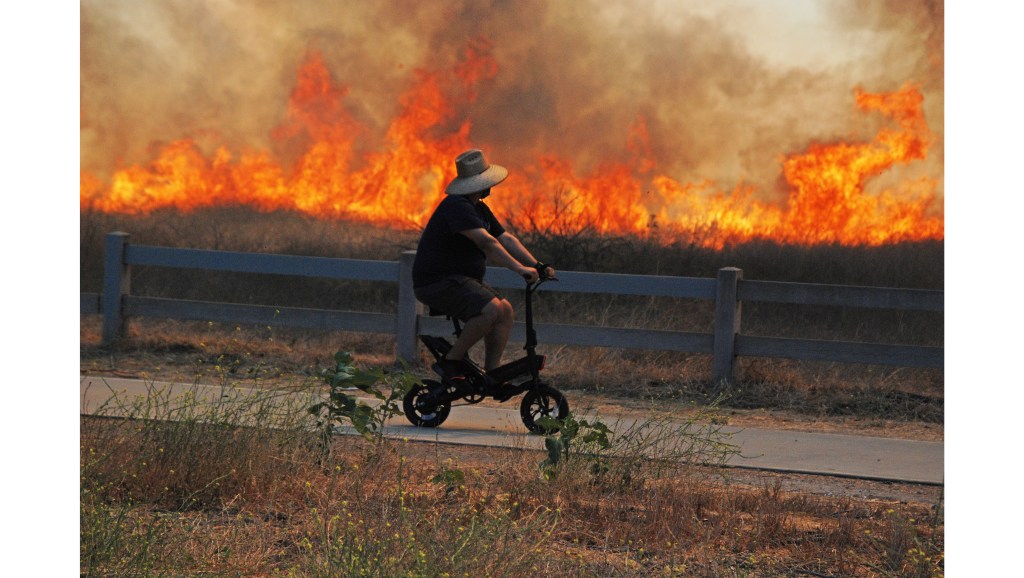
A man rides his mini bike down a bike path at Lake Balboa in the Sepulveda Basin as a wall of flames approaches Saturday, July 18, 2020. The fire put up a huge cloud of smoke and burned for well over an hour near a model airplane park and along Woodley Avenue. The blaze charred about 4 acres of brush before over 60 firefighters managed to contain it. No structures were damaged and no injuries were reported. (Photo by Mike Meadows, contributing photographer)

One of the ameliorating joys of moving to Van Nuys in 2000 was escaping, on bike, to Woodley Park, that formerly glorious area of bird sanctuaries, bike paths, grasslands, ponds, and the Japanese Garden.

Through the years I was so happy to ride through it, to feel the wind and the sun and openness of the park, a place to photograph, and wander and exercise in.

Since the reign of Mayor Eric Garcetti (Garbageciti) began in 2013, the park has become a homeless encampment, with hundreds trashing it with shopping carts, drugs, needles, garbage and worst of all, starting fires. 

It seems that every other month there is a massive blaze in Woodley Park, illegal cookouts or arson or just exploding propane tanks, and now the park is an ashen graveyard of nature, just black fields where tall grasses once thrived.

Why is it “humane” to allow vagrancy, disorder, disrespect and abuse of our parks, our streets and our environment?  We thought we had seen the worse of this city and nation in 2020, but if you want to feel even more gloom, take a saunter over to Woodley Park and witness for yourself the broken fences, the depleted environment, and the still evident trash camps of tents, shopping carts, stolen bikes and litter along Burbank Boulevard.

And ask yourself what competent and worthy leader would permit his city to become so degraded that even a simple park is too embarrassing to look at?

Option A: Still Waiting


In September 2017, 180 small businesses, 58 properties and 1,000 workers in Van Nuys learned they might be in the way of a 33-acre demolition project, Option A, proposed by Metro Los Angeles for a light rail service yard. Oxnard, Aetna, Bessemer and part of Calvert St., from Kester east to Cedros might be condemned.

A total of four options: A, B, C, and D are under consideration.

B, C and D are centered on the areas adjacent to Metrolink North (which are existing train tracks) and all involve far less demolition and displacement than Option A.

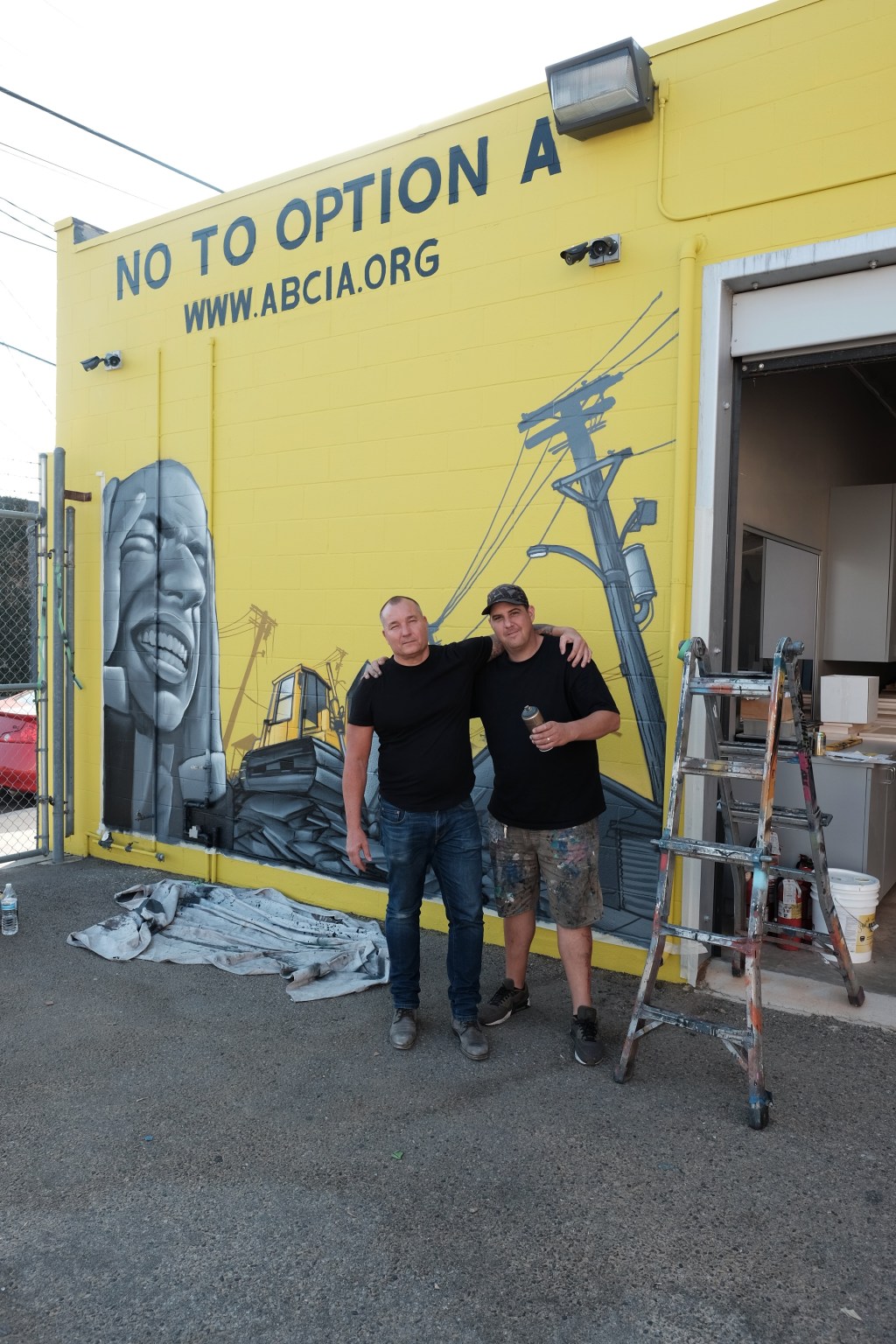
The bright, lemon yellow banners one sees all over the Kester/Oxnard area come from opponents of Option A who include community leaders, business owners and also the Office of Councilwoman Nury Martinez, who is firmly against something that would wipe out thriving, small companies who repair cars, build cabinets, record music, clean up flooded properties, plumb, weld, design and innovate right near downtown Van Nuys.

Ms. Martinez knows that the loss of these small businesses: walkable, diverse, local and entrepreneurial; would be disastrous for Van Nuys which has already been gutted out by the departure of GM a generation ago.

After multiple meetings downtown, speaking in front of the Metro Board, as well as Mayor Eric Garcetti and Board Member Sheila Kuehl, the Option A community was assured that an official announcement was forthcoming in January 2018. Walt Davis, Metro Transportation Planning Manager, was almost sanguine and breezily casual about how quickly the decision would be made to NOT APPROVE OPTION A.

 But, as of March 1, 2018, there have been no Metro announcements.

Option A still sits on the table. And people are increasingly nervous about the delay.


Showcase Cabinets’ Peter Scholz speaks with Marilyn Balduff, property owner of 14807 Aetna St.

Anxious and alarmed includes Ms. Marilyn Balduff, 75ish, a widow who owns 14807 Aetna St., a 10,000 square foot building housing half a dozen businesses providing her rental income and retirement assurance.

For fifty years, her late husband Bill ran Little Willy’s garage here. Marilyn worked as a CPA upstairs and kept an eye on the factory floor below from her elevated perch.

She is a smart, numbers ordered woman who knows how to invest, balance books, and manage real estate. She is not a super wealthy person, but rather a working woman who used 14807 to leverage the purchase of other properties. She is still paying off the mortgage, and the prospect of losing her family’s building saddens and frightens her.

For 14807 cannot be sold or rented to new tenants while the uncertainty of Option A hangs in the air.

I spoke with her when she came to visit her property today, and was handed a rent check by one of her tenants, Tom Bolan, a plumber.

Marilyn Balduff and Tom Bolan, tenant.

Jeff Montag, Marilyn Balduff and Jim Tabolsky.

She was also greeted by her largest tenants, Jeff Montag and Jim Tabolsky, owners of Regent 24/7 Carpet Cleaning, a company that has ten employees who clean out flooded properties, and work with property owners and insurance companies to remediate water damage.

Jeff and Jim, best friends and business partners, grew up in Sharon, MA and came to Los Angeles in the late 1980s. Jeff has four kids and three grandchildren and Jim has five children. They are solid, hard-working, experienced, and well-respected.

14807 is perfect for Regent because trucks can drive right into the building and unload water logged cabinets, furniture, and rugs. And equipment to clean the carpets can be put right on the truck. The 405 is nearby, and the workers also come local. It is an ideal place to have a small business.

Marilyn Balduff may have a business head, but she also has a sentimental heart. She spoke of her life, born and raised in Los Angeles, marrying Bill at age 18, the days they spent at Little Willy’s garage, and their mutual interest in specialty cars, including a 1908 Thomas-Detroit Runabout that Marilyn bought from Harrah’s (the former Harrah’s Automobile Collection at Reno) in 1983 when she saw its picture in the auction brochure and fell in love with the car.

Marijuana growers, who are gobbling up space all over Los Angeles, and out-bidding legitimate enterprises, by offering all cash and higher rents to owners, have approached her.

“I don’t want them. The mold and the humidity will ruin the building. And it’s not only the moral issue, it’s a degradation of the place,” she said.


Over on Calvert Street, Israeli born car repair mechanic Doron Danisky, 53, runs a scrupulously clean, orderly shop, D Best Automotive. His topless red Jeep with Hebrew lettering is parked along the curb near MacLeod Ale. (The Luck of the Scottish brewery, on the north side of Calvert, is outside of the area threatened by demolition.)

Doron bought his 3200 square foot building in 2011, and he uses his mechanical know-how from the Kibbutz (Yagur) to fix large trucks, jeeps and any old school vehicle. He has three rotary lifts and two employees. The atmosphere is airy, friendly, and low key.

Doron Danisky, owner of D Best Automotive.

“I’m not worried,” he said, offering cold water, soda and chocolates to me as we sat in his office. “Eat chocolate, it’s good for you.” He seemed fatalistic about Option A.

Perhaps coming from tense, on-alert, survival conscious Israel makes other concerns seem smaller.

“It’s a dream location, and when I heard about Option A, I was quite upset. But now I am OK with whatever happens,” he said.

D Best


But most, who depend on this district to earn a living, are not OK, until they hear the decision from Metro.

Apprehension and dread hang in the air along with the acrid fumes of car paint and the sour smoke trails of cannabis.

If eminent domain comes to Van Nuys, as it did with the tragically failing ghost-slum Civic Center (1960), another viable, historic, community-oriented, and socially supportive area will be ripped out and replaced by a post-apocalyptic emptiness.

Will the bureaucrats and elected officials make the right decision?

The people of Van Nuys are waiting.


SaveSave

Dormant Beauty


On a Sunday evening in July, on foot, after a few beers, the old town of Van Nuys, carried a note of Tribeca 1985, in its summoning of potential, laid out, for dreamers and developers.

There were empty storefronts and shabby alleys, but there were also women in chairs, attending children on bicycles, who played near clothes for sale, hung on a fence. Here Andreas bought a shirt for $3.

There were menacing BVN insignias on garbage bins and apartment walls, but there was also the eternal light of California soaking the decay in cinematic color. If I were sober, if I were alone, I probably wouldn’t have walked here.

Intoxication, used wisely, is a gift. When nerves are soothed, adventures commence.

What glories the cessation of fear brings to the eye. Every corner revealed something: teal and brown homeless tarps seemingly sculpted, the wood pallets in the alley placed with artful intention, a wood gate in the back of a parking lot like the entrance to an old western town.

The best buildings were the forgotten ones: The steel walled packing house on Vesper St., the pink stucco cottages on Cedros, and 14225 Delano St. a mid-century structure with a dark green cornice and an inverted glass wall, respectable, laconic and businesslike.

It was Sunday night but some people worked.

On Bessemer St. a worker at Technology Auto Body buffed a gleaming pick-up truck, squeezing the last minutes of light to finish his job.

Last night, these fearsome streets, Calvert, Bessemer, Vesper, Delano and Cedros, were peaceful and passive. Sometime soon, this walkable, neighborly and nostalgic area will revive, and these ramshackle adventures through denigration will take their place in the history book of Los Angeles.


SaveSave

The Festival of Garbage


For anyone who lives in Van Nuys, and has not lately visited Raymer St. between Kester and Van Nuys Bl., the Festival of Garbage is now in full display.

Dumped along the median from the bridge to the boulevard are tons of trash. It is perhaps the filthiest, most appalling and most wretched scene of degradation in the entire city of Los Angeles.

Calcutta looks like Beverly Hills compared to this.

Across from the sanitation crisis is a large recycling center, an irony that one might analogize to having an indifferent fire department next door to a burning building. If you are in the business of collecting refuse, how can you refuse to clean up the area around your business?

Adding to the criminality of the area, dozens of unhitched trucking trailers are parked along the road, taking up space, and attached to no moving vehicles.

The bridge over the railroad tracks has been, naturally, taken over by the homeless who live under, in and on top of the structure. They cross on foot over the tracks where Metrolink speeds by a few times an hour.

Does Los Angeles have any measure of pride? How does the city allow this tsunami of trash?

Who is responsible for this mess?

I vote for Councilwoman Nury Martinez and Mayor Eric Garcetti.

The Dispossessed


carpios-vsco
Carpio’s Auto Repair

A light rain fell yesterday morning, and after the weather system left, the skies were clear, the sun came out, a few clouds hung in the sky. And I went for late afternoon walk with camera.

Near Bessemer and Cedros, in front of the Valley Planing Mill, along the sidewalk bordering the Orange Line, is a metastasizing and makeshift encampment of homeless men and women.

It has grown, to encompass an area that probably accommodates some fifty people, who have erected tarp-covered boxes, umbrellas, tents, and wood crates as shelter from the rain and the sun. Around the temporary housing are shopping baskets piled high with anything and everything one might buy at Target.

img_3137img_3143img_3141img_3140img_3144img_3142img_3139

A green metal fence, protecting new cars owned by Keyes Chevrolet, encircles a rented out parking lot leased from Metro. It provides a safe and civilized enclosure for automobiles. Vehicles are well taken care of, except for one or two burned up, sitting in their spaces with melted and deformed bodies.

Humans (who did not want to be photographed) are left to fend for themselves on public sidewalks. Bed sheets and rattan mats are hung on the fence to sanitize. Privacy, cleanliness, and dignity are pulled out of dumpsters and transformed into street fortresses.

The situation here is appalling. But words do not suffice. And moralism, directed at politicians, developers, law enforcement, social workers and the homeless themselves cannot make sense of this 21st Century barbarism in our Golden State.

img_3138img_3150img_3146img_3147dscf0718