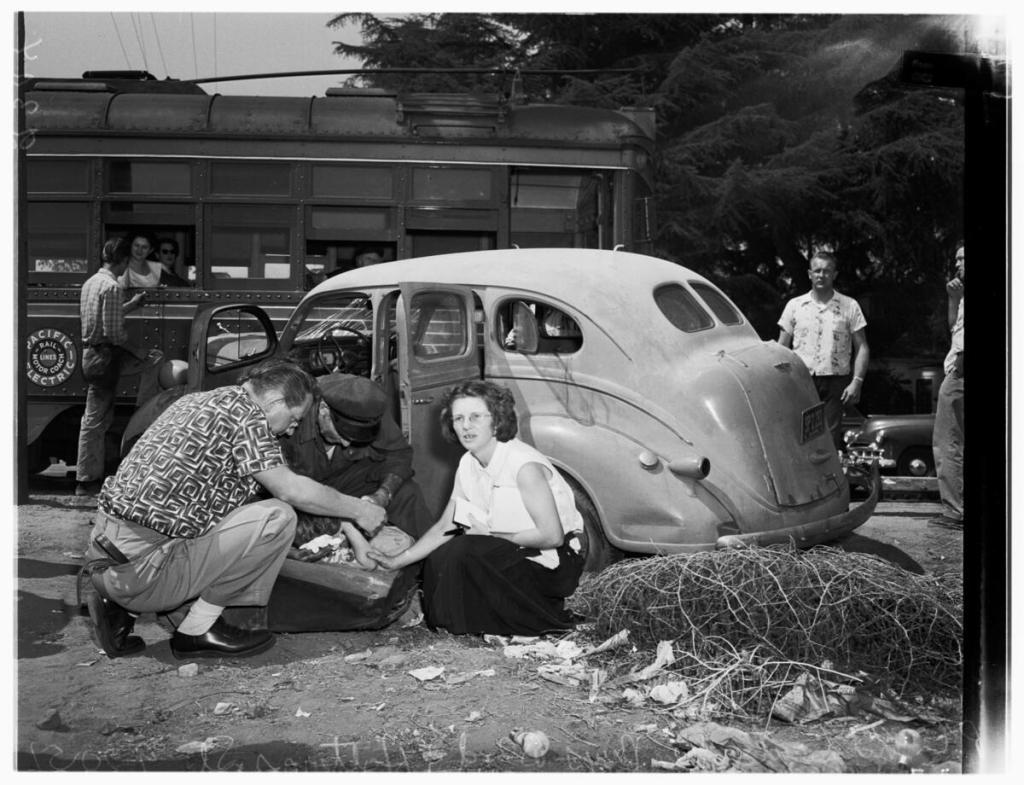
Sept.20,1951: Car Collides with Pacific Electric Streetcar in Van Nuys.


From the time it was established in 1911, Van Nuys was connected to the rest of greater Los Angeles by the Pacific Electric Streetcars that ran up and down Van Nuys Boulevard and traversed Chandler Blvd. to connect to North Hollywood.

The entire apparatus of light rail cars was dismantled by the late 1950s, and Van Nuys was wiped clean of these in 1956. Before the streetcars were taken out, Van Nuys had a thriving business district with diagonal parking, many vibrant stores, clean streets and a congenial sense of optimism and orderliness.

Van Nuys Circa 1945

On September 20, 1951, five years before their demise, an unlucky mother and son were involved in a collision with their car and one of the streetcars. It seems both mother and son survived.

Photos are from the USC Archives. Here is their original text:

“Pacific Electric versus auto (Van Nuys Boulevard and Hatteras Street, Van Nuys), 20 September 1951. Jimmy Quigley; Ann Quigley (mother); E.T. Ophus (motorman).; Caption slip reads: “Photographer: Glickman. Date: 1951-09-20. Reporter: Glickman. Assignment: Pacific Electric versus auto. Van Nuys Boulevard and Hatteras Street, Van Nuys. Passersby comfort Jimmy Quigley as his mother, Ann stands along side of him (in torn skirt). Motorman in picture is E.T. Ophus, who piloted Pacific Electric that hit Quigley’s car”.”

Clearing Up a Photo Mystery


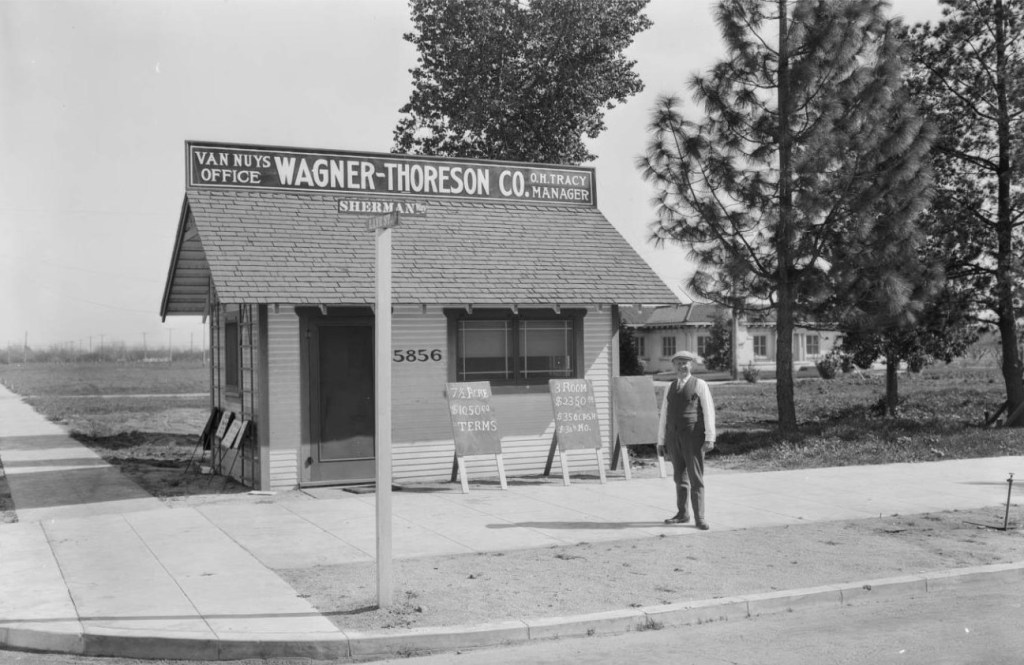
I found a DWP  Collection photo from the 1920s that shows the Van Nuys office of “Wagner-Thoreson Co.” (a realty company) and a nattily attired man standing in front. 

In the background is an estate on a large piece of land. A signpost reads: “Sherman Way” and “Lane St.” The photo had some information underneath which said “Lane St. was later renamed Califa St.” 

Where exactly was this? 

On Google Maps there is not a “5856 Sherman Way.” I thought the signpost might be blocking a number “1” so I inputted “15856 Sherman Way” but that address, in present day Valley Glen, was not at an intersection.  Califa and Sherman Way do not intersect either.

The 1926 San Fernando City Directory listed “Wagner-Thoreson Co.” at 5856 Van Nuys Bl. (at Califa). Not “5856 Sherman Way.”

Then I remembered something. 

Sherman Way was once the route of the Pacific Electric streetcar. The PE snaked its way up through the Cahuenga Pass into North Hollywood, then west down Chandler Blvd. It turned north up Van Nuys Blvd. and then travelled to go west on Sherman Way.

But Chandler Blvd. and Van Nuys Blvd. did not exist in name until 1926. From 1911 until 1926 Chandler, Van Nuys and Sherman Way were all named: South Sherman Way, North Sherman Way and Sherman Way!

On May 25, 1926, the Los Angeles City Council, with some infighting between San Fernando Valley residents, came to a compromise and agreed to partition the Sherman Way family into three distinct names: Chandler, VNB and Sherman Way.  


So the man in the mystery photo is standing on present day Van Nuys Blvd. at Califa, a block south of Oxnard.

Van Nuys Bl. 1930

Pacific Electric service lasted until December 29, 1952. 

Cahuenga Pass 12/29/52
N. Hollywood, CA. 12/29/52
Chandler Bl. 12/29/52

These sad and wondrous Kodachrome photos from the collection of Caesar “CJ” Milch (not the original photographer) show the #5146 car that once ran up through the Cahuenga Pass and into the eastern San Fernando Valley on its last day.

Image

Chandler Boulevard 1940s


Chandler Boulevard 1940s

A Pacific Electric “Hollywood” Streetcar travels down placid and empty Chandler Boulevard sometime in the 1940s. This mode of transport was removed in the early 1950s as the private car took over Los Angeles.

(Alan Weeks Collection)

Pacific Electric at Barham, 1947


Photographer Robert T McVay captured a fan trip with Pacific Electric no. 1036 on March 23, 1947, at this stop at Barham Boulevard at the Hollywood Freeway. Pacific Electric no. 662 seems to be on regular service and is just passing through the scene.

Robert T. McVay Photo, Norm Suydam Collection

Courtesy of the Pacific Electric Railway Historical Society

South On Van Nuys Bl. Near Sylvan St. 9/27/1952


Among the many changes Van Nuys has undergone in the last 60 years, two stand out in this old photograph.

Diagonal curb parking and the Pacific Electric Rail helped ground the street and divide it into manageable, smaller, more walkable and more friendly parts.

In 1954, the street was widened, and the streetcar eliminated. North Hollywood’s Valley Plaza (1951) helped hasten the decline of the small business shopping street, and thus, the decline of Van Nuys Boulevard as a clean, pleasant, prosperous destination.

LAPL: 1958 plans for Valley Administrative Center in Van Nuys


The late 1950s saw the demolition of many blocks of old Van Nuys to make way for the civic center, a misguided urban renewal project that put the LAPD hundreds of feet behind Van Nuys Boulevard and created a dead zone behind the Valley Municipal Center. A new library in this moonscape replaced the older, more elegant one on Sylvan which still stands today.

And cobra necked anti-crime streetlights disfigure Van Nuys Boulevard and give it an air of a malingering, dated, 1960s speedway.

Los Angeles Back Then


Image

Image

The old Los Angeles, the city of streetcars, steel signs, orange trucks, red cars, brick buildings, men in hats, ladies in skirts and high heels; the city of overhead wires, decorative lampposts, cops and conductors, kids on bikes, corner drugstores, ice cream parlors, neighborhood movie theaters; they are all alive and bustling and visible on the pages of the Pacific Electric Railway Society.

 Image

The dismantling and destruction of public transportation and the elevation of the automobile to the status of a deity has destroyed the richness and civility that once characterized the City of Angels.


Go visit the page, make a contribution, and gain some understanding of what we lost and what we might try to rebuild as we again go back to trains.

 Image

In the words of the organization:


“It is a non-profit association dedicated to the preservation of the memory of the Pacific Electric Railway. The goals of the PERyHS are: to preserve and maintain historical documents, visual images, oral histories, and historical studies; to make these materials available to the general public via publications (monographs), presentations and displays to non-profit groups and organizations and to assist other non-profit organizations in their efforts to preserve the legacy of the Pacific Electric Railway.”

Image