Purse Snatchers and Parking Lots. (Chinatown Part 2)


On the day we walked here, a few hours after we left, a 68-year-old woman, fighting a purse snatcher, was stabbed 8 times but survived. Her attacker was tackled by others and kept down until police arrived and arrested him.

One can sense the presence of danger here even though it may not be knifing you in the chest. You wouldn’t just rationally wander here at midnight. Maybe if you were drunk. 

North Spring Street is neglected. There are burned out buildings, empty storefronts, and lots waiting for life to return. New High Street between Alpine and Ord is made of one-story buildings and 50% asphalt parking lots. 

What a struggle to run a business in Los Angeles, especially a restaurant. How have any survived the pandemic, taxation, crime, inflation, food costs, employee wages? It’s a wonder anything is functioning.

My architectural imagination wonders why many streets in this district, adjacent to downtown, are so depleted of apartments above stores, why there are still one-story buildings and acres of parking lots all around. 

Along Alameda Street, there are gas stations, and a concrete building from the late 1960s housing The Los Angeles County Fleet Services. Against the brutal and blank façade are shrubs, a mid-century idea of environmental eyeliner. 

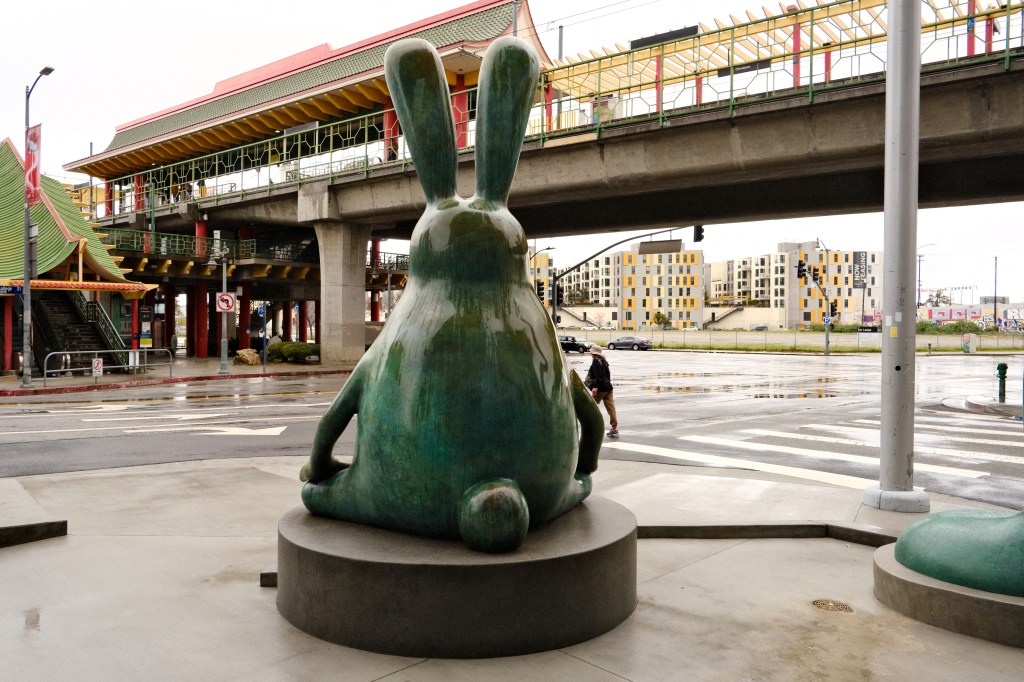
The light rail station is good looking with bright colors of red, green and yellow and decorative chinoiserie. There is a whimsical, large bunny statue on a pedestal standing guard across from the train.

There are handsome new buildings nearby but I hadn’t taken any photos of them. I will, perhaps, return here and photograph them someday. 

Chinatown in the Rain. Part I.


Chinatown is particularly poignant in the rain. 

The old and tired streets are washed in puddles. Pagodas, lanterns and the color red are reflected in asphalt. 

Everywhere there are old signs, some neon and some plastic, reminding us of families and times from long ago. 

There are old people with canes, umbrellas and face masks out shopping for hot soup and vegetables.

And packs of visitors waiting in line for take-out dim sum.

There are many empty parking lots selling parking spaces for $5 a day.

A big sign advertises Grandview Gardens, Cantonese Food next to a grass filled lot that might have once contained a restaurant. A history of this place is found online. It closed in 1991. 

Thirty-three years ago.

Grandview Gardens: an old sign like a cemetery headstone. Should it not be another restaurant or apartment or apartments over a restaurant? 

Don’t we have a critical, crying need for housing?

Everything moves so fast in Los Angeles. We come here young and eager and wake up neither.

But everything vital and necessary for the humane needs of humanity is tied up in litigation, neglect, bureaucracy, politics and abuse. For years and decades things decline but politicians are always promising the end of homelessness, the end of pedestrians dying in crosswalks, the end of hate, the dawn of tolerance, a new city of walkable, clean, affordable and safe neighborhoods. But I don’t have the funds to move to Vienna, Austria and neither do ten million other Angelenos.

Yet we drive fast, passing thousands sleeping in tents on garbage filled streets and tell ourselves that everything is normal. Another day of murder, another day of car crashes on the news, another walk through a community that has some thriving businesses and many others dying or dead. Have a smoke, get high, meditate. What else can you do?

In the civic imagination, Chinatown is one of Los Angeles’s happier places. Nobody thinks ill of it, they long to come this neighborhood, hobbling along in D- condition, months out of a pandemic that still haunts it. 

City Hall is a ten minute walk away.

A Controlled Destination


I hadn’t been to ROW DTLA/ SmorgasburgLA since the pandemic. 

This past Sunday was cool and it seemed like a good day to go down there, so we drove to the weekly event, parked in the commodious and well-ordered concrete car park, and walked across to the food trucks and cheerful carnival of Smorgasburg.

I ate a type of goat cheese and beet Chivadilla (a mulita style Quesadilla)  from The Goat and later had pulled pork on a roll at Battambong BBQ, a Cambodian American joint. I tried a fresh fruit drink from another Cambodian seller, Sweet Grass. Everything was delicious and affordable (to a point).

The crowd was varied, and dressed colorfully, some pushing baby strollers. 

I stopped to speak to one man at Lost in LA, selling embroidered knitwear. He had recently returned from Japan which he had visited a few times. We both admired the public civility of that nation and wished we had more of it here.

“Their kids clean their own classrooms!” he said.

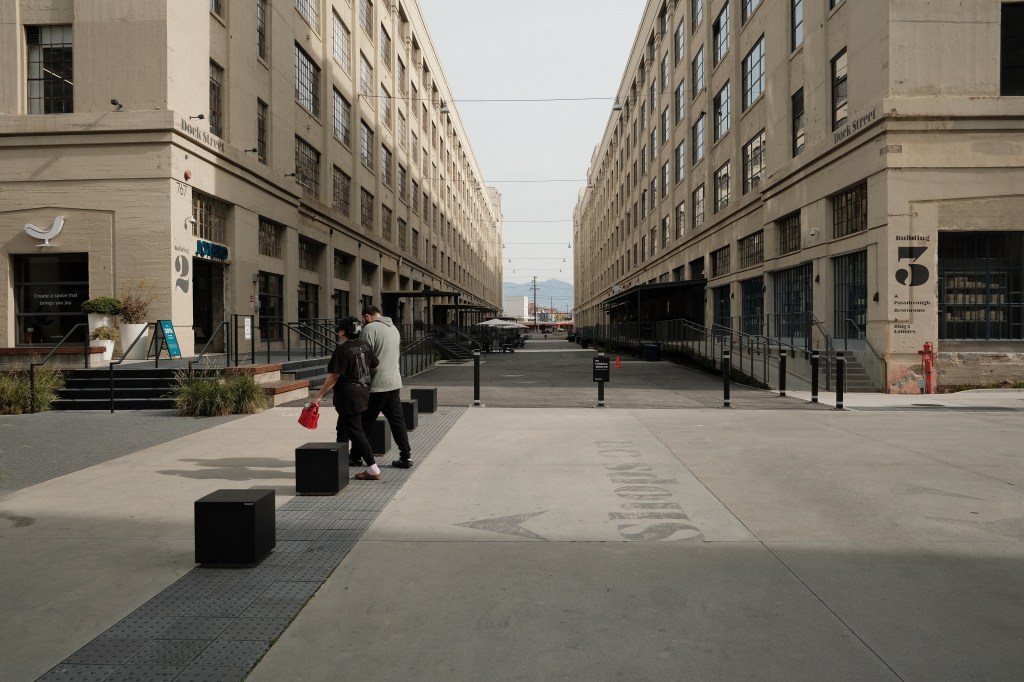
Later we walked along the landscaped, manicured and well-swept symmetrical street of shops where they sell luxury perfumes, furniture, clothes, liquors, coffee drinks, pottery and jewelry.  This is a kind of “downtown” you might find in Zurich or Singapore, a controlled destination where crime is rare and all the social ills are absent.

But this is Los Angeles, so we make do with an artificial representation of urbanity other cities take for granted. Because we don’t have civilized choices downtown or in Hollywood where our safety is sacrosanct. We instead find walkable and safe spaces under private ownership, guarded by for hire security forces.

On the route back home, we drove along Alameda and past tents where human beings reside along old railroad tracks next to shuttered industrial buildings that are awaiting new, more profitable uses. Piles of garbage and debris lined the road. And this wasn’t even the worst example of vagrant life in our city. There are many worse places nearby, skid rows by the dozens all over the Southland and a paucity of humanity and public policy to house and minister to people who are down on their luck and their circumstances.

There is not a park, a freeway underpass, a river, bus stop, library, 7/11 or a major street without RVs, tents, shopping carts, and piles of garbage. Wilshire Boulevard from downtown to Wilton for example.

Wilshire Boulevard! The once prime and pristine example of the glory of this city! Can it be that Los Angeles will soon host the 2028 Olympics? What can this city do in 48 months to become what it should be and disavow what it should not be? 

Walking Along the 6th Street Bridge.


I finally made it down to the 6th Street Bridge.

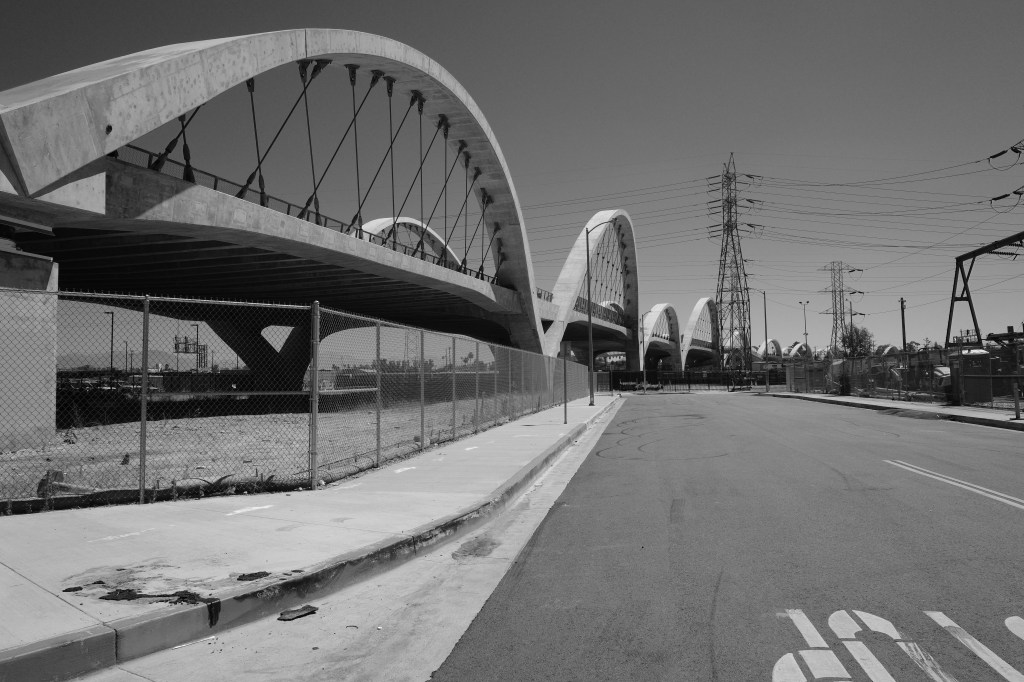
It’s an impressive structure that leaps and struts and flies over rail tracks and factories, electric yards and the river. It is startlingly plain, almost crude in its sculpted mass and bending arches. There are raw bolts attaching the cables to the concrete. Steel fences stretch along the pedestrian walkway. Dark shadows and blinding sun mark the bridge from beginning to end.

Unyielding in substance, rigid, unforgiving, brutal; it is a stage for fast cars, reckless driving and unintentional suicide. But also a balletic performance of geometric shapes and unexpected revelations along the way.

Mute yet expressive, untested in the long term, it is a baby of this metropolis. And born to a city that abandoned it to a wasteland which one day may be remade with trees, parks and apartments; or left behind to become yet another great, unfulfilled California promise.

Walking here last Saturday, August 26th, I thought of the late Mike Davis (City of Quartz) who wrote brutally and trenchantly about Los Angeles.

I don’t have his exact words, but in that book he described an architecture of barbed wire, steel gates, security cameras, the way this city is set up like a penitentiary with hostile inmates surrounded by deterrents, police and threatening lethality.

The 6th Street Bridge, ironically, has earned a reputation for criminal mayhem: daredevil driving and people who climb upon the arches to show off. I saw no rowdiness, in fact the road was remarkably empty and we only passed a few pedestrians. But in all directions artificial and man made structures are the entirety. Absolutely nothing is natural. The lone exception I saw was a cellphone tower who identified as a palm tree.

Sentries of the Past.


There are ten houses along the west side of the 6600 block of Norwich in Van Nuys.

They are all ranches, built in the early 1950s, solid and compact.

Unusual for Los Angeles, the houses are all original. There are no tear downs. There aren’t any protective fences, walls or gates on any of the properties if I recall correctly. The front lawns are still grass. Not concrete, not RV, not Hummer.

Yesterday, I walked down the street, which has a real sidewalk, and on both sides of the block, two rows of identical tall trees, species unknown, currently bare of leaves, chopped up by Cortadores de árboles.

There is something midwestern about this street: sedate, well-tended and reserved. The only person I know who lived on Norwich was a blond-haired man who came from Ohio, married a woman, divorced, and moved back to Ohio. 

Norwich Ave. reminds me of Lincolnwood, IL where I grew up. Especially one thing….

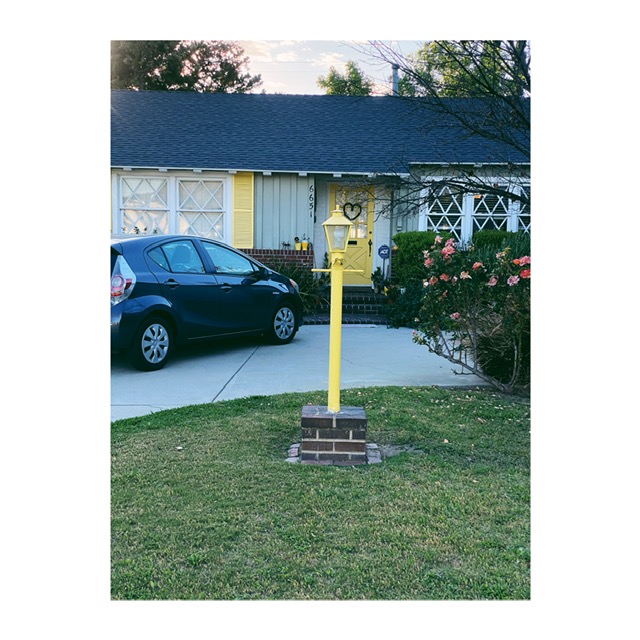
Each of the ten houses has a lamppost in front. 

You can stand on the end of the block, on the south, at Kittridge, and on the north at Lemay, and look straight down and see the lights lined up, like sentries, in front of each property.

These exterior lights belong to mid-20th Century suburbia. They functioned, in their time, as gracious servants who lit up sidewalk paths for evening guests, paths planted with geraniums, petunias or marigolds; illuminated walkways for the wintertime mailman, dad coming home from work, and junior on his Schwinn thrown down, rushing in for his dinner of fish sticks, tater tots and Kool-Aid.

Some of the posts have address numbers attached.

Like every other block, people see what their neighbors are doing to their homes and they copy it. 

The lamppost is a survivor from a domestic time seven decades passed. It has no real security value, and when it’s turned on during the day it indicates that nobody is home, thus negating its magical protection.

But walking past these homes and their lights, brings you back to the old days of bourgeois Van Nuys, when this district was neat, safe, and proud. And citizens thought that men in suits and uniforms, serving under sky god and nation flag, were looking over them and protecting their lives and family, fulfilling oaths sacred and lawful.

When the people, who always paid taxes and sometimes voted, discovered that nobody was in charge, that security was your own problem, that only wealth bought law and justice, the decorative lamppost went out of fashion.

And here we are today, in the new dark ages, monitored and terrified.

Progress Report.


On a brief walk, after dropping off a package at the UPS on Van Nuys Bl. I walked west on Sylvan, south on Vesper, ending this set of photos at the new fire station on Oxnard.

There is a small but significant amount of new apartments going up. They are pleasant additions to the neighborhood and are all in the currently popular white style, blindingly white, with dark windows.  They add some upgraded cleanliness to an area which has long been the sad kingdom of slumlords. 

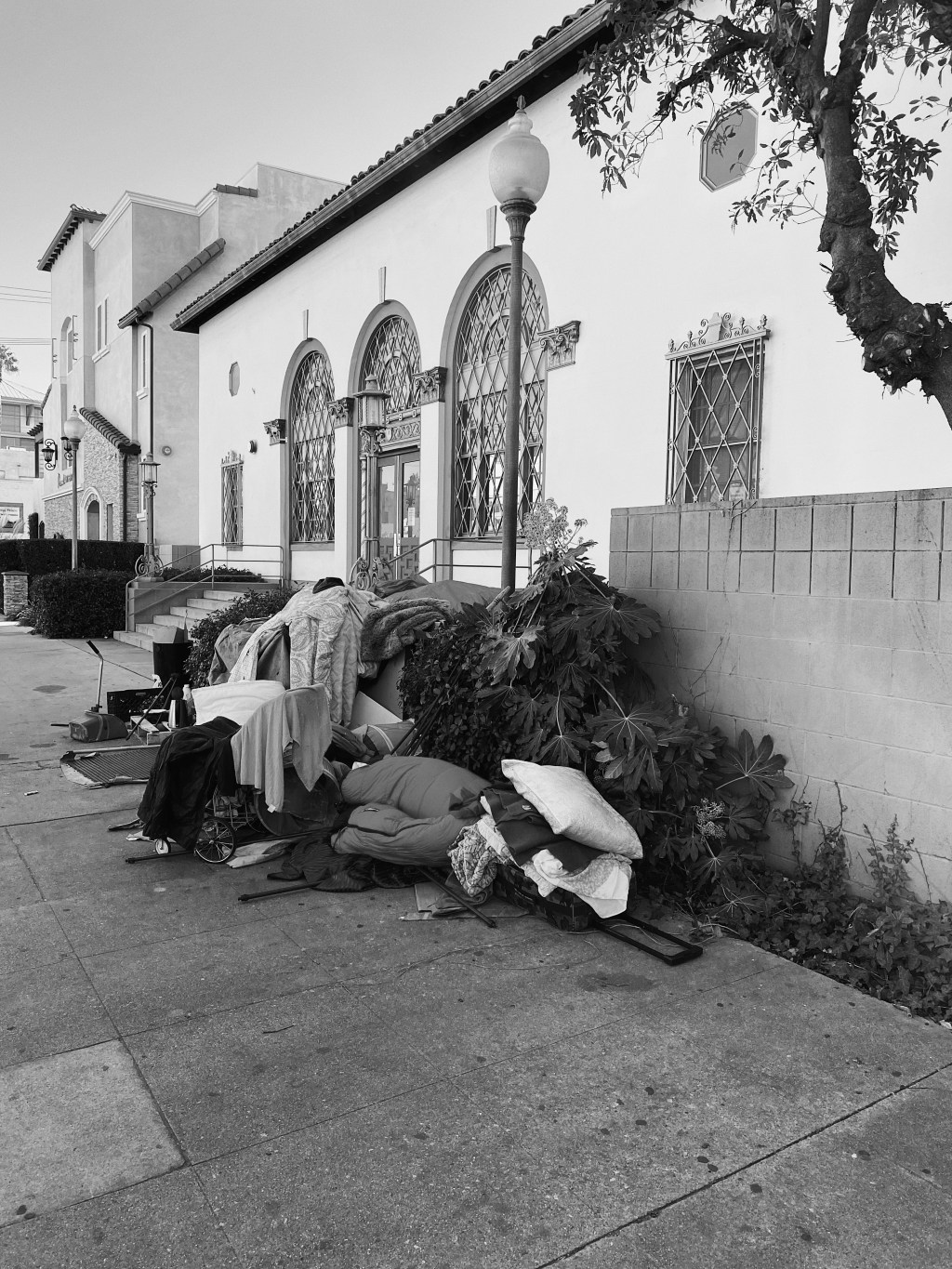
On Sylvan, the former post office, built during the 1930s by the WPA, in a classical style, was later a home for Children of the Night, a non-profit created to fight childhood sexual exploitation. They have since moved out, so the sidewalk outside the gracious building is now a trash camp.

The new fire station (2019) is a great asset for the neighborhood and has significant architectural beauty that recalls the 1930s Streamline Era, and is also conversant with the first fire station on Sylvan (1939) as well as the former DWP building on Aetna and Vesper (1938) just behind the new edifice.

Just to the east of the fire station, Aetna is closed, with a high fence, between Vesper and Van Nuys Boulevard, most likely due to the trash campers who took over the area. They are banished to fly somewhere else, probably to the bird sanctuary in Woodley Park.

Councilwoman Nury Martinez has jurisdiction over this area, and her office is nearby in the Valley Municipal Building. She is now the head of the city council, and the first Latina to hold that position in city history.

We can applaud the justice of diversity, the idea that anyone from any background can ascend the ladder of politics and achieve leadership.

We cannot applaud the failures of Ms. Martinez, and her predecessor Tony Cardenas (who is now a congressman in Washington, DC) for they have had over 20 combined years of allowing Van Nuys to fall into utter disintegration, filth, homelessness and blight. 

Their ethnicity has pushed them up into the spotlight even as their academic records in elected office should be graded D- or F.

The idea that one’s identity deserves praise rather than one’s achievements is a new chapter in our American conversation. If Van Nuys should fall further into the gutter, which seems unimaginable, we will think of the paucity of Ms. Martinez’s and Mr. Cardenas’ accomplishments and recall this verse from Matthew 7:16 “Ye shall know them by their fruits.”

Rotten.