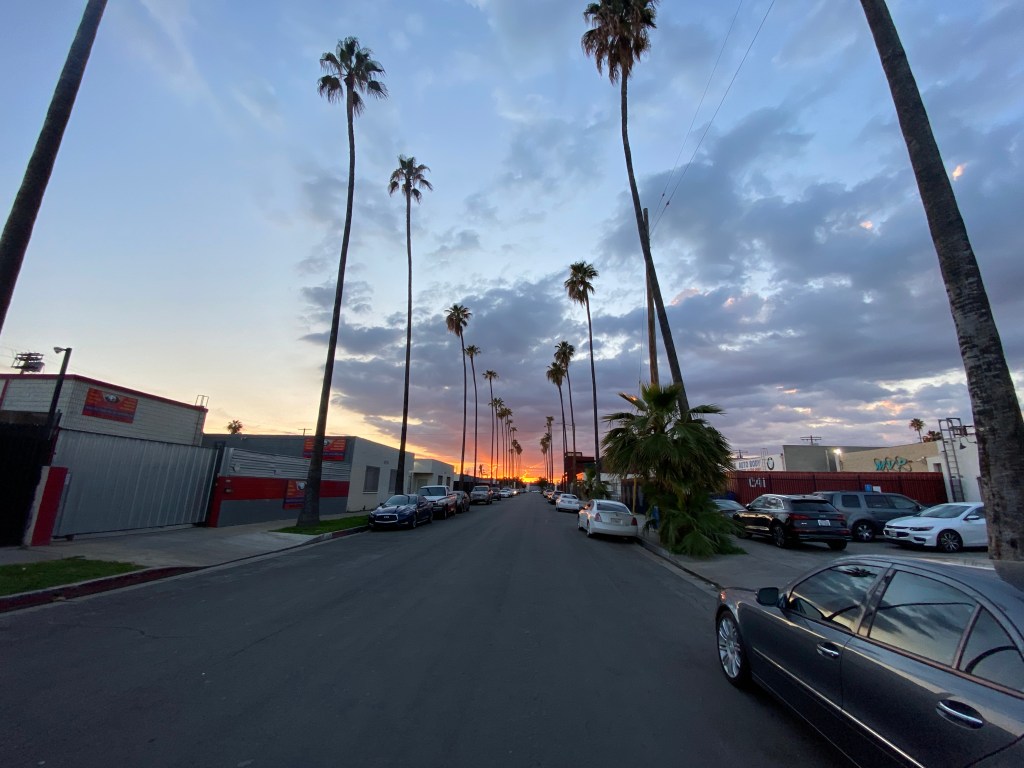
Why You Taking Picture?


A housing and planning blog I read, Granola Shotgun, recently had a post about how the author is hassled for taking photos in public for such elements as parking lots, buildings, encampments or anything structural connected to a human.

In the past 15 years, since I started this blog, I have had similar experiences of being confronted when diligently just recording any exterior anywhere because it captured my imagination.

As recently as March 2020, on the last night I went out to drink at MacLeod Ale, I left the brewery. I was with a friend, who also had a camera. The sun was setting. The light was golden and glorious. I had my Fuji XE3. While walking on Calvert towards Cedros, I started photographing many things that the light was hitting, including the exterior of an auto body shop. 

Several tough, menacing looking men were conversing across from the shop. One yelled at me, “Hey! Why you taking picture?” he said.

I had a few beers so I answered, “Because I want to. I’m not on private property and the sun looks beautiful on that building.”

“What building? What sun? What you talking about?” he answered.

We walked over to Bessemer St. through the trash of a block long homeless encampment, (which I wouldn’t dare shoot) which once would have been illegal and immoral, but is now normal. People living, shitting, drinking, sleeping on the street. By the tens of thousands. OK in Garbageciti.

On Bessemer, as we got into the car, a tinted window Mercedes SUV drove by slowly, eyeing us, letting us know we were under his surveillance. Nothing happened, but we drove away chilled at the implicit threat. 

I write and photograph about the urban condition of my neighborhood. I do it with the intent of telling the truth, not to promote my product or sell a political dogma. A billboard on Kester at the golden hour is just a billboard.

In 2006, I was photographing the exterior of the historic Valley Municipal Building on a Monday morning. An older woman came out, not a security guard, just an older woman, and she screamed, “What are you doing! Why are you shooting this building!” She had a car, and she drove up to me as I walked along Sylvan St. asking again what I was doing. 

 “There are people who want to harm this country!” she said through her window.

Like her. Opponents of constitutionally protected free speech.

Photography is politicized now, like everything else. A public photo in Los Angeles is assumed to be:

  1. ICE finding undocumented people.
  2. TMZ trailing a celebrity.
  3. Location scouting for a porn.
  4. A developer intent on building something.
  5. A Karen uncovering a violation.

Will a photograph ever just be a photograph again? Could Robert Doisneau or Henri-Cartier Bresson shoot children on the street today? Or would they be confronted by parents or teachers or strangers asking what the hell they were doing?

How did it come to be that a joyful, celebratory, observant act, public photography, become so reviled and feared? We live in a time when every person has a camera on their phone, so anyone can really take a photo anywhere at any time, yet the deliberate, artistic, considered flaneur, strolling through the city after a few glasses of wine, can be confronted if he carries a traditional camera and aims it at strangers.

Then there is the aspect of shame. We have no public shame anymore. People dress, eat and behave in ways that would largely be considered shameful by 1945 or 1970 standards.  So shame is employed as a tool by the weak, sometimes used against others who are weak, but often to gather like minded bullies together to defeat free-thinkers.

These examples of 21st C. public dress and obscene signs would have probably been against law or custom 60 years ago. Just as today it would be unthinkable for grown man with a camera going up to a children crossing the street and photographing them, as Henri Cartier Bresson did in Paris 80 years ago.

The public no longer knows what is properly public and what is not.

When private people prohibit public photography, they often think they are exercising the rule of law. Security guards fall into this category. Yet they stand on weak ground. No building, other than a military installation, has the right to not be photographed.

And we live in time of political intention. Every act is political. One can identify with a political party by wearing or not wearing a virus guarding mask, or drinking soda with a plastic straw, living in a gated McMansion, expressing sympathy for the police, or wearing a red baseball cap. All can get you harmed or doxxed.

At the 2017 Woman’s Rights March, I went out with several older neighbors and of course I had my camera. It was a historic moment. And I photographed a crowd near Universal City. Which provoked a young guy, masked in bandana, to walk up and demand to know why I was photographing.

There is nothing illegal about photographing people in publicOr buildings. Even outside a schoolyard, even families picnicking in the park, even photographing a parking lot in a poor area of Van Nuys. These are all legal and protected by law.

But no law protects against widespread public fear of freedom of speech. When enough mobs band together to ban something you can be sure it will be. Photography by photographer is on the list of once free rights that face censoring, cancelling and expulsion. 

The Local Sweeties and Public Safety.


IMG_9555

Courtesy of a community minded neighbor, we folks gathered tonight in a computer lab inside Casa Loma College on Kester to hear Senior Lead Officer Erica Kirk, Gang Officer DeLeon and a man from the Los Angeles Department of Building Safety speak about property crimes, prostitution and gangs.

The people were mostly older, largely white, and on friendly terms with one another. Before the speakers began, two chatted up about church, “I don’t hear the bells ringing any more!” and on grandchildren, “My granddaughter still works in Woodland Hills for a sod broker!”

Around the building, within spitting distance, ghetto apartments were sprayed with gang signs, prostitutes walked freely, speeding cars plowed through red lights, and old refrigerators and couches were dumped alongside the road.

But inside the room, reassuring voices of authority, festooned with badge and pistol, spoke of laws and arrests, patrols and progress against criminal activity.

Abandoned houses, trashy front yards, barking dogs at 3am, explosions, gunfire, helicopters, stolen cars, discarded marijuana containers, dumping, ubiquitous sex trade, stinky winds that blow sewage smells into the bedroom, none of these facts of life in Van Nuys would soon disappear, but some attendees were damn angry and determined to speak up and put a stop to the madness.

“Why don’t you arrest these prostitutes and ship them up to Nevada where it’s legal!” one man yelled. “They’ve been at it for forty years on Sepulveda.” And I pictured a sad whore, walking in the sun since 1975, wrinkled, abused and hated by local homeowners.

Another new arrival to Orion came with his pretty wife and spoke about his accounting of the used condoms found on streets around his beautiful estate.

“Since August 1st I’ve counted 33 condoms on Blucher, 44 on Langdon, 53 on Peach Avenue and 27 on Blucher!” he announced. My mind, always visual, imagined a sticky, gooey condom near a peach. For his wife, inviting the grandchildren into the front yard while a sex act was going on in front of the roses and white picket fence was quite appalling.


Some gentle people seemed innocent as to the fact that they lived amongst violence and anarchy. “The Mexican Mafia? What’s that?” a woman asked.

Another older woman spoke of her son coming home at 3am and passing three young men tagging a stop sign near Valley Presbyterian Hospital. “He stopped his car and rolled down his window and asked them why they were doing that,” she said. Officer DeLeon advised that it was, perhaps suggestible, not to confront three taggers at 3am in Van Nuys.

If Donna Reed and her family were transported to tonight’s meeting they would fit right in. That old time Angeleno, who came of age after WWII, whose life was formed in a sea of childish televised wonderment , made an appearance tonight, as delightful and improbable as Walt Disney meeting the Devil.

The local sweeties who came for this meeting were the nice ones who make up the silent and invisible and powerless backbone of Van Nuys. They cannot compare, in numbers or influence, these citizens, to the 180,000 who are in Van Nuys illegally, and whose presence regularly is spoken of in terms reverential and pandering, as when immigration reform comes up, as if we as a nation are commanded to do something to break the system further and destroy national sovereignty in the name of political correctness.

These people who gathered here tonight are regularly told there is not enough money for law and order, but when I spoke up and asked the crowd if they would pay fifty cents a gallon tax on gasoline to double the size of the (13,000) LAPD and bolster it, nobody raised their hand. “Why don’t you tax cigarettes?” a female cancer patient asked.

There will no doubt be more community meetings in the future, but the prospect for improvement in Van Nuys is dim. Without leadership, even the best intentioned community group, even the best cops on the beat, cannot hope to overcome the nonsensical and insane carnival of crime that dances all around us day and night. IMG_9557 IMG_9552