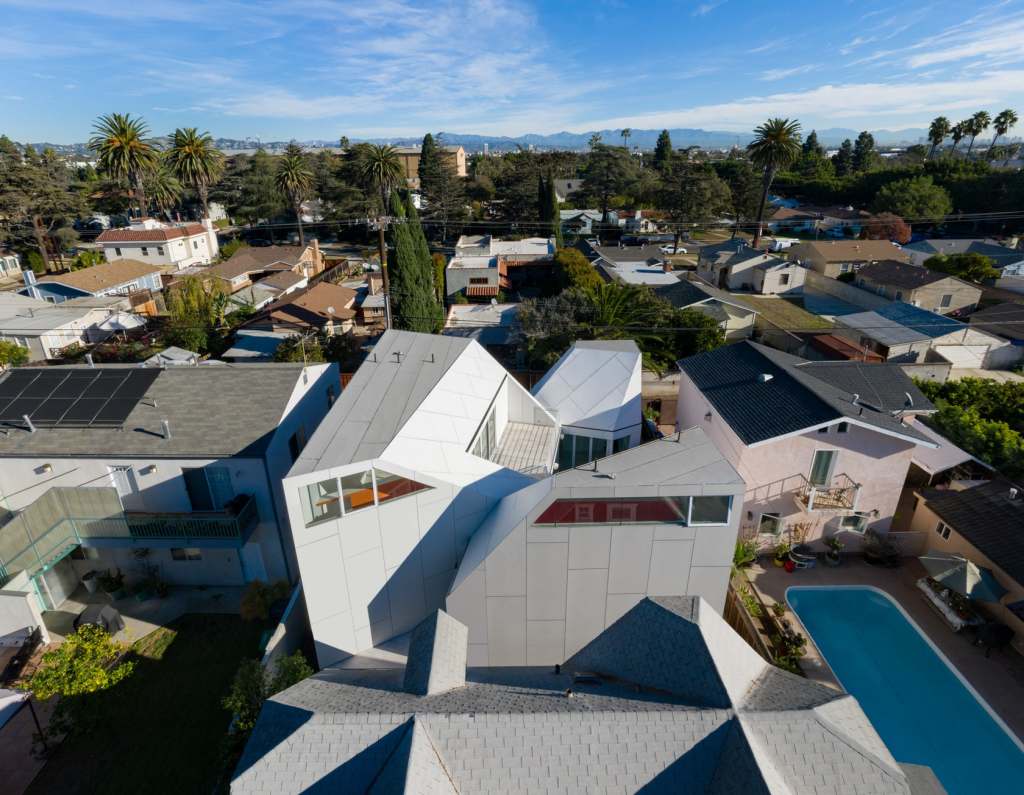
Glamorous Granny Flat.


All photos: Eric Staudenmaier

The Accessory Dwelling Unit (ADU) is a second house built in the backyard of a first house to provide additional income for a “single family” homeowner.

Los Angeles has now legally liberalized the lawto allow these types of dwellings to go up all over the city. The moral reasoning: this will increase the supply of housing in a city where rents, not to mention costs, are skyrocketingly expensive. 

The so-called maximum square footage of the ADU is 1,200 SF but the one on this page is 1,600 SF.

One can imagine less beautiful and less artful types of ADU’s going up all over this city. 

The $99,000 vinyl and stucco ones that will go up in Van Nuys will be built without architects. Hector and his crew will dig, hammer and nail and the Home Depot and Ikea will supply. Four recent college grads from film, acting, and comedy schools will move in and split the $4600 a month rent with parental assistance.  

So the tenants will not be someone’s granny.

What will likely occur is a kind of typical Los Angeles situation. Property owners will build in the backyard and in a slapdash way shove driveways in front, destroying trees and lawns to create more parking. Security gates and cinderblock fences and concrete will serve as front yard landscaping.

More renters will mean more cars, so almost every street that once was clean of vehicles, will have bumper-to-bumper cars belonging to renters who live in the backyard house. Curbs will be full of McDonalds wrappers and discarded beer bottles.

That’s the Van Nuys way.

I don’t, ironically, object to ADU’s. If every ADU looked like the one on this page, it would be wonderful for architecture in Los Angeles to see a proliferation of fine design.

But the bottom of the barrel ugliness that is the norm, not to mention the cost of construction, ensures that the homely, crowded, poorly thought out ADU will prevail. 

And the ADU on this page will never become the home of a working family. It is, most likely, a guest house for an affluent owner, or perhaps an $8,000 a month rental. So increasing the ADU supply will hardly affect the supply of normal, affordable rentals in Los Angeles.

Credits: Architizer

FIRM

FreelandBuck

TYPE

Residential › Private House 

STATUS

Built

YEAR

2019

PHOTOS

Eric Staudenmaier

One Story Town


One Story Town is Sepulveda Bl., from Oxnard St. north to Victory Bl.

It is 2,569 feet long, almost a half a mile. It encompasses the Orange Line Metro Busway, LA Fitness, Costco, Wendy’s, Chef’s Table, The Barn, CVS, Dunn Edwards, Bellagio Car Wash, Wells Fargo Bank, Enterprise, Jiffy Lube and other small businesses selling used cars, folding doors, RV rentals, Chinese food, hair cutting, and ceramic tile.

The Southern Pacific freight trains once ran through the present day Orange Line, and they fashioned the district into a lumber- oriented, light industrial area. Such behemoths as Builder’s Emporium were located here, and the stretch of Oxnard that borders the old rail line has retained an industrial use.


The zoning designations for almost all the parcels along Sepulveda are commercial. They prohibit residential within walking distance of the Orange Line, and they prohibit it even though buses run up and down Sepulveda!

A beautifully maintained bus stop perfectly sited for long waits in 110 degree heat.

Available online for public research, is the Los Angeles’ ZIMAS, a website run by the Department of City Planning. Here one can select a parcel, for example, 6206 Sepulveda Blvd., where The Barn furniture store is located, and see that it occupies two parcels totaling 44,250 SF. It is not, according to ZIMAS, in a transit-oriented area, nor is it designated as a pedestrian oriented one, nor is it part of a community redevelopment one.

Someday the owners of The Barn, which has sold, since 1945, brown stained furniture in heavy wood to seemingly nobody, may choose to sell their business. And here there is enormous potential to develop a first-class residential and commercial building just steps from the Orange Line.

Residents of Halbrent St. just east of The Barn and other businesses, are on the ass-end of parking lots, illegally parked homeless RVs, and are subject to the use of their street as a speedway for cars entering and exiting Costco. Maybe, just for once, Halbrent St. might see a better development on its west side.

Every single one of the businesses, up and down Sepulveda, between Oxnard and Victory, is located, by observation, in a transit- oriented area. Yet ZIMAS states they are not.

Perhaps that will change as Los Angeles reviews its zoning, and permits taller, denser, more walkable development within a 5-minute walk from public transit.

At dusk, with the early October sun hitting the one-story buildings, there is a homely, lowbrow, neat banality to the structures along this stretch.

This is not the worst of Van Nuys. It is generally tidy. But nobody living nearby, some residing in million-dollar homes, would come here to mingle, to socialize, to sit and drink coffee, eat cake, shop or walk with their kids after dark.

Studio City has Tujunga Village.

Tujunga Village, Studio City, CA. Photo by John Sequiera.

And we, in Van Nuys, have, this:

The One Story Town: what is it and what could it be? Might this district, one day, contain vibrant restaurants, outdoor cafes, beer gardens, garden apartments, parks, trees, flowers, fountains? Why not?

In planning for 2027, 2037, 2047 and beyond why would we keep the preferences of car-oriented, suburban dreaming, 1975 Van Nuys, in place? Why are thousands of parking spaces at the Orange Line Busway used to store cars for Keyes Van Nuys? Is this the best we can do?

Could not a group of architects, developers, urban planners, government leaders and vocal citizens devise a Sepulveda Plan to transform this wasted opportunity into something better, or even ennobling?

Where is our vision? And why are we so starved for it when we live inside Los Angeles, the greatest factory of imagination, illusion and improvisation the world has ever seen?


Alleys and Architecture.


Day 4-Near Hotel Celestine  48 Day 2-Shinjuku-ku 40 Arrival at Hotel Celestine 13

(Photos: Andrew B. Hurvitz)

Last year, on a visit to Japan, I discovered alleys that were vibrant, clean and functional.

In a country where 127m live on land mass that is smaller than California, space is put to good use.

Little houses, imaginatively designed, are integrated into narrow streets and alleys. (Photos: Dezeen)Cave-by-Eto-Kenta-Atelier-Architects_dezeen_1sq dezeen_Small-House-by-Unemori-Architects_0sq House-by-Tsubasa-Iwahashi-Architects_dezeen_1sq House-in-Fukasawa-by-LEVEL-Architects_dezeen_3sqa KKZ-House-by-International-Royal-Architecture_dezeen_ss_50 Monoclinic-House-by-Kazuko-SakamotoAtelier-Tekuto_dezeen_sq Switch-restaurant-and-residence-by-Apollo-Architects_dezeen_3sqa

Whether an entrance is in front or back makes no difference to a Japanese house.

What counts is the integrity and artistry of the architecture.

LA, and the entire state of California, has an extreme shortage of affordable and civilized housing.

Why not emulate Japan and make use of our alleys, the back of our buildings, and enormous asphalt parking lots to create civilized spaces for residential development?


Sherman Oaks alleys below.

Photo credit: Andrew B. Hurvitz

DSCF0096

DSCF0106 DSCF0105 DSCF0104

Sunday Afternoon on Kittridge St.


It was late Sunday afternoon in December, here in Van Nuys.

The air was brisk, the sun was low, a pork butt simmered in the slow cooker.

This is the time of the year when you can see the mountains beyond the orange trees.

Days are brief and what gets done gets done quickly. The Christmas season is sewn in living threads joyous and melancholy, lonely and familial; aching, sad, reverent and intoxicating.

Football, films, electronics envy; shopping, eating, packing presents; drinking orange beer under red lights where the smell of pine, vanilla and chocolate is pervasive, these are some of the elements placed here annually.

DSC_3617

DSC_3615

I walked yesterday, in waning light, along Kittridge, a neat and well-kept street of homes between Columbus and Van Nuys Boulevard.

West of Kester, Kittridge is a ranch house neighborhood entirely built up after World War Two. Within living memory of some, this area was once entirely agricultural. What lay west of Van Nuys High School was the vast beyond of walnut and orange trees, ranch lands and open spaces. Within 15 frantic years it was developed or destroyed, depending on your viewpoint. And by 1960, it was the Valley we know today, structurally, not demographically, of course.

The homes here are solid, the lawns (mostly) cut. The flat streets and sidewalks recall a Chicago suburb, a place where American flags are flown, and bad news and bad behavior is kept quietly behind drawn drapes.

Van Nuys, CA 91405

Two friendly eccentrics were outside yesterday: a man who looked like Fidel Castro with an engraved “RICK” metal belt buckle, and his beer mug holding friend. They stood on the corner of Kittridge and Lemona as workmen re-sodded Rick’s lawn.

I spoke to them briefly, repeating my infernal line. “I write a blog about Van Nuys called Here in Van Nuys.”

“Here in what?” asked the beer mugger.

Here in Van Nuys,” I said.

“You work for the government?” he asked.

“No. Let me take your photo,” I said.

“No. You got a card?” he asked.

I handed him my printed business card.

“So you write what?” he asked.

“A blog, called Here in Van Nuys,” I said.

The older man with the Fidel Castro beard knew exactly what a blog was. He also complimented my camera and my quilted jacket.

I moved on after that, and crossed to the east side of Kittridge.

DSC_3627

DSC_3629

DSC_3630

DSC_3632

DSC_3634

On the east side of Kittridge, north of Van Nuys High School, the street is grounded in civic and religious solidity by the presence of St. Elisabeth’s Catholic Church and the enormous VNHS.

Rod Serling might have come here to film an episode of The Twilight Zone, so awash in normalcy and Americanism that one could be dropped here and think that nothing had changed in Van Nuys since the Eisenhower administration.

Notably eccentric and interesting collections of houses line the street, ranging from neat bungalows to sprawling pre-war ranches. They are placed on long, narrow lots, going back far, into deep yards, but they seem to have been immunized from the decline into squalor infecting some older streets in Van Nuys.

I stopped and stood in the parking of St. Elisabeth’s across from a tall white spire bathing in the remaining daylight. People were gathered, under umbrellas, for an event involving food and prayer.

And the second part story of my Sunday walk will continue in another essay….

DSC_3638

DSC_3648

San Diego Way


San Diego Way, originally uploaded by Here in Van Nuys.

In Carthay Circle, not far from Fairfax and Wilshire, I stumbled upon a neighborhood of old homes, gracious and traditional, smack up against glass skyscrapers.

Calm, clean, prosperous, and quiet, it represents one of those anomalies of life in Los Angeles, which people either find exhilarating or deadening, the idea that you can have a suburban house in the center of the city.

In a few years, a subway stop will exist only a block north of here, making this area even more convenient, and blessedly less car-dependant.