Navigating Public Space in Marina Del Rey.


In the 1960s, the swamps of south Venice became a multi-million dollar building project that culminated in what we now call Marina Del Rey.

Pleasure boats, yacht clubs, nautical facilities, circular high rises with balconies overlooking the harbor, landscaped roadways with palm trees, office buildings, pharmacies, tennis courts, a hospital, a fire station, a library; and many restaurants overlooking the yachts, sailboats and motor boats.

A district devoted to tanning, drinking, carousing, love making, and living the good life amongst airline pilots, stewardesses, restaurant workers, aspiring actors, and retirees. The 1960s dream of accessible pleasure for anyone white with a convertible.

They even built the 90 Freeway to get people in fast, before the boat left the dock. Imagine the high quality of life 60 years ago, when a new freeway was affordable and considered the highest and best use of land.

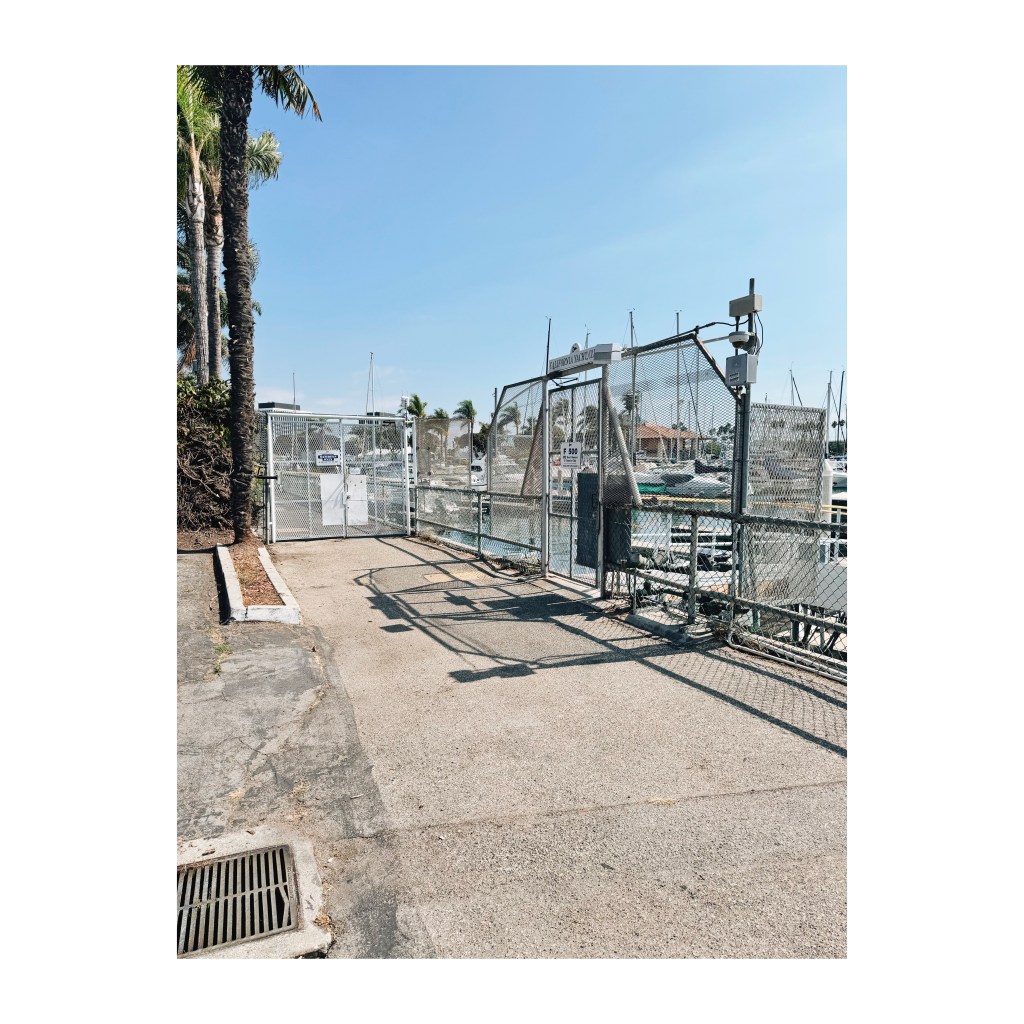
From its inception, Marina Del Rey feigned a public purpose while raking in the dollars fencing off the best parts for private use of yacht clubs and apartment dwellers. Docks are locked up and there are many barriers to prevent the use of the harbor for the general public unless you are there to purchase a dinner and drinks on a boat, bar or restaurant.

Over the years, there have been community projects to create usable public space, such as Yvonne B. Burke Park on the north side of Admiralty Way which has athletic equipment, bike roads and jogging paths. That park too has recently been incarcerated when Bay View Management built a cinder block wall that closed a public access point behind a Ralph’s store on Lincoln Boulevard. 

God forbid a pedestrian in a park might access a supermarket on foot.

Other luxury apartments, understandably fearful of crime, vagrancy and violence, have illegally built obstructions along their land to prevent the park from becoming a way to enter their properties.

Every few hundred feet, the green parks become parking lots. An athlete running, riding a bike or rolling skating will eventually stop at a busy road where vehicles speed by at 60 miles an hour. And other cars and trucks will be entering the parking lots or exiting, creating additional hazards for the non-driver.

The big, popular restaurants, anchored in seas of asphalt, offering seafood, steak, alcohol, valet parking, and private parties to corporate diners and red nosed, melanomatous men in Tommy Bahama, have all gone out of business. Café Del Rey and Tony Ps with their crumbling, dated, Brady Bunch style restaurants are empty. The cigarettes, cigars, Aramis and lounge singers gone with the wind.

The great pandemic meltdown which has stolen our lives, taken our movie theaters, pillaged our department stores, and defecated upon our civic dignity, has now obliterated the big dining establishments of Marina Del Rey.

These popular places, that seemed immune to time, forever serving enormous plates of grilled lobster, prime rib, baked potatoes, cheesecake, ice cream sundaes and voluminous cocktails are now dead. Silent as Hiroshima after the bomb, these outposts of high on the hog, intoxicated living were ailing, out of fashion, and are now exiled from our spartan, self-consciously healthy era.


For a pedestrian who is trying to stroll one mile of the harbor west from Bali Way to Palawan Way, with the boats in view along the south walkway, there are several private obstructions that make it impossible to complete the walk.

I speak from experience as my friend Danny and I did the walk today.

The California Yacht Club locks up the walkway with their own use of the property. 

One is forced to detour to Admiralty Way with the unused parking lots of the long-gone restaurants on one side, and the near-death experience of speeding cars on the other.

To reenter the harbor walkway, you find the Los Angeles County Fire Department Station #110 (4433 Admiralty Way) and walk behind the building to rejoin the path along the water to once again enjoy the public recreational qualities that are supposedly there for everyone to enjoy, not just yacht members.

The Marina City Club encompasses three early 1970s high rises which are entered securely by several guarded driveways on Admiralty Way. This complex has swimming pools, tennis courts, a convenience store, but is threatened by similar structural defects that brought down the Surfside, Florida condominium in 2021, killing 98 persons.

For now, residents who own property there pay high HOA fees, and even those who bought in cheaply face repairs that will surely cost collectively in the hundreds of millions of dollars to make these three, 55-year-old buildings safer in a location where tsunamis and earthquakes are always visiting unexpectedly.  

Concluding the walk today, we went north along a dirt path on the west side of the Oxford Basin “Wildlife Refuge” which connected to Washington Boulevard.

As we passed a vagrant man sprawled on wall, shopping cart and garbage nearby, my friend Danny shouted, “Get going, walk faster.”

Danny had spotted a handgun in the vagrant’s hand.  

Just another reminder, if any is needed, that nobody should assume that this is a safe area, regardless of how much homes sell for. The demoralizing and unsanitary aspects of Los Angeles are all around, because we live in perhaps the dirtiest metropolis in the United States, one that believes public trash camping is a civil right and mental illness is only a danger after it kills.

How this city will present during the 2028 Olympics is something Orwell would have pondered.

Some Old Van Nuys Restaurant Menus


Philip Ahn’s Moongate Restaurant, located at 8632 Van Nuys B(Credit: LAPL)

50 or more years ago people (of means) ate out perhaps once a week.

In Van Nuys, up until the late 1960s, the dining scene reflected the overwhelmingly white make-up of the region. The vast immigration from Central and South America, Africa and Asia that has made present day Los Angeles so varied and so heterogeneous and brought us Malaysian, Taiwanese, Laotian, Mongolian, Thai, Filipino, Vietnamese, Guatemalan, Russian, Indian, Burmese, Persian, and Ethiopian did not exist half a century ago.

Valerio St. School Van Nuys, CA June 1956 (Tom Cluster)

What was on the menus back then offered a variety of “German”, “Italian” and “Chinese” cuisines that had as much authenticity as a studio back lot.

Which is not to deride the food. It was offered to customers graciously, copiously and somewhat formally, as people would not dare enter a restaurant without being dressed up, with men in suits and ties, and women in dresses, skirts and high-heels.


(Credit: LAPL)

At Hoppe’s Old Heidelberg, 13726 Oxnard, men and women who fought in WWII, 15 years earlier, would dine guiltlessly on Schnitzel A La Holstein for $2.75 and enjoy an imported German beer for sixty cents.

Entrees came (free of charge) with soup, salad, potato and vegetable, fresh bread and butter and a dessert. Light eaters might order fruit cocktail for 20 cents and a glass of tomato juice for 15 cents.

(Credit:Museum of the SFV)

Otto’s Pink Pig at 4954 Van Nuys Bl. offered many fine seafood dishes, some of which are seemingly extinct in Los Angeles dining, such as frog legs, mountain trout, abalone steak, filet of sole, and Crab Mornay. All the aforementioned were also offered under $5.

Otto’s had a huge beef menu offering 19 choices. There was a 16 Oz. Culotte Steak, Sirloin Steak, NY Stripper Steak, Porter House Steak, Filet Mignon, Ribeye, Steak Au Poivre, Steak Alla Pizzaiola, Grenadine of Beef Bordelaise, Beef Steak Surprise, Dinner Steak, Steak and Green Peppers, Tournedos of Beef Au Sherry, Tournedos of Beef Morderne, Beef in Brochette, Steak and Eggs “King Size”, Steak and Eggs “Princess Size”, Steak Sandwich, Megowan Steak Sandwich De Luxe. And there were three roasts as well!

(Credit: LAPL)


(Credit: LAPL)

(Credit: LAPL)

At 6801 Van Nuys Blvd. at Van Nuys and Vanowen (think of that lovely location today) stood Nemiroff’s with its blue menu and regal crest.

It seems to have been a Jewish style deli much like Jerry’s, without kosher offerings, but selling such sandwiches as Lox and Cream Cheese on Bagel for $1.25 and Chopped Chicken Liver on Rye for 90 cents.

Every day of the week offered a special, such as Monday’s Beef Tenderloin Tips with Egg Noodles and Garden Fresh Vegetables, described as an “exquisite meal” for $1.95 or Friday’s Filet of San Francisco Bay Red Snapper for observant Catholics. Indeed, Nemiroff’s seems to have delved into many styles with its German Sauerbraten ($1.95) and Irish Corned Beef and Cabbage with boiled potatoes and fresh carrots, horseradish sauce cooked in “Nemiroff’s Kettles for natural flavors” and it also cost $1.95.

There were many more restaurants, too numerous to mention, but places, spoken of today, regarded fondly, chiefly because where you ate when you were young is sacred, and every drop of cottage cheese and chocolate pudding, canned peaches and fish sticks, transports you back to a time when the world possessed freshness, vigor, and possibility.

And all the dreams you had were still in the future, waiting to be fulfilled, and a dream job, a dream car, a dream girl, a dream boy, a dream house, existed not only in the imagination, but for many, across this region, in reality.

May 1956/ View south down Columbus towards Vanowen/Bassett (Tom Cluster)

Sepulveda Drive-In Theatre, Van Nuys, CA circa 1954


Van Nuys Boulevard: Between Sherman Way and Saticoy (Part 1)


DSCF1046

Bustling, aesthetically hideous, vibrant, multi-ethnic, colorful, trashy, tacky, inhuman; filled with families, vagrants, small businesses and the newest Americans.

Van Nuys Boulevard, between Sherman Way and Saticoy, that is where the action is.

Reformers and planners might dream of trees and benches near the Valley Municipal Building, in the old downtown, but Van Nuys has moved up north, where the bus riders catch the #162 and #163, stopping to grab lunch at Boston Market, buying a cake at Mey Fung Bakery, picking up smokes at Angie’s Cigars, getting their hair cut at John’s Barber Shop, and snacking on Ceviche Peruano at Ay Papa Que Rico, a Cuban restaurant rated highly on Yelp.

7429 VNB

DSCF1026

Like a vision from old Tijuana, a row of brightly painted shops near 7433 Van Nuys Blvd, houses El Progresso Supermarket and Guateex “Rapido y Seguro” a place to send packages and shipments to Central America; a barber, a tattoo shop and “Tropical Fish and Pets”. Each business is enclosed in a cube, vividly colored, advertising signs.

7301 Van Nuys Blvd, Van Nuys, CA 91405

Salvadorean food is served at La Carreta (“The Cart”) a one-story, stand alone restaurant with tables and parking at 7301 Van Nuys Boulevard. Mediocre reviews alternate with better ones on Yelp:

“This is a small Salvadorian restaurant in the middle of Van Nuys (yeah, yuk, Van Nuys I know) I work out here and it’s hard to find good places to eat. Here, I love the pupusas. I get them filled con frijoles, con loroco y con loroco y frijoles.”

Ay Papa Que Rico Ay Papa Que Rico

And smoke pours onto the street from burning mesquite at Ay Papa Que Rico, 7344 Van Nuys Blvd, Van Nuys, CA 91405 where Yelp reviewers are ecstatic:

“I was getting my car serviced & I smelled the most delicious mesquite scent coming from this place on the corner. I walked in got a half chicken, & Wow!!!!!! It has to be some of the best tasting grilled chicken I have ever had.”

 “The grilled chicken is a definitely must order! It’s Tender, juicy & well seasoned. Cooked to perfection. Also try the Cuban sandwich, it hits all the right notes.”


DSCF1087

English Westz

As night falls, the long day of men and women who work in dirt and heat, under cars, in kitchens, cutting hair, stacking boxes, looking after children,  go back to their apartments, (like “English West”), collapsing on the couch, taking a long shower, resting in a bedroom where the air-conditioning blows cold.

Part 1 of a 2 part article


Plowing Asphalt into Green Spaces.


This slideshow requires JavaScript.

click bottom center of photo to STOP.

Two big parcels of land on Van Nuys Blvd., encompassing at least three acres, have come into being now, due to the demolition of the Keyes Mercedes building at Chandler and the emptying of Rydell Chevrolet on the NW corner of Burbank.

To see these lots cleared is to appreciate the enormity of space they once occupied, and offers urban dreamers the chance to imagine how these land areas could be utilized for greener businesses.

According to my friend Dick Carter, a restaurant real estate broker, parking is always a problem. The Keyes and Rydell lots offer possibilities for integrating parking, dining and agriculture.

An organic diner or restaurant could grow herbs, citrus, vegetables, and sustainable plants on these lands, products grown locally and freshly right here in Van Nuys. People would sit outside, in gardens, under trees, and dine on foods grown on Van Nuys Blvd!

Government tax breaks, modifications in zoning, and enlightened planners could transform our environment, our neighborhood and our health.

And Steve Weiss at Capital (818-905-2400) is leasing the Rydell space.