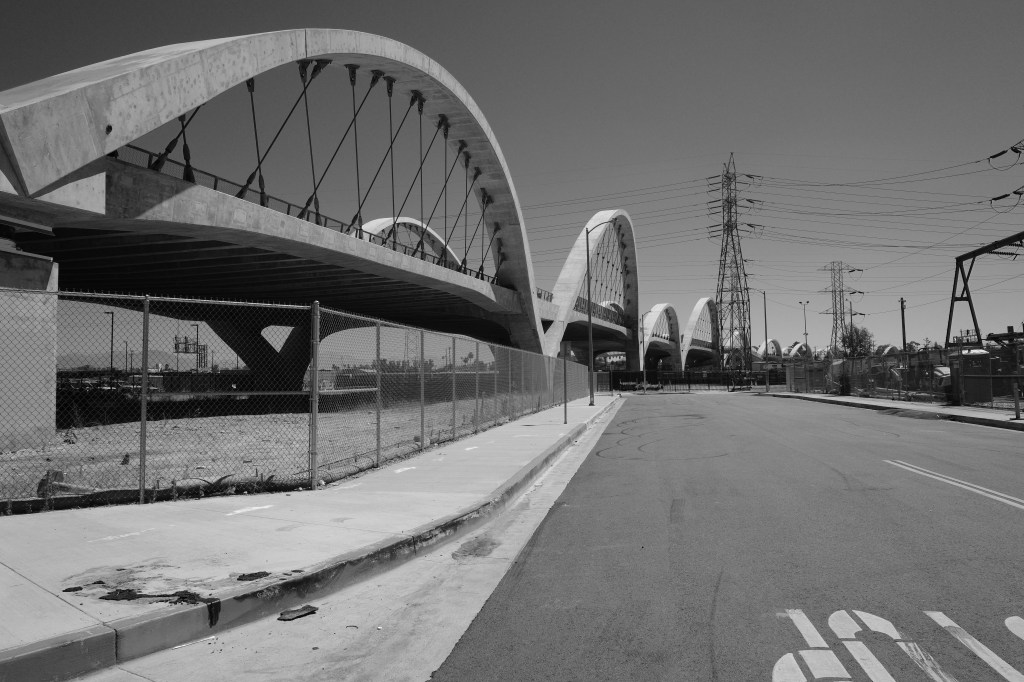
Walking Along the 6th Street Bridge.


I finally made it down to the 6th Street Bridge.

It’s an impressive structure that leaps and struts and flies over rail tracks and factories, electric yards and the river. It is startlingly plain, almost crude in its sculpted mass and bending arches. There are raw bolts attaching the cables to the concrete. Steel fences stretch along the pedestrian walkway. Dark shadows and blinding sun mark the bridge from beginning to end.

Unyielding in substance, rigid, unforgiving, brutal; it is a stage for fast cars, reckless driving and unintentional suicide. But also a balletic performance of geometric shapes and unexpected revelations along the way.

Mute yet expressive, untested in the long term, it is a baby of this metropolis. And born to a city that abandoned it to a wasteland which one day may be remade with trees, parks and apartments; or left behind to become yet another great, unfulfilled California promise.

Walking here last Saturday, August 26th, I thought of the late Mike Davis (City of Quartz) who wrote brutally and trenchantly about Los Angeles.

I don’t have his exact words, but in that book he described an architecture of barbed wire, steel gates, security cameras, the way this city is set up like a penitentiary with hostile inmates surrounded by deterrents, police and threatening lethality.

The 6th Street Bridge, ironically, has earned a reputation for criminal mayhem: daredevil driving and people who climb upon the arches to show off. I saw no rowdiness, in fact the road was remarkably empty and we only passed a few pedestrians. But in all directions artificial and man made structures are the entirety. Absolutely nothing is natural. The lone exception I saw was a cellphone tower who identified as a palm tree.

Unsecured Networks.


Yesterday afternoon, for an hour or so, I was perched, up high on a wooden chair, in the back of my favorite coffee shop in Studio City. I was writing a short story and concentrating on a character who suffers a nervous breakdown.

Across from me, diagonally, and seated at a lower table, a middle-aged woman sat with her open checkbook, her mobile phone, and artfully addressed mailers with her mid-century name and current address calligraphically sharpied.

Her name and address were so large and so graphic that I could read it seven feet away: Terri Lynn Graumann, 12765 Moorpark #Apt. 2904. Studio City, CA 91604 [Name and address have been changed]

I went back to my writing but then the woman turned around, frazzled and disoriented, and asked, “Did you see anyone go into my purse?” She was referring to her black, poster-board sized, leather handbag that looked expensive and elegant.

“No I didn’t,” I answered. I half expected her to accuse me but she didn’t.

She turned to another couple, in conversation, to ask them the same question.

It soon became obvious that the woman was missing another electronic device that her mobile phone indicated was right there in front of her, or nearby.

She rifled nervously through her 36″ x 24″ x 1″ purse, and upended her papers and looked under the table and inside her black duffle coat pocket. She brought us all into her missing electronic device mystery, and we had to stop writing, or talking, or thinking, and listen to her plea to find her missing Ipad.

Then she ran out of the coffee shop, ostensibly into her vehicle, to locate the missing object. On her table, left behind, were blank checks, her name, her home address and her mobile phone.

She returned, relieved and carrying her missing device. She had found it in her car.

She sat down, opened it and started to work on her finances, which I could not see in detail, other than the large logo for Chase Bank.

I’m often jittery about getting robbed, and sometimes, like that woman, I’ll wonder if that wallet or phone or laptop I brought in to the coffee shop has gone missing. So I am not without empathy for her temporary debacle.

But again, it is ironic, in this day when shows like “Mr. Robot” dramatize how easily one’s information can be hacked electronically, especially, in public places; to see someone do almost everything wrong, and indeed, dangerously, to put her personal information and financial privacy out in the open.

Again, real people sacrifice reality to save a digital device.

In a larger sense, we lose “friends” who come to town and post photos on Instagram and Facebook and never bother to see us in person. If we “unfriend” them that is as grave an insult as not getting together in person. Or maybe it isn’t.

We work on our online persona, to gain followers, to get compliments from strangers, to make friends with people who have more fans, and then we fail to visit our family for Christmas.

Or we are thrown into a panic because one portable computer is missing and we think that it is the end of the world.

And an idiot on Twitter, the most powerful man in the world, cannot resist joking about global warming, the FBI, nuclear war and health care. His projections matter most to him and the rest of the world must be brought into his virtual drama.  That real icebergs are melting, that real people are sick and have no insurance, that real children die from guns, that real wars are started by selling weapons to evil countries, those facts are real. But a tweet, a conjuration of idiocy read by millions, it matters only because it is spoken online.

That’s the true story of modern life: to rescue the imaginary while imperiling the real.

And not knowing the difference.


Graffiti Deterring Cameras Installed Under Van Nuys Airport Tunnel.


LA Now reports that there are now tagger catching cameras under the Sherman Way tunnel which runs under Van Nuys Airport.
I reported on the vandalism in this blog a few years ago and wondered how the post 9/11 airport security could tolerate this blatant law-breaking on their property.
Now the authorities are finally doing something about it.
Here is the article:
3:30 PM | July 23, 2009

A dozen surveillance cameras have been installed inside a San Fernando Valley tunnel hard-hit by graffiti vandalism.

The 711-foot tunnel on Sherman Way next to the Van Nuys Airport has been riddled with graffiti for years, and residents were fed up, said Stacy Bellew, a spokeswoman for Los Angeles City Councilman Tony Cardenas, who represents the area.

“Our main message was, ‘Taggers beware. You are entering a no-tag zone,’ ” Bellew said. “If you decide to get out of your car and tag, we are going to catch you at every angle.”

The cameras and posted warning signs will serve as a deterrent to taggers and help police catch violators, Bellew said. Two more cameras will be installed within six weeks with the capability of capturing license plate numbers, she said.

The city spent $36,000 on graffiti removal in the tunnel last year, not including a general cleaning every six months, according to the city Department of Public Works. Business leaders, residents and Cardenas’ office raised $30,661 in public and private funds to install the surveillance system, Bellew said.

“This system will be a deterrent for taggers and will provide extra surveillance for pedestrians who walk through the tunnel every day,” said Steve Leffert, a member of the Lake Balboa Neighborhood Council, which contributed $6,000 to the project.

Bellew said she was impressed with how the community took the project “into their own hands,” and expressed hope that residents of other neighborhoods would work to have similar surveillance equipment installed in their areas.

“It’s not just about catching taggers,” she said. “It’s about public safety as well.”

—Gerrick D. Kennedy