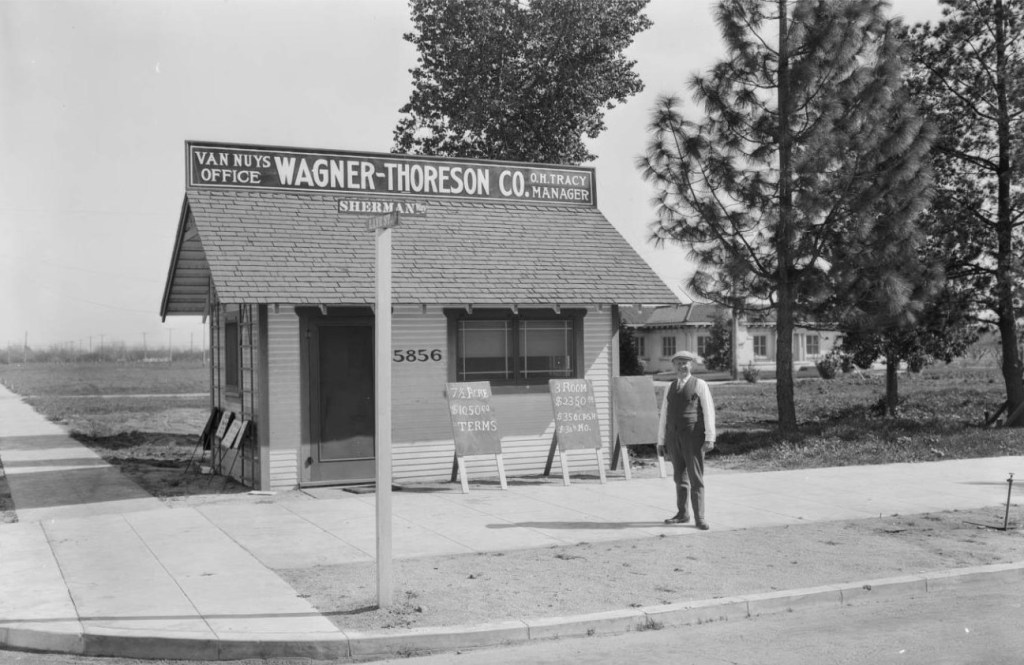
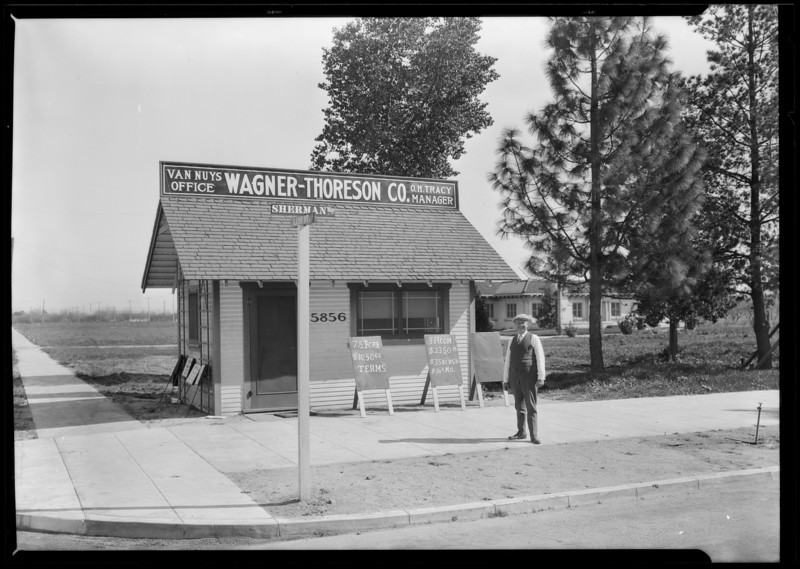
I found a DWP Collection photo from the 1920s that shows the Van Nuys office of “Wagner-Thoreson Co.” (a realty company) and a nattily attired man standing in front.
In the background is an estate on a large piece of land. A signpost reads: “Sherman Way” and “Lane St.” The photo had some information underneath which said “Lane St. was later renamed Califa St.”
Where exactly was this?
On Google Maps there is not a “5856 Sherman Way.” I thought the signpost might be blocking a number “1” so I inputted “15856 Sherman Way” but that address, in present day Valley Glen, was not at an intersection. Califa and Sherman Way do not intersect either.
Sherman Way was once the route of the Pacific Electric streetcar. The PE snaked its way up through the Cahuenga Pass into North Hollywood, then west down Chandler Blvd. It turned north up Van Nuys Blvd. and then travelled to go west on Sherman Way.
But Chandler Blvd. and Van Nuys Blvd. did not exist in name until 1926. From 1911 until 1926 Chandler, Van Nuys and Sherman Way were all named: South Sherman Way, North Sherman Way and Sherman Way!
On May 25, 1926, the Los Angeles City Council, with some infighting between San Fernando Valley residents, came to a compromise and agreed to partition the Sherman Way family into three distinct names: Chandler, VNB and Sherman Way.
So the man in the mystery photo is standing on present day Van Nuys Blvd. at Califa, a block south of Oxnard.
Van Nuys Bl. 1930
Pacific Electric service lasted until December 29, 1952.
Cahuenga Pass 12/29/52N. Hollywood, CA. 12/29/52Chandler Bl. 12/29/52
These sad and wondrous Kodachrome photos from the collection of Caesar “CJ” Milch (not the original photographer) show the #5146 car that once ran up through the Cahuenga Pass and into the eastern San Fernando Valley on its last day.
One day, soon, there will be a revitalization of Van Nuys Boulevard.
Gone forever will be the hopeless days when people laughed to mock it, or ran away in revulsion.
All the central gathering places that should be occupied by civilized things, all the lots that hold parking, all the empty buildings along Van Nuys Boulevard, will be replaced with vibrant, happy, upbeat, successful businesses and residents.
It will take nothing more than $5 billion dollars to invest in new transit, new apartments, new multi-family housing, new police officers, a new police station, an army of street cleaners, and law enforcement people who will ticket illegally parked cars, handicap placard abusers, unregulated street sellers, unlicensed signs, and unpermitted businesses.
The narrowing of Victory Boulevard, the planting of 200 oak trees from Kester to Van Nuys Boulevard, will bring about a revitalization of the formerly crappy strip of low rent mini-malls, slum apartments and empty stores. The LAPD Victory Precinct at the corner of Van Nuys Boulevard and Victory, and its drop-in center there will be open 24 hours a day, 7 days a week.
150 new LAPD officers, out of a police force of some 10,000 will be specifially assigned to the area.
Some 50 new apartment buildings, from Sherman Way to Oxnard, with 10,000 new apartments, will be built and 20% of them will rent for under market value.
Security cameras will enforce the law to prevent speeding, red light running, assault, vandalism, burglaries of properties and hold-ups on the street.
There will be decorative streetlights, three new parks, new benches, and thousands of shade trees planted along the boulevard to protect against temperatures that get hotter every year.
Bike lanes, light rail, automobiles and pedestrians will share a new Van Nuys Boulevard divided between all types of transport, from foot to motor to public.
And the architecture will be inventive, modern, and integrate environmentally such necessities as solar energy and district wide free wi-fi.
In a nod to the old Van Nuys, the first orange grove planted in the Valley in 90 years will be manned by formerly homeless men and women who will guard the orchards as they would their own children. There will be 10 houses planted around the grove to ensure the safety and security of the new urban agriculturalists.
The low industrial buildings in the neighborhood around Kester and Oxnard, all 33 acres, were preserved in 2018, and later became an incubator for creatives who settled in the area and built narrow houses near the Orange Line, and worked and lived next to artisans, musicians, brewers, car restorers and craftspeople of every skill.
All of this is possible.
The people who will decide whether this is fantasy or reality are reading this post.
I previously wrote about this topic in 2014, but bring it up again as Los Angeles, and the State of California, are now in a furious debate about housing, cars, homelessness and how best to build.
All B&W photographs below are by Ed Ruscha.
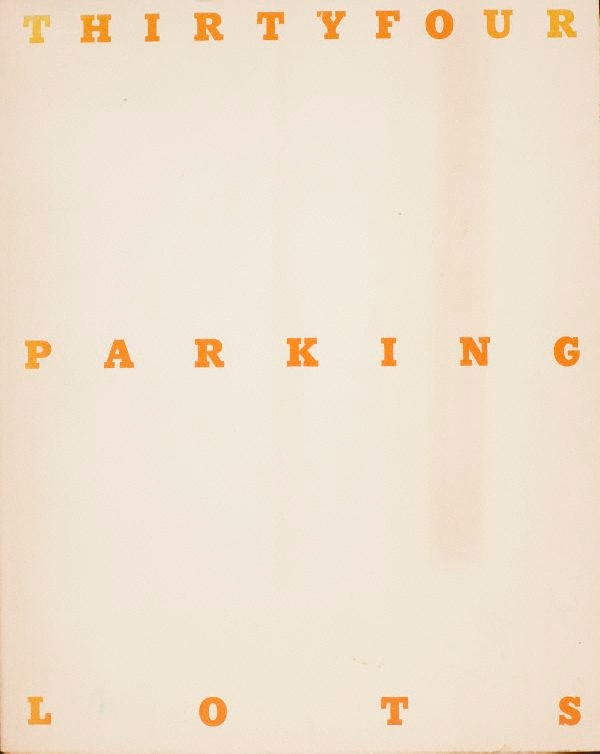
Ed Ruscha’s “Thirty-Four Parking Lots in Los Angeles” was published 51 years ago.
The artist, born in Nebraska in 1937, came to this city in 1956 to study at the Chouinard Art Institute. He also had an apprenticeship in typesetting.
Graduating in 1960, only 23 years old, he started working at an advertising agency doing graphic design. Influenced by the works of Jasper Johns, Robert Rauschenberg, Andy Warhol and Roy Lichtenstein, Ruscha was featured in a 1962 survey called “New Painting of Common Objects.”
That year he published “Twentysix gasoline stations” and later “Every Building on the Sunset Strip.” (1966)
He was the first, or perhaps the most notable artist, to create a deadpan, earnest, unesthetic photography of built Los Angeles. He looked, without pretense, at the sprawling, cheap, roadside city of billboards, car washes, instant apartments and filling stations and wrapped up his black and white photographs into little, smart, best-sellers.
Ruscha was talented and knew how to sell things, always a winning combination in the city of angles. (intentional)
The 1960s was a dirty flood of bitter reckoning that hit America and threw cold water on its made-up, powdered face.
Assassinations, sexual relations, racial issues, drugs, protests, music, environmental desecration, Vietnam: the entire decade blew up a contented self-image.
A nation, which thought itself a beacon of light onto the world, was forced to reconsider its own grotesque violence and misunderstand it.
Confronting Los Angeles, Ruscha presented a homely city with a picture book full of raw honesty.
State Board of Equalization 14601 Sherman Way, Van Nuys, CA.
May Co. 6150 Laurel Cyn NH
Inside “Thirty Four Parking Lots in Los Angeles” are some aerial shots of ordinary Van Nuys, North Hollywood and LA in 1967, with those enormous oceans of parking lots floating boat-like buildings.
Up in an airplane, looking down, Ruscha captured lines and boxes transposed upon the land, asphalt which looked, on its surface, much like the curtain-walled office buildings of that era.
Goodyear Tires 6630 Laurel Cyn NH
Good Year Tires at 6610 Laurel Canyon in North Hollywood occupies only a dot atop a long “I” shaped land-mass of parking.
Dodger Stadium
Dodger Stadium is buried deep within the hot skins of asphalt, a vaginal shaped structure where men played ball.
7101 Sepulveda, Van Nuys, CA.
And 7101 Sepulveda, a now abandoned office tower near Sherman Way, has trailers and motels on its perimeter, as well as plenty of free parking. Today, this area often hosts large encampments of homeless people, so the peripatetic ways of Van Nuys have historical precedent it seems.
Eileen Feather Salon 14425 Sherman Way, Van Nuys, CA.
14425 Sherman Way was called the “Eileen Feather Salon” and has but one long building fronting Sherman Way with parking in back.
Today, that corner is a cacophony of grossness and visual pollution including donuts and Denny’s. Signs are everywhere. And the weary eye becomes nostalgic for the simple joy of a lone building and its parking lot set down on arid land in the once less populated San Fernando Valley.
7128 Van Nuys Bl. 8/5/14
We are now engaged in a great civic debate about housing, and public transportation, and some voices hope (mine included) that denser buildings along bus and train lines will help alleviate high rents and homelessness.
Yet we never quite escape the trap set by the automobile: where to drive it, where to park it, how to best accommodate its needs.
Every single debate about new buildings always begins and ends with parking. Tens of thousands sleep on the street, families cannot afford rents or mortgages, developers are hamstrung providing parking for everyone and their guests, and Los Angeles dies a little each day from auto related illnesses.
Every time we think we are biking or busing more, something sinister comes onto the scene, and we now have 100,000 Ubers and Lyfts clogging the roads, and making our lives more hellish even as we praise their conveniences.
We plan a light rail down Van Nuys Boulevard and the auto dealers like Keyes stop it at Oxnard. They still run things. They destroy the city, and they are congratulated and worshipped for it. Thousands of their new cars are stored at outdoor transit adjacent parking lots built by Metro with taxpayer funds. Ironic.
Every time we imagine we are free of the car, we are forced back into it to chauffeur little white kids to school in better neighborhoods, to commute to $10 an hour jobs, to spend three hours every day in our vehicle so we might live in a house that consumes 50% of our income. Madness.
Ed Ruscha’s simple aerial photographs of parking lots are still a fact-based statement of what this city is. And how we are all swallowed into it.
On May 31, 2017 it was announced that homelessness in Los Angeles had increased by 23% in the past year, a figure true to anyone who drives down boulevards packed with old RVs, or passes many bus stop benches hosting overnight guests.
60,000 or more are sleeping outdoors, and many more are arriving daily from cold cities and small towns, around the world, to camp out here. Others fought and suffered in our long running theaters of international conflict, and still more lost their jobs, their health insurance, and their families.
But sixty-four human beings are no longer homeless because they now live at the Crest Apartments on Sherman Way, a glistening, five-story tall tower built by the Skid Row Housing Trust which provides permanent supportive housing for people afflicted with poverty, poor health, disabilities, mental illness or addiction.
Or all of the above.
Yesterday, there was a grand opening at Crest, attended by architect Michael Maltzan, Los Angeles County Supervisor Sheila Kuehl, Congressman Tony Cardenas, and District #2 City Councilman Paul Krekorian, CEO Mike Alvidrez of SRHT, and other workers from agencies, private funding groups, banks and the blogosphere.
Little trays of pretty little food were laid out. Smart looking people with downtown clothing and uptown education mingled amongst the residents. The air smelled of refinement called into service for a national emergency.
Two sartorial standouts, a tall man and a tall woman, radiated chicness in oversized collars and skinny, pegged black pants. They said nothing but perused the on-site finishes. I walked up the stairs with them in silence. They must have come here on their way to LACMA.
As the dignitaries spoke, a cold, foggy wind blew across the seats, chilling dieting women and putting men like me into a stupor. Yet, perhaps because we live in chilling times, with an international ignoramus in the White House, the words emanating from the dais seemed charged with eloquence and urgency, rousing us from our jadedness.
“Get active not angry!” thundered Representative Tony Cardenas, the former City Councilman whose previous epoch in Van Nuys made everyone angry and inactive.
Sheila Kuehl told a metaphorical story about three women saving drowning babies in the river. One rescued the babies, one taught them how to swim, the other lady wanted to know who was throwing the babies into the water. Sadly for Sheila, the nearest river was the LA one, so it was hard to imagine it flowing.
A Vietnam Vet, disabled, now living here, spoke of his previously unraveling life that left him without a place to put his “NAM” cap. He had been chosen, like a lucky lottery winner, to move into Crest Apartments.
We were all gathered here to celebrate something that is uncommon in Los Angeles: An exquisite piece of architecture, run by a non-profit, financed by private and public funding, dedicated to the proposition that all humans deserve a chance to live in dignity, cleanliness and even artfulness, while rebuilding their broken lives into something moral, fulfilling and contributory.
The Architect
Michael Maltzan, the architect, has become the go-to guy for homeless housing perhaps because he quietly designs top-notch, low-budget, stripped-down minimalism.
Here, at the Crest, he contrasted a white facade with some bright colors and brought in light. The breezy, gentle, undulating landscaping includes organic gardens, and flowering trees softening his straight lined, laconic forms.
Maltzan is unlike many of his bedazzling contemporaries in Los Angeles. He is a shy reformer, like Irving Gill, or RM Schindler, an architect who builds without fancy materials, but plays with light, inserting windows and openings to create a rhythm.
Walking down the spare halls of Crest yesterday, there was a penitential severity in its white walls and concrete floors, but then you would turn a corner and stumble upon freedom: a bright, open-air lookout, painted in green or yellow or blue.
CEO Mike Alvidrez of SRHT and Architect Michael Maltzan
From the street, the Crest Apartments is like a sting of pearls left in a dumpster.
Smoky, chemical fumed Sherman Way is up there on the list of the ugliest and most inhuman streets in Los Angeles, a road where civilized life was extinguished long ago, hosting a violent deluge of speeding drivers, fuming trucks, asphalt parking lots, Thai restaurants, mini-malls, baklava outlets, tattoo shops, marijuana clinics, car washes, discount marble, gentleman’s clubs, unlicensed medical clinics and an air of impending menace and blazing desperation.
Yet, this degradation is also where you stumble upon one of the gentlest and best-intentioned small projects erected in contemporary Los Angeles.
One of the best buildings in Los Angeles has opened in one of the least likely locations.
Crest Apartments, 13604 Sherman Way, is a $20 million dollar, 45,000 s.f., 64-unit apartment for the Skid Row Housing Trust. It is east of Woodman Av.
It provides special needs support for the chronically homeless as well as veterans. Social services and a federally supported health clinic are part of the complex.
Architect Michal Maltzan designed a five story tall, tautly elegant building. Rising subtly from its garish surroundings of motels, billboards, discarded furniture, speeding cars and urban decay, Crest Apartments is a crisp, all-white façade with no signage and no ornamentation.
Mr. Malzan has experience designing many lauded buildings, including another homeless project near downtown, New Carver Apartments, which has received many awards.
There is irony in the fact that an exquisite, understated and artful building will now house a marginalized group of people.
The Crest Project is but a drop in the bucket of solutions to the appalling and obscene homelessness afflicting our city.
In a better nation, morality, money, architecture and the public good would join hands to build a more humane and aesthetic city. But reality favors bluster, bravado and bragging.
Some of the ugliest housing in Van Nuys and greater Los Angeles is still going up for those who feign affluence and success.
Yesterday, between the rains, after the air had been washed, the skies were radiant. And enormous cumulus clouds towered above, bottoms gray, tops white. The sun came and went. Streets of dark shadows ended in blinding light.
I walked in the wind up Sepulveda, north of Vanowen, and went left along Hart Street.
This is a neat neighborhood of mostly well-kept houses on generous lots. It is not rich here, but the general feeling seems contented. There are no sidewalks but lots of walkers.
Near Sepulveda, at 15322 Hart, there is a burned-out house with a lovely second floor balcony and no trespassing signs on a gate; secluded and romantic, it awaits rebirth from ruin.
At 15439 Hart, someone is selling a 1970 (?) Yellow Ford pickup truck.
15521 Hart (built 1952) is a white house with blue awnings. Though it faces south, into the hot sun, there are no shades trees in front.
Firmament Avenue is the last street in this neighborhood east of the 405 freeway. Large houses and empty lots, well kept estates, battered weed infested places, townhouses and bungalows, all are found on the block between Hart and Sherman Way.
These are the kind of typically Californian streets that make people from other states uneasy. They mix danger with intoxicating beauty, ruin next to richness. Is this a good or a bad place? In this area an old lady might come outside and offer you apple pie… or aim a gun at your head.
7110 Firmament could be a location in a 1940s Van Nuys movie with its roadside mailbox, cyclone fence, picket gate and wood houses set way back behind mature trees and overgrown ivy.
Next door, at 7128 Firmament, a brown stucco house with a red tile roof and white balustrade bedecked wall is carefree and liberal with its architectural elements. They are seemingly picked out of air and dropped onto a large lot hidden behind black screened fences and decorative lanterns. A Nury Martinez election placard is planted near the driveway.
Up at 15549 Sherman Way, Helen Towers (built 1972) is a large, 93-unit apartment building with a pool and lots of parking set on an acre and a half property right next to the on-ramp for the Northbound 405. Strangely bucolic, it seems well kept, if a bit dated.
At the Starbucks (15355 Sherman Way) a man ignited himself in burning flames last week and later died. I stopped off there for iced green tea. There were no signs of death, only life, and frozen faces glued to phone and screen.
My walk back home took me past the Royal [6920] Sepulveda Apartments, a “K” shaped, two-story complex frivolous in design, far from royal. Built in 1961, the 92-unit complex seems sex-soaked and secretive, untethered from anything around it, a floating, decadent motel of licentious and libidinous acts. Surrounded by parking, for quick escapes and quick arrivals, behind its closed drapes lie transient guests.
You must be logged in to post a comment.