Before it Changes…….


Curbed LA recently published a photo essay by Kwasi Boyd-Bouldin, “An Ode to the Valley Before it Changes” featuring images of grass growing through concrete and defunct gas stations in parts of the San Fernando Valley. It’s a type of setting I have long adored and sought out.

Photo by Kwasi Boyd-Bouldin.

Mr. Boyd-Bouldin writes, “The Valley neighborhoods I encounter still vibrate with an authenticity that I took for granted in the past and that have all but disappeared from the rest of the city I love. I am doubtful the Valley will always look this way as the pace of redevelopment picks up around it.”


Here are some my photographs of Van Nuys, taken with a different eye and intent.

14640-victory
14640 Victory Bl.

Should one yearn for authenticity and places that have not changed or improved in 50 years, a person might travel down Victory Boulevard between Kester and Hazeltine, where the buildings are 1950s shops and 1960s office buildings converted to vacancy, pot shop, and bail bonds. The Coalition to Preserve LA would no doubt approve of the frozen in 1966 retardation of Van Nuys where “greedy developers” have not come in and built anything on the scale of The Grove. Here preservation, in the form of economic impoverishment has worked wonders.

van-nuys-branch-library

Should one desire a great example of failed urban planning from the 1960s, one might walk amongst the sleeping homeless gathered in front of the police station, next to the library, behind the Valley Municipal Building, on that mall of nothingness surrounded by the Superior Court and the small statues sitting in pools of pee.

Van Nuys is full of the real, the urban, the forgotten, the abandoned, the neglected and the ugly. We have blocks and blocks of empty buildings, empty parking lots, and shuttered retail stores awaiting tenants, investment, customers, renters and buyers.

14547 Gilmore
14547 Gilmore-why not a beer garden or a garden?

There are no parking problems along Van Nuys Boulevard because nobody shops here. There are plenty of parking spaces in big asphalt spaces on Gilmore west of the “downtown” where Matthews Shoe Repair shut down, and other buildings, with tens of thousands of square feet of space, awaiting the next boom.

Matthews Shoe Repair-CLOSED

This is Van Nuys. I’ve been writing and photographing it for over ten years. I show it as it is. Or I try to.

Van Nuys, CA 90401 Built: 1929 Owners: Shraga Agam, Shulamit Agam
Van Nuys, CA 90401-a slum property owned by a wealthy Encino businessman.
Built: 1929
Owners: Shraga Agam, Shulamit Agam
Van Nuys, CA
Van Nuys, CA-why not a cool burger spot? Why not?

And I welcome change, provided it’s done with some architectural integrity and it’s not just the result of shlock hucksters and con-men throwing up the next slum.

But I would live with change, I’d welcome it, if it made my neighborhood safer, more prosperous and livelier.

 

Anti-Family Planning.


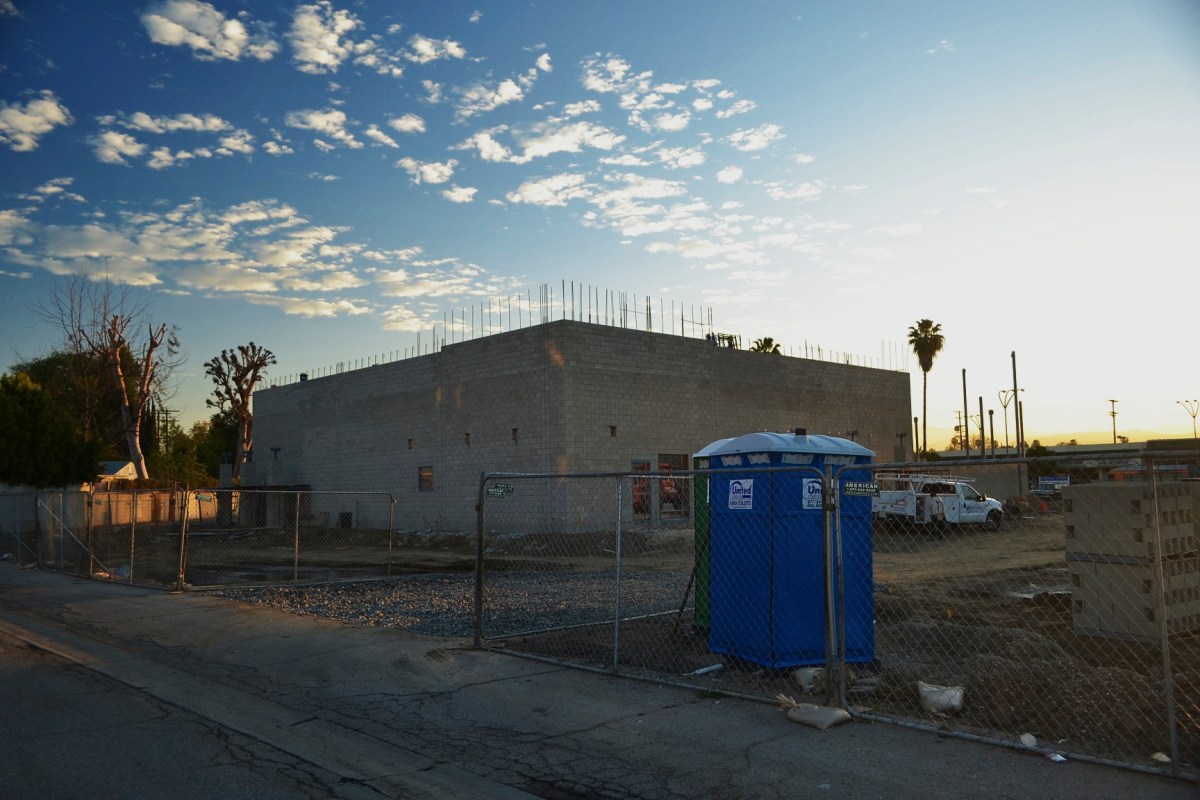
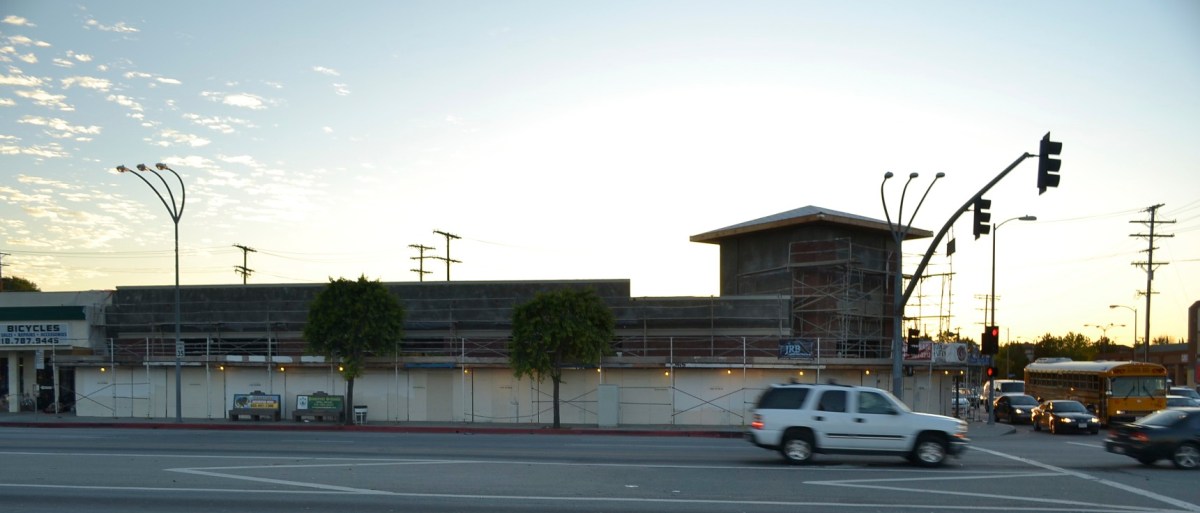
On the corner of Van Nuys and Burbank Boulevards, two large commercial buildings are going up simultaneously.

Chipolte (2011 net income was $214.9 million, an increase of 20.1%) is erecting a restaurant on the NE side, with the requisite peel-on bricks and pointy top roof, but commendably, its building comes right up to the sidewalk and will enliven the street with its presence.

But on the NW corner, the CVS Corporation ($7.2 b in net income, 2010) is constructing one of its signature cheapy drug stores, entirely of cinderblock, set back some 30 feet from the sidewalk, without windows and seemingly without any concern or regard for the urban possibilities and architectural imagination which it can surely afford.
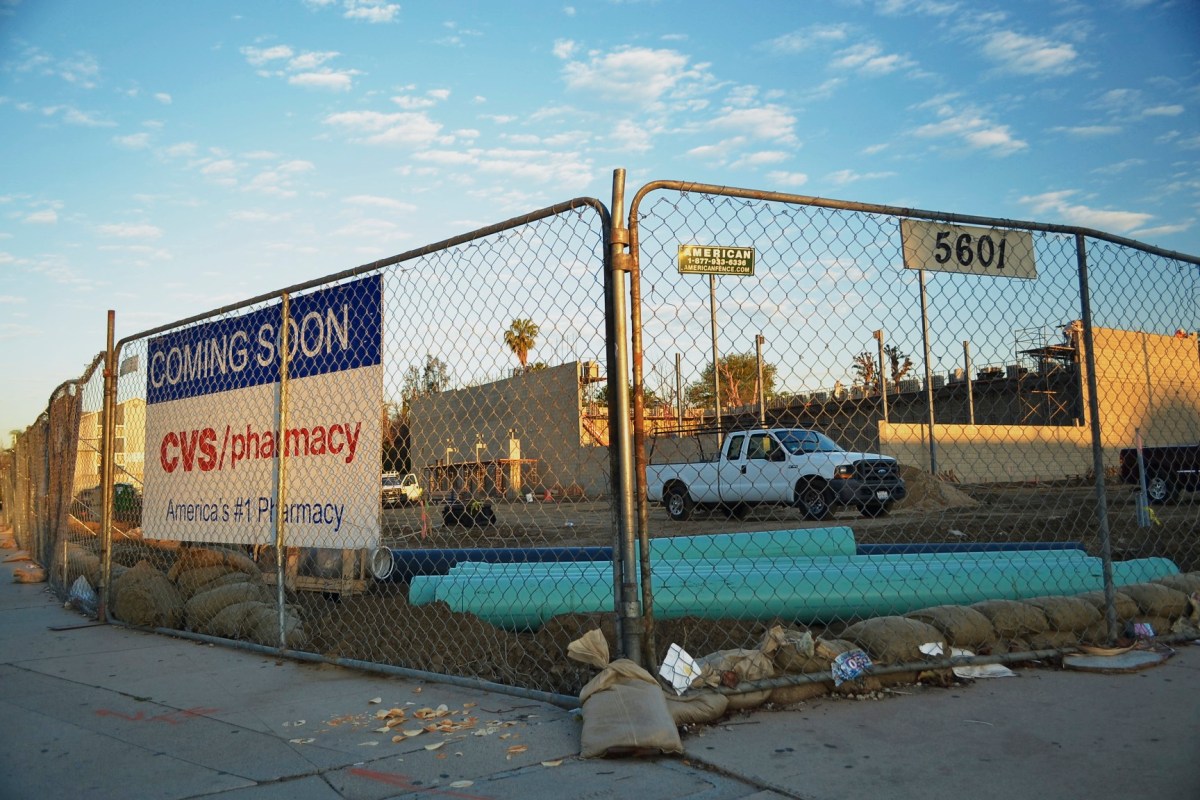
It is a small point to discuss this one small drugstore, but one that has larger implications into how Angelenos and our city fail to plan and design commercial architecture to improve our neighborhoods through pedestrian-oriented design.

This area of Van Nuys is full of pleasant apartments and small houses, though much of it recently has seceded and renamed itself “Sherman Oaks”. It’s confusing, but the car dealerships are allowed to call themselves “Van Nuys” but the homes behind them are now in “Sherman Oaks”.

During the day, the street is a blindingly boring stretch of car dealerships that are slowly climbing back to sell us more of what is bankrupting us. Fill ‘er up!

And at night, the whole area is floodlit with acre upon acre of parking lots full of cars, watched over by security guards and security cameras.  Dog walkers with plastic bags full of warm shit stroll by quickly. There is nothing to do here other than get out fast.

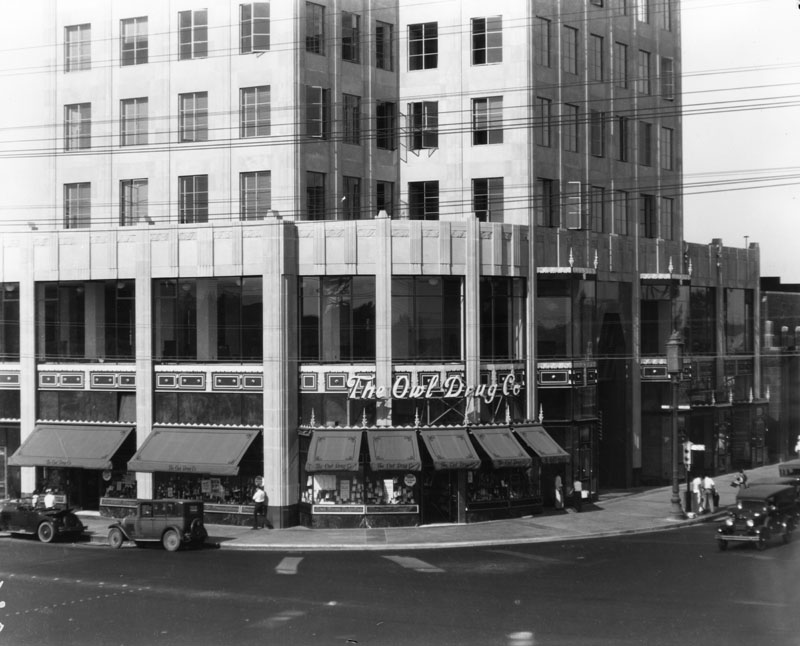
So the corner of Van Nuys and Burbank cries out for some lively alternative, such as one of those Owl Drugstores that were all over Los Angeles in the 1940s, the ones that had plate glass windows and soda counters. Those are still the best example of what a drug store can aspire to.

And who would not prefer Owl with its old, artful, graceful pharmacy lamps and glass counters, corner awnings and decorative script lettering; against the modern, plastic CVS- a windowless box in a parking lot- which has aisles filled with disposable umbrellas, generic whisky, Halloween costumes and XXL t-shirts, which are stuffed into their ugly, fluorescent-lit emporiums?

In a few months, the new CVS will open and the parking lot will be filled with cars and litter, loud music and asphalt baking in the sun.  It will do a certain amount of business, and its numbers will be verified and approved by accountants, lawyers, and the CEOs of CVS.

But Van Nuys will gain nothing.

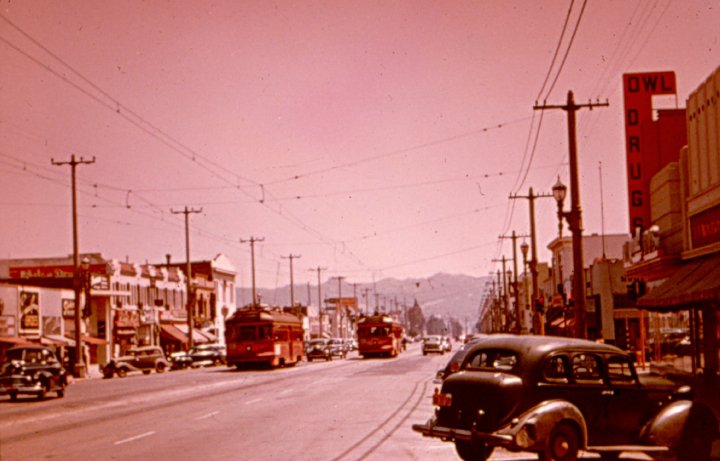
Van Nuys Bl. Circa 1940


Van Nuys Blvd. Circa 1940 (courtesy Valley Relics)

Valley Relics posted this circa 1940 color photograph of Van Nuys Blvd. facing south (towards Sherman Oaks) near Victory Blvd.

Two things in the photo stand out that are different from today: the streetcar running up the center of the street and the diagonally parked cars.

For many years, people have spoken about the loss of the streetcar as a viable way of transportation around the Southland.  Many think that the sprawl of this city makes streetcars irrelevant and automobiles the only solution.

But streetcars traversed the sprawl of Los Angeles from the beginning, going across hundreds of miles, even when much of the land was undeveloped. They brought the Pasadenan to Venice and transported the Hollywoodian to Chatsworth.  They were above ground and had open windows.   No city of millions of people can be without a viable public transport. And cars–polluting, crowding, noisy, inefficient, expensive, deathly–are the most self-centered and self-destructive machines ever put inside a city. Los Angeles has been demonstrably more dysfunctional since the Red Car tracks were torn up.

Diagonal parking is a way of making shopping more convenient and serves to slow down traffic and discourage speeding. While current day Councilman Cardenas proposes raising metered parking rates in the midst of the Great Recession, the old photo above shows a thriving and much more appealing Van Nuys, with free diagonal parking,  than exists today.