You March That Way, You’ll Live This Way


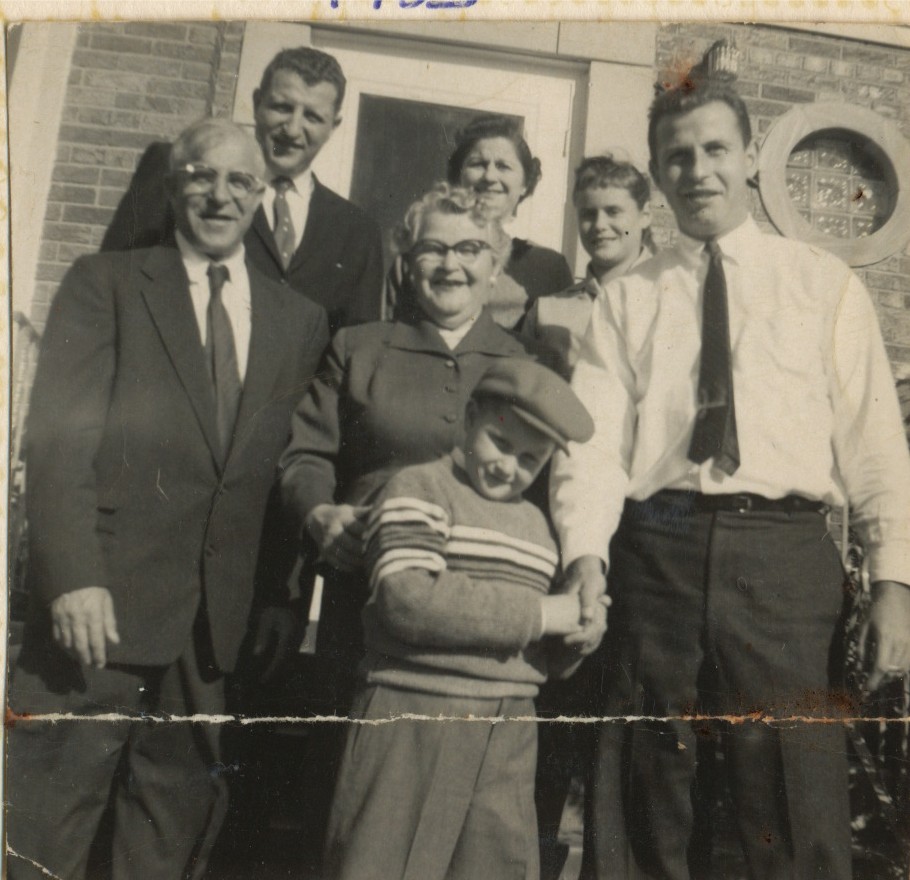
1955.

Once upon a time, my father’s family lived on the South Side of Chicago.

Grandpa Harry and Grandma Fanny had their little house on 88th and Clyde, a squat brick home built in 1950 with a back porch and a spotless kitchen. 

Uncle Paul, Aunt Frances and Barry lived on Luella, not far from Grandpa Harry.

And Uncle Harold and Aunt Evie lived with their children, Adrienne, Michael and Bruce in expansive, grand old apartments overlooking Lake Michigan along the South Shore.

Harold and Paul had both been soldiers during WWII, married young, and came back home. Harold was an engineer, so he started a heating/air-conditioning company that installed systems in many buildings in Chicago. Paul (1921-), veteran of Iwo Jima and the Battle of Leyte, worked as a plumber and electrician. He is still alive at 99 and lives in Woodland Hills, CA.

In 1968, after the assassination of Martin Luther King Jr., there were nationwide riots. And the stores on the south side were burned down and looted. And my grandfather’s new 1968 Chevy Impala, parked on the street, had its antenna broken off by a vandal. That’s when everyone sold their houses and moved up north to Rogers Park and Lincolnwood, North Lake Shore Drive, Deerfield and Highland Park. 

Because they were safe there. 

There were federal investigations by the Kerner Commission, whose findings were released in 1968, to get to the root causes of rioting from 1967, the year before. And they found, (surprisingly!), that segregation, poverty, discrimination, poor jobs and broken families contributed to unhappy lives. 

_______________________________________________________________________-

After every insurrection, after every march, after every episode of mass looting, there comes a vow to move forward and make certain that this time, this time for sure, these events will not happen again.

So the streets in major cities were renamed Martin Luther King Jr., and on television Norman Lear created “The Jeffersons” and “Good Times.” And Hollywood and the media proclaimed that justice would reign over all the land.  See the diversity!

And then there is a reaction, a call for law and order, new laws for harsher sentencing, new reforms for welfare, and progressive ideas to rebuild the cities (Brooklyn, Venice, South End Boston) by making everything safe for tech and shopping and historic renovations, and guess who will be removed again? 

Giuliani is the king. Love what he’s done! This city is the best it’s ever been. We’ve been through 9/11 and now we are never going to be down and out again!

_____________________________________________________________________

Who gets shot and who goes to fight the wars and who dies in the streets and who dies on the battlefields and whose population is dying today of Covid-19 and why is it always the same answer?

Why is it still terrifying to drive through the west side of Chicago before you reach Oak Park and tour Frank Lloyd Wright’s houses? Who lives there and who kills there and who suffers there? It’s always the same answer.

Let the looting and fires and protests begin! America don’t you see what’s going on! 

You are violent by custom, and this is another type of violence. How dare they smash shop windows and steal what isn’t theirs!

___________________________________

Note:

Estimated U.S. military spending is $934 billion. It covers the period October 1, 2020, through September 30, 2021. Military spending is the second-largest item in the federal budget after Social SecuritySource.

That works out to about $2,838 per person in the US. Or about $236 a month for every man, woman and child in the country.

We aren’t even at war. But you could argue we are always at war.

__________________________________

People of pinker pigmentations are again woken up and made to face the suffering of some of their fellow, darker citizens. And every year the same old story is retold, just with new clothes, new celebrities, new movies, and now, a new hashtag, #oscarsowhite or #blacklivesmatter. 

And a silent majority, one whose all-white room I sometime inhabit, deplores criminality, violence, and looting; and I’m locked in there in that all-white room; I can’t get out, because I like the all-white décor that tells me that some people are violent and barbaric and have the wrong values. I feel better about myself, in that all-white room, knowing I’m law abiding and that should be end of the discussion. I’m suffocating in there, I can’t breathe, but I am relaxed in my self-assurance and high self-esteem.

Because if you get in trouble you are a troublemaker. 

_________________________________________________________________

Where I came from is some of who I am.

I grew up in 1970s Lincolnwood, IL and there were no black people other than domestics who worked in people’s homes. 

In 2017, Lincolnwood was racially composed of 57% whites, 30% Asian, and 6.2% Latino or other.  I didn’t see a mention of African-Americans.

There was once a way to run away from troubled places, and seek refuge in a safer neighborhood, but I think we have run out of hiding spots.

They have come to Beverly Hills and Buckhead and Santa Monica, and they is us. 

In 1992, I worked in the Polo Ralph Lauren mansion on 72nd and Madison in New York. There was no social media, no Twitter or What’s App, only rumor.

So as Los Angeles burned, New York City trembled, and rumors of mobs attacking Herald Square and other locations were falsely spread. There was not mass violence or destruction in New York City, that year, and it remained largely in Los Angeles, mostly, infamously, in South LA and Koreatown.

The Polo Store had wooden doors with glass windows, and the security guards pulled the cloth window shades down. They turned the lights off, and we all went home around 3pm on Friday, May 1, 1992. I walked through Central Park in my linen suit and back to my little apartment on West 96th St. to sit in the air-conditioning and wait out the troubles. 

Until this past week I thought we lived in a new time of toleration and nobody was that angry and the times I saw horrendous videos of police brutality seemed the exception and not the rule. And I lived, because I am allowed to do so, in a bubble of wishful thinking and fantasy, in a country that mistreats others but not me.

I thought Barack Obama was the pinnacle of we shall overcome. 

And I was wrong. Dead wrong. 

I was naïve. 

Me? 

Naïve? 

No. 

Just white.

I’m protected from the injustices perpetuated by a system designed to give me a boost up, a feeling of betterment, because others are down there, and can’t be as good as me, no matter how spectacular they are, by virtue of their inherited DNA.

That’s really the truth. Because you might have an MBA, or be the CEO of a company, and if you go running as black you might be shot dead. So why bother to be the best if your country already decides you are the worst? That is the quandary of racism, it rips down the individual to a category, incarcerating her within a foul story of failure. 

It takes a remarkable concentration of effort for the protagonist to overcome her role as the demon in a bad fairy tale.

Like an Obama or Oprah or any father or mother of color in North America.

______________________________________________________________

We are at a point that is not only about the murder of the man by copper knee in Minneapolis. 

There is the small matter of our chief executive, a corrupt ignoramus, who came to power, by questioning the birth certificate of our black president.

We are sick, we are unemployed, we are uninsured, we are scared. 

We were kept home, kept in fear, brought out in mask, and indoctrinated to wash hands. We stayed home and got our groceries delivered, and got a check from the government, and some people got sick, some died, and the nation looked in vain for a leader who could not lead, a savior who could not save, and today we are waking up in the wreckage of our homeland.

A virus still stalks the Earth and lives in our saliva.

When Los Angeles was at its richest and most prosperous, three months ago, there were 100,000 homeless. And that was permitted, by the leaders, the citizens, and the public. 

When Los Angeles was at its most diverse, the whitest among us drove our children to school districts that were majority white, and our morning and afternoon traffic was largely made up of children riding to and from whiter schools with their parents. 

And that was toxic and unjust, racist and unfair, blatantly racist. When you think about it.  Public schools where no children walk to school. Public schools, not of neighborhoods, but of magnets propelled to collect like particles to adhere with.

And what have we done to change education, health inequalities, housing shortages, racism itself? Because it all circles back to race when you ask people where they want to live or go to school.

We have an invisible problem right before our very eyes. 

Our feet stand on blood-soaked soil. But we don’t see under our white sneakers.

We are striving to succeed, we want our children to succeed, but what is personal success if our nation is a failure?

So many marched, that way this week, holding up signs: impassioned, motivated, angered.

It was a religious fervor of moralism sweeping the country. 

But nothing has changed, really. Stores are burned and looted, cops get down on their knees, mayors and governors call for a new dawn of tolerance and kindness.

The new plate glass windows go up, the tags scrubbed off the buildings, and surely Oprah will find a new heartwarming book to promote by a young black author.

Instagram will black out, and hash tag, and celebrities will proclaim they stand with the oppressed and the hated, and vow that a new day is here.

And new laws will get passed. And everyone will listen to great podcasts about race and police. And eventually the marchers will not march. They will go home, or get jobs, or go back to school, and the national hibernation will end, and the fast, furious ambitious race to get more for me will resume. 

The next time someone dies unjustly, Our God, Lord Smartphone, will record it. 

But Lord Smartphone cannot right a wrong. Only we can.

We marched that way, but we’ll live this way.

Option A: International Affairs, A Back Story.


Perhaps the quintessential Option A story grows out of the life of Ivan Gomez (b. 1972) the owner of Pashupatina, a fine custom decorative metal shop on Aetna.

He was born in Mexico, by chance. His other four siblings (one sister and three brothers) were all born in the USA.

They were raised in Pacoima and later Friar St. in Van Nuys. Ivan experienced the turmoil and insecurity of being a little boy who had to register with the INS every few years.

He later went to school in Tarzana, and saw the other world of privileged children. Never bitter, always ambitious, he worked in Van Nuys at Bargain Books, devouring books on design and mechanical art. He graduated from Van Nuys High School where he met his current wife, a Lebanese immigrant, Natalie Magarian. He did not go to college, but worked at Tower Records, and Aah’s on Ventura Bl.; Taco Bell, and most importantly, at a cabinet shop in South Central where he learned about the manufacturing, design and installation of custom woodwork.

Ivan formed a band called Stikman (1989-92) and they often played in the dug out ruins of old factories near downtown Los Angeles. He went to raves, but remarkably, he remained clean of drugs. His strong character resisted violence, self-destruction and falling into the traps of depravity all around him.

He does not smoke or drink. He has a wife, two children, a thriving business, a home in Lake Balboa. And both sets of in-laws live nearby.

I thought it instructive and interesting to explore the city of Los Angeles in the first 20 years of Ivan’s life, to give some context for what it felt like to be a young immigrant absorbing all the culture, music, crime, drugs, police brutality that fell atop the intelligent, observant, fervent, creative mind of Ivan Gomez.

All statistical facts in this article are from original sources and are footnoted.


The Idyll

Photo by John Divola

In 1970, there were some 966,240 persons in 26 San Fernando Valley communities in Los Angeles. The population was young. And the average age was 29.

There were small percentages of racial minorities in every community in the Valley, except Pacoima where 33% were black. 4% of Sun Valley was minority, mostly Mexicans.

In Woodland Hills, the average rent was $172, the highest in the Valley. And the minority population was 1%, the same as in Tarzana.

Encino had the most expensive homes, averaging $50,000 in value.[1]

Many worked in the defense-aerospace industry, 348,000 jobs in Los Angeles County. Some of the San Fernando Valley employers: Lockheed in Burbank, Boeing Co.’s Rocketdyne Propulsion and Power in Woodland Hills, Hughes Missile Systems in Canoga Park. Bendix Aviation, Ramo-Woolridge Laboratories, Litton Industries, RCA, Atomics International and Bunker-Ramo. [2]

There had also been cutbacks in the defense industries, ironically due to the Vietnam War. Research and development, which was a large part of defense contracting work, took a back seat to output and manufacture of weapons. When the war was on, rockets and planes were needed, fast. Employment fell from 616,000 in the state in 1967 to 400,000 in 1972. 70% in Los Angeles still depended on aerospace to earn their living. [3]

Military attack aircraft, surface to air missiles, rockets, bombs, satellites, electronic controls for weapons systems, defense-related communications systems, The Stealth and the P-3 antisubmarine craft, were only some of the advanced weaponry produced here.

All these weapons of war, sent around the world, would ignite and fuel conflicts that one day would come back to the San Fernando Valley and upend the placidity, the normality, the blessed banality of pools, homes, burgers, convertibles and blond-haired boys and girls riding bikes around safe and clean neighborhoods.

ph: Mike Mandel, People in Cars, North Hollywood, 1970.
Photo by John Divola, San Fernando Valley, circa 1970.

If you were wealthy in 1972, and could spend more than $100,000 on a home, you might want to live in Brentwood.


A Confluence of Events

**ADVANCE FOR SUNDAY, JUNE 8–FILE** In this April 29, 1975 file photo, mobs of Vietnamese people scale the wall of the U.S. Embassy in Saigon, Vietnam, trying to get to the helicopter pickup zone, just before the end of the Vietnam War. (AP Photo/Neal Ulevich, file)

In the late 1970s, a confluence of international events; wars, revolutions, and genocides swirled around the globe. Under the umbrella of American anti-communism, military interventions produced results that eventually washed back up onto the shores of Southern California.

In Vietnam, in 1975, the fall of the Saigon government, the helicopter evacuation of the US Embassy, and the triumph of Ho Chi Minh brought a new influx of refugees to the US. At the same time, in neighboring Cambodia, Pol Pot captured Phnom Penh and instigated a deadly forced labor and collective farms movement causing the deaths of millions. Cambodians who could, got out.

In US allied South Korea, still developing its economy, an uneasy and tense truce lingered. Fearful of a new war, the government encouraged some citizens to emigrate to the US and send money back home. Millions left and settled predominately in Los Angeles.

Filipinos who had served in the US military during WWII were allowed to become US citizens, and many war brides came to America. Relatives of people already in this country were permitted to come here and gain citizenship.

Los Angeles also became home to the largest group of Thai people outside of Thailand.

The engine for all the changes in allowing new countries to migrate to the US came after 1965.

The U.S. Immigration and Nationality Act of 1965 (also known as the Hart-Cellar Act) eliminated national origins quotas and gave priority to immigrants with skills. In addition, the law allowed the spouses, unmarried minor children, and parents of U.S. citizens to enter as non-quota immigrants.[4]

Previously the law had favored northern and western Europeans. The involvement of the US in Asian affairs prompted Congress to change laws. The US needed to look magnanimous in Far Eastern eyes so that our role in Vietnam might be justified.

In Taiwan and Hong Kong, the prospect of American retrenchment and Red China’s rise fueled new immigration to the US. The San Gabriel Valley, once a bastion of whites, became a sprawling Chinese community.[5] Asian-Americans would become the largest immigrant group by 2014.

In 1979, the Shah of Iran, an ally of the US, was overthrown and replaced by an Islamic fundamentalist government. Fifty-two American diplomats and citizens were held hostage for 444 days (November 4, 1979, to January 20, 1981) after a group of Iranian students took over the U.S. Embassy in Tehran.

The Shah had been a large weapons purchaser and his regime was seen as a bulwark against Russian expansionism.

By miraculous coincidence, all the US hostages were freed on the very day of Ronald Reagan’s inauguration. An overjoyed nation overlooked what some might call collusion.

Persian immigration to Los Angeles spiked. Beverly Hills and Westwood became the heart of a new community of refugees from Tehran and vicinity. Christian Armenians, many of them living in Iran, also came to Los Angeles and settled in East Hollywood and later Glendale. The Soviet Union also eased up on restrictions and allowed many Armenians to leave the communist ruled nation.

Notable too was the Soviet Union’s invasion of Afghanistan in 1980. It lasted over nine years, from December 1979 to February 1989. Insurgent groups known as the mujahideen fought against the Soviet Army and the Democratic Republic of Afghanistan government. These groups, which later morphed into Al Queda, were backed by the United States and Pakistan, making it a Cold War proxy battle. Between 562,000[27] and 2,000,000 civilians were killed. [6]

In Lebanon, a power struggle between ruling Maronite Christians, Shia Muslims, as well as the influx of Palestinians, resulted in Civil War, lasting from 1975-90, killing 120,000. Wealthier Lebanese, many fluent in Arabic, French and English, fled the country.


The War Against Central America

John Hoagland, El Playon, El Salvador, a well-known location where bodies of the “disappeared” are often found, Sonsonate, 1980.

In Central America, civil war broke out in El Salvador (1980-92). The government, with the support of the US, fought against guerillas who sought to bring social justice reforms. 75,000 people died. And the US spent $6 billion to aid a repressive regime.[7] President Reagan made a stand against the expansion of communism in the Western Hemisphere by brutally ramping up the wars to contain it.

In neighboring Honduras, Contra Guerillas fought against socialist Nicaragua’s Sandinista Government. Reagan also supported the Contras. A secret plan, hatched up in the White House, used illegal weapons sales to Iran to finance anti-communist Nicaraguan guerillas.

In El Salvador, Honduras, Guatemala and Nicaragua, millions were killed, and the murder rate, even today, remains the highest in the world. By 2011, 564,000 Central Americans would live in Los Angeles.


Mexico: Our On Again, Off Again, Family.


Mexican workers await legal employment in the United States, 1954 (LAT)
Braceros working in US farm fields.

Mexico and the US have had a long love/hate relationship . The northern colossus relied on migrants to harvest crops, and allowed free, casually monitored movement of Mexicans who supplied low-cost labor to US industries.

A mercurial, schizophrenic, self-centered immigration policy alternated between friendly and hostile. The pawns were poor Mexicans on foot, seeking work, escaping poverty, exiles from two nations, never fully at home in either one.

In 1930, after the Depression hit the US, half a million Mexicans, including children born in the US, were deported.

Then in 1942, the Bracero Program was established to bring in Mexican agricultural workers to fill in for war workers sent overseas or into weapons manufacturing.

But in 1954, “Operation Wetback” launched by the INS, arrested 1 million Mexican immigrants at their workplaces and many were again sent back.

In 1986, President Reagan, now a lame duck, signed an amnesty bill into law for 3 million illegal immigrants. Half of these stayed in California. In Los Angeles, 33% were foreign born in 1990, compared to 11% in 1970.[8] By 1989, Los Angeles had the largest population of Mexicans outside of Mexico City.

How did this tidal wave of immigration happen in such a brief period of time in the 1980s? One explanation:

“Mexico, burdened by international debt, imposed economic austerity measures further hurting the poorest members of its society, which caused thousands to make the dangerous trek north for economic survival. Guides who could lead families across the border to a better life in “El Norte” were nicknamed “coyotes.” Signs along the northbound interstate freeway in San Diego County graphically warned motorists to avoid hitting families fleeing across the highway.

More than 2.3 million foreign-born Latino residents in the U.S. took advantage of this [amnesty] program, leading to naturalization and green-card status. However, most foreign-born laborers did not want to give up their Mexican citizenship, preferring to work in California on a temporary basis and then return home. The IRCA required people to make a choice. Most choose to stay in the U.S. and sent for their family to join them. Under Reagan’s leadership, Congress had tried to limit Latino immigration, but instead, they created incentives that would lead to its increase.”[9]

Last year, some in the Mexican-American community shrugged their shoulders at Trump’s invectives. It had always been that way.


Imagine this man, a make believe character, a true, fine, successful, once famous Angeleno:

Up on Mulholland Drive, east of Beverly Glen, sometime in 1980, there is an old, white songwriter, Len Shnauzerman, attended by his housekeeper Esmerelda, sipping wine on the deck of his estate, overlooking the Valley, purchased for $39,000 in 1949. He’s still collecting large monthly residuals for a few songs he wrote 35 years earlier (“Mippity-Dippity”,”The Cow Girl’s Serenade”, “Hoopy Doopy Waltz”, “Pretty Girls and Peanuts!”). He used to love LA, but it was now a cesspool. He is angry at those illegals, riding the bus to work, mopping floors, digging trenches, pouring concrete, those illegals collecting benefits in his country.

He may be fiction but there were plenty like him and perhaps there still are. Just because you worked hard, doesn’t mean you didn’t get lucky.


Plagues of the 1980s

The 1980s also became the high water mark of the Cocaine Era, much of it originating in Colombia and sent up through Central America. Crack-cocaine addiction destroyed poorer communities, and ended up with the arrest and incarceration of millions of black Americans.

The Angel of Death, AIDS, arrived just about 1980 mowing down the young, the brilliant, the innocent, the uninhibited.

The party was over.

Los Angeles would undergo challenges to its identity and survival never anticipated.

Suddenly the faces one passed on the freeway were strange, exotic, and menacing.

Cindy Brady was replaced by MS-13.


 Communism Ends

The fall of the Berlin Wall in 1989, meant the end of the Soviet Union, and the death of the Communist Revolution. Soon, client states like Cuba could no longer count on Russian help.

The end of the Cold War affected the military-industrial complex in the US. There was a decline in spending at the Pentagon, and this was felt, most deeply, in California, where defense industries were a backbone of the state economy.

Skunk Works, Lockheed, Burbank, CA.

Beyond the Beach


Life Magazine, 1970.

To the average Angeleno, politics in the late 1970s was something that only mattered when it came to local issues: freeway traffic, water rates, school boards, fire protection, crime and safety.

The chosen ignorance of the larger world, the anti-intellectualism of the American Mind, would come back to haunt pleasure loving California, which did not make the connections between the military-industrial-political-money machine, and its role in eventually undermining the peace and security of domestic life in the Southland.

Many loved the Republicans who were tough on crime, tough on communism, tough on deviants, tough on high taxes. They carried the flag high, and promised a restoration of law and order and the banishment of all enemies, foreign and domestic.

Insulated from international traumas, residing in a bubble of postwar prosperity, enjoying a beer and a cigarette on the beach, the people frolicked in the surf on the edge of instability, oblivious to the coming tsunami of social upheaval in Los Angeles.

The low point of it all came in the early 1990s when riots, an earthquake, the Rodney King beating, and the OJ Simpson murder case, seemed to encapsulate a region unhinged. Random people were murdered. There were drive by shootings every day, gang warfare, and a feeling that Los Angeles was just a giant cesspool of dystopian failure.

5/19/92 LA Times


The 21st Century: A New City of Many Nations.

Through all the tribulations of violence, economic hardship, racial injustice, environmental degradation, social dislocations, skyrocketing housing, education and health care costs, the Californian pushed ahead to forge new horizons in virtual reality, public transportation, immigration policies, social justice, police reform, housing codes, environmental, gender and age protections.

And the remaking of Los Angeles, painful yet exhilarating, a city that would once again embrace so many different people, living in so many unique ways, that future also came to pass, a hopeful passage into the future; creative, imaginative, innovative, multi-dimensional, internationally engaged.

All this brings me back to Van Nuys and Ivan Gomez.

More on his life, and the meaning of Los Angeles and here in Van Nuys, to come……

Pashupatina: Ivan and Daniel Gomez in their shop which they completely renovated with their own hands and money in 2015.


[1] Valley Population Near Million; Growth Slows

–LA Times, April 29, 1971


[2] AEROSPACE LAYOFFS: THE HUMAN TOLL

Gottschalk, Earl C, Jr

Los Angeles Times May 2, 1971;

[3] http://articles.latimes.com/1999/dec/18/local/me-45171

[4] http://immigrationtounitedstates.org/673-korean-immigrants.html

[5] http://www.nytimes.com/2013/04/29/us/asians-now-largest-immigrant-group-in-southern-california.html

[6] https://en.wikipedia.org/wiki/Soviet–Afghan_War

[7] https://www.huffingtonpost.com/theta-pavis/decades-of-us-interventio_b_5610684.html

[8] http://articles.latimes.com/1993-11-14/news/mn-56940_1_illegal-immigrants

[9] http://picturethis.museumca.org/timeline/reagan-years-1980s/mexican-american-culture/info

SaveSave

War Costs Money. Our Money.


Where were all these geniuses when the US first invaded Iraq, and later Afghanistan? All these wars and all the spending overseas, not to mention weapons expended on such wonderful allies as Pakistan, is directly visible in the deplorable condition of American infrastructure.

Here in Southern California we have a substandard school system, bursting water pipes, pot-holed pavement, bankrupt police and fire departments, cutbacks in every type of poverty aid; cities who are laying off park, sanitation, and medical personnel; and a public transport system which would be fine in a city of 4,000 people.

And we don’t have glorious public parks, efficient and clean streets; underground electrical, or well-patrolled and safe neighborhoods.

If you take a Google Street View of any street in Denmark, Finland, France, Sweden, Germany or Italy and compare it to many sections of Los Angles, you will have a real life story of how our nation is literally decaying and dying and how our leaders continue to pour money into useless and self-defeating war that is bankrupting us financially and morally.

Go to Google Street view and compare bombed out Dresden, Germany in 2011 to the victorious San Fernando Valley or Detroit, Michigan and see how the US treats its own.

Vietnam War Photographs.


This slideshow requires JavaScript.

Steven Curtis is a Hollywood based photographer and Vietnam War veteran. I met him a few years ago and spent an afternoon touring his house, inspecting his vintage camera collection, and learning about his experience as a soldier and shooter (pun intended) in that long ago, but never forgotten conflict.

His photographs can be found here.

War and Health Care.


War and health care.

These are the two big issues I care about.

Even as I look for work, being unemployed for some time now, I think that our nation must end its destructive and expensive interference in other nation’s affairs, and bring our spending priorities and needs back to the US.

Obama has not ended the war in Iraq, and he has ramped up the war in Afghanistan. What war is next? Yemen, Pakistan, Indonesia?  We are on a constant war footing with boogie men on every continent.  An endless battle with no end.

And what became of health care? It has been downsized, weakened, bended, fractured, anesthetized to make it palatable to Lieberman and Blue Cross, Pfizer and John McCain.  I still paid over $3,000 last year to cover one $40 doctor’s visit.

President Obama, you are losing my confidence because you seem to stand for nothing. You “lost” in Massachusetts because you don’t stand for anything. You are continuing the Bush, Clinton, Reagan policies of neo-conservatism, neo-militarism and neo-know nothingism that furthers the decline and impoverishment of the United States.

If you had only been bold and courageous enough to end the wars and demand single payer health care, I would respect you. Again.

Grocery Wars: Again?


Opening Day of Ralph's Supermarket/ April 25, 1942/

Photo from USC Digital Archives

The LA Times reports that major food chains like Ralphs and Vons are lowering prices in an effort to win back price conscious consumers.

Trader Joes is where I usually shop. With no coupons, they still have the lowest prices. Bread, eggs, yogurt, jams, cereals, produce: they all cost less at TJ’s.

Even with coupons, Ralphs is a rip-off. Who has not done their weekly shopping and walked away spending less than $75?  When I meander down the aisle, every item seems to cost no less than $4.99.  Notice how they round it up to almost $5?

Ralphs is also a very inconvenient store to shop in. They have TOO MANY CHOICES and many aisles filled with junk foods, pet foods, organic foods and rip-off, overpriced produce.

Gelsons is expensive but very courteous. Vons tries hard but is often dirty and poorly managed. Whole Foods is full of entitled bitchy shoppers. Ralphs is mediocre with mostly high priced goods and no service.  Fresh and Easy gives you low prices and no choice and zero personality.

The only thing Trader Joes needs to work on: their crazy, overcrowded, exasperating, slow, accident prone parking lots.