Yesterday, Sunday, there were no evident calamities around us. Tragedy took a day off. The air was clear from fire smoke, some blue showed in the sky, and we went for an air-cooled drive around our San Fernando Valley behind tinted windows and masked faces.
We passed Woodley Park, once a bird sanctuary, now just a burned-out bunch of fields with blackened pieces of wood and broken fences, shopping carts of trash and an air of war, desolation and defeat.
There was the farm stand at Tapia Brothers and we stopped to buy tomatoes, Anaheim peppers, carrots and peaches, standing six feet away from other masked shoppers. Pulling out of the dusty lot there were two choices: drive somewhere else or go home. We chose the former.
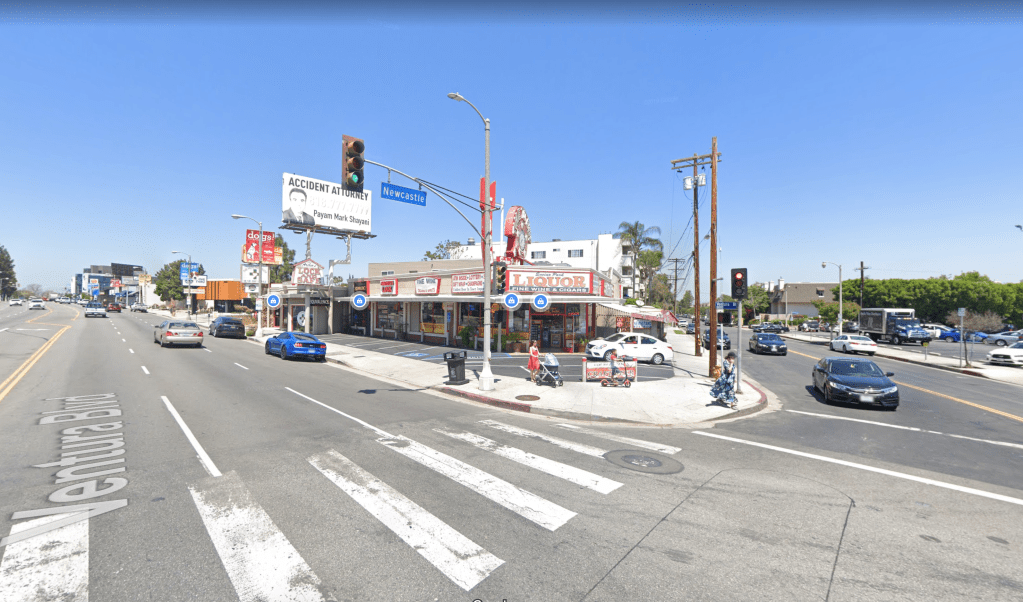
We went for a drive west along Ventura Boulevard through Encino and Tarzana, past those billboarded and plastic signed points of shlock and tackiness beloved by many, demoralizing in a good year, demoralizing in a bad one.
At Newcastle, groups of Jews in masks, yarmulkes, and tallit, walked with prayer books, dressed in their Rosh Hashana suits and dresses. A mentally ill Black man, without a shirt, danced obliviously in front of the liquor store as the faithful passed by him pushing baby carriages, on their walk home.
Further west, a homeless woman emerged from a tent parked along a concrete channel behind the prow shaped Encino/Tarzana library, temporarily closed. A blue sign hung along the fence on Ventura, “NO DUMPING: This Drains to Ocean.”
We drove all the way to Shoup Avenue in Woodland Hills, a district of Los Angeles where people once moved to get away from everything bad in the city. Under the 101, dozens of men and women were set up in a trash camp, living under tarps, in tents, the public sidewalk their front lawn.
At Woodland Hills Park, where Uncle Paul, Aunt Frances, Cousins Barry, Helene, Julie, Jason, Delaney and Courtney, spent many days of the past half century in the world of juvenile baseball and softball, homeless RVs parked. I wonder what flowered apron and blue rubber gloved Aunt Frances, who died in 2012, would say. She kept a spotless house, even telling me she would not eat dark raisins because they reminded her of little bugs.
“Oh, Andy you’re so funny,” she would often say.
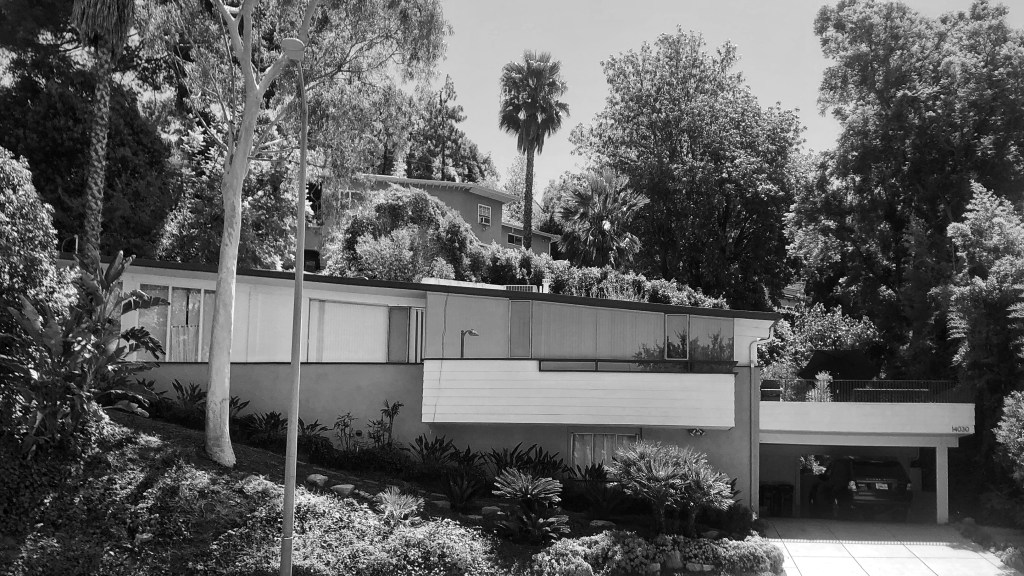
We turned down Erwin Street just to look at the corner ranch Aunt Frances and Uncle Paul bought for $63,000 in 1973. Uncle Paul is 99, a widower, still living there. The stucco is faded pink, there are bars on the windows, and Zillow estimates the house could fetch close to a million. Property taxes are about $800 a year, eternally fixed at the purchase price, a good deal for the retired soldier who fought at Iwo Jima and Leyte Island.
We didn’t go in but I thought of the inside I first saw in July 1974.
The Barcalounger, the brown carpet, the brown paneling, the yellow wallpaper, the cottage cheese ceilings, the dining room with the glass shelved cabinets full of Lladros and ceramic poodles and carved children with fishing poles, a room nobody ate in; the other dark rooms with the Roman shades or pleated drapes always pulled down against the sun, the bathrooms with wall-to-wall carpeting and mylar wallpaper, the rooms full of family photographs, the 1,762 square feet of living space without one book; the air-conditioning that ran year round, and the garage housing the Buick LeSabre, full of power tools and Leslie Pool Equipment, the refrigerator packed with Costco frozen foods, bottles of cold water and diet sodas, the TV always on for baseball and Fox News, these are the moments one cannot easily forget.
Then we turned around and drove east along Victory Blvd. passing the empty weed infested parking lot at temporarily closed Pierce College. We drove down Winnetka to get to the 101 and again passed another encampment under the freeway, more men and women living outdoors without housing in Los Angeles.
When I go out these days, leave my house for a drive, I am in another nation, not my own, a scarred and withered place of broken people, angry and exhausted, in a city unclean and unjust. And ominously, seemingly, frightfully just about ready for a violent revolution.


You must be logged in to post a comment.